
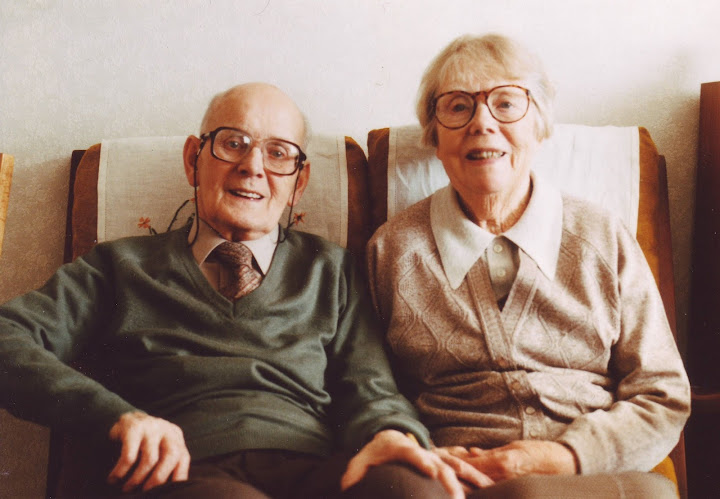
My parents were Salvationists and lived in Cardiff. During the Great War of 1914-18 my dad joined the R.A.M.C. and mother took my elder brother and sister and myself, aged two, to her home town of Wiveliscombe in Somerset. There was no Salvation Army Corps in Wiveliscombe and so my earliest ‘spiritual’ memories are of a Congregational Church and Sunday School in that very beautiful, to my mind, little market town.
I remember the ladies in their ankle length dresses, the winter evenings when the gas lamps were lit in the street and in the church, and I remember the words and music of “Lead Kindly Light” which I have requested be sung at my funeral; so haunting are the earliest impressions of life.
In 1919, with my dad’s discharge from the army, we returned to Cardiff where six of us lived for a while in two rooms (my youngest brother had been born in 1916). Eventually we moved into a council house, where I still live after 70 years (bit of a record that!) Now we were Salvationists (again) – a somewhat different spiritual experience, with its `Hallelujahs` and `Praise the Lords’, its hand-clapping and tambourine waving and a deep commitment to saving souls (and especially one’s own). How I agonized in those far off days on whether I should go out to the ‘Penitent Form’, give my life to Jesus and be saved; but I put it off until, at the age of twelve, my parents said to my younger brother and myself that if we wished to go to another place of worship, we were free to do so. (Note the compulsion: not that we were free to leave the army and go nowhere.) I chose the Baptist Chapel for the simple reason that it was near at hand. Within twelve months I had been baptised (by full immersion), was a full member of the church, had given my heart to God, and very shortly afterwards I resolved to go in for the ministry.
Then followed four or more years of rather hectic activity. Choir practice, prayer meetings, Bible study, the lot, until…. All my life since then I have been very careful, neither by word nor deed, to say or do anything which may weaken or destroy another’s faith. Unless, that is, I could offer something better in its place. For I have experienced the agony of losing one’s faith. At first I thought it was my lack, my sinfulness, my weakness, which was to blame. I went through the hell of self-recrimination. Gradually I began to understand that the fault lay not in myself but in the inadequacies and contradictions inherent in Christianity. And when a certain measure of peace was vouchsafed, I was introduced to a family of Spiritualists. Then began my second awakening.
The years went by. I was reasonably happy with my new-found beliefs. In 1934 I met a young lady and eventually we married, but Joyce was C. of E. while I was (nominally) a Spiritualist. I could never go back to a church while Joyce had no feeling for my beliefs. And so we drifted on through life without any spiritual foundation whatever. Something was missing – but neither of us realised what it was. Ten years went by – we had two lovely children, a boy and a girl. One day Joyce saw an advert in the local paper for a Psychology Club. We went to a few meetings and there met a lady who was a Theosophist. I had been to one meeting many years previously but had not followed it up. Now we both went to the Theosophical Society, became members, and for the first time in our lives found an interest which we could both share, which was outside of the home and, most important of all, it had a spiritual content.
Seven happy and peaceful years came and went. I was elected on to their committee, became a public speaker (memories of my preaching days when in the church) was invited to address meetings in Bristol and Bath. Altogether we could find nothing in Theosophy with which we could disagree. The theory of reincarnation held a special appeal.
Eventually, some time in 1959, I said to my wife as we came home from a meeting “I don’t know, but I don’t think I’ll bother to go any more”, to which she very wisely replied, “Well I think we ought to continue until we find something to take its place.” I agreed. On the following Sunday, after the meeting, a lady there (who was neither a Theosophist nor a Bahá’í) told us about a Bahá’í meeting on the following Wednesday. They didn’t charge for admission; we might learn something interesting, so why not go.
I had never heard the name Bahá’í before. Joyce had read about it in some paper or other. The speaker at that meeting was Mr David Hofman. His subject, “Thief in the Night”. (The book by William Sears was just about to be published). I sat there enthralled. If this message was true, all my early hopes, all my precious dreams about the Coming of God’s Kingdom to earth WAS ACTUALLY ABOUT TO BE FULFILLED. We went to a couple of firesides. Another public meeting, this one addressed by Meherangiz Munsiff, and finally a One Day School at Caerphilly. The Bahá’í Faith was everything I had ever dreamed of. It satisfied every test I could think of – except for one. What about reincarnation? For several years I had lived, thought, even taught the theory; now I was being asked to `throw it away’. How could I possibly overcome this obstacle? Then I said to myself – “I will be dead from anything between 50 and 500 years before my soul will be called upon to return to earth – if ever. So why let it worry me now?” On the following day, 18th October, 1959, I called at Barbara Lewis’ home and asked “What does one do to become a Bahá’í?”
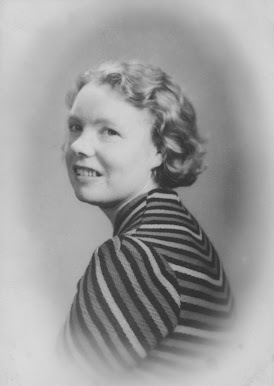
Joyce as a young woman
———————
My wife Joyce’s motives were somewhat different. She was greatly impressed by the warmth of the love which greeted us at that first (and subsequent) meetings and by the obvious sincerity of all the Bahá’ís we met. She saw this as the next logical step on our mutual quest towards Eternal Truth. While waiting for Mr Hofman’s meeting to start, I picked up a pamphlet and read: “…. upwards of 20,000 martyrs went gladly to their death….” I thought to myself, “What movement in the world today can boast half a dozen martyrs – this movement is worthy of investigation.” Joyce realised that the Theosophical Society had taken us as far as it could along the spiritual road. A few weeks later she too `declared’.
It was a little while later that we learned that we (quite impersonally of course) had been the subject of prayers at the Holy Shrines in Haifa where Marion Hofman, then a member of the Local Spiritual Assembly of Cardiff, was engaged on a project, and the Cardiff Assembly was below numbers.
From then on for twenty-seven years, that is until advancing years and ill health enforced a slowing down, we devoted ourselves to Bahá’u’lláh. In 1963 we were present at the World Congress in the Albert Hall. In 1966 we went to Haifa and enjoyed our pilgrimage. I have had the privilege of addressing meetings in every capital city, including Belfast and Dublin, and innumerable places besides from Inverness to Torbay, from Norwich to Cork. Conventions, Teaching Conferences, One Day and Weekend Schools all followed in bewildering succession, so that now, nearing the end of our earthly sojourn, we can look back and say “How wonderfully `The Hand that Guideth’ has led us on our way.”
Carl Card, Cardiff 1991
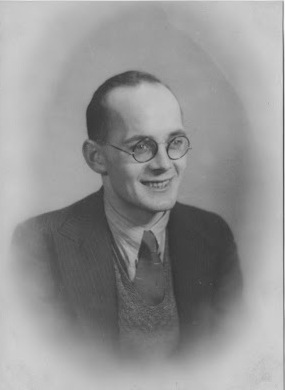
Carl as a young man
 UK Baha'i Histories
such a lovely story…. Carl and Joyce were very much a part of my family’s life in Wales. This service is precious beyond words. I learned more about Carl and Joyce than I ever did in all the years we met in person. Thank you UK Baha’i Histories Team!
.
A wonderful, inspiring story.
Alliteration – the repetition of an initial consonant sound.
We used to love the way the name and home town of Carl Card from Cardiff rolled off our tongues! Such a well-remembered and much loved Welsh Bahá’í, with his wife Joyce, at National Conventions in the 60s – and probably later – but by then we were a few thousand miles away in the Solomon Islands and Nepal.
Several times in the 1960’s Carl drove, in the evening, from Cardiff to Salisbury to give a fireside talk at our house. He used to return to Cardiff the same night (a round journey of at least six hours). They were wonderful talks given with such love and sincerity. Thank you Carl . You and your family are such treasures.
Carl and Joyce played a very special part in my life especially when I was a new Baha’i, they showed such kindness and hospitality and took Viv and I to meetings all over Wales with never failing patience and love as we strove to understand the Faith. Such dear souls!
How nice to read my parent’s story! It is also good to know that my own memory of events from the time when they were Theosophists is the same as theirs. This is probably because their story is my story. Dad embraced modern technology. He had an early Acorn Electron and wrote a programme to calculate the gas and electricity bills. He would have been thrilled to see how computer technology has developed to this extent and that his and others stories are so easily available. Mum would also have gained pleasure from the access to the beauty of poetry and also to information about the night sky that the internet provides.
My earliest memories of Carl and Joyce was 2 souls with shining eyes of devotion to Baha’u’llah. They loved to sing and seemed to feel the UK Baha’i community was so lacking in that joyful expression of devotion. It truly was an honour to know them.
Pingback: Mina Beint (Rowshan) | UK Baha'i Histories
Pingback: Joyce Card | UK Baha'i Histories
Pingback: Rita Bartlett (1946-2013) | UK Baha'i Histories
Pingback: Joy Sabour | UK Baha'i Histories
Pingback: Viv Bartlett | UK Baha'i Histories
Pingback: The Newman sisters | UK Baha'i Histories