
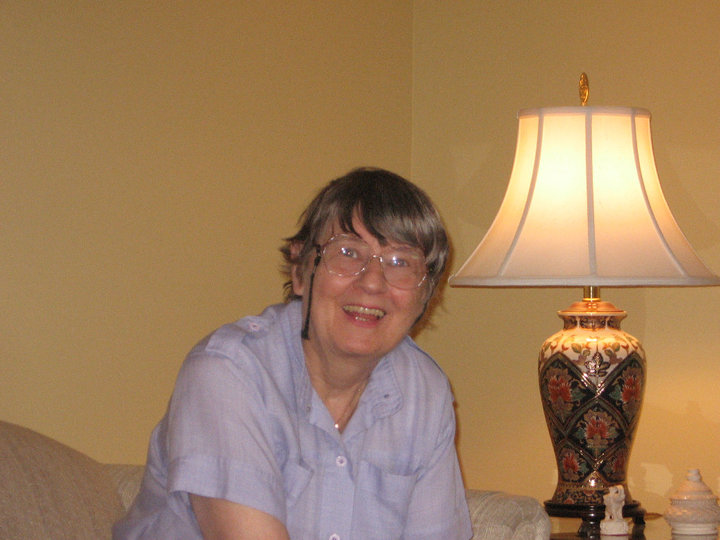
Elizabeth Asbury
I was about fourteen or fifteen years old at the time. One night, lying in bed before going to sleep, I started to become obsessed by the fact that Jesus Christ would be returning to this world, as foretold in the Bible. I anxiously wondered whether this would be happening during my lifetime and how I would know that He had returned. It occurred to me also that, when He did return, He would not know His own churches as they had strayed so far from the real spirit of Christianity. I was, of course, at the time a “junior youth”, although it is only recently that the House of Justice has used this term and emphasized the importance of this time in one’s life.
At that time I was attending school in Ipswich, Suffolk. My father had been a civil servant with Customs and Excise, and my mother had been a State Registered Nurse before her marriage, so I grew up in an English middle-class, professional environment. I was raised virtually as an only child, my half-siblings being considerably older than myself, but was surrounded by a large extended family in my home town. As far as my family’s religious background was concerned, members of the family normally followed the rites of the Church of England at various milestones in their lives such as baptism, confirmation, marriage and burial, with some attending church more regularly. Notwithstanding that I did not go to Sunday school because my parents did not force me to attend (my mother felt that her attendance at Sunday school as a child was a waste of time), the regular school curriculum included a certain amount of Bible study as well as the obligatory daily act of worship each morning. In spite of this, I do not feel I ever had any real spiritual connection with Christianity or any of its churches. Moreover, I did not know anyone at the time whom I could look up to as a role model of a true Christian. As one of my relatives said to me after I had become a Bahá’í, “You never really had Christianity, did you?” but she was glad that I had embraced a faith which was making me happy. In fact, while I was still at school, I even went through a mildly agnostic phase when it occurred to me that there might not be a God. While my father merely said that this was something that people had argued about for centuries, my mother urged me to have faith. The fact was that I had very little faith and had never really been taught to pray.
After completing high school, I moved to London and took a two-year bilingual secretarial course at the French Institute in London which was very enriching not only for my professional development but also for the window on the world which it gave me through contact with people of diverse backgrounds which, at the time, was lacking in my home town. At the end of my first year, I experienced the first major tragedy of my life when my mother died of lung cancer after an illness which had lasted just over a year.
I spent the next few years working as a bilingual secretary with various companies in London and Paris. While in Paris, I was daily perfecting my knowledge of French, but little did I know that the chambre de bonne where I was living in the 16th arrondissement was very close to the French national centre of a world faith about which I still knew nothing.
In 1967, after I had been back in London for some time after a spell of working in France, and while I was employed at the French school where I had originally been trained, I found out that a Mrs. Munsiff, a social worker, was going to give a talk about the Bahá’í Faith. A friend of mine at the time encouraged me to go and find out about the Bahá’í Faith as it was “not a religion but a way of life.” This was the turning point of my life. Mrs. Meherangiz Munsiff gave a very clear, concise talk about the history, teachings and principles of the Faith, and I was hanging on to every word she said. She told me later on that she felt she was speaking exclusively to me, the rest of the audience were simply not there. I subsequently attended the weekly public meetings at the Bahá’í National Centre in London and spent hours reading the books which I bought there.
The following nine weeks saw me attending regular public meetings at 27 Rutland Gate, London, and finding new friends among some of the Bahá’ís of London, including Audrey and Earl Cameron, whose children happened to be attending the school where I was working and to whom I will be forever indebted for their friendship and their constant efforts to deepen me in the Faith not only until my declaration of faith but until I left London for my first pioneer post. I was also devouring one Bahá’í book after another, especially those concerning the return of Christ. I was becoming confirmed in my own faith and being led to recognize the Manifestations of God who came to the world after Jesus Christ. The first Bahá’í book I read was Christ and Bahá’u’lláh by George Townshend. Amongst other things, I was astounded that a high-ranking Christian clergyman would devote a considerable portion of the book to the divine origin of Islam and its teachings, and by accepting Bahá’u’lláh, I also accepted all the Messengers of God. On reading this book and The Wine of Astonishment by William Sears, I came to understand that the various doctrines of Christianity such as baptism, the Trinity, the Bread and the Wine, Heaven and Hell, and the resurrection of Christ, were to be understood in their spiritual sense and not taken literally. I was fascinated and enthralled by everything I read and I was convinced that this new world proclaimed by Bahá’u’lláh was just around the corner and that everyone was going to embrace it. I had yet to find out that this was going to be a long, slow process and that there were many tests and difficulties to be faced and obstacles to be overcome.
I should also mention Dr. Fari Jabbari and her husband, Behrooz, then living in Hammersmith, London, before returning to Iran. They were the first Iranian Bahá’ís to invite me to their home. (I like to tell the Persian friends that I joined the Faith because I enjoyed the Persian food so much!) Fari’s father, Dr. Masíh Farhangí, was martyred in Iran in 1981. The Jabbaris are now living in Canada, near Hamilton, Ontario, and it was a pleasure to renew my friendship with them after their arrival in Canada. I am still in touch with them from time to time.
Nine weeks after attending this initial lecture on the Faith, I was invited, in fact commanded, by Mrs. Munsiff to go to her home for Sunday lunch when she announced to those present, namely her husband Eruch, her daughter Joyti and another Bahá’í, Miss Mabel Joseph, the news that I was going to join the Faith. At that time, Bahá’í teachers were required to read with their new declarants the Will and Testament of `Abdu’l-Bahá as this is all about the Bahá’í Covenant and the Administrative Order. To cut a long story short, Mrs. Munsiff went through the Will and Testament with me. At the end of the afternoon, Mrs. Munsiff left me with a prayer book, saying I was not to let her put pressure on me but, considering what had transpired that afternoon, I felt I had no choice but to make my declaration of Faith. Of course, Mrs. Munsiff was ecstatic and phoned several Bahá’ís in the London area to give them the good news. I should mention that Mrs. Munsiff who passed into the Abhá Kingdom a few years ago, had a very long and distinguished record as a Bahá’í teacher and her spiritual children are scattered all over the globe. She was named a Knight of Bahá’u’lláh during the Ten Year Crusade for opening French Cameroon to the Faith, and undertook many teaching trips all over the world, including her native India where she, as a child, had known Martha Root. She warmly supported me in my plans to pioneer to French-speaking Canada, as Shoghi Effendi had strongly encouraged her to teach in Quebec, where she made one teaching trip during the 1950s. She felt I would be carrying on her work.
Soon after my declaration, I was persuaded that it was important to attend the Continental Conference in Frankfurt in 1967 to commemorate the centenary of Bahá’u’lláh’s proclamation to the kings and rulers of His time. The highlight of the trip was the visit to the European House of Worship but, to be frank, I was not really ready to attend a Bahá’í gathering of that magnitude as I hardly knew anyone there and understood almost nothing of what was going on. Under these circumstances, it is difficult to function in a large crowd. I returned home spiritually exhausted, but I have subsequently attended international conferences in Reykjavik, Iceland in 1971 (just after settling in Canada), Montreal, Canada, in 1982, and the second Bahá’í World Congress in New York City in 1992. I understood much better what was happening and felt more joyful on my return home from each of these events.
As far as my family is concerned, they were quite upset the first Christmas after my declaration when I refused the alcoholic drinks offered me but have become more accepting of the Faith after seeing that I have stuck with it and that it was not just another fly-by-night fad. However, none of them has shown any real interest in it except for one of my aunts who, just before I left for Canada, asked me several questions. She died of a heart attack not very long after.
During the 2½ years I spent in the British Bahá’í community, I had a lot of administrative challenges thrust upon me all at once and, I felt, prematurely, first of all becoming a member and then the secretary of the National Youth Committee, being elected for the first time to a local Spiritual Assembly, and then serving full-time in the Bahá’í National Office where I received hands-on training in the functioning of the Administrative Order at the national level. My lack of knowledge and experience were a test to some of the Bahá’ís at the time who seemed to be expecting more of me, and for a while this was a source of discouragement. Fortunately, the support of Audrey and Earl Cameron sustained me during that time and I gradually gained more knowledge and experience. While working at the National Office, I met several Hands of the Cause who were passing through London, including Amatu’l-Bahá Rúhíyyih Khánum just as she was setting out for her African Safari in 1969. For me, this was like coming face to face with the Queen of England.
I should at this point mention that I worked under three National Assembly members, Mrs. Betty Reed (later appointed a Continental Counsellor for Europe), Mr. Charles Macdonald and Mr. Joe Jameson. They, as well as their fellow National Assembly members, have now passed on to the Abhá Kingdom. My other colleagues at the National Office included Miss Jackie Bendix who served for a short time before moving to Durham to take on a teacher training course but later died from her chronic health problems, and Mr. John Bohlig from the United States who was also a member of staff for a time before returning to the States. Miss Mabel Joseph mentioned above, now deceased, was a devoted volunteer for the Bahá’í Publishing Trust during the time I was at the office, and was nearly always on hand to sell books during the weekly public meetings on Thursdays at the Hazíratu’l-Quds. Joe Jameson, Jackie Bendix and Mabel Joseph are now buried in the New Southgate Cemetery close to Shoghi Effendi’s resting place, as are Meherangiz and Eruch Munsiff.
During this time, I also made teaching trips and attended summer schools in Belgium, Luxembourg, Germany and France.
About Shoghi Effendi’s resting place, my first visit there was on November 4, 1967 shortly after my declaration, on a rainy day which, I was told, was reminiscent of the rainy day of the Guardian’s funeral 10 years before. I was accompanied by Jeanette Robbin (now Hedayati and living in Texas, USA) who, with Claire Copley, had served devotedly at the National Office before me and were active members of the Hammersmith Bahá’í community. They were on the Assembly which accepted my enrolment in the Faith. I had many occasions to visit this blessed spot before leaving for Canada and since then, on return visits to the U.K.
Knowing that any sincere Bahá’í should sooner or later consider the possibility of leaving home to go pioneering, I wanted very much to pioneer to a French-speaking country and was thinking in terms of Europe. However, Mr. Douglas Martin, who was then the Secretary of the National Spiritual Assembly of Canada (later a member of the Universal House of Justice), was passing through London on his way to the 1968 International Convention in Haifa, and mentioned to me the needs in French-speaking Canada (notably Quebec) which was an undeveloped but potentially fertile field of activity. In fact, on one visit to Shoghi Effendi’s resting place, I felt that Shoghi Effendi himself was telling me to move to Canada, and from then on all doors were open to me. I was able to fulfil my heart’s desire in February 1971 when I left England for good to settle in Hull, Quebec, Canada. The National Spiritual Assembly of the British Isles gave me a very warm send-off and lots of encouragement (as did the National Spiritual Assembly of Canada many years later when I retired from full-time service at the Bahá’í National Centre in Markham, Ontario).
While in Hull, I worked, along with other pioneers and the newly-declared French-Canadian believers, on consolidating the Local Spiritual Assembly and developing the community, as well as trying to spread the Faith in that locality. At the same time, I worked for the Government of Canada in Ottawa as a bilingual secretary. It was a most enriching experience for me as I found myself adapting to a new country and to people of different cultures and becoming sensitive to the issues of the two “solitudes” in Canada, English and French, with regard to language and culture. However, I think this was probably the happiest time of my life because of the solid friendships I made.
Five years later, I was asked by the National Spiritual Assembly of Canada to work at the National Centre in Markham, near Toronto, where I stayed until my retirement in 2004. I was the full-time English-French translator for the National Spiritual Assembly and its committees, working on our bilingual Bahá’í Canada, as well as policy manuals and correspondence with French-speaking administrative bodies and individuals both in Quebec and the rest of the French-speaking world. I struggled daily to attain some degree of excellence in this art and was constantly motivated by the knowledge that translation has a crucial role to play in maintaining the unity of the Bahá’í community of Canada as well as the nation as a whole. By the time I left in 2004, I had spent 30 years of my Bahá’í life as a full time employee in national offices, both in London and Toronto
Having learned that obedience to the Covenant means immersing oneself twice daily in the Creative Word which Shoghi Effendi has made available to us through his superb translations of the Writings, I found that I was beginning my education all over again. I seem to have become more independent and more articulate. At the same time I feel a sense of safety within this divinely-appointed Administrative Order which permits freedom of expression and at the same time demands submission and obedience to the centres of authority. I can say that my main “hobby horses” when studying the Faith are the Covenant, the history of the Faith and the Administrative Order.
Over the years, I was also fortunate enough to make several brief teaching trips to French-speaking territories such as Martinique, Guadeloupe, St-Pierre-et-Miquelon, France and Quebec. In September of 1987, on the twentieth anniversary of my declaration of faith in London, I arrived in St. Pierre & Miquelon, a small cluster of islands off the coast of Newfoundland, the only territory in North America which is still part of France, for a week’s visit with the lone pioneer there. From there I sent a postcard to my spiritual mother, Meherangiz Munsiff, thanking her for bringing me this great message.
Since my retirement in May, 2004, I spent 3 ½ years as a pioneer in Saint-Jérôme, a small town not far from Montreal, and am now living in Gatineau (the new name of the municipality which used to be called Hull but also includes four other former municipalities), where I began my life in Canada. It is part of a cluster where intensive programs of growth have been launched and where, until recently, I served on the Area Teaching Committee. I am presently a member and recording secretary of the Spiritual Assembly of Gatineau. In other words, I pioneered to this area in 1971 to consolidate a local Assembly and returned to the same area in 2009 to help promote the development of the cluster.
I should also mention that I have been on pilgrimage to the Holy Land five times in my Bahá’í life. The first time was in 1970 from London, a year before emigrating to Canada. The fourth time was in March, 2010, but the pilgrimage was, unfortunately, cut short because of a fall I had outside the Seat of the Universal House of Justice which resulted in hospitalization, surgery, being airlifted back to Canada and a long period of rehabilitation. However, I have since made a full pilgrimage to the Holy Land which I think will definitely be my last. I encourage others younger and fitter than myself to partake of this bounty, if only once during their lifetime. It was such a privilege to revisit the Holy Shrines, especially now that the Shrine of the Báb and the Ridván Garden have been completely restored, as well as the Terraces and the buildings on the Arc.
___________________
Elizabeth A. Asbury
Gatineau, Canada, March 2014

London Youth – taken in a London park some time in 1968.
Elizabeth on the far left, in the front row
 UK Baha'i Histories
Lovely story that really tugs at the heart strings (although Elizabeth herself may not even fully realise this). She may be assured that her touching love for my parents and our family in general is whole-heartedly reciprocated.
And to be sure, Elizabeth was a more than welcome visitor to the two of homes we moved in and out of in London, after we had become Baha’is. I remember my mother (Audrey) saying to me in private once when Elizabeth arrived to stay with us in Deena Close, North Ealing, carrying two bags full of food items which she proceeded to empty unbidden into our larder, something along the lines of “See, this is the kind of guest I love having to stay: someone who knows exactly what to do when she arrives, is no burden on you at all, and is generally a delight to have in your home.” And that was truly the case. Liz was a fixture in the Cameron household as a frequent and favourite guest we were ALWAYS genuinely delighted to to see again.
I remember her — as a child growing up during her time working at the French Lycée in London and, later, on her visits to London from Canada — as someone who had an endearing mix of humility, loyalty and steadfastness, while at the same time she was seemingly forever endowed with a bright and cheerful countenance, having a quick readiness to see the funny side of life.
One thing that was also very noticeable about her, other than her great affection for feline animals and her proactive interest in all things French, was her unflagging dedication to the work of the Bahá’í Administrative Order, especially at a national and international level. Small wonder then that the Bahá’í National Institutions in Canada are so mature and well respected.
There’s no doubt in my mind that Elizabeth is one the stalwart pioneers of the Faith and a dearly beloved and blessed soul in the “divine Vineyard.”
Thank you, Simon, for all these kind words. I shall ever feel indebted to your family for all you did for me and for your loving hospitality on several occasions. I hope all is going well for you and your family in the Solomons.
A fascinating story! I don’t think we ever met but were probably in Paris at the same time – I was there from 1965 – 1967 – living in attic rooms and meeting a diversity of people on our separate journeys towards discovering the Bahá’í Teachings 🙂
Carolyn, I was living in Paris from 1962-63, so our paths would not have crossed. However, it is interesting that we seem to have followed similar paths.
Dear Liz. Further to the photograph, the girl in he yellow dress is I am certain the then Chereen Youseffian youngest daughter of Dr Yousseffian and sister to Shoreen. One is in South Africa, the other is in Greece both married. The lady front left row looking out is Rouha Khoshbin who used to live with the now Benizirs and others at 3A Leopold Road Ealing Common W5, who the last time I saw her was a a pioneer in Trier Germany, but that was quite a few years ago (1991).
As regards the above photo of London Youth taken in a London park sometime in 1968, three of the boys standing at the back are Paul, Stephen and David Jenkerson. The girl in pink in the middle row is Jeanette Robbin (Hedayati) who used to work at the London Baha’i Centre in the 60s and now lives in the U.S. The young man in a beige suit standing in front is Nihal Goonetilike, who used to live in Hammersmith. The lady sitting far right of the picture is Mrs Rouha Khoshbin. As already mentioned, Elizabeth Asbury is the girl in front wearing the pink headband.
The Youssefian girls are not in this photo. As Ron Roe correctly says, Shirin Youssefian (Maanian) lives in Greece these days and – sadly, and all too recently, her elder sister Shohreh passed away in South Africa at the end of June.
If anyone can identify other friends in this photo, please do so.
Dear Elizabeth,
How precious the memories stored in my heart while working at the Haziratu’l-Quds from 1965-1968 and seeing this photo! Thank you for sharing.
The girl sitting in the middle in the front wearing sunglasses is Faezeh Setareh (now Hedayaty), no relation to my husband Vahid. Faezeh now lives in New Zealand. At the time the photo was taken she was living in Hammersmith in the same house as myself and Claire Copley (now Greenberg), who also worked in the National Office but now lives in Belfast, her original home. Claire is not seen in the photo.
You are a dear. Sending you love from Texas.
Dear Jeanette,
I remember Faezeh very well although I did not recognize her from this photo. I did not know she went to New Zealand. Thank you for your response. Much love.
Dear Elizabeth
I was doing a little research into our family tree and I found this page. I am your cousin, Jane. It was so lovely to read your story.
I really enjoyed your story Elizabeth – having only known you in Canada it filled in many gaps especially since I am from England!
What an amazing Baha’i life and journey you have had, my dearest Elizabeth. I knew nothing of all this and am utterly surprised, but also confirmed in recognizing your devoted soul in service to our beloved Faith. Merci beaucoup pour tous tes services.
I’m a bit late to this conversation but: The lady in yellow in the middle row is Pari Pourami (now Levin). The lady in green at the end of the row is Fakhereh Bolourchian (now Mottahed). I believe in the front to the right are Mr & Mrs Setareh.
Dear Elizabeth
I am sue cracknell, nee asbury. My father Lewis asbury and your father Frederick were cousins. I remember you coming round our house in Ipswich when I was about 18 in 1963. You have had such an interesting life and I am so pleased to have found you.
Hello Elizabeth – your father Frederick was my father Lewis’s uncle. I remember meeting you in my house in Ipswich. I still live near Ipswich. Would love to hear from you. Best wishes and love – Sue Cracknell (nee Asbury)
Hello Elizabeth
I did reply to your request, but not sure you have received it.
I found you on the Baha’i histories site, and thought it would be lovely to get in touch with you. My husband, Graham, has been doing the family tree, and I know that Frederick Asbury was also keen to do the same.
You may or may not know that Frederick passed away last year, so our relatives are getting depleted somewhat now.
It was good to read that you have had a happy and fulfilling life.
If you would like to keep in touch, please email me.
Best wishes Sue Cracknell
Sent from my iPad
>