
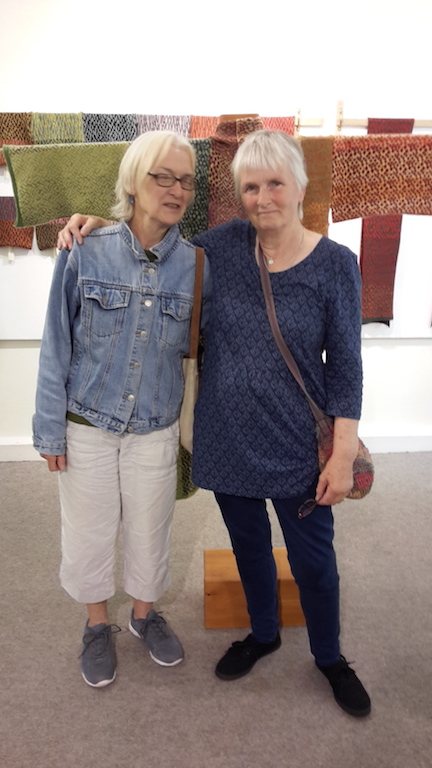
Carol Forrest (L) with her sister
My first name is Elizabeth but I am known by my middle name, Carol, chosen by my mother because I was born in December quite close to Christmas Day. I am the eldest of five children, having two younger brothers and two sisters.
My parents were religious – my maternal grandfather had been a minister in Kircowan but he passed away before I was 2 years old. Many years later I received a copy of the eulogy that had been printed in the local paper describing him as a loving caring person who had set up ‘Band of Hope’ groups whose purpose was to cut out the consumption of alcohol.
The first family home was in an upstairs Edinburgh flat and I have vague memories of the school I started at when I was 4 years old. I had to catch a bus at the end of the road from home and one morning I was in tears because I had missed the bus. A young man asked why I was crying and after I told him he explained that there would be another bus so I didn’t need to cry. He was right – along came the bus and when I climbed on, I could see other children in the school uniform!
Our next home was in a larger house in Dalkeith.
Then when I was 8 years old, my father was appointed head teacher of a small primary school in the tiny village Lyne of Skene in Aberdeenshire. This was a massive change for me. Suddenly my father was my teacher. I started off calling him ‘daddy’ at school but soon was addressing him as ‘sir’ at home! The Buchan dialect, that was spoken all over the county, was like a foreign language to me. I became the ‘dominie’s daughter’ [dominie is a Scottish word for schoolmaster], and when my father had occasion to punish someone, I was ‘sent to Coventry’, i.e. treated as if I didn’t exist, by the other pupils. What a relief when I got to secondary school. Nobody knew my father!
When it was time to leave school, it was Edinburgh university for me although all my school friends went to Aberdeen. I scraped through the academic work and had many ‘firsts’: cinema, parties, dancing, alcohol. Four years flew by and all my friends were applying for teaching jobs and going for interviews with Directors of Education. I was confused and frozen. I felt that I had only just left school and now I had to go back to it as a teacher. It didn’t seem right. What could I do?
There was a huge poster in the Teacher Training College office with the headline “VSO”- Voluntary Service Overseas.
Yes!! Even if I didn’t get paid, as long as I got fed, I would love to do voluntary work!
I was sent to Ghana! The minimum time for VSO then was two years. I stayed four years. Living in Ghana was the best education I had in my life – teaching in an isolated residential college – living in a flat overlooking the campus; learning how to cook plantain, dancing to ‘highlife music’; holidaying in a slave fort on the coast, 2 degrees north of the equator. Ok, I nearly died there when I got malaria in neighbouring Togo (it recurred in Glasgow). But ‘nearly’ is the right word.
After four years there however, the friends I had made were leaving the area, the class I had taught for four years had finished their course. It seemed the right time to return home. I applied for a teaching job in Glasgow, worked there for 12 months, got accepted onto a post graduate course in African Studies at Edinburgh University. Then at the end of the academic year I was penniless and jobless when all the schools in the UK were closed for the summer holidays.
Don’t fret – I got a job in an English Language school in Germany and after 12 months’ work had money in the bank, new clothes, LP records and books!
I actually didn’t really want to be a teacher – I had always wanted to be a social worker. I now learned that in England I didn’t need a qualification for this work so moved to Wigan, then Bolton, and after a few years unqualified work was sent to college in Manchester for training.
That is the background for my Baha’i Story. It starts with the social work. Two colleagues – Tony and Eric – and I were working with a small group of teenagers who were having a difficult time in their lives.
We workers would pick up the young people and take them to a community centre where we would sit and talk, sometimes cook and eat, and discuss behaviour – maybe what was happening within a specific period of time – otherwise what had happened in an individual member’s week. When the meeting finished we would take each young person back to his or her home, then meet up in a pub to discuss how the session had gone, what we could have done differently and whether it had been difficult to control some of the behaviour – and we would have a pint.
One Wednesday after our discussion, when Tony and Eric had both left the pub for their respective homes, I was on my own, and when I got to my car, I found that someone had let all the air out of the back tyres so I couldn’t drive it. However, there was a petrol station with an air pump just across the dual carriageway. I moved very slowly and carefully into the forecourt.
Unfortunately, the garage was about to close and the young man in charge told me the air pump had been switched off. He offered to drive me home but I was allowed to use the garage phone to call a friend (this was a time before mobiles!!) My friend came and picked me up, and I left my car in the garage and went back the next day to collect it.
After this, over a period of time, I got to know this person who worked in the garage. His name was Foad Rahimi and he was from Iran. He had left Iran at the time of the revolution when Khomeini took control of the government of the country. He had had to dodge bullets in Tehran when organising his escape from the country. One day he had a T-shirt on bearing the words “Bahá’í Faith”. “What’s that?,” I asked. He gave me a little information and I went to one or two Bahá’í meetings.There was a young woman called Joan Ambrose who was a native Bolton Baha’i who always had food for everyone when she hosted the meetings. This was fabulous for me as I often had to work overtime and so hadn’t eaten before going to the meeting. I met the Fanayans there, a third generation Iranian Baha’i family whose open home was full of light, music, food and laughter – and live santur music! After some time they moved to Australia and unfortunately I lost contact with them.
The principles of the Faith attracted me – the oneness of humankind, the equality of women and men; the elimination of prejudice, the independent investigation of truth – they resonated well with my principles in life. Then there were principles that hadn’t occurred to me – the independent investigation of truth, the essential harmony of science and religion, a universal auxiliary language, spiritual solutions to economic problems – these also resonated well with me.
I had difficulty with belief in God. Then I learned that the Baha’i teaching is the perfect explanation for difficulty in connecting with God, which is that the limitations of existence in this life mean that it isn’t possible to attain a better understanding while we are on this earthly plane.’
One bank holiday weekend I got into my car to drive to Greenlaw to visit my parents and my brother and sisters who also lived in small towns in the Scottish Borders. After a few hours’ motorway driving, the route went onto a country road that took me through a small Borders town called Hawick. I needed a bit of a rest so parked the car at Greenlaw, got a drink and sat by the side of the river. It was a beautiful day and the sun was being reflected in the moving water. Looking into the river, I suddenly realised that I wanted to declare as a Baha’i! This is a poem I wrote to describe what happened:
“Sunlight catches the water
On a fine summer’s day.
Crouched in the river bank grasses,
I watch, enchanted,
A murmuring pool of golden whirls;
The sparkling yellow fragments of reflecting light;
A million suns in the ripples.
God looked into the pool of my eyes
Through the river’s lens
And spoke to my soul
Of His Grace and Glory”
When I returned to Bolton after the weekend, I went round to where Foad was living to tell him I wanted to join the Bahá’í Faith. He was delighted and immediately phoned Joan to let her know. I was welcomed into the community at the next feast.
That was in July 1984 – as I write this, it’s March 2019. The Faith has transformed my life. I am happier inside. I can cope better with the challenges and/or difficulties life throws at you. I love the writings and prayers and I still find them exciting – at times challenging – comforting and beautiful. The Faith helped me to deal with the horror of developing ME – Myalgic encephalomyelitis – a poorly understood and devastating illness which took everything away from me – my job, my friends, my strength. I needed home-help to do my shopping, cooking and cleaning.
Very slowly over several years, some strength has come back to me – not as great as it had been – but then age has caught up with me now – although I don’t argue with it!!!
The aim of the Baha’i Faith is the unity of the world – “One planet, One people”- and the means of achieving it are described in the Baha’i writings – from the adoption of a world language to harmony between science and religion.
When I say to people “I’m a Bahá’í”, the response I usually get is “What’s that?” Only a minority of people up to now have heard of the Faith. The writings are moving. Somehow it amazes me what a couple of flat tyres can do in a person’s life!
Now I’m very much looking forward in May to my first pilgrimage ever.
Carol Forrest
Duns (Scottish Borders), April 2019
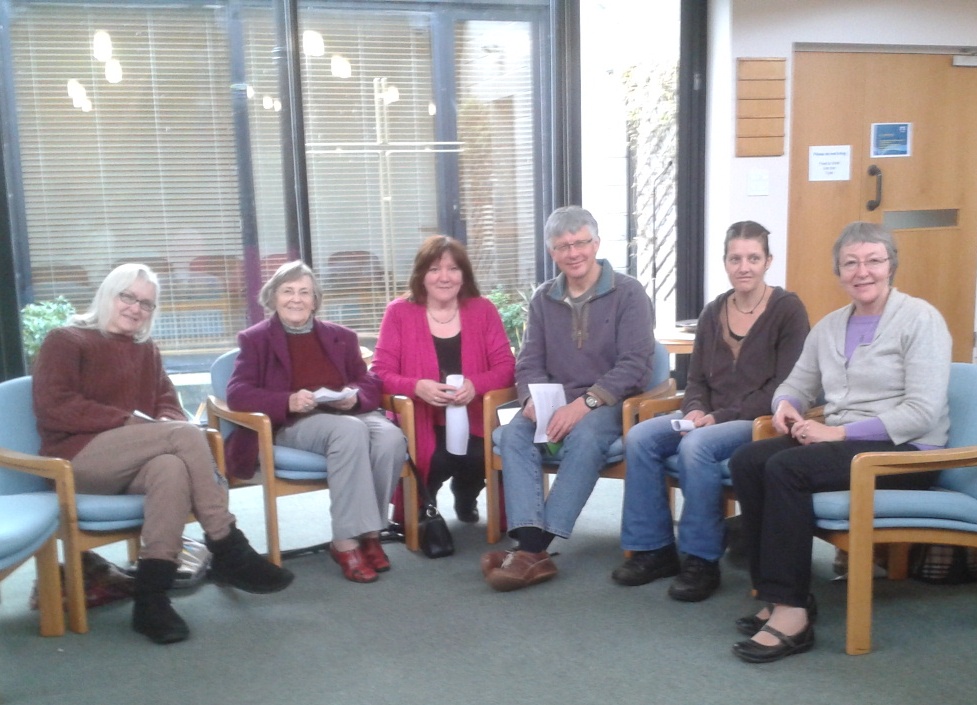
Galashiels, November 2013
L to R: Carol Forrest, Dorothy Green, Rita Docherty, Rob Hain, Sheena Murphy, Zoe Turner
 UK Baha'i Histories