
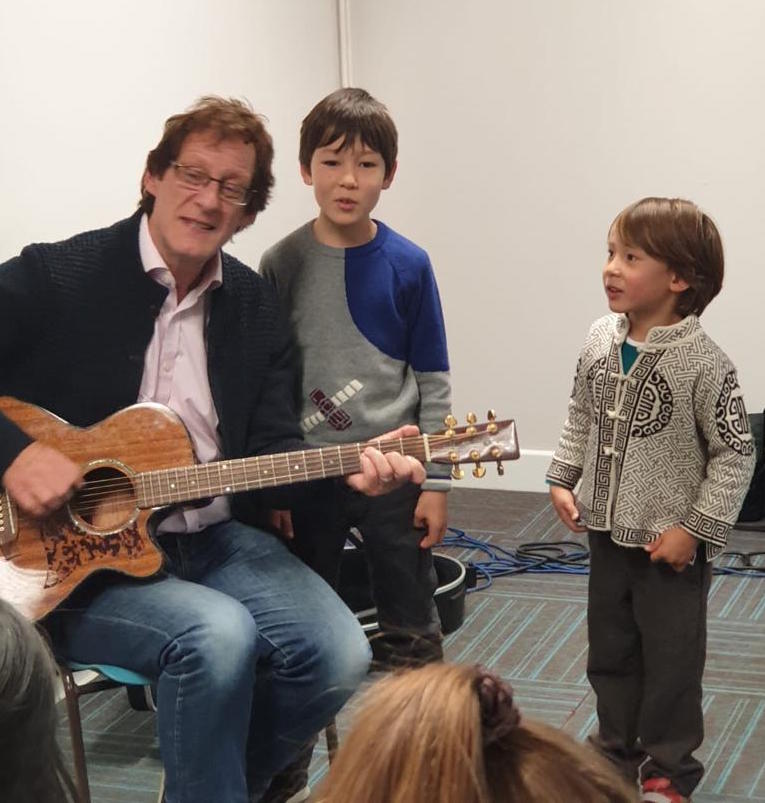
Bicentenary celebration in Rugby, 2019
I was born in France, because my father was in the Royal Corps of Signals of the British Army, and was stationed in Fontainebleau. I was only there six weeks before the family returned to England, following which we lived variously in the family home in Brailes in Warwickshire, Catterick Camp in Yorkshire, and a brief spell in Turvey near Bedford, before moving to Singapore when I was six, where we spent two and a half years. We returned when I was eight, and after a short stay in my great Aunt Emmeté’s house in Shottery, near Stratford-upon-Avon, we moved back to the family home in Brailes during the cold winter of 1962/63. Just before my ninth birthday I started boarding school not far from Brailes, and then moved on to Public School (Haileybury) until I completed my ‘A’ levels. When I left school I went to work in Manchester for GEC at Trafford Park. This was part of a “Sandwich Course” that involved spending a year in industry both before and after a three-year University degree course. I studied Electrical Engineering at Bristol University.
In the fifties and early sixties we all went to church on Sunday, and when we were in Turvey I attended Sunday School classes. In Singapore, the family would attend church together with other army families, after which everyone would repair to the bar up on a hill for drinks, at a place called The Gap, and the children would run around the rocks there and gather round the gully-gully man who would arrive with his baskets of snakes and make the snakes dance to the tune of his pipe before handing them round to the children so we could handle them and wrap them round our necks and arms! Back in England, when we lived in Shottery, all the families in the entire street would pour out of their houses every Sunday and wend their way in a joint procession to the church near Anne Hathaway’s cottage. Then at some time, we as a family, along with many other families it seemed, stopped going to church except at Christmas and Easter. Twenty years later, when I was living in Ireland, I witnessed the same mass processions to church, and realised the extent to which in England the church-going had “dried up”.
At school, church was a daily or at least a several times a week affair. I have a definite recollection of asking the head master of my Prep School if he thought Jesus would ever return, as it seemed a good idea if He did. Unfortunately I can’t remember his answer! At Haileybury my best friend was a Catholic, so instead of going to Holy Communion, he was collected by his family on Sundays and taken somewhere else. When I and my other schoolmates started attending confirmation classes, he didn’t come, and I remember thinking I didn’t really want to be confirmed in the Church of England, I’d rather be confirmed as a Christian, but it was a conundrum I couldn’t resolve. After I had become a Bahá’í I realised I had also become the Christian that I always wanted to be.
How I became a Bahá’í
During my childhood and adolescence, I was well-known by my family as a Beatles fan, along with many others of my generation. I was attracted not only by the music, but also the Irish/Liverpool quick sense of humour, the independent thinking that went with the whole sixties phenomenon, and a desire to replace the aftermath of war with a stronger allegiance towards peace. All you need is love, give peace a chance, and the world will live as one. After leaving school I no longer attended church, although I still believed in Jesus. I was also attracted to George Harrison’s singing of spiritual ideas rather than the usual pop mantra of romantic and physical love. I was particularly intrigued when he rhymed Hare Krishna with Hallelujah in My Sweet Lord. I had taken up the guitar when I was about sixteen, and was particularly fascinated by the technique of writing songs, and one of my first attempts was a song in the form of a prayer, entitled “To an Unknown God”, which I wrote a few weeks before I met the Bahá’ís in Manchester.
During my first-year apprenticeship in Manchester, a colleague of mine invited me to go out on a Friday night to a disco known as Mr Smith’s in town, where during the evening I met his friends, some of whom were Bahá’ís, though I didn’t know it at the time. A while later I was invited to go to see the musical ‘Hair’ at the Princess Theatre in Oxford Road, and on the way back the group I was with were talking about Bahá’í this and Bahá’í that, so naturally I asked what it was they were talking about. One of them said they wouldn’t tell me, I had to go to a “fireside” to find out! I was at a loose end (I was sharing a house full of medical students together with my elder sister Sue who was studying at Manchester University, and they were all away on holiday) and I lived in Fallowfield just around the corner from the Bahá’í Centre in Wilmslow Road. So I went along one Friday evening via the Centre, where I was met and taken to the home of Jimmy and Ruth Habibi, arriving slightly late. I sat in the corner, cross-legged on the floor, as the room was packed. There was a Persian called Shahram Mottahed, talking about the World Order of Bahá’u’lláh, whose name means the Glory of God, and how He had come to establish the Kingdom of God on earth, and that one day most people would become Bahá’í. Well I looked around the room at the motley collection of differing hues and ages, and thought straight away that this was going to be really easy: either these people were completely insane, or else I had stumbled upon the most important thing in my life, and all I had to do was to work out which alternative was the truth!
At the end of the fireside, someone said there was some Persian food on offer at another home, if anyone wanted to go. So already intrigued by what I had learned so far, I went along with a few others to the home of Linda and Shabbas Farhangi, and listened and soaked in the conversation, before finally heading home on foot at around 4 o’clock in the morning. I had a strong sensation of the light dawning in the eastern sky, and feeling the sun was about to rise in my life but I hadn’t seen it yet and had no real idea how big or bright it was going to be. I just knew it was very big, and very bright.
At that first encounter someone had given me a copy of Bill Sears’ book Thief in the Night, about the prophecies in the Bible concerning the name and date of the coming of the Son of Man in the Glory of the Father, and that book ignited the spark of curiosity into a flame. I had a collection of pamphlets which I had been given at that first encounter. They explained the concept of progressive revelation: the succession of the Messengers of God, including the Aryan sequence of Krishna, Buddha, and Zoroaster, as well as the more familiar Semitic line of Abraham, Moses, Jesus, and Muhammad. Additionally, in the middle of the nineteenth century, in fulfilment of the promises made by all the earlier prophets, the “twin Manifestations” of the Báb (meaning Gate) and Bahá’u’lláh (meaning the Glory of God) appeared in Iran. At work I kept the pamphlets in my jacket, and I used to sneak off to the toilets to read them again! It was as if I wanted to pinch myself to make sure I wasn’t dreaming.
I learned that the Báb was executed by firing squad after a dramatic six-year ministry that saw twenty thousand of His followers killed in heart-rending circumstances at the instigation of a cruel and fanatical clergy. Bahá’u’lláh, the leader of the Bábí community after the Báb’s martyrdom, was spared, perhaps because of His father’s senior position in the court of the Shah. However, He was exiled with His family, initially to Baghdad, then even further afield to Constantinople (now Istanbul), then Adrianople (now Edirne), and finally to Acre in what was then a Turkish penal colony in the remote edge of the Ottoman Empire, across the bay from Haifa, and which is now in Israel.
I attended deepening classes with Habib Habibi, Jimmy’s father. I read Some Answered Questions next, then Gleanings from the Writings of Bahá’u’lláh, and The Priceless Pearl. I managed to attend some sort of Bahá’í function nearly every night of the week. I also joined a singing group with Ruth Habibi, and Dave and Margaret Grant, and others, called the ‘Valley of Love’. Then someone asked me when I was going to “declare”, and I asked when the next Holy Day was. So on 9thJuly 1971, following the commemoration of the Martyrdom of the Báb, I signed up and joined the Bahá’í community.
What changed in my life when I became a Bahá’í
One of the first things that struck me when I met the Bahá’ís, was the friendliness and love within the Bahá’í community. During my childhood, especially at Boarding School, I didn’t have many close friends. When I went home in the holidays, I didn’t know anyone because I was mostly away at school, so I spent most of my time cycling around the Warwickshire countryside, playing with my model trains, and later practising on my guitar, and listening to my records. My social skills were definitely latent. Then along came this group of people, full of energy and love, and I must have responded in kind. I attended many events up and down the country: conferences; summer schools; winter schools. At these occasions there was a rich mixture of visitors from the World Centre in Haifa, some Hands of the Cause, travellers from all parts of the world, and there were late night talks on difficult subjects, courses on Islam, and always the music and singing. With the approach of the first Christmas I announced to my family I wasn’t coming home, and disappeared off to Wiston Lodge in Scotland to attend a Winter School there. I had a Honda 50 scooter at the time, and in my second Bahá’í summer I headed off to a Summer School in Harlech, driving through the night immediately after work on a Friday, across darkest Wales. Later that summer I went up to St Andrews for another Summer School on my trusty steed. It took me three days to get there from Brailes. I stopped off in Manchester, then with family friends, the Drews, in the Lake District (who I found out later were also friends of the Hellaby’s, a Bahá’í family who lived in Kendal at that time, and had sold them their piano). Diana Drew asked me what I would like to drink, I said anything not alcoholic, to which she replied: “What, the son of a Brigadier, and you don’t drink??!!”
How did my friends and family react when I told them I had become a Bahá’í?
When I told the colleague who had introduced me to the Bahá’ís, he responded with: ”you fool!”. When I told my mum she said she always believed the religions were one, and had a Rodwell translation of the Qu’ran. I gave my parents a copy of George Townshend’s “Heart of the Gospel” and “Christ and Bahá’u’lláh”, and Gloria Faizi’s“The Bahá’í Faith”. My dad said he would have to go on a trip somewhere, as the only time he ever read was when he was flying in a plane. I think it was just so radical a change from middle/upper England when you rarely talked about politics or religion, let alone got worked up about it or did anything about it, and then there was me. I wasn’t very articulate, I hadn’t worked out how far to push or explain, and how much to live by example, so I decided to try and do the latter, and life eventually settled into a status quo, but I am sure if it hadn’t been for France and Singapore, and my parents’ unprejudiced attitudes towards both race and religion, I would have been in a different place, and could easily have chosen a different path. Dad once recruited a couple of Persian students from Banbury College to help in the garden, and when he told them I was a Bahá’í, and he had been to my twenty-first birthday party in Bristol, hosted by Minoo and Heshmat Sabet, and had enjoyed the Persian food, they told him they knew all about the Baha’is. In our country, they told him, we don’t like the Bahá’ís! Often Mum would send me cuttings from The Times whenever she noticed an article about the Faith, such as the obituaries of Mark Tobey and Dizzy Gillespie, or the opening of the Lotus temple in India. When she passed away in 2010, I read “From the Sweet-scented Streams of Eternity” in the village church at her funeral, and I was half way through when the church bells, which play a hymn tune every six hours, chimed the tune for midday. It was the 9thJuly.
My Bahá’í life at local, national or international level
During those early years both before and after university I went a number of times to Bangor in North Wales, to support the Bahá’ís who were living there.
While at university, Dave Grant and I decided to spend our summer vacation visiting the US, and during the three and a half months we were there we met with many Bahá’ís in Chattanooga, (Tennessee); Fort Myers and Micanopy (Florida); Shreveport (Louisiana); Ann Arbor (Michigan); Thunder Bay (Ontario, Canada); and Sault Sainte Marie (also Canada). During this trip, we also spent four weeks in Wilmette, Illinois, at the Bahá’í House of Worship, acting as guides.
After University, when I was living and working in London, I had a rail pass for the Eastern Region, and managed to pioneer to Ipswich for a while to help the community there. I also helped form the local assembly in Colchester. Local Spiritual Assemblies are elected on 21stApril every year (a Bahá’í Holy Day) provided there are at least nine believers in a town or village. In this case there were nine, but the youngest had only just become 21, and hadn’t claimed his voting rights, which at that time was necessary. I therefore decided to go to the National Office to claim those rights. On arrival, I rang the bell and the custodian, Philip Hainsworth, appeared. I excitedly explained the purpose of my mission but to my dismay, Philip explained apologetically that it was a Holy Day and the office was closed. Crestfallen and dejected, I apologised and turned to go, when he laughed and said: “Nigel, I was only joking!”
In the long hot summer of 1976 there was an international conference in Paris and I drove over with three other friends, following which we went to Luxembourg to join a teaching campaign there. We then drove on to visit the Bahá’í House of Worship near Frankfurt, Germany.
A big part of teaching the Bahá’í Faith to the world at large is the act of pioneering, of moving from one’s homeland to another part of the world, a process that has resulted in the successful spread of the Faith from its original homeland, Iran, to become the second most widespread religion in the world after Christianity. When I became a Bahá’í I wanted to use my job to finance my travels to support this process. After I had completed my university education I ended up in London working at railway depots in Ilford, West Ruislip and Hornsey. During this time I consulted with the Overseas Pioneering Committee, and corresponded with various National Bahá’í Communities around the globe in my efforts to secure some overseas employment. My boss at the time indicated that there were opportunities within GEC, and earmarked me for a job coming up in Taiwan. Knowing that my company had many years of contracts in South Africa, I asked the Committee if my being offered a job in South Africa would be of any use. They got very excited and said if you get offered South Africa, don’t even ask, just go! Not long after I returned from the Paris conference, my boss phoned me one weekend, and said “Can you go to Cape Town on Monday?” I asked him how long for, and he said 4 months. (I returned to the UK 6 years and 4 months to the day!) It took me ten days, to terminate my flat tenancy in Leytonstone, sell my Honda 50 scooter (to Bob and Margaret Watkins, who gave me invaluable advice regarding South Africa), hand over my Renault 4 car into the safe keeping of my younger sister Judi, get my jabs and tickets, and board the plane to Johannesburg. I spent two months there initially, sharing a flat with Jurgen Aiff, and being introduced to Bahá’í South African life with Lowell Johnson, who had pioneered from the US in 1953. I attended a national conference in Umgababa in Natal, where I was introduced to the infectious African singing that still rings in my ears and in my soul to this day. Then I was given the keys of a clapped-out white Ford Escort by the head of GEC South Africa, who pointed me towards the horizon and said “Cape Town is about a thousand miles that way”. At the advice of Lowell, I detoured via an exhibition by the Bahá’í artist Reg Turvey in Graaf Reinett, then a night in Wilderness, before travelling along the Garden Route to Cape Town.
The Bahá’í community in South Africa in the late seventies was a very special group of people. In Cape Town the majority were from a Muslim background, Cape Malay or Indian. Shoghi Effendi, the great grandson of Bahá’u’lláh, and Head of the Faith, with the title Guardian, from 1921 to 1957, had encouraged the early pioneers to focus on teaching the indigenous peoples of Africa. With the complex cocktail of the laws of Apartheid (separateness), combined with Bahá’u’lláh’s teachings on “die Eenheid van Mensdom” (the Oneness of Mankind), obedience to government, and the use of wisdom, we trod a delicate path that focussed on the quiet, unobtrusive establishment of Local Spiritual Assemblies in as many places as possible. In 1976, Johannesburg I think had just formed a mixed Spiritual Assembly for the first time, and Cape Town held the first South African Summer School in December of that year. During those first few months I met at least three Hands of the Cause, including Bill Sears and Dr Muhajir. One evening while still in Johannesburg I travelled with Lowell Johnson to Pretoria in his faithful VW Beetle, together with another Hand, John Robarts and his wife Audrey, reciting 500 Removers of Difficulties 500 times along the way.
In Cape Town I had the use of my company car at weekends, so on most Sundays over a period of several years I drove to the towns of Worcester and Ceres, about 130km from Cape Town, with some of the local friends from Cape Town, to form assemblies in those places. Although I did my best to learn the Afrikaans language that was spoken in the country around the Western Cape, I didn’t say much when we got there, leaving most of the talking to the others. I felt that the white man ought not to do all the talking. They often told me the only white people they ever saw were the police and the priests. I enjoyed my role as taxi driver and guitar player, and we initially started by holding children’s classes, then the parents wanted to know what all the singing was about. When my sister Judi came to visit me, I took her to Ceres to meet the friends there. When Odette, my first wife, and I got married in Cape Town, we had to write to the government in Pretoria to get permission to invite black people to our wedding, which was granted on condition that there was no alcohol and no dancing at the wedding.
During my time in South Africa, I managed to travel to the Hogsback Mountains in the Eastern Cape on a teaching trip, with Rose Perkel Gates, who had the title of Knight of Bahá’u’lláh, as she was the first Bahá’í to settle in Alaska during the 1950s. I also attended Summer School in Botswana, and went up to Namibia to visit some of the friends who had pioneered there from Cape Town. Later, on return visits to South Africa I attended Summer School in Swaziland, and a conference in Harare in Zimbabwe.
After leaving Cape Town, I lived in Ireland for three years, and again more recently for six, both times at the behest of my company, GEC, for whom I still work, and have done since leaving school. My connections with Ireland started in 1974 when I went with a car-full of Bahá’í friends to help man a Bahá’í exhibition in Derry. We stayed with Dr Keith Munro and his wife Anne, and met some wonderful people there, many of whom I have kept in touch with ever since. I went back the following spring, and stayed with my new friend Jim, whose brothers later formed a rock band called the Undertones, in the Bogside. Once at breakfast I said to Jim: ”Do you think I should let on to your dad that my dad’s a retired Brigadier?!” I remember going to send a post card home, and finding where the Post Office had been the previous year was now a car park made from the rubble of broken bricks.
During the eighties Adib Taherzadeh was living in Ireland, and the Irish community at that time was very young. Most had become Bahá’ís during the same months of the same year that I came across the Faith in Manchester. When I look back, I realise I have attended Summer School in Ireland in every decade since the seventies. During the summer of 1984 we used to go camping at weekends, and a handful of the friends would gather at a pre-arranged spot out in the West or the South, and once in Kilkenny, and we would set up our tents and spend the weekend together just socialising. The bonds formed then are still with us to this day.
During my more recent spell in Ireland I attended the Ruhi classes, and went through them in turn up to Ruhi Book 7. This too had the same effect of bringing the friends together in unity. We set up teaching groups, and Terry Smith, Frances Madden and I formed one together, and we decided to compete with each other to see if we could attract friends and make new acquaintances. Terry joined a walking group, Frances started devotionals at the National Bahá’í Centre where she was the caretaker, and I started Friday night film evenings in my flat overlooking St Patrick’s Cathedral in Dublin, as an antidote to the usual ritual of going down to the pub at the end of the working week. It was at one of these evenings that I met Nemekh, originally from Mongolia but who was living in Dublin at the time, a friend of Joan Estall. Two years later we married in the Westbury Hotel, Dublin. Since leaving Dublin, Nemekh and I have been back regularly to Irish Summer Schools in Kilkenny, with our children William and Alex, and on occasions my daughter Emmeté has also joined me at the school.
Involvement in various plans, teaching campaigns, Summer Schools, and other ‘special occasions’
Other activities I was particularly fond of during my last time in Ireland involved travelling to the islands around Europe, inviting a dance group to Dublin, running a course on Islam, and co-ordinating children’s classes.
Trips to the Islands of Europe: In 2003, in response to a call from the Universal House of Justice, the body elected every five years to adminster the affairs of the Faith from the World Centre in Haifa, I set about visiting as many islands around Europe as I could. That year I found myself finishing Ruhi Book One in Corsica, in French; I did Ruhi Book 3 with Matt Kennedy and Tina Salter in the Faroes; and spent two weeks at a Summer School with my son Duncan in Cyprus. A couple of years later I also wound up in Iceland with Terry Smith at the invitation of his friends Antje and Kristjan.
Lights of Unity Dance Group: I came across the Lights of Unity, a Bahá’í-inspired dance group from Northern Ireland, managed by Edwin Graham, when I attended a conference in Scarborough in 2005. I was so impressed that I invited them to come down to Dublin, and we arranged with a number of schools and other venues for them to perform. The show involved a mixture of theatre and dance, around various subjects that were of themselves challenging and thought-provoking, and aimed particularly at youth.
Course on Islam: I also managed to run a course on Islam at the request of the Dublin Assembly. The course started off as a request at a Feast, to run a course on Islam because no-one knew much about it. We then constructed the course on a do-it-yourself basis, each person attending choosing a specific subject. I chose ‘Shiah Islam’, someone else ‘The life of Muhammad’, another brought a collection of poems he had written about the Prophet. We were given a month to research, then each Monday for about six weeks one of us would give a presentation on what she or he had discovered. At the end, three of us went on a field trip to Spain to visit the Alhambra and the city of Cordoba, to study the impact of Islam in its heyday in Andalusia. We asked the National Assembly in Ireland to contact the National Assembly in Spain, to see if anyone in the area was well versed in Islamic history. When we arrived we duly linked up with a young man who gave us a tour of the Arabic quarter in Granada, and then handed us over the following day to his father in Cordoba, who gave us a tour of the ruins of an Islamic Palace there.
Children’s Classes: During my second time in Ireland, I was appointed Children’s Class Coordinator during the transition from one central class in the National Office to a number of home-grown classes scattered throughout the greater Dublin community. This came very naturally to me, after my experience singing with the children in the Western Cape, and on my return to England I have also supported Children’s classes in Rugby, Nuneaton, and Nottingham.
Visits to Holy Places, Pilgrimage, & Houses of Worship
As well as visits to the Houses of Worship and the one in Frankfurt, I also went to the ‘Lotus’ temple, New Delhi, following a business trip to Mumbai in 1996. Instead of flying directly home from Mumbai, I took a train to New Delhi, and flew home from there. The train ride was an interesting 16-hour journey during which I read from the Buddhist scriptures the Dhammapada, a copy of which I had bought in Mumbai, and shared a compartment with three born-again Muslims returning from an Islamic get-together in Sri Lanka. They were dressed from head to toe in flowing white robes, they wore white skull-caps, and all had dark, shiny, curly black hair and well-trimmed beards. None of them said anything, so it took me a while, but I thought “Hm..mm… sixteen hours, I really need to try”. Eventually I plucked up courage and asked the guy next to me: “er, do you speak English?” “Och aye,” he replied, in a thick Scottish accent, “I’m from St Andrews.” It turned out one of his mates was from Newcastle, and the other was from Canada!
Of my two recollections from my Lotus temple visit, one was that when Dave and I were guides in Wilmette, one of our duties was to stop people coming into the House of Worship in bare feet, and if we saw anyone barefoot we would politely ask them to put their shoes on. In India, however, built into the approach to the entrance of the temple was an underground shoe store where people going into the building could leave their shoes. This was again out of respect. I really liked the way the faith could accommodate differing cultures around the world so easily, rather than impose a unilateral uniformity. The other memory was of sitting in the auditorium inside the temple, reading from the Dhammapada and just happening across the passage: “A true disciple is like the lotus flower, growing among the garbage by the side of the road, and bringing joy to all those walking past.”
Three months in Montreal and Boston (1998)
I was asked in 1998 to support a bid my employer was making in the USA in connection with the Boston commuter railway network. I spent three months, there, sometimes in Boston, where I joined the friends in a 19-day Feast a couple of times, and sometimes in Montreal, where I rented a flat near McGill University, within walking distance of the “Maxwell House”, the home of the Maxwell family whose daughter Mary married Shoghi Effendi and became known as Rúhíyyih Khánum. The house was preserved in the same style as when ‘Abdu’l-Bahá (Bahá’u’lláh’s eldest Son and successor who was Head of the Faith from 1892 to 1921) stayed there during his trips to North America. I had the privilege of being able to go there at will, sit in the bedroom where ‘Abdu’l-Bahá had slept, and pray for assistance during a particularly difficult time in my life.
Pilgimages (1974 and 1983) and 3-day visits (1978 and 2005)
I have been on two nine-day pilgrimages to the Bahá’í World centre in Haifa, in 1974, and 1983. I have also called in for three-day visits in 1978, 1980, and 2005, when I travelled with a number of Irish friends, including Terry Smith and Shaun Thorpe.
Ten days in Iran 1978 (Tehran, Isfahan, and Shiraz)
After my first two years in South Africa, I was allowed to go home for two months’ UK leave. I remember going to the travel agent with my full return ticket, asking how far east could I go without the ticket costing any more. I was told Israel, and I thought “That’s a good idea, I’ll call in for a three-day visit to Haifa on my way home. When I mentioned this to a Persian friend, Vida from Durban, she said: “Why don’t you go and visit my mum in Tehran?” So I did! I contacted the Persian National Assembly, was told that a revolution was under way and that I should avoid Tabriz, but I could go to Tehran, Isfahan, and Shiraz. While in Tehran, I visited the house where Bahá’u’lláh grew up when His father was a minister in the court of the Shah. I was then handed over to a member of the National Youth Committee, Shua’u’llah, who kindly drove me to Isfahan, where I visited the house that belonged to two famous brothers who were killed during the early years of this new religion. On the way to Isfahan we drove through the Holy city of Qum, with its gold domed shrine to Fatima, sister of the eighth Imam. Then we went to Kashan, where many of the Bahá’ís there were apparently opticians. From Kashan we drove into the mountains to a village where the entire population was Bahá’í. We arrived late at night in time for a 19-day Feast, the monthly Bahá’í community three-part get-together involving prayers and readings, consultation, and refreshments. All the children were still up, and after the Feast I slept under the stars in the village square. In the morning I climbed the hill behind the village, looked down on the roofs of the houses adorned with fruit neatly laid out and drying in the sun. We drove back into Kashan, then on to Isfahan. They told me the saying “Isfahan nes fa jehan” which means Isfahan is half the world. I had no idea what to expect, but when I saw the square in the town centre with the huge exquisitely decorated blue-tiled mosques, I was mesmerised. I kept thinking of the words of Jesus: “Beware of false prophets”, that you could tell the true prophets by their fruits, and that a thorn tree couldn’t bear fruits. I think until then I had accepted Islam logically. After Isfahan I really started to understand it, and was able to separate the state of decay it and all the other traditional religions have fallen into, from the stupendous benefits and achievements that have adorned its early history: the education, the science, the medicine, astronomy, the universities, the hospitals, and the civilisation that shone out like a dazzling beacon during the same period that Europe languished for a thousand years in what we were taught in school were called the Dark Ages. After Isfahan, Shua’u’llah put me on a bus to Shiraz. In the middle of the night, in the middle of the Iranian desert, the ancient bus broke down. Not to be outdone, the bus-driver and his mate proceeded to strip the beast in the middle of the road. With the gearbox, the clutch, and a multitude of nuts and bolts and other bits strewn across the highway, the two methodically worked their way through the damage, finally putting it all back together again, until as dawn rose the bus roared back into life, and we all trooped back on board. I got off somewhere in the centre of town, somehow managed to find my way to the Bahá’í Centre without asking anyone “where’s the Bahá’í Centre?”, and was greeted and welcomed and shown to my room. During my stay in Shiraz I was allocated a personal assistant, Farzaneh, who brought me breakfast and took me to Takht-e-Jamshid, which is the local name for the ruins of Persepolis. I hadn’t seen Farzaneh again since then, until two summers ago, nearly forty years on, at the Bahá’í summer school in Kilkenny. There she was with her Liverpudlian husband Martin, and lives in China. She arranged for me to visit the house of the Báb, which sadly was destroyed soon after the revolution and the co-ordinates of which are now part of some new roadway in the city. I remember Mr Afnan, the custodian, saying when I was there that what we were looking at wasn’t the same bricks and mortar that had housed the Báb, as the House had been destroyed something like five times in its history, but that the Bahá’ís had lovingly restored it each time from the records they kept around the world in safe keeping. I hope one day it will rise again from the tarmac and our children and grandchildren will be blessed as I was with pilgrimage to a very special and hallowed spot.
Trip to Greece and Turkey and Edirne (2007)
While in Ireland I went to Greece three summers in succession, each time to Kardamyli near Kalamata. In 2005, I went with my son Duncan. The following year I attended an art course, and the last time, in 2007, I spent a week in Kardamyli, after which I hired a car and drove 3,500km around Greece. I visited both Olympia and Delphi, and then made my way to Thessaloniki, where I called in on Helen Kontos, whose daughter Kim had performed in the ‘Lights of Unity’ in Dublin. From there I carried on to the Turkish border, left my car in Greece, and after negotiating my way through customs, caught a taxi to Edirne where I visited the House where Bahá’u’lláh had stayed under house arrest during His exile. I kept a diary of that trip, and the following records part of the time I spent in Edirne, where I visited the House where Bahá’u’lláh had stayed under house arrest during His exile. I kept a diary of that trip. The following text is a record of part of the time I spent in Edirne after I crossed the border and met up with Mustafa, a gentleman Helen had told me to contact. “That evening Mustafa took me to eat at a restaurant run by a Bahá’í called Mahmoud. We were joined by Yusuf the Bulgarian, who spoke German but not English. The food was superb, kebabs of chicken, lamb, and mince, on a bed of rice, preceded by a soup of red lentils, and accompanied by a salad of cucumber tomato and lettuce all finely chopped. There were also some spicy hot meat balls which you ate wrapped in lettuce leaves, and I elected to drink some “doogh”, a Persian version of lassi, a slightly salted, natural flavoured yoghurt drink, with ice. Then towards the end of the meal, a plate of Turkish pizzas arrived; they were also delicious. The taste of the food may have been enhanced by the fact that I hadn’t eaten (other than fruit and fruit juice) since the previous night’s Persian meal that I cooked in Thessaloniki, which seemed well over twenty-four hours ago. But it was excellent, and I continued to quiz Mustafa on life in Turkey, and the situation with the Bahá’ís here. It appears they have a core of around 50 local assemblies in a population of around 70 million. Istanbul probably has close to 1,000 Bahá’ís; Edirne more like 50. Countrywide there are good cluster activities (Training Institutes, Prayer meetings, Children’s Classes, and Junior Youth Groups), and a regular and sustained increase in numbers.
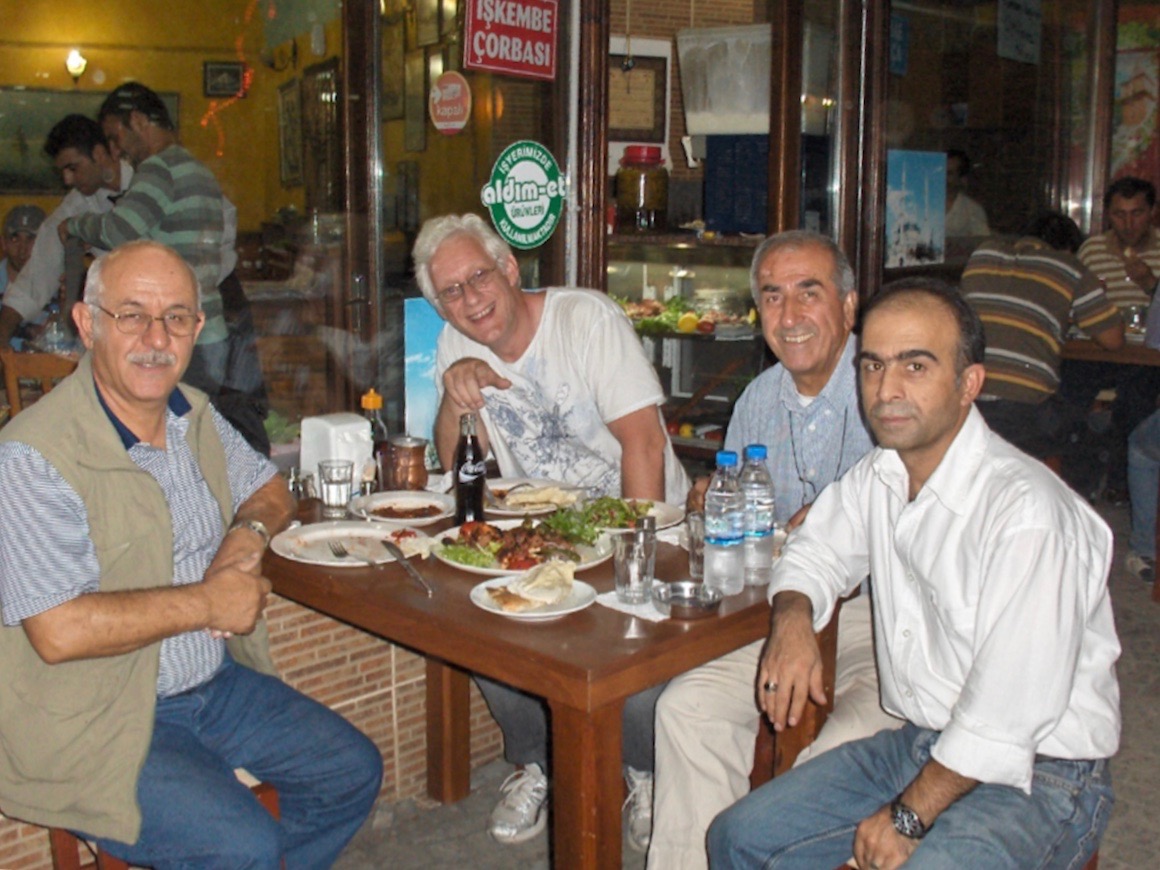
Day 14: Selimiye Kebap: from l to r Mustafa,Haji Osman Effendi Irlanda’i, Yusuf, and Mahmoud
He told me that Edirne is a good place to live, there were few problems with alcohol or crime, and women could walk around late at night in safety. I sensed feeling safe on my own walking around the town.
As we finished our coffees, Mustafa and Yusuf turned their cups upside down over their saucers. Being Turkish coffee, the dregs ran down the inside of the cups into the saucers. After a few minutes they turned the cups the right way up, and proceeded to tell each other’s fortunes. When I followed suit, Mustafa read my cup and furnished me with four items of information:
- My heart was in love (with life, he said, rather than a romantic love). This was from the lump of coffee grinds in the base of the cup.
- I would travel to many places, as the lines on the sides of the cup were all continuous and open ended.
- I would receive good news, there was the shape of a bird, which he said symbolised the bearer of a message.
- I had had a difficult past, but that my difficulties were over.
There was a young guy there they had been talking to, I think he was selling lottery tickets, and they asked me to come up with five numbers, which I did in Turkish, as I was then able to count to 20 in Turkish (I couldn’t in Greek at the time!). Then Mustafa asked him to read my cup, and he said that:
- My heart was full of love.
- My tears were behind me.
- There was a bird with an envelope in its beak, which meant I would receive good news.
- I would have enough money; it would not be a problem in the future.
I was impressed, amazed, and unsettled. And I also had a new name. I had been re-christened (not quite the term they used there….) by my new-found friends: “Haji Osman Effendi Irlanda’i.” Haji because I was a pilgrim. Osman after the first Sultan of the Ottoman empire (after whom the word Ottoman is derived). Effendi is the Turkish title of respect, and was from Ireland.
Day 15: To be a pilgrim
After a really good night’s sleep, I rose at 9am, breakfasted, and strolled around the shops and bazaars of Edirne. On Tuesdays and Thursdays the Bahá’í Holy Places were open from 12 noon to 5pm to allow for cleaning in the mornings. For the other five days, they were open from 10am to 5pm. At 12.30, after writing more of the diary, I arrived at the Pilgrim House, which is opposite the House of Rida Beg. Yesterday I had met a Persian family from Shiraz. Today I met Fariba, and Roxana, her 8-year-old daughter. Husband Behzad had been unable to come. They had travelled from Isfahan to Tehran, flying to Istanbul, then going by bus to Edirne, arriving at 11pm the previous night, a mother and daughter in a strange land with no hotel booked, and trusting in God as their sole provision for the journey. Then a party of Canadians arrived, followed by another Persian extended family from Tehran. There was also an Iranian woman and son who had been living in Ecuador. All the time I was there, there was an intriguing cross-flow of languages, Turkish, Farsi, and occasionally English. Young Roxana opened up over coffee and biscuits (I noticed the older ones drank tea, the young ones, coffee) and told me she loved her English lessons back home. At the close, Fariba invited me to Isfahan to visit her family. Suddenly I was struck by a ray of that infinite love. I asked myself the same question that I first pondered at the age of 18 in Manchester. What was this new world order that Bahá’u’lláh had started, this new paradigm, where the earth was one country, there was one language taught in every school across the world, alongside the mother tongue? Science and Religion were in harmony, and women and men were two equal wings of the same bird. There was a single global currency, and differences of religion had gone, because if there was only one God there could only be one religion. “Others I have which are not of this fold” had become “one fold, and one shepherd”. Peace on earth, and goodwill to all men.
Such is indeed the goal towards which humanity, impelled by the unifying forces of life, is moving. “You may say I’m a dreamer, but I’m not the only one…” (John Lennon)
__________________
Nigel Freeman
Nottingham, March 2020
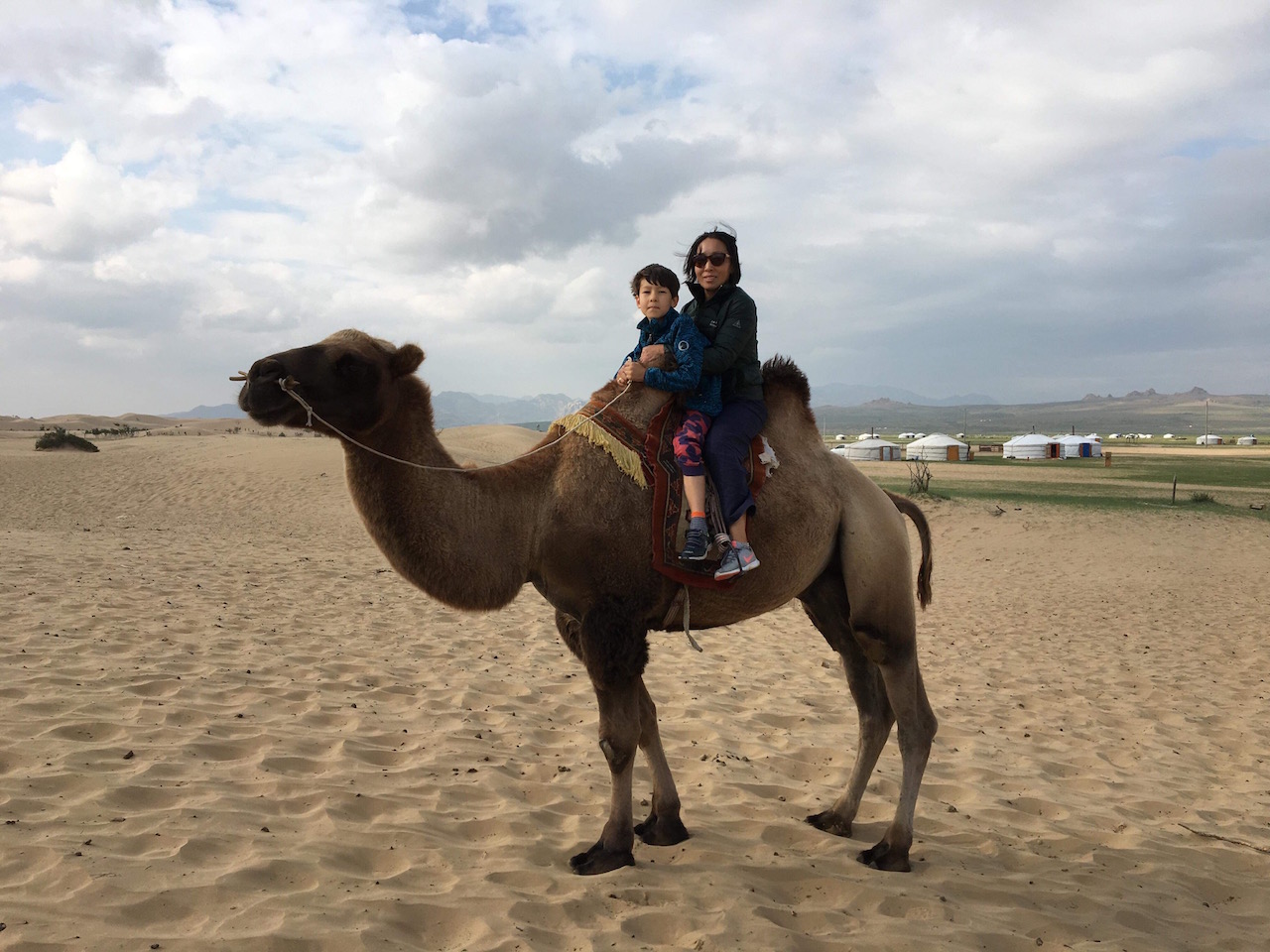
Nemekh and William in Mongolia, 2019
 UK Baha'i Histories
What a wonderful ‘read’ Nigel! Such interesting highlights of your Bahá’í years… Good to see mention of Frances Moran who popped up just last night on Zoom to hear Peter Moore speak about his pottery inspiration, from Limassol.
Glad I came across this again Nigel – I opened up the computer one last time before retiring for the night. It’s been a long time since we ran into each other – Schools in East Anglia and Irish Republic come to mind. Lovely to hear about your ongoing life and adventures – wishing you may more active years xx
So good to learn more about Nigel Freeman after meeting him at the Paris Conference, so long ago. If you see him, please give him my greetings, in case he remembers me from the Chicago area.
Valerie Smith
Great to read your story, Nigel. Can’t believe I didn’t know most of it before! Hope all is going well with you and yours. Congratulations on your grandchild (my great grandchild!) who is adorable. Duncan sends me all the hundreds of photos and Odette also sends whatever she takes so I am kept up to date with her progress. Do keep in touch. Love, Sylvia
So good to learn more about Nigel Freeman after meeting him at the Paris Conference, so long ago. If you see him, please give him my greetings, in case he remembers me from the Chicago area, now on the Connecticut shoreline.
Great story, I love how all these stories take us to the many parts of the world we haven’t visited ourselves xxx
Delighted to read this having had the pleasure of seeing Nigel in the long ago past.