
The following biography of Lady Hornell was researched and written by Hazel Holmlund.
I first met Kathleen Hornell at National Convention in London in 1966. Charles Macdonald, who was then Treasurer of the National Assembly, called me over and said, “Come and meet your Bahá’í grandmother.” The Macdonald family had been taught the Faith by Lady Hornell when she was a pioneer in Belfast but she had moved to Venice by the time I began attending firesides in the King and Macdonald homes. She was at her second pioneer post in Italy when we were introduced and she invited me to visit her in Cagliari, Sardinia. I accepted her invitation, and not only was it the beginning of a loving friendship which lasted until she passed away in 1977, but it was a complete turning point in my life.
The early years
Kathleen Veronica Walker was born in Brighton on 1 July 1890 and was taken to London the following year. Her father, Dr Walker, was a musician and composer. He was one of the first musical academics, along with Arthur Sullivan of Gilbert and Sullivan fame, to be awarded a Doctorate of Music. She had a happy childhood along with her five sisters and three brothers but finances were often stretched, as music did not provide a steady income, and the family often found itself living in genteel poverty.

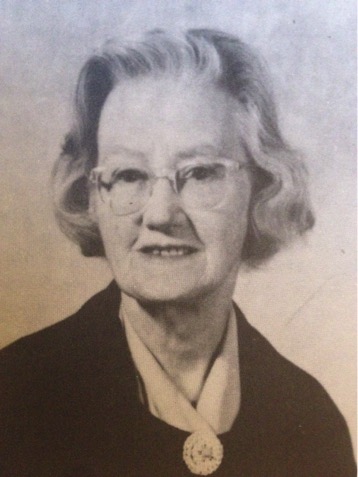
The young Kathleen Walker
In 1911 she married Arthur Brown (1884 – 1939), a barrister in the Indian Civil Service, and moved to live in India. Her only child, Mary, known to family and friends as Molly, was born on 1 August 1916. Early in 1922 she left India with her then six-year-old daughter to travel to London, and did not return.
Her autobiography
During the period that Kathleen was a pioneer in Sardinia (from October 1965), the Italian National Spiritual Assembly asked the believers to write their Bahá’í autobiographies. Ever ready to render instant, exact and complete obedience, Kathleen was one of the first to comply, and my husband James was privileged to type it up for her. This record is particularly significant because, as well as providing information about Kathleen’s own service to the Faith, it gives an insight into the lives of other early believers living in the UK and of the development of the Institutions.
Kathleen’s Bahá’í autobiography begins with her return to London from India.
Encounter with the Faith and with early believers
“In October 1922 I heard of the Bahá’í Faith from Miss Elizabeth Herrick when I interviewed her and took up residence in her house at Clapham Common North Side, London SW4. She, with “General Jack”, as the Master ‘Abdu’l-Bahá called her [Marion Jack], were honoured to be hostesses at a meeting in their studio in London where He spoke. Elizabeth also had the great privilege of meeting ‘Abdu’l-Bahá in Liverpool as he came off the boat that had brought him back to England in 1913 from His extensive teaching tour in the US of America. She travelled with him on the train from Liverpool to London. She was a member of the London Local Assembly when I met her and was writing a testimony of her faith in Bahá’u’lláh’s and the Báb’s messages. I read her manuscript and found myself in agreement with Bahá’í aims.
Very soon after, I met Dr Lot’fu’llah Hakim, then a student, who had accompanied ‘Abdu’l-Bahá on His travels in England and Scotland. Lot’fu’llah has now retired from the Universal House of Justice at his own request. He was called by the Guardian, Shoghi Effendi, to sit on the first International Bahá’í Council. He was elected onto the second (International Bahá’í council) and onto the first Universal House of Justice. He pioneered to Edinburgh, Scotland during the British Six year Plan and visited me in Nottingham when I was pioneering there. A very dear friend indeed of mine.
About the same time, before Ridván 1923, I met the author of the famous book “Bahá’u’lláh and the New Era,” John Esslemont. He lived in Bournemouth, Hants., England but was often in London seeing his publishers. Whilst checking his manuscript before publication, he would stay as a guest of Elizabeth Herrick. It was on such an occasion that I first met him. He impressed me very much – a true Scottish character. He also knew ‘Abdu’l-Bahá well and had the privilege of having some of the chapters of his book reviewed favourably by Him before His passing to the Abhá Kingdom. He had learnt Persian and at the end of his life he lived in Haifa, helping the Guardian, Shoghi Effendi, with some of the beautiful translations into English of the writings of Bahá’u’lláh.
Again at that time, I met and loved the first Bahá’í of the United Kingdom, Mrs Marion Thornburgh Cropper. She and Lady Sarah Blomfield entertained ‘Abdu’l-Bahá in their homes. To the latter he gave the name Sitarah, meaning “star”. She is the author of “The Chosen Highway” and a great Bahá’í teacher. She, with Miss Eglantine Jebb, founded the Save the Children Fund, which ‘Abdu’l-Bahá blessed, as it was not only for children needing help of the allies but also for those of the enemies in the war of 1914-1918. Lady Blomfield and her daughter, Mary Basil Hall, were loving friends of mine. Another other Bahá’í whom I learnt to love dearly was Miss Ethel Jenner Rosenberg, my spiritual grandmother, the second Bahá’í in England and spiritual daughter of the first, Mrs Thornburgh Cropper. Miss Rosenberg’s notes as a pilgrim in Haifa in 1899 and 1901 and notes of ‘Abdu’l-Bahá’s visits to England are valuable archives housed at the Haziratu’l-Quds in London. I had the great privilege with another student, of studying for the first time the “Kitáb-i-Iqán” (Book of Certitude) with Miss Rosenberg. That edition was the first in English (1904). Shoghi Effendi’s translation came out very much later (1931).
Declaration, and election of the first National Spiritual Assembly of the British Isles
At Ridván 1923, after having attended Bahá’í weekly meetings at the home of Miss Florence George who had become a Bahá’í in Paris and met ‘Abdu’l-Bahá there; and attending the Naw-Ruz feast in the [North London] home of Zia’u’lláh Azgarzadeh (of Tabriz), whose grandmother was the owner of the silk factory where the sacred remains of the Báb and His faithful disciple were first hidden, I was considered a believer in Bahá’u’lláh’s word and given a voting paper for the election of the first National Spiritual Assembly of the British Isles. That was my birth into the Cause of God.
Before speaking of my spiritual infancy and childhood, I must mention the third early Bahá’í of the British Isles. Her name was Claudia Coles who came from Southern USA and she was a member of the first NSA seated in London. She received, as secretary, letters from the Guardian and news from America, Persia, Germany and France, which were read at meetings for Bahá’ís only. The Nineteen Day Feast was not held in those days; I and two other believers were given permission to hold Nineteen Day Feasts by the London LSA to which the members thereof did not attend. This happened in about 1930 when London had its first centre in a block of flats in Upper Regent Street, not so far from the hotel where the beloved Guardian was staying with Ruhiyyih Khánum when he passed away to the Abhá Kingdom some 25 or more years after. He had visited this first Bahá’í centre of the London community when he was in London. My friend Zia’u’lláh Azgarzadeh was asked by him to take him to see this centre. He saw no one else. He could not be just if he could not see all of the friends so he only saw Zia. Another time when in London with Rúhíyyih Khánum, buying furniture for the archives building on Mount Carmel, they saw the London Hazirat’ul-Quds from the outside but did not enter.
First Bahá’í responsibilities
I return now to my Bahá’í infancy. Seven years passed before I was given any responsible Bahá’í work. I was a deputy member of the LSA without the right to vote. There were two of us appointed to attend meetings to help make a quorum. We listened but were not allowed to speak. How strange it seems now with the Institution of the Universal House of Justice established! Such development has been the work of ‘Abdu’l-Bahá. After nine years of infancy, I found myself elected to the London Local Spiritual Assembly. I was a member of the Feasts and Entertaining Committee, a member of the Bahá’í Ladies Social Service Committee, Assistant Treasurer, Assistant Secretary, Assistant Secretary of the first Summer School Committee, the Care of the Centre Committee…. These various duties covered 18 years, the last nine of which I was also elected onto the National Spiritual Assembly [1936-1944].I became Treasurer while still Treasurer of the London LSA.
Shoghi Effendi asked Dr [sic] Townshend to resign from the church where he had remained under advice from ‘Abdu’l-Bahá who told him to bring the Church into the Faith with himself. Alas, without persecuting him, it was unwilling and the time came for him to resign. The British Publishing Trust was founded with the object of publishing Dr Townshend’s book, “The Promise of All Ages” and other works. A fund was opened for this purpose to which the Guardian donated liberally. I was put on the BPT by the NSA and made treasurer of this Committee. Dr Townshend was one of the first 12 Hands appointed by Shoghi Effendi, the beloved Guardian.
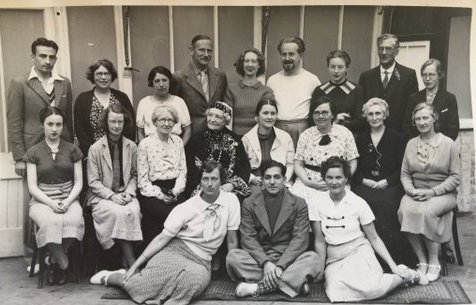
Summer School, Matlock Bath (1937)
Back row L-R: Habib Bakeroff, Elsie Cranmer, Miss Breed, Richard St. Barbe Baker, Marguerite Wellby, Mark Tobey, ??, Walter Wilkins, Mrs Brown.
Middle row L-R: Molly Brown, Elsie Gibbs, Miss Isabella Niven, Lady Blomfield, Helen Bishop, Constance Langdon-Davies, Mrs Sugar, Lady Hornell.
Front Row L-R: Claudia Aldridge, Hasan Balyuzi (age 28), Rosalind Vance
War years
The time came when the 1939 – 1945 war broke out. By then, Mrs Thornburgh-Cropper, Miss Rosenberg and Mrs Coles had passed to the Abhá Kingdom and Lady Blomfield followed them on December 31st, 1939. Mr Balyuzi and David Hofman, since Hand of the Cause and member of the Universal House of Justice respectively, were responsible for the publishing of her famous book “The Chosen Highway.”
In 1939 my daughter and I went to stay with a cousin out of London for a few months. We returned to London and very soon the first bombing attacks started on September 7th, 1940. We went to Torquay in S.W. England where we were able to fill 2 gaps in the LSA. I was able to help a lady, Mrs May White7, to accept Bahá’u’lláh before my daughter was married to Mr Hasan Balyuzi, thus filling her place on the LSA. In 1942, after 18 months in Torquay, I returned with my daughter, her husband and young baby son to London from Evesham, the Bahá’í work being carried on in spite of the war. The BBC had evacuated to Evesham from London and was then returning to London.[Hasan Balyuzi was working at the BBC]
The Six Year Plan
There was a lull in the bombing when the centenary of the Declaration of the Báb was celebrated. The Convention was held at that time instead of at Ridván, by request of the Guardian. At that Convention it was proposed that the NSA ask the Guardian for a plan to cover the 6 years from His Declaration to His Martyrdom. The Guardian joyfully gave one. We were 5 Local Assemblies in all the British Isles. He asked for 19 more. It had to include Scotland, Ireland and Wales. I was made Secretary of the National Teaching Committee. With all my effort, I could not get one soul to pioneer over 18 months. The Plan became a 4½ year plan. Marion Holley came to England to marry David Hofman and organised the Teaching Campaign. Ursula Newman, who later married Dr Samandari, grandson of Hand of the Cause Mr Samandari, and myself, unknown to each other, started out as pioneers on 28 October 1945.
I went to Nottingham as wished by the NSA, and she to St Ives, Cornwall. With the help of others, an LSA was established [in Nottingham] by Ridván 1947.”
Marriage to Sir William
In 1946, while living in Nottingham, Kathleen married Sir William Woodward Hornell, former Director of Public Instruction, Calcutta, and Vice Chancellor of Hong Kong University from 1924 to 1937. Sir William passed away in September 1950 and Kathleen returned to London the following month.
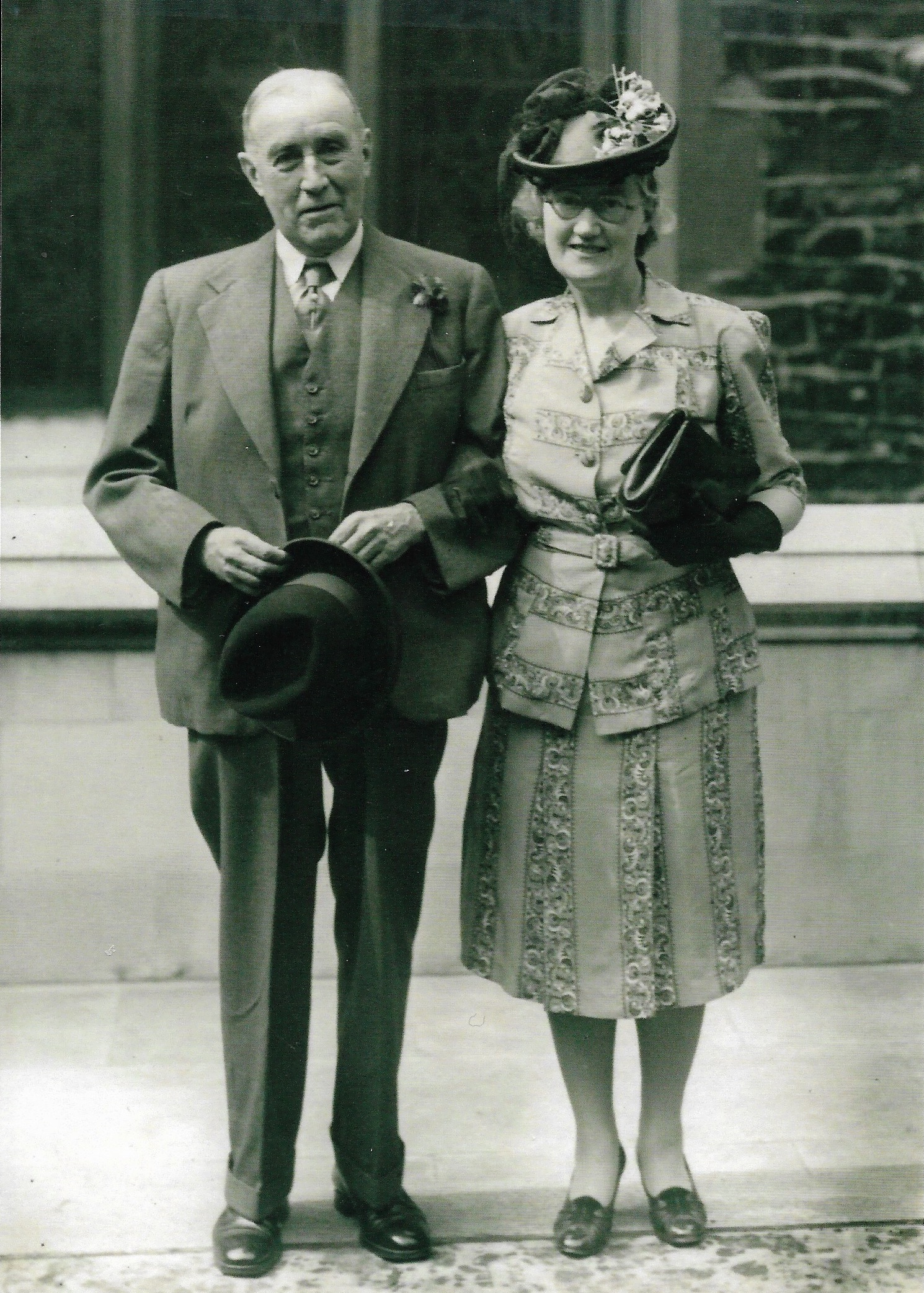
Sir William and Lady Kathleen Hornell on their wedding day
The narrative continues:
The Two Year Plan and the Ten Year Crusade
“The Six Year Plan was fulfilled much to the Guardian’s joy. He gave the British NSA a year’s respite followed by a 2 year plan in Africa. Then he gave us the goals for his Ten Year Crusade. In February 1951, I went on a teaching trip to Edinburgh and Glasgow. In October 1951, the NSA asked me to go to Belfast for a month to tell the friends the NSA had no money left in the National Fund to pay for the refreshments (at the Nineteen Day Feast). A pathetic mission, for they were all poor and once the numbers to form an LSA were reached, they were left to carry on for 18 months alone¹. I was asked to teach them the Bahá’í Administration. I stayed a month (November 1951) taking them through two 19 Day Feasts and 3 Anniversaries and organised a public meeting. I took the Chair at a big public meeting at Northampton, speaker David Hofman, on my way back to London.
Belfast and the Guardian’s Instructions
The following Ridván, the National Assembly asked me to pioneer to Belfast. Old contacts from the days before LSA status were looked up. I held a weekly fireside in my furnished rooms. After another 18 months, one of these early contacts declared in December 1953. Nine months after, a second declared. But in January 1954 I went on my first Pilgrimage and had the privilege of meeting Shoghi Effendi. It would take too long to speak of my experiences as his guest. He told me to return to Belfast and consolidate it, which I did. Bahá’u’lláh was with the Belfast friends from that moment. New believers trickled into the Faith each year – all dedicated souls.”
Lady Hornell held separate firesides for the poorer early believers and the relatively more affluent, educated enquirers, and ensured they did not meet each other until they had a good understanding of the Faith. This seems strange to us but times were different 65 years ago and people of very different social classes would have felt awkward if brought together too suddenly.
Regular visitors to Belfast included David and Marion Hofman and Ursula Newman who gave talks in Belfast and Bangor.
So what impression did Lady Hornell make on the people of Belfast? Iain Macdonald, whose grandparents, as well as parents Charles and Yvonne were among Kathleen Hornell’s Belfast spiritual children, recalls, “It was an investigative urge which drove my grandparents to take shelter one night from the rain-soaked streets in Belfast’s Grand Central Hotel. What caught their eye was a notice advertising a meeting about the Bahá’í Faith. The talk they were to hear was given by a Lady Kathleen Hornell.
In spite of my father’s somewhat scathing reaction to news of the Bahá’í Faith, my grandparents managed to persuade my Mum and Dad to meet this Lady Hornell. ’Lady’ indeed! That certainly aroused some curiosity, particularly as she ended up being invited for tea.
She turned out to be a small, bespectacled, very intelligent and kindly woman whose husband had been knighted for his services to education in the British Empire. Lady Hornell had a rather frustrating habit of talking a great deal whilst eating, which dramatically delayed the next course for the rest of us. My child’s heart sank when I saw her once again put down her knife and fork to discourse further on some spiritual truth! My parents were clearly enthralled. I wanted to finish the meal. Lady Hornell’s favourite expression of endearment was “Bless your darling heart” and on my tenth birthday, a year or so later, she presented me with a copy of Gleanings from the Writings of Bahá’u’lláh which might have seemed rather daunting at the time, but which has sustained me through my life until now. She, like so many of those early believers in the British Isles, was laying a sure spiritual foundation; making a long term spiritual investment! Inscribed in my copy of Gleanings was the following:
He hath indeed, partaken of this Highest Gift of God who hath recognised His Manifestation in this Day – Bahá’u’lláh
She went on to hope:
May you be the cause of bringing many to this recognition.
One of the early pioneers to Belfast was Rustam Jamshidi who arrived from Karachi in 1956 to study medicine. When Rustam’s father was on pilgrimage, the beloved Guardian suggested he go to Britain where he could study and be a pioneer. His father wrote to the National Spiritual Assembly of the British Isles and they replied that the most need was for Belfast or Edinburgh. Not knowing anything about either city, Rustam chose Belfast, “because B was before E in the alphabet.”
Lady Hornell and Jane Villiers-Stuart met him at Nutt’s Corner Airport and accompanied him to the lodgings that Lady Hornell had chosen for him with Mr and Mrs Campbell, a loving Esperantist couple. Although he was only a teenager and spoke very little English when he arrived, Rustam said that he never felt homesick because Lady Hornell was just like a mother to him. He said that she always emphasised the importance of being a Bahá’í and of the Administrative Order and that he never forgot that.
The narrative resumes:
“The pace quickened and by 4 November 1957 when the Guardian passed to the Abhá Kingdom, Belfast was consolidated enough for me to move 13 miles to Bangor and form a group, and without more pioneers an Assembly was established. There was an appeal from the Hands of the Cause in Europe for pioneers in Europe from the British Isles, I offered to go but on condition that I could remain in Bangor till after Ridván 1960 to be able to give the LSA a year’s experience of the Administration. This I did and was posted by the European Teaching Committee to Venice, Italy.”
As well as deepening the friends in the Faith and the Administrative Order, Kathleen ensured that both the Belfast and Bangor Assemblies were incorporated.
Venice
“It took till the end of July before I arrived in Venice with another pioneer from Bangor.² Difficulty between the Bank of England and the Italian Consulate in London was the reason. In the end I arrived as a tourist and was told to report to the police on arrival. This I did. My permit to stay was renewed every 3 months for a year, then permit for as long as I wished but must not take permanent employment. I stayed 5 years in Venice. All the friends [Bahá’ís] were Persian except my friends and myself and Teresa Taffa³ who pioneered from Rome in 1958 alone for 18 months. There was an Italian believer at Lido, a spiritual child of Mrs Emma Rice of America but, alas, her family were not very sympathetic. She has remained faithful but cannot be active. At Convention 1962 Teresa was elected on to the NSA and made Secretary. This forced her to return to Rome. Venice was a difficult place because of the long distances to meet and because we had not been able to get unity which is the basis of consolidation.”
Kathleen was 70 when she pioneered to Venice and 75 when she left. It was a challenging time physically. Only Cristina, Teresa and Kathleen lived in Venice proper, sharing an apartment, and the meetings of the community were held in Mestre, the mainland part of the city. Meetings took place after 8.00 pm and travel entailed a water bus and tram ride each way so they rarely got home before midnight. Language was also a challenge. She came to understand Italian quite well but never became a fluent speaker. Venice is hot and humid in summer and Cristina Pasquali recalled how Kathleen totally unselfconsciously would carry a large black umbrella to shade her from the August sun when walking in Saint Mark’s Square.
The Nine Year Plan
“In the Ridván Message of the Universal House of Justice in 1964, there were the goals for the Nine year Plan given. Cagliari (the capital of Sardinia)was to have an LSA amongst many other goals. At the Teaching Conference, when an appeal for pioneers came, I offered to leave Venice for Cagliari as soon as I was free from the contract made with the owner of the apartment I had rented. It ended in October 1965. I arrived in Cagliari that month and have seen a great change in the short time I have been here. There have been pioneers go and other pioneers come but, in spite of that, the group has proved itself united in love and firm in the Covenant of Bahá’u’lláh. It has been tested in many ways with long illnesses and financial problems but holds its head high. There have been 2 local believers declared since my arrival and a third, a short term student here from Sicily. He has qualified as a lawyer⁴ and is having some training now in Sassari, North Sardinia. He may not establish himself here in Cagliari, but the 2 local believers Mrs Livia Pargentino⁵ and her daughter are not likely to move. Both are fine, active Bahá’ís.
I am sorry to be obliged to leave this commendable group, well consolidated. It will surely expand into LSA status by 1973 and perhaps much sooner⁶. I go back to London. I know not what is awaiting me but there is plenty to be done wherever one is. Hearts once knit in the love of God do not forget each other. The Cagliari friends have a specially warm corner in my heart. Till we meet again, may God bless your efforts to serve the Cause. My prayers are very sincere for the progress of Cagliari and Sardinia.”
Lady Hornell returned to London in 1967 to live with her daughter Molly and son-in-law, Hand of the Cause of God Hasan Balyuzi. I visited her in Cagliari in 1966 and several times over the years until her passing in 1977. With her encouragement, I pioneered to Cagliari in 1970 and was a member of the first Assembly. She came to my marriage to James Holmlund in Belfast and was delighted when our daughter Kathleen was named after her.
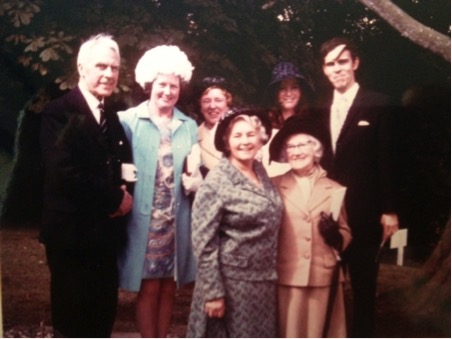
Lady Hornell, front right in Belfast for Hazel and James Holmlund’s wedding 17 August 1970
L to R – George Hackney, Amy Shields, Madge Crilly, Lisbeth Greeves, Marie Whiteside, Lady Hornell, Eddie Whiteside
I have such fond memories of that first visit to Cagliari when I had the bounty of getting to know that wonderful Bahá’í teacher and enormously loving person. At that time she was the Treasurer of the Bahá’í group, an office that was not new to her as she had been Treasurer of the National Assembly of the British Isles and of the London Assembly. Before she married for the first time and moved to India, she had worked in a Post Office. I often wonder if that was where she learnt her bookkeeping skills. Her accounting system continued to be used by the Cagliari Assembly and the second Assembly in Quartu St Elena.
Kathleen Hornell was tiny and ladylike but totally confident. I will always remember how, dressed in her white suit and hat, she strode out onto the pedestrian crossing of a very busy street in Cagliari and held her arms wide to make sure the traffic stopped so that my friend and I could cross in safety.
Readers will recall that 1966 was the year England won the football World Cup. My friend Marie Whiteside, who went with me on that trip to Cagliari, and I still reminisce about watching the match with Lady Hornell on a black and white TV in the guest house where she was living. We were amazed to discover that she was an avid, well informed football fan, having gone to matches with one of her grandsons in England. Imagine her joy at that exciting and as yet unrepeated win!
The later years
Kathleen spent the last years of her life with her daughter and son-in-law in their home in Hampstead Grove. She was happy there and loved them both very much and loved to see her grandsons. She wrote to me of her great joy when her first great grandchild was born. Her relationship with her son-in-law was special. She would tell me how ‘dear Hasan’ brought her a cup of tea every morning and, in another moment, when speaking about the Institutions of the Faith, she would refer to him as the Hand of the Cause of God; such a balance between love for the person and respect for the Institution.
I can still picture her sitting room and her bedroom with a carved Greatest Name above the bed. It had been made by a German Bahá’í prisoner of war. She continued to see friends until the last year of her life. She was very frail when we called to see her on our way to Ireland after the Paris Conference in 1976 but she was excited to hear all about the conference and the offers to go pioneering.
She kept up a copious correspondence with her Bahá’í children, teaching and deepening them while at the same time taking a keen interest in their wellbeing. When she could no longer write, she dictated her letters to dear Molly (her daughter, and wife of Hasan Balyuzi). I particularly treasure the outpouring of love expressed in a shaky hand in those last letters.
I will always remember Molly’s kindness and warm hospitality. She always made a meal for me when I was travelling through and nothing was too much trouble for her. A particularly precious memory was the time when I was travelling through London with our two oldest children and the Hand of the Cause was well enough to meet with us, which made Lady Hornell as happy as it made us.
Kathleen Veronica Hornell passed away in 1977 and is buried in the New Southgate Cemetery to the left of the Guardian’s resting place.
Over 1,800 people attended the commemoration service in London and the Universal House of Justice wrote:
“PASSING LADY HORNELL ROBS BRITISH COMMUNITY ONE OF FEW REMAINING LINKS EARLY DAYS FAITH. HER UNWAVERING FAITH, CONSTANT DEDICATED SERVICES PIONEER, TEACHING, ADMINISTRATIVE FIELDS OVER SO MANY YEARS ASSURE HER HIGH STATION ANNALS CAUSE PROVIDE SHINING EXAMPLE PRESENT FUTURE GENERATIONS. ADVISE HOLD BEFITTING MEMORIAL MEETING. ASSURE ARDENT PRAYERS SACRED THRESHOLD PROGRESS HER LOVING SOUL ABHÁ KINGDOM.”
________________________
Written by Hazel Holmlund, 2015
Notes:
¹Belfast was opened to the Faith by Charles Dunning in 1948
²Cristina Baillie Pasquali was from Northern Ireland. She remained in Venice where she married Giorgio Pasquali. She and Giorgio moved to Northern Ireland in the 1980s where Cristina passed away in 1988.
³Teresa Taffa was elected to the first National Spiritual Assembly of Italy and was its Secretary for many years.
⁴Cesare Giordano went on to work as a lawyer in Northern Italy. He is the author of the Italian Wikipedia account of Marie Ciocca Holmlund, Knight of Bahá’u’lláh to Sardinia.
⁵Livia (Pargentino) Salvago, the first person to declare in Sardinia, was a devoted believer who served on the National Assembly until her health failed. She also assisted with translations of Bahá’í books from English into Italian. These included God Passes Byand The Dawnbreakers. Her daughter Stella Pargentino, a dedicated believer until her early death, was a pioneer in the Northern Sardinian city of Sassari at the time of her passing.
⁶The Local Spiritual Assembly of Cagliari was formed at Ridván 1970.
7Mrs May White, as far as is known, is the very first Welsh believer. Although she lived in Torbay she was “a staunch believer who, on a number of occasions, visited Cardiff as a Baha’i ‘travel teacher’”. (The Religious History of Wales by Dr. Richard C. Allen et al. Chapter 20. – – Pub – Welsh Academic Press, 2014)
 UK Baha'i Histories
I was introduced to the lovely Lady Hornell in 1966 by Charles Macdonald. As I had recently met Miss Pinchon in Bournemouth that year. I wondered if all the early Bahaí ladies were petite sweet with a formidable intellect. I also discovered later they understood what service really is. What a wonderful memory..
Pingback: Claire Greenberg (Copley) | UK Baha'i Histories
Pingback: Hushang Jamshidi | UK Baha'i Histories