
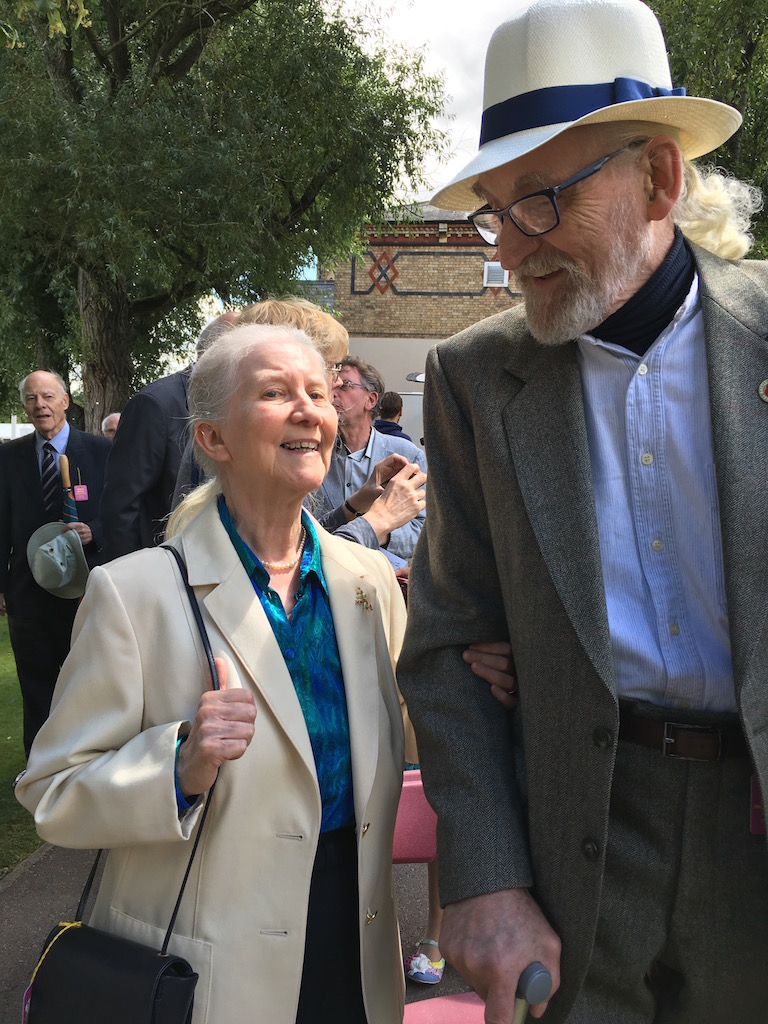
It seems reasonable to include a little information about the pre-Bahá’í life of my wife, Audrey, and myself. We met at Thornes House Grammar School, Wakefield. We had arrived there within a short time of each other, Audrey from the Girls’ High School, Gainsborough, and me from the City Grammar School, Sheffield. Audrey was fourteen years old, I was roughly thirteen and a half.
Audrey moved to Wakefield because of her father’s job. I moved there because my father, who was in the Royal Air Force, had been posted to Singapore as Senior Air Movements Officer for the Far East, so I went back to live with my grandparents in Wakefield, in preference to the boarding school the RAF offered.
I think that for Audrey, school was a very positive experience, for me it was very much the reverse. My single experience of trying to get an understanding of a point by asking questions caused the teacher to think I was being cheeky, which actually I wasn’t. The result was a broken nose and two broken fingers. I never asked another question in school and found my own ways of learning. To me schools still look like prisons for children!
My father was determined that I should be able to take full advantage of passing the eleven-plus exam. He had won a ‘scholarship’ in his day, but his father had been unable to pay the fees that were still required then. As a new boy, I had been ‘ragged’, and when it was suggested that Audrey should be so treated, I was able to prevent it. Later, comparing notes both Audrey and I noticed that our classmates seemed to have noted a connection between us that we weren’t aware of at the time. When I became seriously ill, a friend told her that I was doing well after the operation. Audrey responded by wondering why he thought she cared! In any event Audrey was not allowed a boyfriend until she was sixteen. There was another occasion when I was carried off to the sick bay unconscious after cracking my head on a frozen lake. That time it was a teacher who told Audrey “Keith is alright. He will be taken home when we are sure he is fully recovered.” Again Audrey’s response was “I don’t know why you’re telling me, Sir.”
Our first outing together was the day after Audrey’s sixteenth birthday, and we walked eighteen miles chatting all the way. We walked from Wakefield to Barnsley and back. We remained girlfriend and boyfriend for a little over a year, but when my father returned to the UK he was posted to Kirkham in Lancashire, and we went to live in Lytham St. Annes. At that time, travel was difficult across northern England and circumstances forced Audrey and me to go our separate ways. There were six occasions when we bumped into each other by accident, when irrespective of where we had been heading we stayed together for the whole day, abandoning our previous plans!
How we got together again some years later, after I’d been in the RAF, is a story in itself, perhaps not relevant here, but we then became determined to stay together, and were married within six months, in St. Helen’s church, Sandal Magna, Wakefield; some of my relatives are buried in the churchyard there. The vicar who accepted our chosen wedding date was leaving that living, so a retired priest had to be brought out of retirement to officiate. We were married on Harvest Sunday, so there was no need to decorate the church. The date was Sunday, 2nd October 1960. Sunday weddings were not the norm in those days, although Sunday is a working day for the clergy. I’ve always considered it to be the best day’s work I ever did. What had been noticed by others whilst we were at school has been confirmed by our life together. We are both very different people but we are also the two halves of something else that is certainly better than my half of it.
We went on to have four children, Sarah Louise, Jane Fiona, Simeon Keith and Abigail Grace, who now have their own children. Sarah became a Bahá’í and still is. Indeed we now have an impressive plethora of progeny! We have fifteen grandchildren and five great-grandchildren.
Next year, should we survive, we will celebrate our diamond wedding – sixty years together. Speaking for myself, I don’t have a single regret and would do it all again. Indeed, if our understanding of the Writings is correct, we will have eternity together, to which we both look forward. I gather great comfort that out of my eighty plus years, Audrey has been a major factor in my life for nearly seventy of them.
The following offers some background to where and how I grew up.
I was raised in the West Riding of Yorkshire, in a skilled working class family. There were time- served skilled tradesmen and women on both sides of my family. At that time the working class ethic was both strong and very politically aware. Working class movements and creations were very strong, trade unions, cooperatives, building societies, the Worker’s Education Association (WEA), even the Labour Party. The WEA was an important if indirect influence in my life. The first time I heard of Plato was listening to some men, mostly miners, discussing what they’d been learning about at the WEA. Their respect for self-improvement led me to a lifetime of learning, not only in the arts, beginning when I was very young, but also many other areas. At the time, the Independent Labour Party (1893) was set up to be the political arm of the trade union movement, as the Liberal Party was reluctant to appoint working class candidates though, this seems to be forgotten now. My family were members and workers from its early days.
As a mature student I did a degree in Economics, at the University of York, after I read that Shoghi Effendi, Guardian of the Bahá’í faith, thought some Bahá’ís should study ‘technical economics’. For the final eighteen months, Audrey and I lived on the campus in a little enclave housing foreign PhD students and their families from many different parts of the world. It was like a mini United Nations! We found it interesting that their children, with many different languages between them, were able to play together and communicate, apparently with little effort. We had planned for somewhere to live after I graduated, however because we were not willing to remain in the property at the end of the agreement, the Council refused to offer us a place to live arguing that we had made ourselves homeless. We viewed this as an immoral thing to do as the next tenant was an overseas student and would have nowhere to live. By this refusal, the Council argued that we had ‘made ourselves’ homeless.
An old friend who we had introduced to the Bahá’í faith and had moved to the Banff area in Scotland, heard we were homeless and offered us a plot of land which he had obtained in payment for some work he had done for a farmer, and didn’t really want it. He also told us about a system of kit houses sold locally. He also suggested that we should build the footings and the septic tank ourselves, and drill a well for water; he knew a water diviner! Once the kit house was erected he and I were to build the outside walls.
I moved north to initiate these plans. However, it turned out I had cancer (non-Hodgkins lymphoma). Audrey was told that it was terminal and that the prognosis was I had three months to live. She had to battle to learn this and fought it well! The hospital was shocked when the first person she told was me, but she knew I always preferred a ‘straight tale’. In any event, arrangements need to be made in such circumstances. As is apparent, the diagnosis was wrong and here I am. The kit house was no longer an option due to my incapacity, so we decided to settle in Aberdeen.
I have studied art since I was a child, initially as my mother’s pupil. She had won many prizes in her year at the Art College in Wakefield and she was the only one with a job as a working artist when she finished. Here’s one for modern women to ponder. When she married, her employment was terminated, but she thought little of it. It was just the way things were. I still think little of it. However, she was still the best art teacher I ever had. There was no false encouragement. If you did less than she knew you could, she said nothing, but you knew. When she approved, there was no effusion, just a slight smile and an even slighter nod. I worked hard for that smile and nod!
There is much more I could say about these times, but let’s move on to when and how Audrey and I became Bahá’ís.
My own path to becoming a Bahá’í was a long and tortuous one, spread over several decades.
My family were socialists, and some had been involved in the early days of the Labour Party. However, their socialism was not revolutionary. It was concerned with working towards a fairer and a kinder world. Indeed, one of my grandfathers once said that revolution only changed one lot of monsters for another lot. My maternal grandmother also said that a change of government meant nothing for ordinary people, all that changed were the faces in the cartoons!
Looking back, I think these beliefs might have grown out of non-conformist religion. Some of them were Methodists, and they had respect for Quakers. They were probably, in modern parlance, ‘Social Democrats’. Though for me, Marx was required reading – at far too young an age.
However, by the time I reached my mid-teens, I was struggling with these ideas. It seemed to me that it was not possible to ‘design’ a social system that would suit everyone. Indeed, I came to believe that such an effort had instability built in to it that eventually would destroy it.
Marx was an acute observer of his day and place, but he was not a good ‘prophet’. His idea that the ownership of production alone was the key to revolutionising ordinary people’s lives caused his works to need revising nearly everywhere they were applied. Later I came to believe that far from being a revolutionary thinker, he was actually a deeply conservative one. Such people seem to believe that one policy alone solves all problems – dangerous and often damaging. Human affairs are very complex, especially when one tries to suit everyone.
For some years I read philosophy but found little of value beyond interesting thoughts, no solutions at all.
It was whilst I was in the RAF (1954/7) a mixture of my dislike for my ‘trade’ – armourer – caused me to try to develop some sort of rational, ethical basis for my life. I became troubled by my interest in the complex mechanisms I was involved with, as opposed to their raison d’être. Bombs are meant to damage people and property, and guns are meant to kill people. No matter how interesting the various mechanisms were, I found their purpose repugnant.
Round about this time there was a eureka moment when a light went on in my mind. The only way to build a more peaceful society was to change the people. It still surprises me that it took so long to understand this.
So began the search for what might persuade people to change for the better.
Here it might be germane to explain that I had grown up believing that religion was the ‘opiate of the masses’. “Pie in the sky, go to heaven when you die”. So initially I didn’t look at religion.
Indeed, when I did start looking at religion, it was reluctantly, and with little expectation of finding anything germane.
In time, and to my extreme discomfort, it seemed that of everything I’d tried to understand, only religion persuaded people to try to change for the better. A faith in this idea had been growing as the realisation gelled, that the religious teachings in their pure form, when followed, produce essentially good people. These people have throughout history changed the societies they lived in.
At this time and place the religion available was the Church of England. After confirmation lessons I was confirmed as a member of the church.
This did not last long. A medievalist vicar destroyed Communion and expected me to believe some of the most alarming things that it was not possible for me to believe. However, when one went into the New Testament, the reported words of Christ seemed to be self-evidently so correct that they could not be argued with.
There it stayed for quite a few years, though it seemed reasonable that somewhere there were teachings for our time – if they could be found. So Audrey and I looked into every religion that turned up, our theory being that if one thing offended our common sense, it called the rest into question and was rejected.
I was designing and making furniture at this time and I used to do arts and crafts exhibitions to try to get my furniture seen. One really good one was run by an artist friend, Roz Wheeler in Selby, Yorkshire, who both respected and liked what I did. Like many at the time, she seemed to us to be quite ‘hippie’, which both Audrey and I viewed with some suspicion. After all, the optimistic promise of the sixties had been thoroughly trashed and commercialised by this time.
At the time we’d just stopped doing self-sufficiency. We had discovered that, for us, it had proved to be just a steady decline into another sort of slavery.
At this exhibition, I was approached by a young man, Olinga Ta’eed, obviously known to Mrs Wheeler. He was Iranian, and wanted to talk about religion. This was not what I was there for. I was there to try to interest people in what I did. To no avail I tried to distract him with Jesuit jokes, ‘proving’ that God does not exist. We were invited to a meeting at the Wheelers’ home that evening. Audrey and I talked about it on the bus going home to our village, and decided that as we’d looked into everything else that had come our way, we should try to go to the meeting. The problem? We didn’t know where they lived and had no means of getting there or back home afterwards. We had the telephone number of their shop, and we knew that they would be going there sooner or later that evening.
The next thing we did surprises us both to this day. We rang the shop and took it in turns to hold the ‘phone until someone answered – it took three quarters of an hour. Why it became so important to us to do this, is hard to justify in logical terms. However, we did. After we finally made contact, Les Wheeler came for us in his car to take us to their ‘fireside’.
I have to say that I came away from the meeting spitting feathers. “All men and women should be brothers and sisters. Oh my word that’s new. Never heard that before. Anyway, “What made this bunch think that they could bring it about?”
Highly irritated is hardly the phrase. Found out later that the Wheelers had only been Bahá’ís for about a fortnight and they had neither proclamation materials nor books.
At this time my workshop was in our backyard. Audrey worked in York. So at breakfast time it was our habit to make sure Audrey caught her bus to work, and I would then have my breakfast.
I had been lent a book by the Bahá’ís. Perhaps it should be explained that I am a reader, to the degree that if there is nothing else, I’ll read the cornflakes packet.
So, I settled down to have my breakfast and read the book, The Earth is but One Country by John Huddleston. By the time I’d read the first two chapters, an analysis of the current world problems, I began to feel that we might have found the religion we had previously been looking for in vain.
That morning no work got done. I read the book, and became a believer. It said that there was a prayer I was obliged to say daily, so I rang our friends to tell them I wanted to start saying the prayer, but didn’t know the words. My dear friend said that I couldn’t be a Bahá’í until I’d signed a card, and in the background I heard his wife say that I was a Bahá’í when I said I was one, and not when he said I was! Bless his heart, he set off immediately with a prayer book and a declaration card for me, the prayer book I still have. I spent the afternoon reading the prayer book, so, no work done at all that day. I became a Bahá’í in a little over twelve hours, during eight of which I was in bed and asleep. This was the twenty second of April, nineteen eighty-one.
Later that day, I heard Audrey’s bus arrive and dashed down the drive to meet her. I helped her off the bus and took her bag, crossed the road, got onto our drive and said “Now lass, this is of God and no one has been mucking about with it”. To which Audrey replied “Er good, we need to get some potatoes peeled”. Practical as ever, my love. She does say, though I deny it, that I frogmarched her from the bus to the kitchen.
Our friends, Les and Roz had become Bahá’ís about a fortnight before, and thought we might be good prospects for the Teachings, so they had ‘set’ the young man onto us. He impressed Audrey by the way he was so on fire with his Faith. As I said earlier, sadly my mind was on other things.
Audrey takes a more measured view of life. She read the book and declared her faith on the third of May 1981. Although it was important to me that she become a believer, it was equally important that she did it her own way and in her own time. Thank heaven, she did.
We have always been a self-sufficient couple, happy with each other’s company and that of a small, close group of friends. These days people trying to demean what we have made together call it ‘co-dependency’. No matter. One of our children had been saying that we should ‘get out’ more, have more social life. Suddenly we were rarely home.
Though we are beginning to get old we still have busy lives, both religious and social, and are grateful that our search eventually proved fruitful.
Pilgrimages
We have had both the joy and the privilege of making Pilgrimage to the Baha’i World Centre in Haifa, twice. The first time was in nineteen eighty five.
Gladys, a Jamaican lady in the Hull community at the time, asked if she could accompany us. The Universal House of Justice had said she could go any time, at short notice, thanks to her wonderful pioneering work in the Channel Islands. The only condition was that she should have some support. Gladys was quite badly affected by arthritis. This meant a slight change in plans. However, all went well.
We stayed at the St Charles Hospice, which we liked, and we became great friends with Sister Judith who managed the Hospice at that time. It was ideal for Pilgrimage because there were no distractions such as television or radio, and the nuns would unlock a balcony door when we went to breakfast and let us out to say prayers, looking up to the Shrine of the Báb.
Pilgrimage was a new idea for both of us and for me at least it was a blessing, but a mixed blessing. There was a certain amount of culture shock which I dealt with as best I could.
Our daughter Sarah bought us lots of slide film, and we became quite interested in using it all. We still have the slides although I have digitised them since. It is quite interesting comparing the whole area then and now – the changes are quite remarkable.
In 1985, Israel seemed a very dry place. There were many green spaces but also many seemed mostly desert to us, accustomed to temperate Britain.
We had booked to stay a few days in Tel Aviv after the nine day Pilgrimage, and from there went to Jerusalem. We found the remaining wall of the Temple and the locals praying at it very interesting, but very discriminatory, in that women were not allowed to approach the wall!
Because I’m bald, the top of my head started to burn in the sun. My view is, when away from home see what the locals do to be comfortable with their conditions. They are the experts. So I bought an Arab headdress and wore it. This was fine until we decided to follow the Via Dolorosa. We started at the bottom, which turned out to be mainly Arab territory. I found myself surrounded by some half dozen angry teenager boys shouting at me in Arabic. Then one of them thrust his face close to mine and yelled “You hajj?” to which I replied “Yes”, and happily the lads bowed, smiled, and melted away.
It was here that Gladys came into her own. She noticed we didn’t know how to haggle, so she gave us lessons!
We also visited Jaffa, now Yafo, and a sculpture, “The Statue of Faith”, at the top of the hill, which is where I first thought of replacing my interest in painting with sculpture.
All in all it had been a wonderful trip. We had seen another way of living and loving, and we had walked in the footsteps of the great Figures of our Faith, surely a confirming experience.
Our second Pilgrimage was in December 2018. Because we are now in our ninth decade, we thought our chance of making a second Pilgrimage had gone.
However we are so lucky in our friendships. Dr Philip Cooles and Mrs Sandra Cooles were kind enough to let us go with them on Pilgrimage. Philip made all the arrangements, for which we were grateful. He also mentioned that whilst in the area he’d like to go to Petra.
I am a sculptor and had hoped to get there for decades! I had always found the idea amazing, of a man standing looking at a cliff, a very inferior chisel in one hand and a more than adequate mallet in the other and saying “Do you know, I think I can make something out of that.”
The scale of the ambition still leaves me breathless. The names given to some of the works in our time, for example The Treasury’, are misleading. They were all tombs.
We also met a lovely Chinese couple from Singapore, who became curious about the Faith. They had been visiting Israel and Petra, where our paths kept crossing, as we were on parallel tours of Petra. They had new questions every time we met. We had no proclamation materials with us, of course, only Audrey’s visiting cards which mention the Faith, so we gave one to them. We suggested they get in touch with the Bahá’ís in Singapore, but have no idea whether they have.
The conditions in Jordan, a country which seems to be composed mainly of sand and rocks, were cold, and the wind raised the sand to sting your face, so I did what I usually do – I bought a bedouin coat and a better quality ghutrah and igal than I’d obtained in Jerusalem in 1985! I still have them.
The Jordanians we met seemed much more relaxed about Israel and Israelis than I had expected. Without any prompting from us one of our guides said
“OK no one wanted them there, but come on – they’ve been there seventy years, get used to it.”
Perhaps he was saying what he thought we’d like to hear, though just maybe … … … I know what I prefer to think!
Back to Israel, and after another night in what has become Tel Aviv-Yafo, we took the train to Haifa to start our pilgrimage. Israel seemed much greener than on our first visit. We were told that the normal water supply is augmented by large quantities of desalinated sea water and that the technology is freely shared.
Pilgrimage is much more closely organised than it was on our first Pilgrimage, and we visited several places we were unaware of. Due to work being done, we were unable to visit the House of Abbud, though we were shown a video about it.
We stayed in a hotel on top of Mount Carmel and were surprised to find there was a whole city up there. This also was a great difference we noted about Mount Carmel. It was much more built up and the Shrine of the Báb seemed less prominent. Walking from the hotel and down the Terraces to the Shrine of the Báb and the Pilgrimage Centre was possible, to our delight. We managed it twice. On the other hand the nine Terraces are now complete – from the top of Mount Carmel down to the top end of Ben Gurion Boulevard, the latter being where the German Templars built their homes to await the Second Coming in the nineteenth century.
The terraces are very beautiful. We found Pilgrimage physically demanding, though thanks to the Grace of God and the help of Sandra and Philip we were well able to meet all requirements. I don’t think we failed to get anywhere.
We were able to visit the Bahá’í cemetery and say prayers at the resting place of Dr John E Esslemont, in whose name the Bahá’ís of Aberdeen have been holding an annual memorial lecture for about the last twenty five years. Words seem to be a poor medium in which to express the exultation, joy and spirituality of Pilgrimage.
These feelings are of the heart, and I have come to believe are a truer guide for me than all the words I can write.
Sufficient to say that our first Pilgrimage fed my soul until our second one, which I expect will inform Audrey and me until we leave this life, which surely can’t be long.
__________________________
Keith Mellard
Aberdeen, December 2019
 UK Baha'i Histories
What a lovely, wonderful story, straight from the heart. Thank you
You are very kind Sir !
Keith and Audrey, Wonderful to read your stories. Brought back memories of the Selby Firesides. I declared a few months after you, as you may remember in September 1981. I remember Gladys well and had forgotten that she had accompanied you both on pilgrimage.
Great days Chris, and thank you for your kind comments. Gladys was lovely, and a fine companion. Lovely to hear from you and of you.
You have had a fascinating life Keith. Do the surnames Dowey, GIbbins, Dewart, Haugh, Walker, mean anything to you Keith? In particular the surname Dowey?
Best wish Carol