
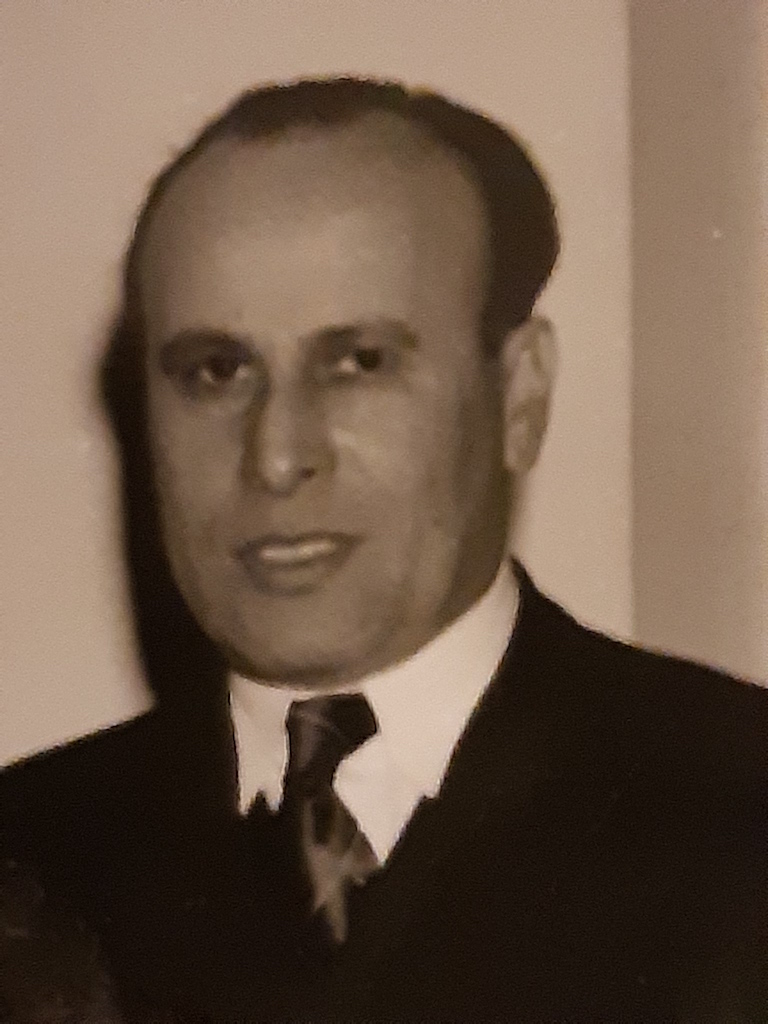
Habib Habibi was born in Hamadán, Persia, in 1912. His father, Mashiya, was of the Jewish Faith but became a Bahá’í at the age of 91. He passed away at the age of 94 years. Habib’s mother, Shamsi, was a Bahá’í who traced her ancestry back to the 1840s when her grandmother Tamar recognised the Báb after hearing Táhirih speak in Hamadán. According to historical research and family records, Tamar was the first Jewish woman to become a Bábi. And since she subsequently visited Bahá’u’lláh, it seems likely that she was also the first Jewish woman to become a Bahá’í.
Habib’s father was a businessman and was about 60 years of age when Habib was born. After the misfortune of eye problems requiring a six month stay in hospital, his business capital had disappeared and Habib’s parents, his four sisters and himself were reduced to poverty. As a five-year old child, Habib had to wear a pair of his father’s old shoes to attend school and had no winter coat or proper nourishment from the food available. It was around this young age that he fell seriously ill and had a significant dream.
While visiting Bahjí during his first pilgrimage, which would be about 1967, he entered the Pilgrim House and, at the threshold, stopped as if in shock. Without explaining further, he surprised the Custodian by accurately describing the different layout of the reception room as it had been during the time of Abdu’l-Bahá. Habib recounted later that during a period of sickness as a young child, he had witnessed the room in a dream, after a doctor had advised his distraught parents not to expect him to survive the night. In the dream, he stood in the doorway, looking into the room as Abdu’l-Bahá served guests at a long table. After a while, Abdu’l-Bahá gazed at Habib and instructed an attendant to give the child a drink of “zuffa” [1], which he drank, and the dream ended. By morning, young Habib had started his full recovery from the illness. The dream experience explained his shock and surprise at the threshold of the Bahjí Pilgrim House.
Habib had to leave school at the age of 11 years and find employment to support the family. He carried out tasks such as carrying children on his back for doctors’ appointments, transporting water and heavy parcels for customers, and cleaning their shops. However he had a very determined character. He carefully recorded in small notebooks his goals for the year ahead and pursued them relentlessly; indeed it was that very determination which led him to God. With his deep dissatisfaction with the prevailing practices of the Jewish faith, in his mid-teens he was drawn to his mother’s faith, because of its focus on justice and unity.
By the time he was 18 he had achieved one of his goals, which was to become trained as an accountant, and he could afford to move his family into a comfortable home in Hamadan. At the age of 21 he relocated to Tehran to become an accountant on a newspaper and at a telephone office. Within a matter of a few years, having accumulated sufficient capital, he left both posts to start his own import-export business.
While still a young businessman in his twenties [2], and married to Nadarah, Habib was appointed to the National Youth Committee and later to the Bahá’í committee tasked with correctly identifying the House of Bahá’u’lláh in Tehran under the direct guidance of the Guardian. That he should be on a committee that included ʻAlí-Akbar Furútan and another future Hand of the Cause was a mark of his determined yet devoted, character. Habib was the principal contributor to the purchase of the House, and his contribution was made under great financial stress, earning thereby the praise of Shoghi Effendi in one of his letters to the National Spiritual Assembly of the Bahá’ís of Iran. The following account details what Habib told his children about identifying and acquiring the House of Bahá’u’lláh:
Many Persian Baháʼís regarded a certain building to be the House of Baháʼu’lláh. Despite friends being directed not to draw attention to the property, many could not resist praying near the building or even kissing its walls. The Jewish owner of the property instructed his sons never to sell it to the Baháʼís until they offered its weight in gold! The Baháʼís at that time were unable to confirm that they had the correct house. The only evidence held by the committee was an early photograph showing a characteristic roofline that was not visible at street level. How could the members get onto the roof to check? The solution was pigeons. They bought a number of birds and released them near the building. Several flew up to the roof, and one or more of the members knocked on the door and were permitted to recover their pigeons. On the roof, they saw that it was not the one in the photograph!
With help from the pigeons, the committee located the true House of Baháʼu’lláh, though the owner was not willing to sell. He did agree, however, to give them first refusal if he ever changed his mind, which happened in August 1941, during World War Two, when Persia was about to be invaded by the Soviet Union and the allies. The house owner wanted immediate payment. Money was understandably scarce at that time, and the only way for the full price to be met was for young Habib to borrow from the ‘Noonahalan’ Bahá’í savings institution by mortgaging his assets, making him the principal contributor. The blessed House of Bahá’u’lláh safely acquired, his business depended upon selling an imported shipment of various foreign products due in Tehran. The problem was that the Soviet army had occupied the city by then and had impounded all incoming shipments. Habib was desperate; without the shipment, he was financially ruined and unable to repay his loan. With nothing more to lose, he risked his life by walking to the Soviet-controlled customs warehouse and asked to see the man in charge. In short, the hours that followed included serious threats to his life, much tea drinking, and hours of backgammon. The result was he recovered a small part of his shipment, which was delivered to his own warehouse, courtesy of the Soviet army, and because the imported nails he received had risen in value many times in that period of shortage, Habib was able to repay his loan and avoid bankruptcy, surely a reward for his sacrifice and steadfastness.
One of his life goals from an early age had been to relocate to the United States and prosper in business. However, at that time the beloved Guardian had placed a ban on travel to the United States by Persian Bahá’ís, and in obedience to this instruction, Habib instead went to Manchester, England, arriving in 1948 after flying to London via Paris with his eldest son, Jamshid.
Again his characteristic determination and focus, and the use of an office and telephone, courtesy of Jacob and Ibrahim Youseph (Jeff and Albert Joseph), helped him to succeed in the business world. He started to meet with textile mill owners and began to export fabrics to overseas markets, including Iran. Later he established a textiles wholesale business which in time became the second-largest textile converter [3] in the UK. Soon after his arrival, Habib was elected to serve on the first incorporated Spiritual Assembly of Manchester in 1950, and gave his valued support to the many activities upon which the community embarked, not the least of which being the 1953 Bahá’í Centenary Exhibition staged at the Manchester Bahá’í Centre. In another area of service, Habib supported the move of the Bahá’í Publishing Trust from the warehouse of the Joseph brothers to larger premises.
The Local Spiritual Assembly spent a great deal of time discussing the letters received from the beloved Guardian, which included plans to set up goal areas. One goal area was an adjacent town, Stockport, and Habib volunteered to pioneer there for a short time while his wife Pouran stayed in Manchester. The development of the Guardian’s Plans called for more goals to be established and many pioneers went out from Manchester. Habib was one of these; he rented a small flat in Chester, where he spent some time each week. Business commitments did not permit full time residence there, but his sojourn was sufficient to establish Local Spiritual Assembly status.
He always wanted the Manchester Spiritual Assembly to have its own Bahá’í Centre, and he was one of the initial instigators to bring that dream to fruition. A large Victorian house was purchased in Wilmslow Road, Fallowfield. The ground floor was converted, and the National Spiritual Assembly granted permission for the house to be designated as the Manchester Bahá’í Centre. He was proud that the Centre had been used extensively over a great many years.
His services to the Faith continued throughout the British Isles and it was in 1970 that he decided to retire from his textile wholesale business so that he could dedicate all his energy to the promotion of the Faith. In September 1971 he went on his first extended teaching trip to Africa for four months. A year after his return, he again left England, this time for about six months in Africa and Portugal. A letter received some time after Habib’s passing, from the Secretary of the National Spiritual Assembly of the Bahá’ís of Ethiopia, testified to the energy and zeal with which he carried out teaching activities. The letter included the following statements:
‘We are very much excited to have a contact with the family of Mr Habib Habibi, whom we loved and admired very much because of his spirituality, dedication, enthusiasm and fantastic teaching skills… His special teaching techniques were:
-
-
- He carried with him plenty of pocket-size declaration forms.
- He associated with the whole strata of society and was not concerned about position.
- He was so dynamic and highly enthusiastic that he never considered his own needs, and never lost a teaching opportunity.
- He was highly persuasive and convincing.
- He presented the Faith like a highly qualified and veteran sales executive, always closing the deal with a sale.
- His presentation was very simple yet highly effective and fruitful.
- He would never accept ‘no’ for an answer. He was so skilful he would not have his contacts respond with ‘no’ but ‘yes’.
- He dwelt on the positive teachings of the Faith, such that he found not resistance but support, and ultimately participation, i.e. declarations.
-
It was very unusual for us at the time to understand how he did it. All that we could remember was that he flooded us with declaration forms from flights, swimming pools, restaurants, enrolling such people as receptionists, executives, and media men. Our Local Spiritual Assembly (Addis Ababa) at the time could not cope with the number of declarations. He then went to Assab Port, Massawa, and Asmara, with the same results.’
Habib returned to Europe and served the Faith with distinction in Belgium and Malta with his wife Wilhelmina, although the contrasting slowness of response in Europe was sometimes a frustration. His forte was serving in the mass teaching areas and for the last ten years of his life he pioneered to India with Wilhelmina. In Himachal Pradesh, he attracted many dignitaries to the Faith, and in 1983, he launched the first eye treatment medical camps in India, at Mysore and Mandya, in the State of Karnataka. A stream of patients, 811 in all, from surrounding villages, arrived by bullock cart, rickshaw and on foot to receive free treatment, medicines, glasses and major operations where needed.
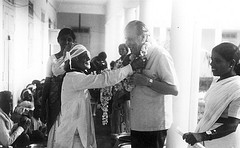
Habib treating patients at one of his eye camps in India
The eye camp was a great success and received the approval of the Universal House of Justice through the National Spiritual Assembly of the Bahá’ís of India:
KINDLY EXPRESS OUR DELIGHT SUCCESS EYE CAMP ASSURE ARDENT PRAYERS HOLY SHRINES NEXT PROJECT MANDYA
Despite being over 70 years of age, Habib energetically arranged a second eye camp, holding meetings with doctors and surgeons at the same time as teaching the Faith to the Principal of the Medical College in Mysore. He recorded that he drove over 2200 kilometres in 3 weeks to ensure effective planning and execution of the eye project. Throughout his time in India, he served on many Local Spiritual Assemblies and one State Bahá’í Council. His last pioneering post was Goa, where he donated two Bahá’í Centres.
Ill health compelled him to go back to Karnataka, to a more temperate climate. He passed away suddenly on 21st November 1989 while in England for one of his regular medical checks. Of his loving devotion to the Faith and its many needs there is ample confirmation; at no time did a call for help go without response. His service was fully reflected in the following cable received from the Universal House of Justice:
GRIEVE PASSING STEADFAST STALWART SERVANT CAUSE GOD HABIB HABIBI. HIS UNTIRING EFFORTS RELATED ACQUISITION ONE OF THE HOLIEST SITES IN IRAN, HIS DEVOTED BAHÁ’Í ACTIVITIES ENGLAND, HIS PIONEERING TO MALTA AND INDIA, HIS GENEROUS CONTRIBUTIONS TO THE CAUSE OF GOD, ARE FONDLY REMEMBERED. PRAYING HOLY SHRINES PROGRESS HIS SOUL ABHA KINGDOM. KINDLY CONVEY OUR LOVING CONDOLENCES ALL MEMBERS FAMILY
Habib was married three times and was survived by four children: Jamshid, Ramin, Sheralyn & Mark who themselves had eight children between them: Leila, Oliver, Michele, Nicholas, Danielle, Thomas, Arzhia & Rezvan and a further nine grandchildren at the time of writing.
Ridván 2020
__________________
[1] His family learned much later that zuffa is a medicinal infusion given on occasion by Abdu’l-Bahá: zuffa (Hyssopus officinalis) or Hyssop.
[2] In many Middle Eastern societies, males younger than thirty years were generally regarded as youth, not to be taken seriously. That Habib was appointed to such a committee while in his twenties was an indication of his capacity to serve the Faith.
[3] Textile converters purchase large amounts of unbleached or undyed yarn or cloth and dye or print them with the company’s own designs. The finished cloth is then sold to retailers, and is also exported.
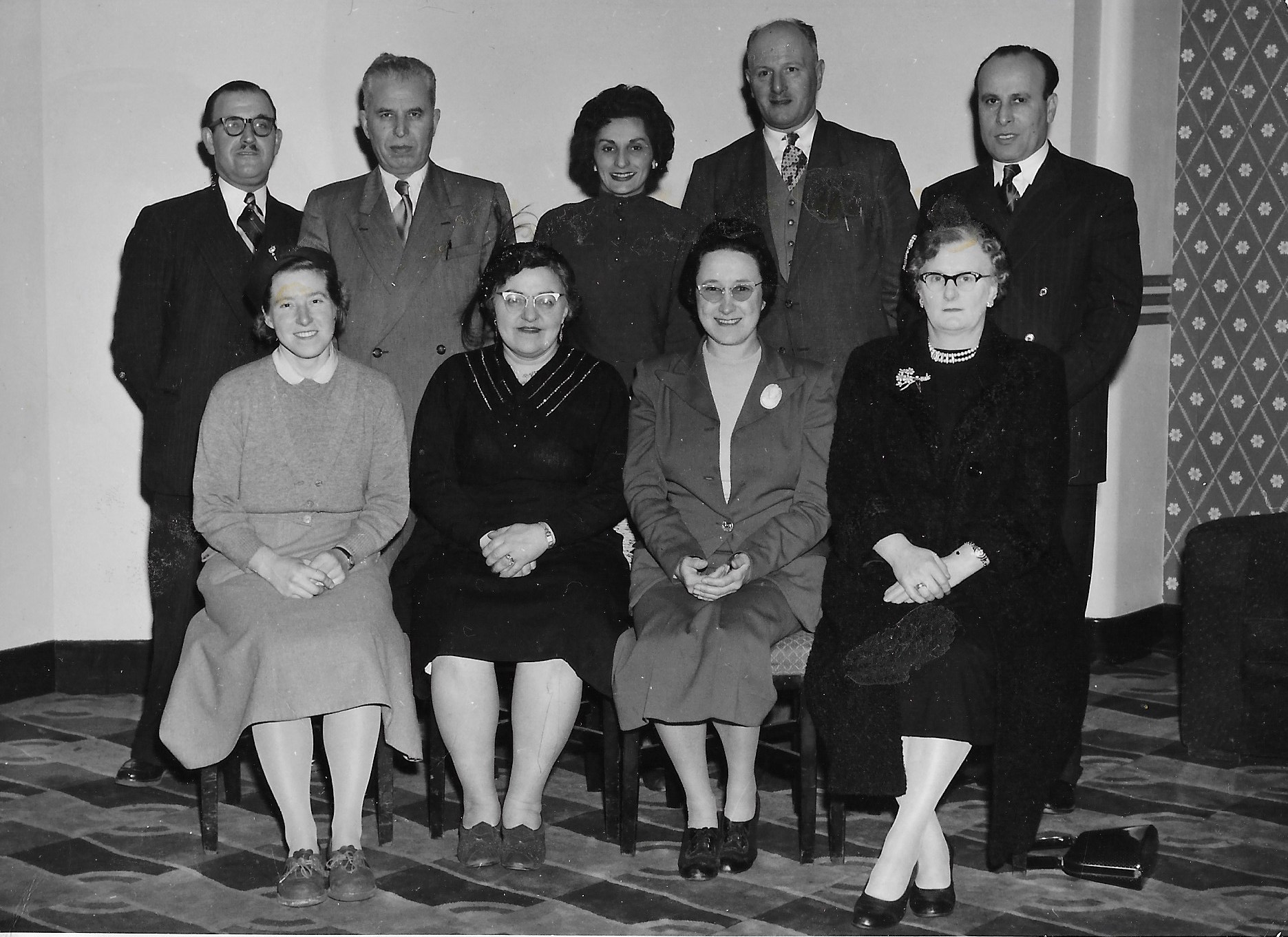
LSA of Manchester 1953-54 Standing from L to R: Louis Ross-Enfield, Albert Joseph (Ibrahim Youseph), Pouri Habibi, Reg Coulson, Habib Habibi Seated L to R: Betty Shepherd, Pauline Senior, Jessica Young, Isobel Robson
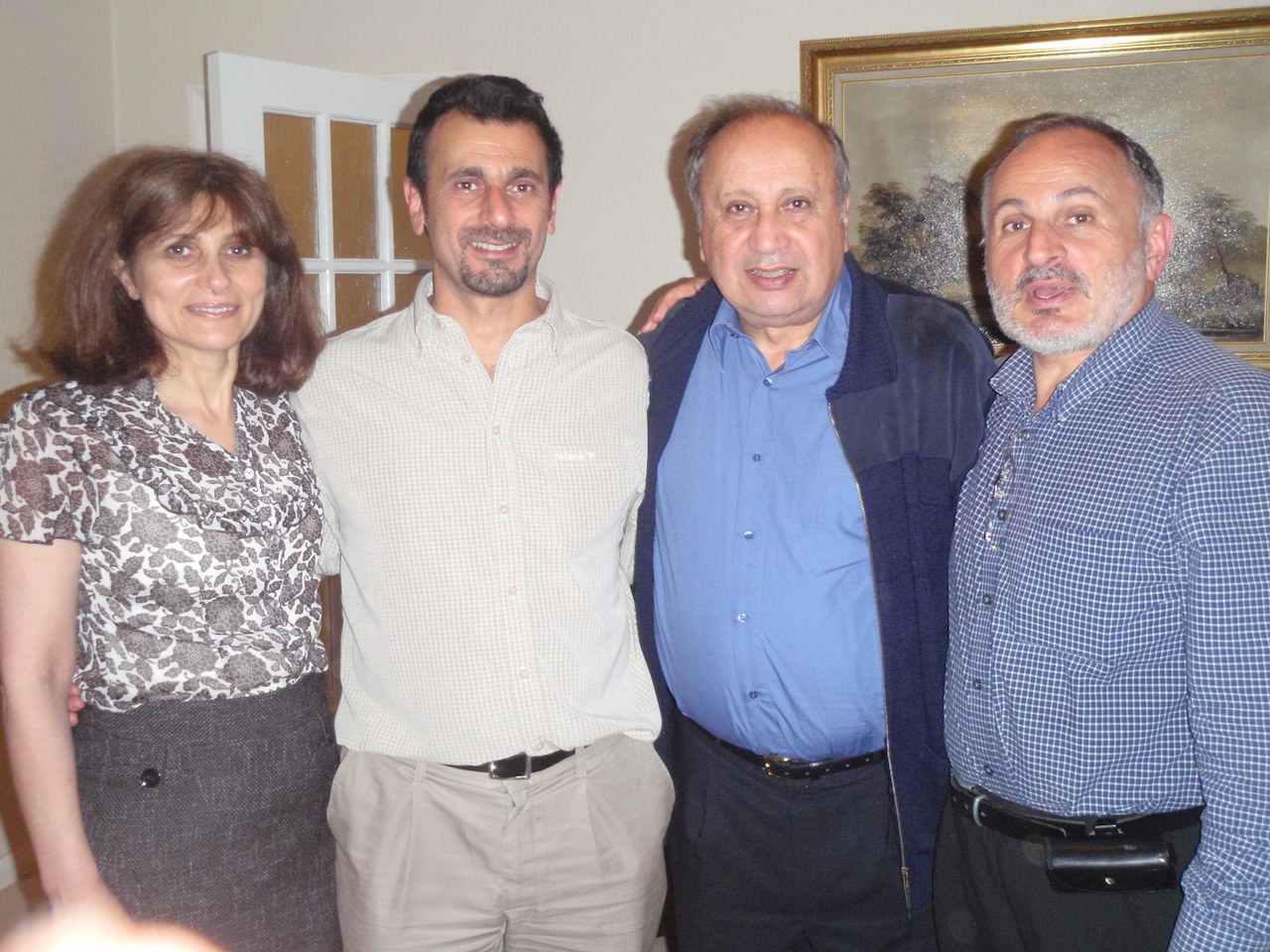
Habib’s four children L to R: Sheralyn, Mark, Jamshid, Ramin
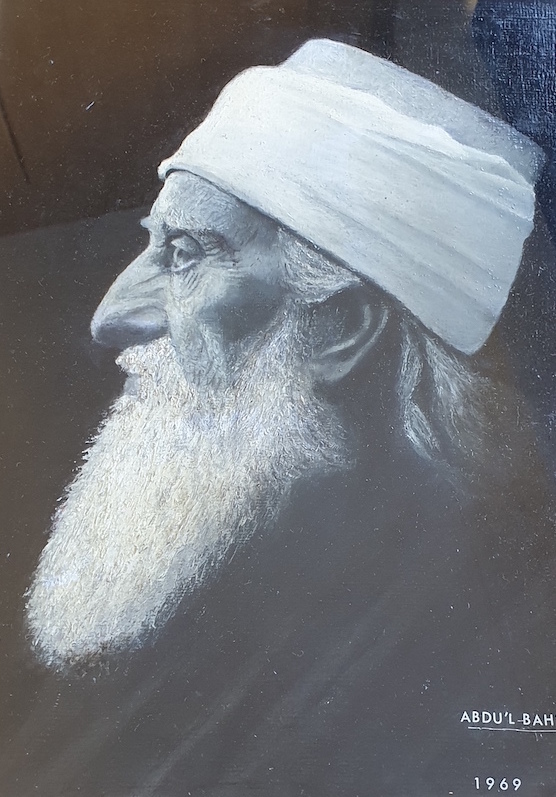
Painting of ‘Abdu’l-Bahá by Habib Habibi. A similar painting by Habib now hangs in the Edinburgh Bahá’í Centre
 UK Baha'i Histories
Fascinating life story. xxx
How lucky we are to have such living histories, and so receive inspiration and guidance on a life well lived!!
l worked for Mr Habibi and his son ” Jimmy ” Jamshid at their business in Watling St Manchester , happy days l was only 16 years old
Pingback: Shahla Haqjoo | UK Baha'i Histories
Pingback: Pouri Habibi (1925 – 2011) | UK Baha'i Histories