

Philip Koomen: How I became a Bahá’í and also found my creative vocation
I first heard of the Bahá’í Faith at the age of seventeen. While walking in Henley-on-Thames town centre, minding my own business, I was accosted by an acquaintance from school. Nick Richardson was a Bahá’í at the time and he lived next door to Mary Hardy who had pioneered to Henley with her four daughters and son. He asked me if I had heard of the Bahá’í Faith. I answered ‘No.’ Nick then asked if I would like to know more. I said ‘No, thank you’.
Two years later, around Christmas 1972, I came home from university. My mother told me about these very engaging discussion evenings hosted by an American lady called Mary Hardy. My mother, Muriel Koomen, a spiritual seeker, had been attending these evenings on a regular basis and she was very inspired by them (at one point my mother actually declared as a Bahá’í but she found the administrative order too unfathomable and the strictness of the laws too challenging). She persuaded me to attend one of these evening discussions. I didn’t realise it was anything to do with religion. This was probably for the best; even though I was seeking, I might not have gone if I had realised this; my mother was very wise.
As I approached Mary Hardy’s home, 69 St Mark’s Road, on foot, I was met in the street by a bunch of Bahá’í youth: Neil Cameron, Hugh Fixsen, Nick Richardson and Charlie Boyle.
The evening began with a talk by an American Bahá’í man. I can’t remember the topic, other than it was about some aspect of the Bahá’í Faith, which made sense at the time. After his talk, the speaker invited the participants to ask questions. At this point I realised I was the only person in the room who was not a Bahá’í. Everyone clearly expected me to ask an appropriate question. I was totally unprepared and unwilling to oblige. This rather uncomfortable feeling soon dissipated however, as people made various contributions.
This talk was my first formal introduction to the Bahá’í Faith. I was very much attracted to the spirit of the message. I went to three or four successive firesides after that. What I learnt about the Faith through these discussions made complete sense. I was a social science student at the time with a very strong left-wing focus. I had also been on my own spiritual search since I was about seventeen when I started to question the narrowness of the Church of England beliefs that I had grown up with. I explored other religions, such as Buddhism, and I read radical Christian left-wing theologians like Ivan Illich and Adolf Holl. As I learnt about the Faith, the jigsaw puzzle bits I was searching for began to make sense. As an activist, I was attracted to the Faith’s worldwide community building and vision. At the same time, I didn’t just want to join another religion and subscribe to a set of beliefs.
The talks at Mary’s were very engaging and over the following weeks I found my understanding of God’s purpose for humankind became more comprehensive. But it wasn’t just Baha’u’llah’s Station and Teachings that inspired me. What made the claims credible to me was the commitment of the global Bahá’í community to build a new civilisation. That commitment was also reflected in microcosm in the little Henley Bahá’í community that I soon adopted.
At the last of the firesides I attended in January 1973, an American, all-female singing group, the Dawn Breakers, performed. After the performance I found myself in conversation with a very attractive African-American young woman. She asked me directly if I was a Bahá’í. I hadn’t considered declaring but I couldn’t come up with a good enough reason why I shouldn’t call myself a Bahá’í. I must’ve said something along the lines of “I guess I must be a Bahá’í”. A declaration card was rapidly produced, which in those days was the form. I read the declaration and with some trepidation, signed it. The company present was jubilant.
As I walked home that evening I pondered the wisdom of my decision. I reflected that if the Faith was not what I thought it to be, the act of declaring was harmless. However, if it was the right thing it would become evident.
My life changed from that moment of declaring; I was nineteen years old. That moment also changed the lives of future unborn Koomen generations and that of Esmyr, my soul-mate, whom I hadn’t even met. My mother’s discreet encouragement has now affected the lives of four generations.
Mary Hardy – Matchmaker!
Two years after I declared as a Bahá’í, I met Esmyr through a friend of Mary Hardy’s, so Mary was not only my spiritual mentor but also the unwitting matchmaker to Esmyr and me. We have been married for almost 44 years since August 1976. Our two children, Jonneke and Jody, are Bahá’ís and at the time of writing we have two young grandchildren, Maya and Layli. I can say with confidence that the loving environment Mary Hardy created at 69 St Mark’s Road generated a heat that melted the hearts of many seekers who, like me, were able to discover the illumination of Bahá’u’lláh’s Revelation. Words cannot express enough the great appreciation and love Esmyr and I feel for how Mary and her family’s efforts have changed our lives and have influenced the next generations of our family.
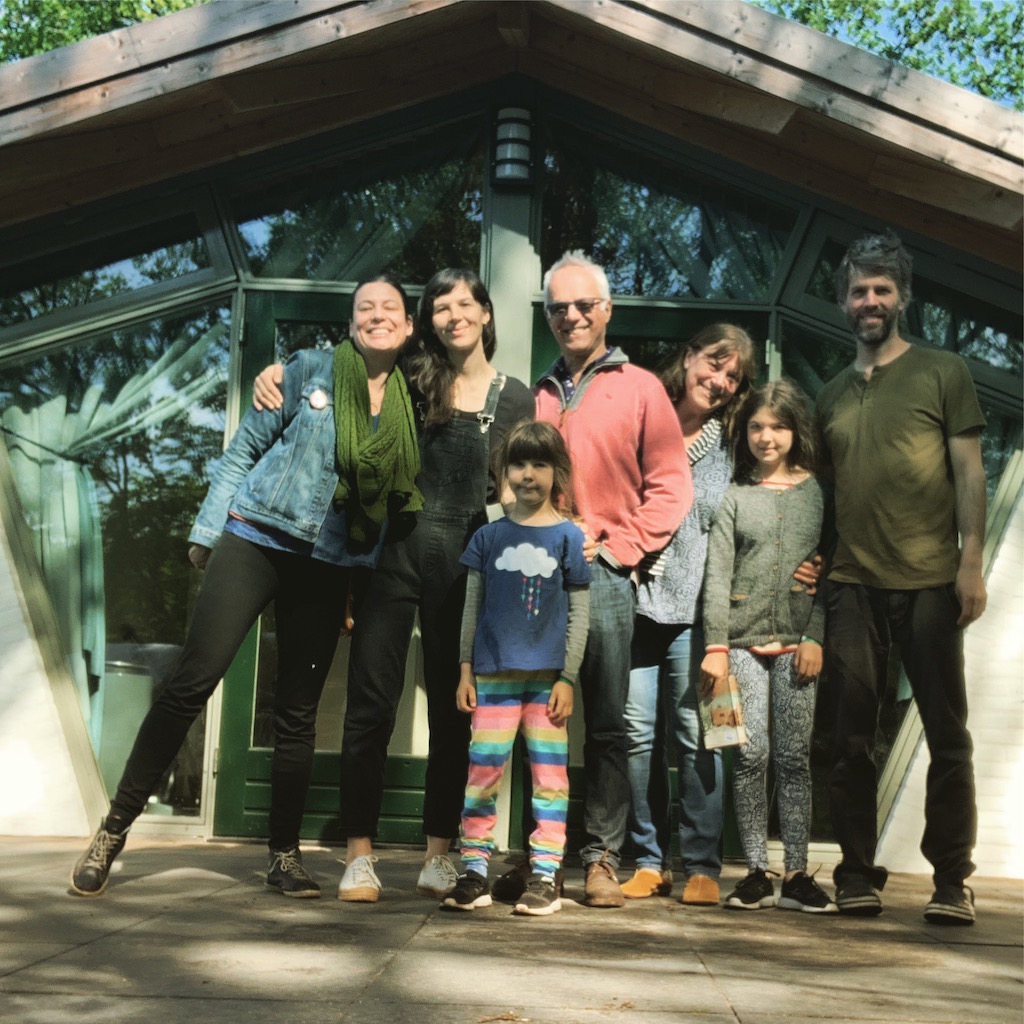
The family on a visit to the Netherlands in May 2019
Back L to R: Jonneke, Gemma, Philip, Esmyr, Maya aged 9, Jody
Front: Layli aged 6
A Baha’i-inspired Creative Vocation
Two years after becoming a Bahá’í, inspired by Bahá’u’lláh’s Teachings and Vision, I decided to become a furniture designer-maker. I remember Brant (Mary Hardy’s son) giving me a gift of a chisel for my 21st birthday when he learnt about my aspiration. I still have that chisel and forty-five years later I’m still making furniture.
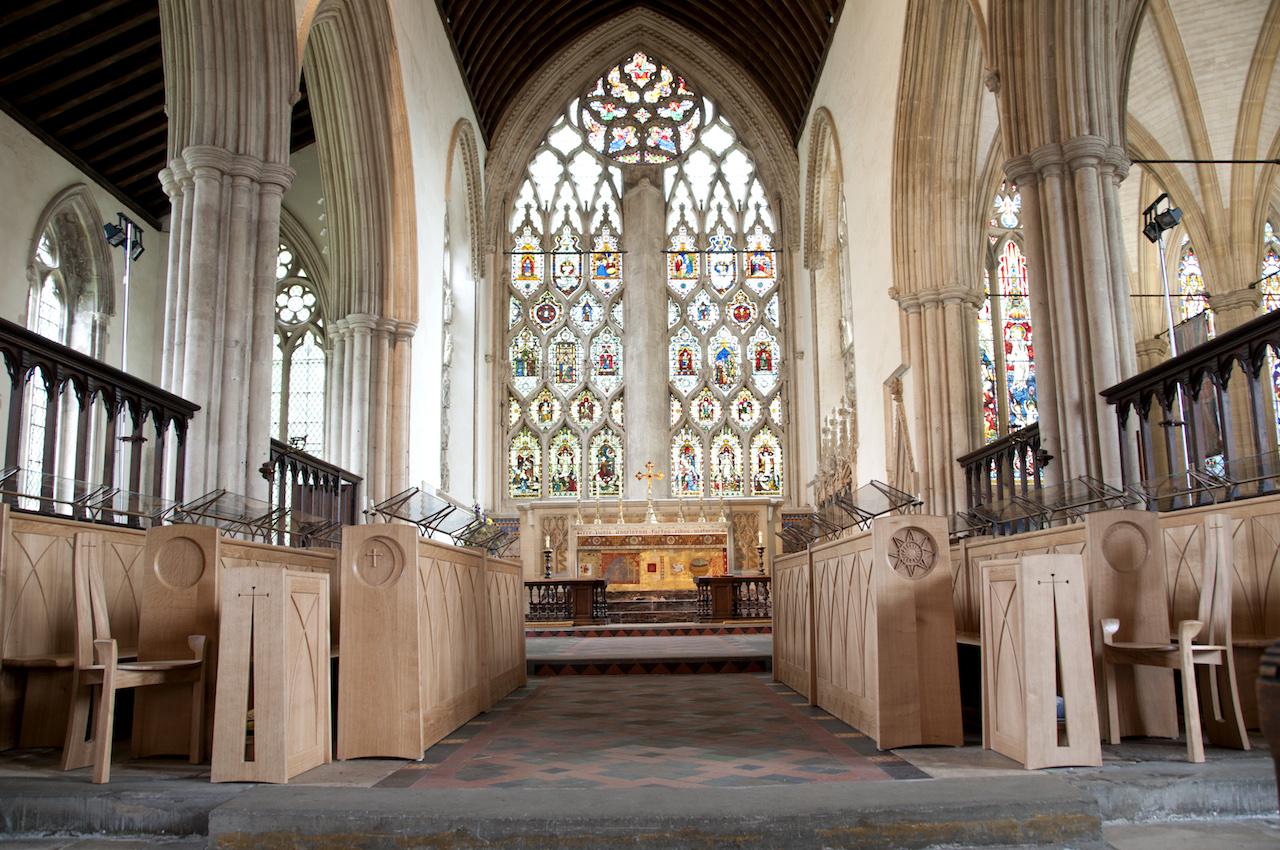
Philip designs furniture for sacred spaces for different faiths;
for example, these choir stalls and clergy seating for Dorchester Abbey (Oxfordshire)
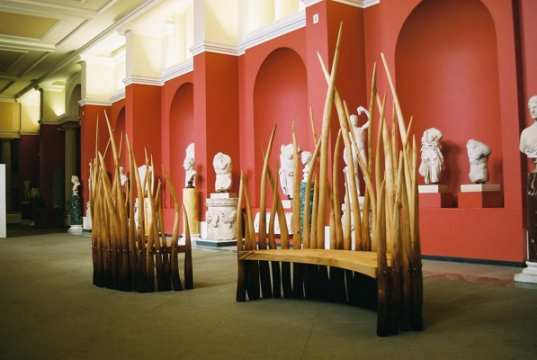
Philip’s iconic ‘pond life’ benches on display at the Ashmolean Museum

Furniture for Oxford University’s ‘Window to the World”\
I have completed over 1800 commissions, but one of the most special furniture commissions I undertook was to design and make the meeting table for the National Spiritual Assembly of the UK. I also trained over twenty aspiring furniture makers, introduced profit sharing and shared equity, and completed a PhD on sustainable practice, all directly inspired by the Teachings of Bahá’u’lláh.

The meeting table for the UK National Spiritual Assembly
partly inspired by the Bahá’í House of Worship in New Delhi
known as the ‘Lotus Temple’
In 2004 I was invited by HRH Queen Elizabeth and HRH Prince Philip to Buckingham Palace for the first Royal Celebration of British Design in recognition of “excellence in the practice of design”. When I read the guest list of fellow invited designers I felt humbled and most honoured to be considered worthy to be in the company of the likes of Tim Berners-Lee, Quentin Blake, Norman Foster, Orla Kiely, David Adjaye, Zandra Rhodes and Stella McCarthy, to name but a few! The only explanation I have for the level of recognition and success I have enjoyed is that I have been a recipient of Divine Confirmations; my creative practice has always been sustained through daily prayer and refection on the Baha’i Writings. (See also Out of the Woods, UK Baha’i Review, Spring 2005).
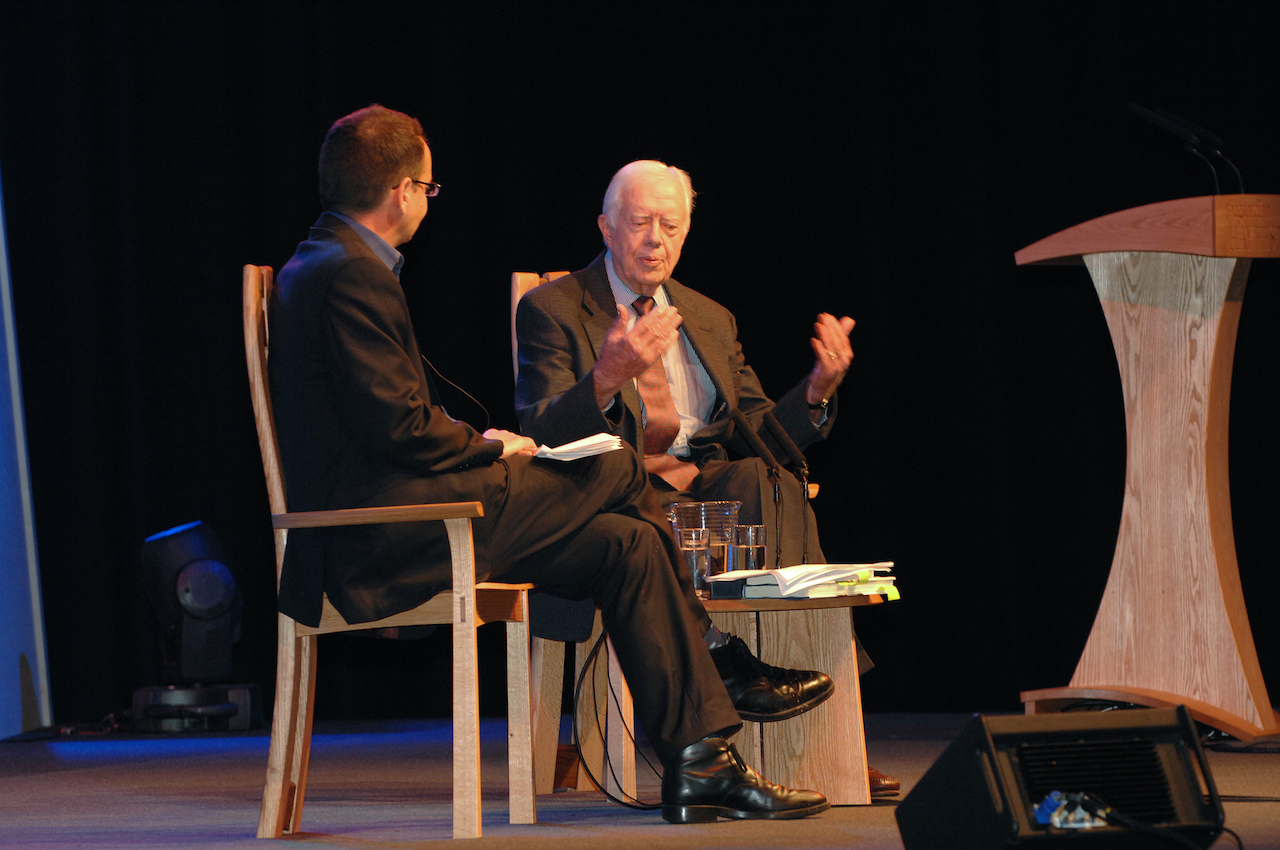
Former US president Jimmy Carter being interviewed by Philippe Sands at Hay Festival 2008
All stage furniture by Philip Koomen
Two-Person Community
Esmyr and I now form a two-person Bahá’í community in Burcot, a village between Abingdon and Dorchester in Oxfordshire. We have a range of community initiatives that we host such as monthly Mindful Mondays (a devotional), Artist-to-Artists discussions on the relationship between creative and spiritual practice, and a book-making workshop, Soul Book, that helps people connect with Bahá’í and other sacred writings.
At the time of writing (June 2020), due to Covid-19’s social distancing restrictions, we have been offering our Mindful Mondays via Zoom. Until we developed the Mindful Mondays we used to host monthly discussion evenings where we had speakers such as, for example, Jimmy and Dr Janak McGilligan, directors of the Barli Development Institute for Rural Women, who we’d become friends with through Esmyr’s role with YOSDesk UK; Dr David Kelly (he spoke about his work as a weapons’ inspector for the UN just months before he was pursued by the powers that be); local friends such as Dr Michael and Sarah Richards, Geoff Cameron (now returned to Canada) and Sam Cleasby, to name but a few. The most popular speakers we have hosted, in terms of enduring enthusiastic feedback at the time and still to this day from our friends (who are not Bahá’ís) as “those amazing speakers we learnt from at your home”, were Dr Mina Fazel (about mental health care in aboriginal communities in Australia), Professor Geeta Kingdon (on her research about the importance and impact of educating girls) and Rob Weinberg (one on Bernard Leach and one on Mark Tobey’s Influence on 20thCentury Art).
We are also a bit more involved with the neighbouring Bahá’í community of Abingdon, who always welcomingly invite the various now “isolated” believers in the former Bahá’í community of South Oxfordshire to their Feasts and events.
In recent years we collaborated with Laura Degenhardt and Sam Cleasby, Bahá’ís in nearby Oxford, and organised a very well-attended and well-received creativity symposium called Ideas in the Making at the University of Oxford Natural History Museum in April 2015. The theme was inspired by the Bahá’í quotation “the source of arts, crafts and science is the power of reflection”.
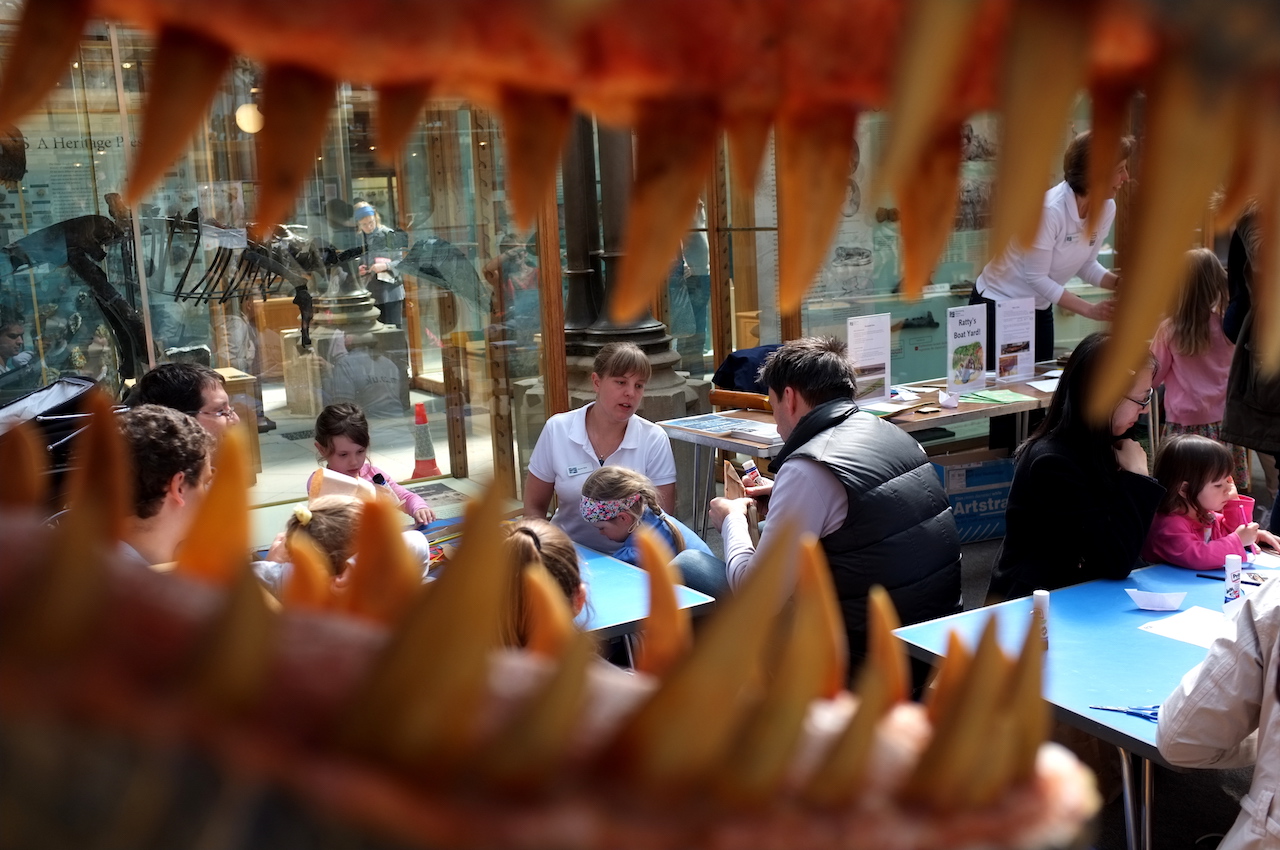
Craft workshops at the ‘Ideas in the Making’ symposium
This free family-friendly event, supported by Arts Council England, invited the public to explore the nature of interdisciplinary creative thinking and practice through a wide range of creative activities, lectures and expert-led workshops. Tom Fox volunteered his services and was our sound recordist of the lectures by keynote speakers.
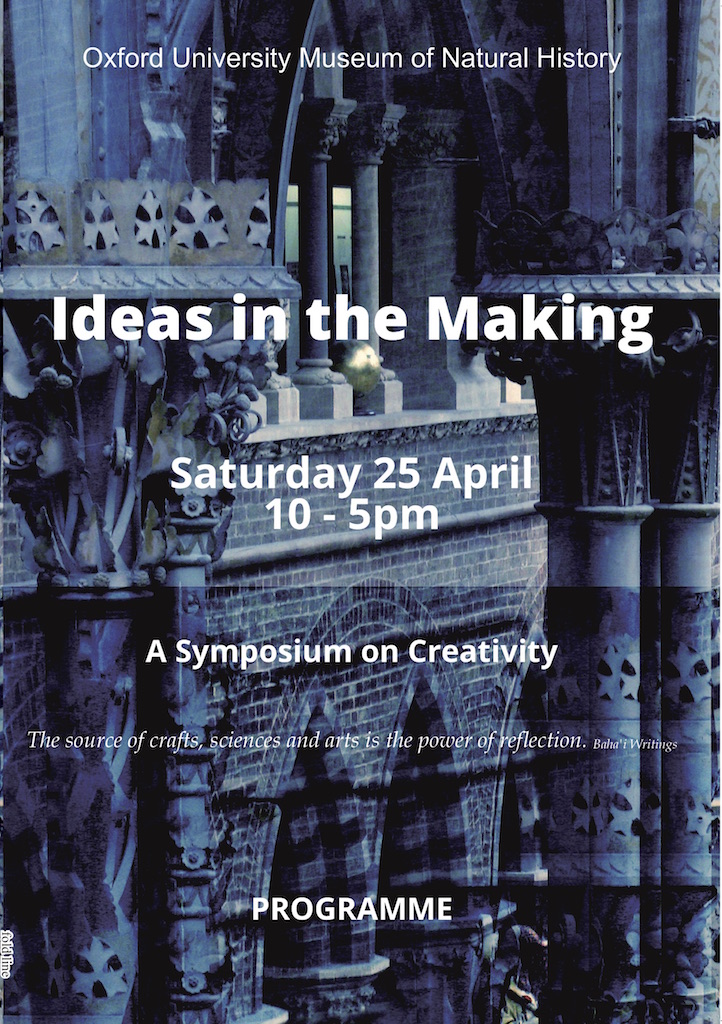
Front page of the programme for ‘Ideas in the Making’
The whole museum and its forecourt were ‘handed over’ to us to use and enjoy; an amazing experience and testimony to how a tiny band of Bahá’ís can pull off such an event, knowing how to use its contacts and networks effectively with other organisations and communities of interest. (See also Ideas in the Making: A Symposium on Creativity in UK Baha’i Journal, Spring 2016.)

Ideas in the Making Symposium
(with Sarah Richards and Vafa Taghavi)
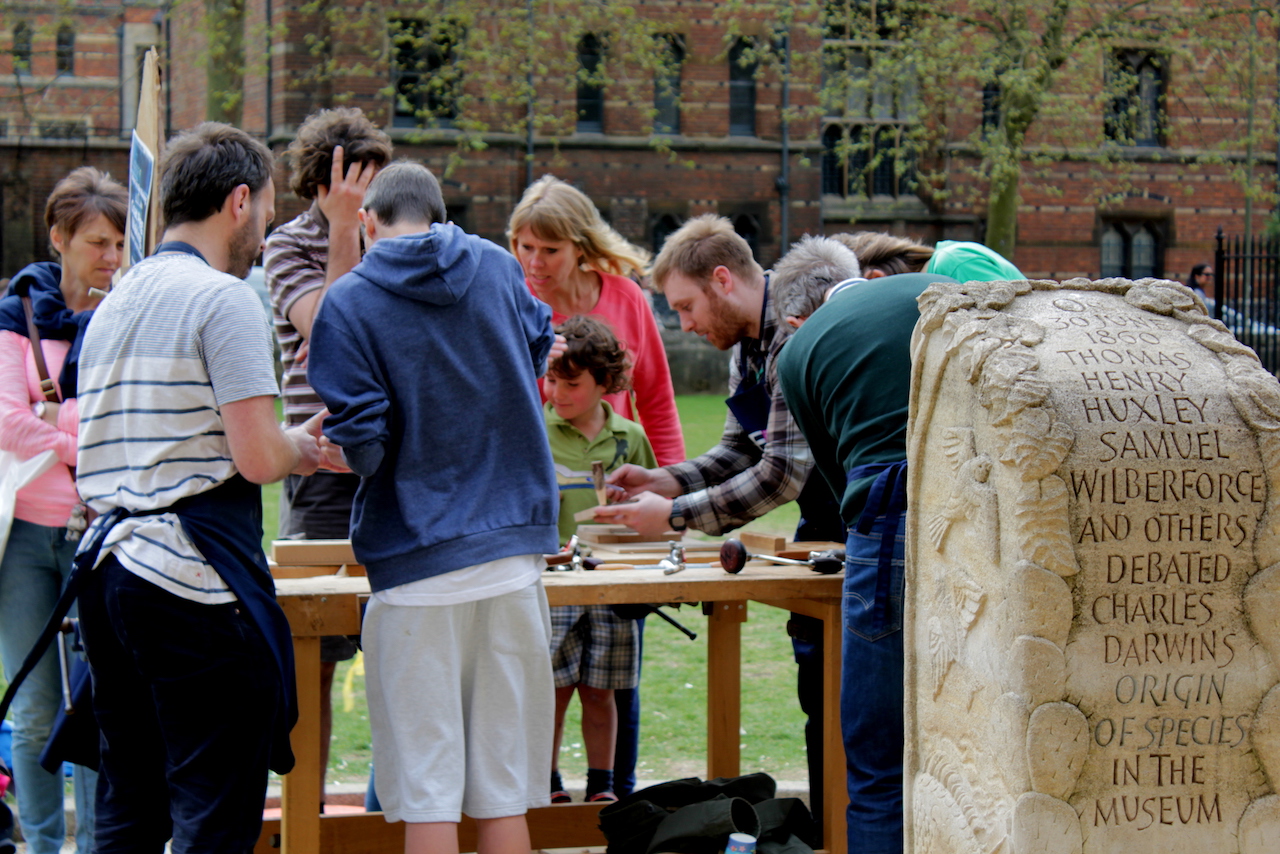
Woodworking sessions were popular across all generations and took place in front of the historic museum
The Soul Book– book-making – workshops were inspired through meeting Lois Sabet-Gardner, a Nottingham-based Bahá’í who is an abstract painter. She had developed a book-making workshop and suggested we collaborate to extend the opportunities for the public. The ideal opportunity came in the form of the One World Festival hosted by Oxford University’s Ashmolean Museum. In November 2018 we put on two workshops at the Festival. The book-making workshop has since been used in Junior Youth programmes, neighbourhood events and at a drug rehabilitation centre.
In 2019 I repeated the workshops at the Ashmolean Museum’s One World Festival with the support of Esmyr, Sam Cleasby and an Oxford Bahá’í youth, Flora Moayed. Participants would make booklets, decorating them with beautiful images, they’d cut from magazines, and spiritual aphorisms in handwritten calligraphy mainly from the Bahá’í Writings. This time, being the year of the Bicentenary of the Báb, we had organised very large ‘pop-up banners’ near our craft table about the Báb and the Bahá’í Faith and members of the public were reading those and asking questions. The event was so popular that the Museum afterwards told us that they’d like to give us more gallery space in future festivals to enable more people to participate in this activity.
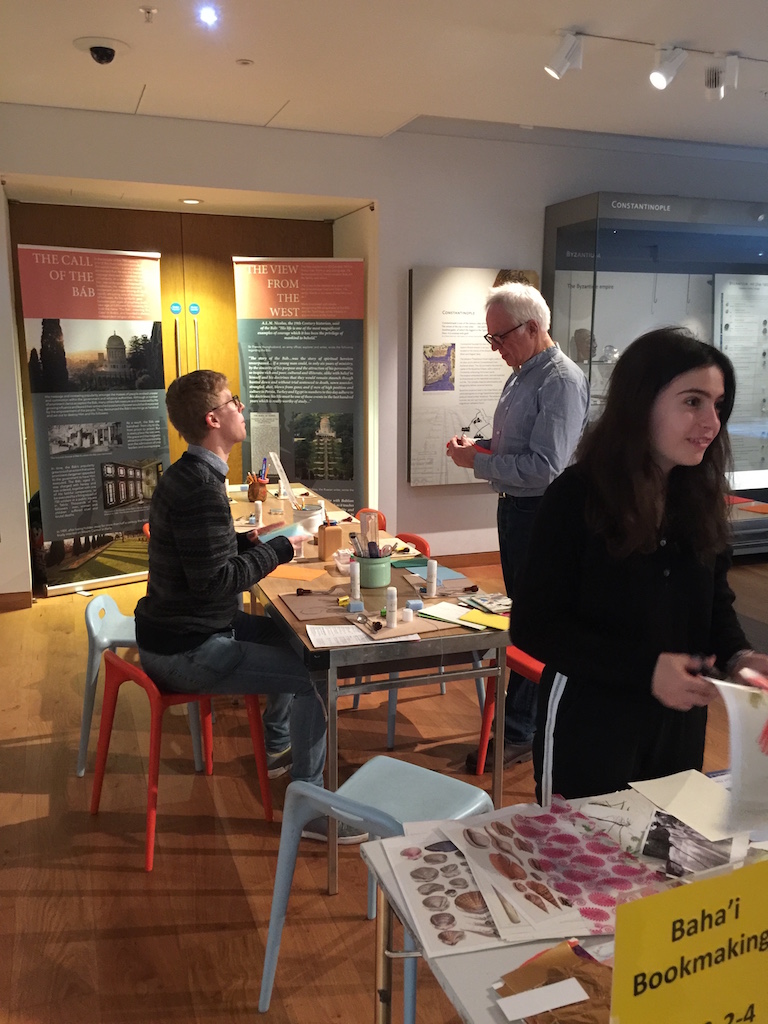
Preparing craft tables at the Ashmolean One World Festival
More recently, in 2019, in celebration of the Bicentenary of the Báb, we again collaborated with Sam and Laura (both fine artists) as well as other Bahá’ís such as Dominic Brookshaw (poet), Naseem Alizadeh (architect), Richard Leigh (musician) and Todd Lawson (scholar). With the financial and practical support of the Oxford Spiritual Assembly, various community members, and Rob Weinberg, we were able to organise a pop-up exhibition and symposium, Art and the Interconnectedness of All Things, on the Báb’s Bicentenary and His Teachings on the arts, at Wolfson College, as well as showcase our various creative outputs. Todd’s introduction to this exhibition is featured in the UK Bahá’í Journal (issue 30), March 2020.
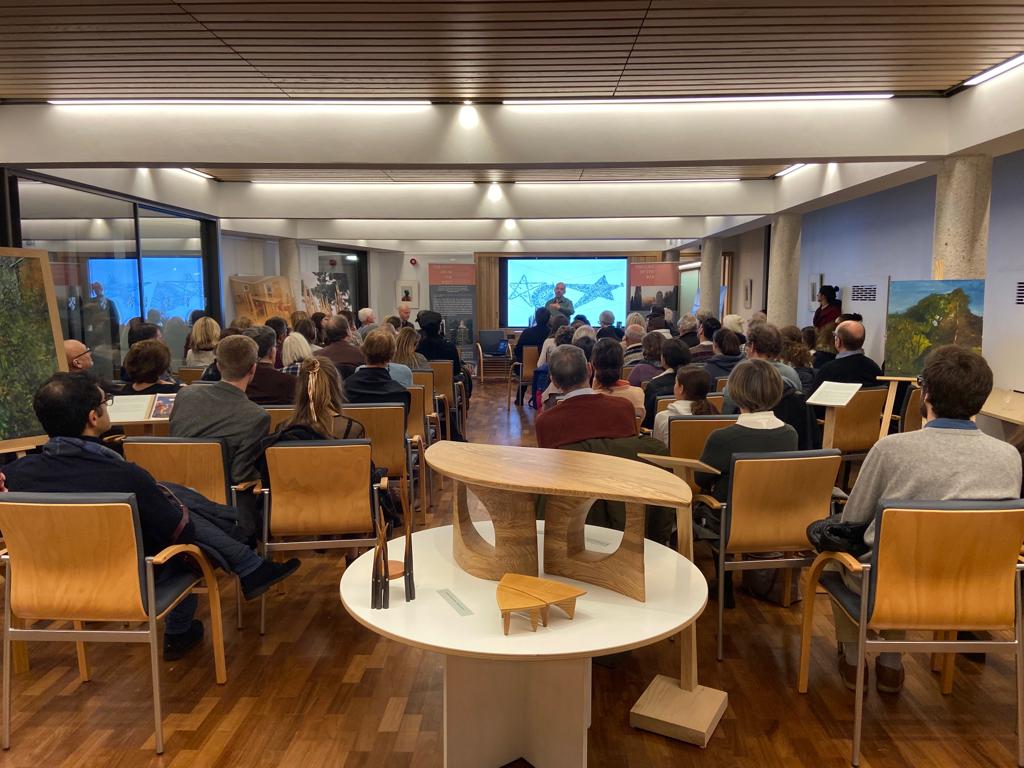
Art and the interconnectedness of all things
These one-off events are balanced with long-term, community-wide commitments. For nearly two decades I have been a contributor to Sunday Morning Reflection on BBC Radio Oxford (it’s like Thought for the Day on BBC Radio 4). I also lead an annual assembly at the local C of E primary school where I explore virtues with the children through creative activities.
Firesides, Presentations and Exhibitions
I’m fortunate in my occupation in that it enables me to naturally mention how the Bahá’í Teachings have inspired my creative practice. Since the mid 1980s I have given fireside talks and these have evolved to reflect my deepening understanding of the Teachings, as I have applied them to my practice.
In the late 1990s I was invited by the American Hardwood Export Council to attend a public relations timber industry ‘soirée’ in London where the American Embassy’s Counselor for Agricultural Affairs was also present. At one point during the social mingling I was in a group of about six people, including the Counselor talking discursively. The Counselor happened to mention the different places he’d been seconded to, including Iran. A propos of nothing he then said the people he most admired in the world were the Bahá’ís in Iran because of the dignity and forbearance with which they endured persecution and their loss of human rights. I was quite stunned but gratified to hear his favourable impression. I asked him if he knew anything about the Bahá’í Faith to which he replied “nothing!”. I responded that I was actually a Bahá’í and for the next twenty minutes or so everybody in that small group were hanging on my every word as I gave an introduction to the Bahá’í Faith.
I’m regularly invited to talk about my work at Colleges, secondary schools and clubs, which gives me a direct opportunity to mention the Bahá’í Teachings.
I also organise and curate exhibitions of my work and research, incorporating the Writings as my main source of inspiration. For example, my practice-based PhD was showcased in Out of the Woods: a Sustainable Approach to Furniture Design, a touring exhibition (accompanied with a catalogue) that was shown at the River Rowing Museum, Henley on Thames; Museum of English Rural Life; Wycombe Chair Museum and Art in Action, Waterperry, near Oxford. The exhibition highlighted the relationship between sustainable practice and ethical global citizenship, citing the Bahá’í Teachings. I took the exhibition catalogue with me when I lectured in Asia about my PhD work.
In 2003, after giving a lecture about my work at the Singapore International Furniture Design Conference in Singapore, I was invited to return the following year to the Singapore Design Forum for Design professionals and Design students. Eleven months had gone by and I was hoping I wouldn’t be asked back as I had found the original journey in 2003 very tedious. I was wondering what the point would be in going, when I received a fax from the organisers asking if I would give a talk at the Design Forum on the Bahá’í Faith and telling me they’d welcome Esmyr too. At the previous conference, I’d mentioned how the Bahá’í Teachings had shaped my creative practice and now they wanted me to tell the 300-plus delegates about the Faith! Now I knew why I had to return to Singapore.
I always frame these presentations on sustainable design practice around the principles of global citizenship, specifically mentioning Baha’u’llah’s Words: “The earth is but one country and mankind its citizens” and “Let your vision be world embracing and not confined to your own self”.
During the panel discussion I was invited to explain the Teachings of the Bahá’í Faith to the packed conference room of over 300 international delegates, students, designers and journalists. After all these years it is difficult to remember what feedback I received at the conference itself. However, there were numerous opportunities to attend endless dinners where people did find asking about the Bahá’í Faith a bit of a conversation starter.
A couple of years later I was a guest lecturer at an international convention organised by the American Hardwood Export Council in Vietnam. After the conference I had to attend a press meeting and was interviewed by the young Chinese editor of an interior design magazine. The interview went very well and at the end I gave her a copy of my exhibition catalogue, Out of the Woods. The following day she came up to me and asked if I was a Bahá’í. It turned out she was studying the Ruhi material with Adam Robarts in Bejing and I was the first Bahá’í she had met outside China! These are moments when you know that you are being used by a higher power.
More recently, back in the UK, the NSA public information office asked me if I would talk about the relationship between my faith and my craft practice on the BBC1 TV show Sunday Morning Live. This was in September 2019, coming up to the Bicentenary of the Báb’s Birthday. The broadcasting day began very early, around 6am, when I was collected by a driver and taken to Broadcasting House. I took some furniture with me and a plaque I’d made with an inlaid 5-pointed star. Along with a group of fellow crafts people from different faiths we displayed our artefacts outside in the courtyard and rehearsed our interviews with the presenters. We then retired to a room in Broadcasting House until we got the call. Regretfully, our slot was squeezed from ten minutes to the last five minutes of the live show. I had time in the interview to mention the principle of the Unity of all Faiths and the significance of the Holy Bicentenary Year; it was all over in about 6o seconds!
_________________
Esmyr Koomen – How I became a Bahá’í and also found the man of my dreams!
I came to Henley-on-Thames in August 1974 for a year to improve my English before I could start my B.Ed. in English & History in the Netherlands. I stayed as an au pair (the gap year concept did not exist then) with a Dutch family who lived in Henley and they were friends with an American lady called Judy who lived in St Mark’s Road and was a friend of Mary Hardy, a Bahá’í who, with her family of teenagers, lived in the same road.
After I had been a few weeks in England, a young man, a Bahá’í contact, visited my host family with a box of books he was passing on to my host who was going to study Social Work in High Wycombe. The young man no longer needed these books as he had decided to study Furniture Making at the same college as my host. This man was Philip Koomen and he was the very dream come true of what I in my teenage mind pictured the ideal man to look like, with NHS round specs, navy duffle coat, brogues, English, and (joy of joys) a black beard! On top of that he was softly and beautifully spoken (I was after all an Anglophile), very friendly in his demeanour, had a wonderful smile and kind eyes.
Philip would return home to Henley during the weekends and would catch a lift back to college with my host on Monday mornings when she would pick him up somewhere at a mutually convenient spot in the centre of Henley. He said my host was always going on about her wonderful au pair and he became intrigued and decided to think of a way to contrive to meet me again. One Monday morning he arrived at our home with the excuse he was so early he thought he’d walk over for his lift rather than wait by the roadside.
On New Year’s Eve 1974 he telephoned. My hosts were at a party and I was babysitting their children. He made pleasant small talk and told me he had a Dutch surname but the way he pronounced it and explained to me its apparent translation just didn’t make sense, so I concluded it was just another, but rather novel and original way of being “chatted up”. English men were a rather obtuse, awkward yet oh-so-transparent species in the field of romance, with their lack of a proper education in the field of geography, languages and literature, compounded by a cinematic indoctrination of what “Scandinavian” (!) girls were “up for”. Anyway, he asked me on a date and the rest is history as he became my boyfriend in January 1975.
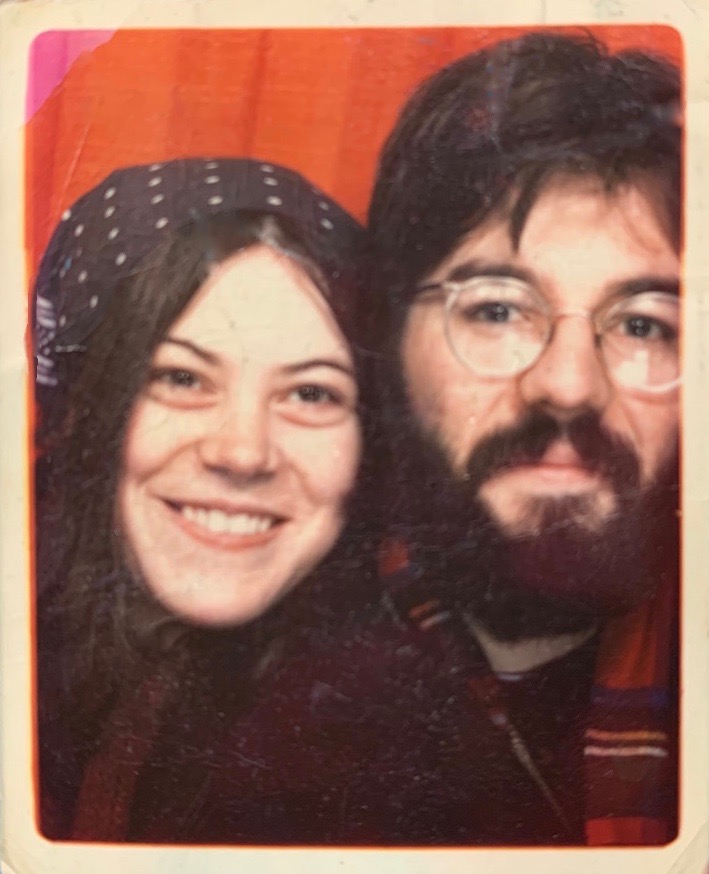
Philip and Esmyr newly dating in 1975
I remembered I had heard of the Bahá’í Faith a few years previously when I was about 13 when a childhood friend of my sister’s, whom we hadn’t seen for many years, had left a leaflet in our letterbox.
Although I realized Philip’s faith was really important to him, I wasn’t interested in it other than as a philosophical thing to argue about. Coming from a Roman Catholic background I had definitely rejected religion as ‘the opiate of the people’ and thought it a sign of weakness and a psychological prop that Philip obviously needed. However, he was lovely enough to stick with! In the summer of 1975 I went back to the Netherlands to start my studies and we maintained our relationship by making regular trips between the Netherlands and England to see each other every six weeks or so. By the following summer we decided to get married as the alternative was a lengthy courtship involving almost another four years of being apart (B.Ed studies in the Netherlands were 4½ years). It was the summer of 1976 with its heat and drought and we often joke that it was sunstroke that made us take this monumental, unplanned step!
My mother spoke to her priest about us and the Bahá’í Faith and he was very enthusiastic and encouraging and told her that Bahá’ís were wonderful and that it was better to believe in God and have a Faith than nothing and that it was “not in conflict with our church at all” (Dutch Catholics).
Our daughter Jonneke was born two years later and our son Jody in 1981. We brought the children up very much immersed in a Bahá’í life with Feasts, Holy Days, and Thomas Breakwell schools, and such events as conferences, Easter and Summer Schools. I was very happy and supportive for this to happen, seeing it as a beneficial way of raising children to enable them to grow up with a strong sense of a Bahá’í identity and the feeling of being loved by a community who always listened to them. I had obviously matured in my attitude to religion!
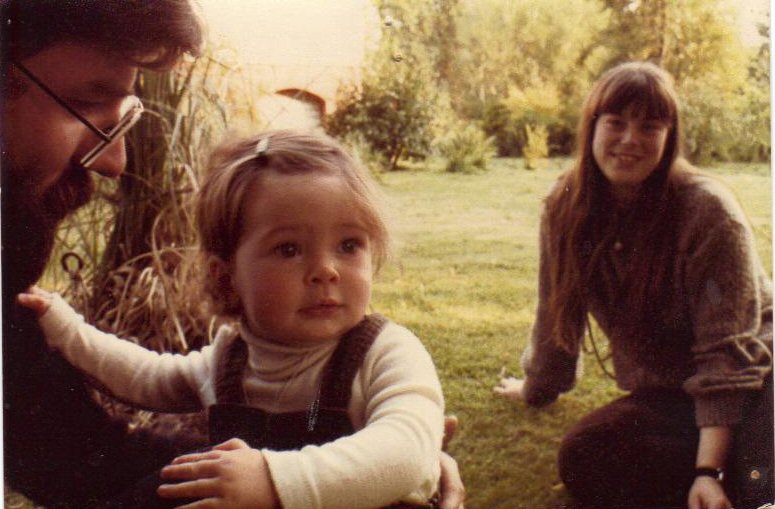
Jonneke aged one, with her parents at Philip’s mother’s home near Henley-on-Thames

Jody aged 18 months, with Philip
I think one or two over-zealous Bahá’ís adopted me as a project and tried to convert me whenever we met, and that had the opposite effect, as I would dig in my heels and think “I won’t fall for all this”. I resented this coercive proselytising and found it quite insulting as I saw myself as a member of the Bahá’í community already and assumed I was perceived by them as such. I started avoiding going along to certain events and Philip used to go alone to conferences, schools and regional events with the children unless they were with me in the Netherlands visiting family during the school holidays.
Through this family life I enjoyed the benefit of being part of a diverse, thriving small Bahá’í community in South Oxfordshire in which the children of half a dozen families were the focus of community life whilst I could comfortably sit on the fence. I felt I was totally seen as part of the community even though they may perhaps instead have thought of me as part of the “community of interest”. I find this sort of term very unhelpful, like the term still bandied about too often, “non Bahá’í”!
It was only when the Warminster summer schools were organized by Jan and Hugh Fixsen with Shirin Monadjem that I was tempted to go along with the family after I heard from Margaret Nash, a Bahá’í in Reading, how wonderful the first Warminster Summer School had been and how she herself became a Bahá’í there. It turned out to be a glorious summer school, August 1993, with lots of friends from all over. There was lots of singing and making music, especially informally and often raucously at night, singing Downtown(my particular favourite!) with much energy, joy and laughter with Geoff and Michaela Smith, Payam Beint and Na’im Cortazzi and their friends.
Margaret Nash encouraged me to come to the talks; I was not too keen due to past pressures or expectations but she insisted I came at least to Viv Bartlett’s talk, assuring me he would not be a bore. Also, my daughter had been questioning me more and more about why I wasn’t a Bahá’í even though we obviously lived very much as a Bahá’í family, so I thought I should be more open-minded and attend some talks and workshops while at Summer School. Viv talked enthusiastically and made it sound so simple, clear and right. I had always assumed I could never call myself a Bahá’í until I had achieved a certain standard of being, which was way beyond my mere mortal reach. However, Viv talked about all of us as being as sparks and flames on a continuum and that one’s faith could be a lighted candle and didn’t have to be a raging fire. Suddenly it all fell into place as Viv talked and it gave me courage and the clarity to know that I could be a Bahá’í without compromising my integrity about not wanting to be hypocritical.
I didn’t want to be the centre of attention at that Summer School so I waited till we returned home and we were sitting round our kitchen table to tell Philip of my decision and resolution. That news wasn’t entirely unexpected to him; he had seen it coming, he said, as I had been on the fence for a very long time and he knew I wanted our children to be happy, trustworthy and purposeful in life by becoming Bahá’ís. He could tell from my relief and radiance after coming away from Viv Bartlett’s talk that I was overcoming my hang ups with the word “God” and signing up to a religion. All those personal, inner obstacles seemed so trivial afterwards and I daily call to mind Bahá’u’lláh’s protective words “Armed with the power of Thy Name nothing can ever hurt me, and with Thy Love in my heart all the world’s afflictions can in no wise alarm me”.Our daughter Jonneke declared the following year when she was 16 and our son Jody declared when he was 17. Of course, they have their own stories!
In 1995, through working in and teaching computing, I was au fait with using the internet (those dial-up days!). I had searched the world wide web (no such word as googling existed then). Altavista was the search engine we used in those days to look for suitable Bahá’í projects around the world for Jonneke, who wanted to do a year of service when she finished school in 1996. I ended up with a wealth of information, contacts, and all sorts of Bahá’í socio-economic projects around the world, which I started to share with Sylvia Miley, who ran the Youth Year of Service project (YOSDesk). She had for some time held in her mind a dream of establishing something she had called PIN (project information network) to enhance the services of the YOSDesk, and thought I would be a useful collaborator to make her vision come true. In 1996, the NSA formally invited me to join the YOSDesk for its IT and website development, so Sylvia and I came together rather fortuitously to make this project network a reality. We were able to set up a dedicated website which rapidly grew into a useful online resource for us as advisors, for our UK youth and for many in other countries. We were frequently called upon to assist other countries’ youth, National Assemblies and innumerable projects with information and contacts. These were of course the days well before so-called social media had its impact. I assume that by now youth year of service placements operate in a different way.
I had thirteen wonderful years of serving on the Youth Year of Service Desk UK and where I was continuously guided patiently and lovingly by the amazing, most pure-hearted and dedicated Sylvia Miley.
______________
Philip & Esmyr Koomen
Oxfordshire, June 2020
 UK Baha'i Histories
Thanks for that Phil and Esmyr, what a beautiful and heart warming account of your spiritual journeys… Mary shed such luminosity on us all.. praise be to God
Lovely to have your stories, so amazing how we can find connections with people we’ve hardly known, or even never met, but woven in to your stories were experiences and people we share in common. I remember seeing you on the tv and thinking that the item was disappointingly short. xxx
Terrific! A lovely story about a lovely couple. Phil didn’t mention how he and I hitch-hiked to the Earl’s Court furniture show in 1973, arriving in a white, stretch limo driven by a beautiful Swedish chaffeur who dropped us off at the entrance where we were whisked in as if we were royalty. Generous, flexible, kind and loving and both incredibly talented, Sholeh and I count them as the dearest of friends. So thank you so much for sharing this chapter. Charles & Sholeh Boyle
Sent from my Galaxy
Charlie, I’m still trying to remember that trip to Earls Court! Love,
Phil
Just a wonderful account and delighted I was part of your life serving the Cause together for all those special thirteen years.
Dear philip and Esmyr. Thank you both for this story of your spiritual ‘journeys’ (we all have one! I was so excited to read about your connection to Mary Hardy because we lived in Twyford and my parents Owen and Jeanette Battrick formed Wokingham Assembly. Owen had a Health food shop and restaurant in Reading. On their pilgrimage Shoghi Effendi told them to go to the Pacific and they sold up and moved to New Caledonia and then eventually to New Zealand where we, the children live now in Christchurch, South Island. So wonderful that there are Baha’is in Henley
Hi llona, Thank you so much for sharing your connection. Amazing how our journeys encompass the world. Best wishes,
Philip
Thanks for this.
I have a lot of catching up to do on Baha’i Histories, but it is a fantastic resource and hopefully more and more countries will adopt the idea. Do you know if this is happening?
Love, Jeremy
>
A beautiful family and a heart warming account
Many thanks for sharing your adventures. ❤️
Hi Naim,
Lovely to hear from you! Congratulations on your recent marriage. Love,
Phil
Amazing and very enjoyable reading. Thanks so very much. Brilliant!
Thanks Steve. Can we hear your story !? Love,
Phil
Thank you Phil and Esmyr, so elevating to read these beautiful accounts which also elicited many memories. Much love to you both
Thanks for your kind feedback. Yes, there are so many memories we share; so many stories tobe told!
Pingback: Charles Boyle (1954 – 2021) | UK Baha'i Histories