

Clarence Ronald Stee was born in a hospital in Toronto when his mother was 48. His parents were Clarence Orrin Stee and Stella Cornelia Jacobson Stee. The story is told that when the doctor confirmed that she was pregnant, Stella said to him, “Do I have to have my grandchildren too?”!
Ron’s father, C O Stee, had broken with tradition. He was the eldest son of a farmer – second and third generation, Norwegian-American born, in Dazey, Barnes County, North Dakota, USA. He had won himself a football scholarship to university and had become a mining engineer. He then took off to Peru for adventure and to make his fortune. like his Viking ancestors had done when they sailed from Norway to the unknown New World – but not before he got himself betrothed to Stella. It was said that his brother, who ended up having to run the farm in Dazey, never forgave C O for this desertion of duty.
Stella, the second of eleven children, whose father had started a bank in Dazey and moved his family there, indicated that she must finish her university education, as well as teach for two years, before she could marry C O and follow him. He was working in Cerro de Pasco, an important silver mining centre in Peru, located in the Andes mountains at an altitude of 14,000 feet above sea level.
C O came home in 1915 to marry his sweetheart and take her back to Peru. They were married on the first day of January 1916 in Dazey at the Lutheran church where he had been baptized. All their family and friends were at the wedding and then he took his bride back to the ‘city in the sky’.
Stella returned home to give birth to their first child, a son, Warren, but could not return home for the birth of Margery (Mio) in 1919. Stella’s sister Astrid took a boat to South America to be with Stella for the birth of her daughter, and that is how she met an officer on the boat, with whom she fell in love and later married, moving to California to live.
Two more children, Tom and Betty, were born in the US in the 1920s when depression hit. The family moved around – to Pachuca, Mexico, to Salt Lake City, USA and back home again, looking for better opportunities overseas.
C O applied for managerial mining jobs in South Africa, Russia and Canada. In 1928 he accepted a job in Val-d’Or, in northern Quebec, Canada, at Cisco Gold Mine, and moved his family to Lachine, a city on the island of Montreal, while he built them a house in Cisco. The couple had five children.
In 1930, their fifth child, Carol, was born in Val-d’Or in a hospital run by Catholic nuns. The 1930s and 1940s were wonderfully rich and comfortable years for the Stee family. C O built a huge house overlooking the lake on the island of Cisco. Stella developed gardens around it, fit for a palace. They built a little grocery store, a golf course, tennis courts, bowling alley, and hockey and curling rinks. They had dog races on the frozen lake that became a playground for the rich who were looking for something different to do in the winter and who would come over from Ottawa by helicopter to enjoy the frozen lake.
Their last child, Ron, was born in Toronto in 1938 and spent the first two years of his life in Cisco, playing in the gardens, following Andy, the gardener, around and pulling his little cart along the paths between the flower gardens. Ron, like most Canadian boys of his time, could skate before he could walk, or so it is said! It was like boys were born wearing hockey skates!
The family often told the story of his having slept with the richest woman in the world. She was married at the time to the American Ambassador to Canada and had gone to Cisco for the winter sports dog race. She saw the cute little two-year old boy with a mass of golden curls and asked if he could cuddle up with her in bed.
Cisco represented golden years for the six young Stee children. No matter where they lived, when they visited Montreal, Cisco was never far from their minds, and stories of those ten gloriously rich years in northern Quebec loomed larger than life when they came together to reminisce at breakfast, lunch and dinner.
These stories have been told to the three generations that followed, very few bearing the name Stee, but C O Stee made his mark and his money and made it into the book of ‘Who’s Who’ in Canada. The Cisco Gold Mine earned enough to make C O well off enough to move to Toronto and start his own company in the 1940s. The house is still there as a reminder of the good old days it represented and there are many stories, movies and photos which document those good times.
Twenty-one years later, Ron walked into my life. Love you my darling!
Ron and the Bahai Faith
They burned the pavements walking all over Prague, Czechoslovakia, during December and the New Year of 1962-63 looking for a bar to enable them to get drunk. They were Canadian students, overseas, studying in the UK, some doing postgraduate work, having won an Athlone Fellowship in Canada to study in Britain. They had gone over to Poland and Czechoslovakia (then behind the Iron Curtain) to play hockey with students there and had not done as well as they had hoped. Being Canadian, they had to uphold the reputation of being best at hockey, but not having maintained the standard they expected of themselves, they wanted to ‘drown their sorrows’.
By the early hours of the morning, they realised that being New Year’s Day, nothing would be open to quench their thirst or get them intoxicated. Ron had been disgusted with himself and decided there and then to give up drinking during Lent. He returned to London, to his residence at Imperial College, and to his studies.
His mother had encouraged him to contact the Bahá’í community in London and visit the Bahá’í National Centre at 27 Rutland Gate, Knightsbridge. He had been reluctant to do that as he did not think he would know any of the Bahá’ís there and it was not clear in his mind as to the spiritual path he wanted to follow. He had never really read the Old or the New Testament from start to finish and he decided first that he would dive into that as a first step, as he did have access to a bible.
As he read that holy book, his mind cleared and memories came flooding back of Bahá’í children’s classes his mother had taken him to and some firesides he had attended at Laura Davis’s home in Toronto, Canada. In those days in Toronto, his ‘god’ had been hockey. He ate, drank and slept hockey – winters on ice and summers in the driveway of their home at 404 Glencairn Avenue.
Years later both he and Nina Robarts (later Tinnion) laughingly would admit that they went to the Bahá’í classes mostly for the pies and cakes provided after the class. Having said that, both seemed to think that the things that they had learned in children’s classes had registered in their psyches and had later affected their lives.
Ron would sit in bed in his residence, reading the bible before going to sleep, and more and more the Bahá’í Faith started to make sense to him. Eventually he decided to take his mother’s advice and look up the Bahá’ís in London. He called the Bahá’í Centre at Rutland Gate and found out that there were two weekly firesides, held on Monday and Thursday evenings. On Thursday 5th March 1963 he took the underground train to Knightsbridge station and walked to the Bahá’í Centre. The chairperson introduced the speaker, Jyoti Munsiff, a 15-year-old girl who gave a pretty good introductory presentation on the Bahá’í Faith. It was nothing new to him and when the talk was over, he got up to leave. He then remembered his mother writing and telling him to go and meet some of the Bahá’ís in London. He looked around the room and noticed Geraldine Robarts, daughter-in-law of John and Audrey Robarts. Ron walked over to her and they started talking and reminiscing about their families in Canada. He felt comfortable and at home chatting with Geraldine as it was John Robarts who had taught the faith in the 1940s to his sister Marjorie in the Toronto Bahá’í community.
Marjorie had declared her belief in Bahá’u’lláh in 1949 and their mother, Stella Stee, had followed in 1950 when Ron was 12 years old. She had taken him to the children’s classes in Toronto and the summer school at Green Acre but those childhood days were when he had gone to school and lived and breathed sports. As he was chatting, an older Persian man came across, Mr Nazar, who was at the time serving on the Spiritual Assembly of London. Thinking Ron was a Bahá’í, Mr Nazar asked if he would like to serve on a committee they were forming to welcome and help visitors arriving from North America for the Bahá’í World Congress soon to take place in London’s Royal Albert Hall that spring. Ron responded by saying he would love to help but that he was not a Bahá’í, to which Mr. Nazar said something like “Oh well, maybe when you are a Bahá’í you could help”, and walked away.
Jyoti Munsiff’s mother, Meherangiz, who was also a member of that LSA, heard the exchange from across the room and dashed over to ask Ron why he was not a Bahá’í. It was very typical of Meherangiz to do that! Ron took a minute or two to respond, saying he did not know. Then he asked the question “How does one become a Bahá’í?” That was a perfect opening for Meherangiz to tell him how.
By the end of the evening they had exchanged addresses and telephone numbers. Ron was going to write a letter to the Spiritual Assembly making known his wishes to become a Bahá’í. As was the practice, the Spiritual Assembly on receiving such a letter, consulted and responded to his request. Walking back home to Knightsbridge station to take the Underground to the campus, he felt content about his decision to become a Bahá’í. He now felt there was a definite purpose to his life and the path seemed very clear.
Being Ron ‘the systematic’, he went to his classes at university the next day and on the Saturday did his shopping and laundry for the week. On the Sunday he wrote his letter to the Spiritual Assembly and posted it. Meherangiz called him early on Monday before he left for his classes, asking him where his letter was. To his response that he had sent it, she asked “Are you sure?” That was Meherangiz! Later that day she phoned again to inform him that his letter had been received and would be consulted upon on the following day, Tuesday 10th March, at their LSA meeting. On the Tuesday evening Meherangiz called him to congratulate and welcome him to the London Bahá’í community. He was then appointed to the committee that welcomed the friends from North America to the Bahá’í World Congress.
I did not meet him at the World Congress. There were so many people there. We were informed that 10,000 Bahá’ís, coming from all over the world, attended that Congress at the Royal Albert Hall. We were both serving on committees welcoming friends. I was helping friends from Iran. We were celebrating the 100th anniversary of Bahá’u’lláh’s declaration in Baghdad in 1863.
The Guardian’s 10 Year Crusade to arise and serve (1953-63) had separated families and friends, as many had left their homes and countries to move and settle in new places all over the world. At the Congress there was hugging and kissing and exclamations of joy as families and friends found each other and reunited in the crowds filling the streets in South Kensington. It was hard to cross the streets without running into someone calling out your name and running towards you to hug and kiss and cry with joy at seeing you! London policemen, ‘bobbies’, some on horseback, had a difficult time keeping the crowds from the road and the pavements. You really had to be there to know what I am talking about. One newspaper called it “the place where kissing begins”.
It was after the Congress that summer that I met Ron. When Bahá’ís started heading back home, many of us Bahá’í youth stayed behind to go to school in the UK. We were from all over the world; Australians, New Zealanders, Fijians, Indians, Malaysians, Persians, Americans, Canadians, Ugandans, to mention but a few.
We got busy with our studies but we also participated in the Bahá’í activities. We attended firesides, had deepenings and went to summer schools together. We went to movies and restaurants, picnics and dances, sang and played Bahá’í music and popular music together, forming life-long friendships.
Ron being Ron, as soon as he declared his belief in Bahá’u’lláh he started systematically reading and studying all the books and writings available on the Bahá’í Faith in English.
In later years when we were married, I often felt irritated when we were arguing on some subject in the Writings, as he was able to bring to mind and mention a particular Bahá’í writing by stating the book, page and paragraph that could be helpful in settling an argument!
Every year after we were married in 1966, we celebrated 10th of March as his spiritual birthday.
______________________
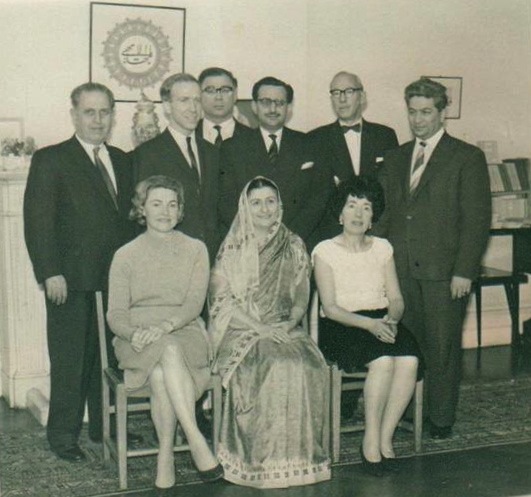
Last Spiritual Assembly of London (November 1965)
Standing (from left to right): Asher Nazar / Ron Stee / Ali Golestaneh / Eruch Munsiff / Donald Millar / Hassan Afnan
Sitting: Kathleen Hyett / Meherangiz Munsiff / Vivian Isenthal
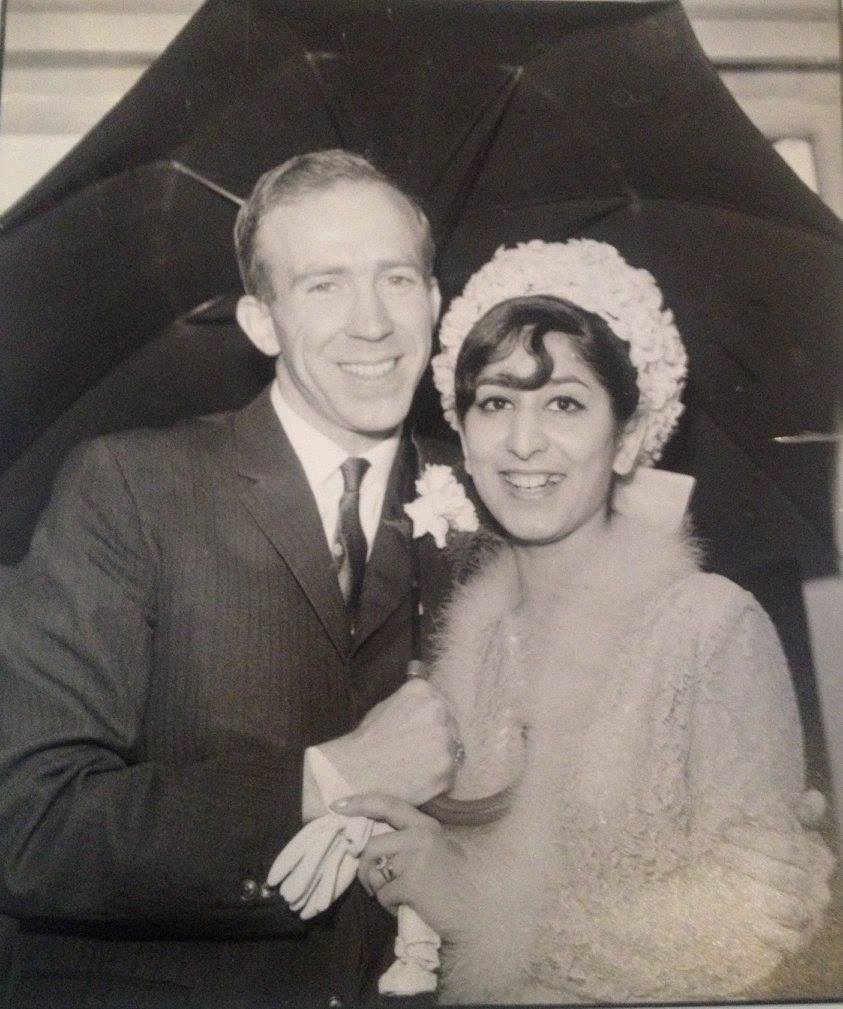
Ron & Shahla Stee – Wedding – 9 April 1966
__________________
Shahla Stee
‘Proposal’
Ron did not go down on his knees or produce a diamond engagement ring. We walked out of the Bahá’í Centre at 27 Rutland Gate, and turned left down the side streets of Knightsbridge. He stretched out his hand and took mine for the first time.
His proposal was more about his thoughts and need for action than a declaration of love. He had not been able to get me off his mind. “Is he trying to get me out of his mind?”, crossed my mind. He told me that his thesis was finished and defended.
As he was about to make his way back to North America, he felt the need to speak. He did not want me to respond immediately to his proposal but to give it some thought. He knew he must have taken me by surprise, which he had. It seemed that he knew me better than I knew myself, as until that walk I had no inkling that he saw me in those terms. He seemed to be giving me an outline of his background, his plans then and in the future, where he was coming from, where he was, and where he wanted to go.
Then he said he was planning to fly off from England in December, stopping in Iceland on the way to the US where he would spend Christmas with his sister Carol and family in Bethlehem, Pennsylvania. His mother would also be there. He and his mother were then going on to Montreal to be with family for the New Year. He would be looking for a job early in January in Montreal and as soon as he had one, we could set a date for the wedding. He would then return to London for our marriage.
Then he said: “That would give us three months to get to know each other and make plans”. As we walked, I was thinking and he was carrying on talking, but I was thinking “I am on my way to Africa”. Africa was very real in my vision and I could not see myself in Montreal. He was talking about Christmas and New Year, of the otherness not part of my culture, and places that conjured no vision in my mind.
Turning and twisting in the back streets of Knightsbridge in the darkness of the evening, listening to this man as he held my hand firmly in his for the first time and hearing the sound of my high heel shoes on the pavement, seemed even less real than the places and people he was introducing me to.
Close to midnight we reached Knightsbridge underground station where I was taking the last train home. We both realised I had said nothing, asked no questions and made no comments during the three hours we had walked and he had talked. As he saw me onto the last train, he asked if I wanted to say anything. As the door of the train closed, I said “Don’t let me go”. That was the last Thursday in September 1965, and the rest is history.
Love you forever my darling.
__________________________________________________
It was the summer of 1963.
We felt invincible.
We were multicultural youth, having just experienced a Bahá’í World Congress held in the Royal Albert Hall in London. (The Royal Albert Hall was named after the consort of the greatest and only Queen to have had the honour of receiving a tablet from the Manifestation of God for this day).
We felt we could do anything we put our minds to, and we wanted to be involved in Bahá’í activities while we had fun and, yes, we had fun. Most things we did seemed outrageous to the older generation but that was nothing new as most youth in every generation had done more or less the same at our age. We were not satisfied to do one thing when we got together. As soon as we ended one activity, someone would think of something else that we still could do before we had to catch the last tube home. We moved and acted. We went to school, we studied, we ate at odd hours and we slept when we could, but we were in constant motion to share the faith in ways that heightened the experience and with the love of Bahá‘u’lláh in our hearts.
One day, we were standing in a queue for lunch, my friend and I. It could have been the second day at Harlech Bahá’í summer school in north Wales, that summer of 1963. Ted Hart, a very good-looking American Bahá‘í stationed in Germany, had just arrived and was standing in the queue right in front of us.
Of course, having never lived in America but having listened to American music on ‘Top 10’ and watched Hollywood movies showing young people jiving and twisting and shouting at every turn, we were sure all Americans could dance well.
That was the ‘in thing’ in those days; we were wondering how well Ted, being American, could dance. There was going to be a talent show at that summer school, for which I was asked to do a Persian dance, and afterwards we were going to have music to dance to and that was all that was on our minds that afternoon.
“Let’s ask him” I whispered to my friend.
“Who is going to ask him?” she whispered back. “Not me”
“I will do it”, I said.
Before I could tap on Ted’s shoulder, whom I had never met before and did not even know his name, we heard a chuckle from someone standing behind us. I turned around and looked up into twinkling blue eyes teasingly judging me.
He said, “You’re a flirt, aren’t you?” with that usual very American/Canadian accent. I suppose you could call it a bit of innocent flirting but I was not going to give him the satisfaction of being right. I did not know him well enough and had only met him that summer. He was one of the two chess players I had first met at 27 Rutland Gate on a fireside night on a Monday. I could not fully remember his name as most non-Persian names in those days took a bit of getting used to for me.
I had gone to the Bahá’í Centre and had arrived a bit early, which was unusual for me as I was not one to be on time in those days and I always ended up being late. Someone who was working in the office at the Bahá’í Centre opened the door and let me in. I walked up the stairs to the room on the first floor where firesides were usually held and walked in on two men who were playing chess in the back part of the room. I went over to where they were sitting and watched the game for a bit, reminding me of years earlier back home when my dad and Mehdi Khan Naraghi (my aunt Khaleh Joon Jamal’s husband) used to spend a big chunk of Fridays (the weekend day in Iran) playing a game of chess and talking about the Bahá‘í writings. I started feeling bored and thought it was a good time to introduce myself and did so. They both looked up and introduced themselves. A few minutes passed and having digested the fact that they both had the same first name (I think one of them was Ron Batchelor) made me smile to myself, and to get the conversation going I asked them if they knew what “Shahla”, my first name, meant in Persian, wanting to spice up the conversation. Not being Persian, and the meaning of most western names being of no interest to them, they both politely looked up, not really interested but eager to get back to their game. I smiled and said, “Shahla means dreamy eyes”. Well I must have shocked them as they did not seem to know how to respond. Others started arriving and the game was given up and we moved into the centre of the front room to begin the fireside.
That Bahá’í summer school in 1963 in Wales, after the Congress, gelled most of our friendships for life. We attended sessions and presentations. We played badminton on the beach below the Coleg Harlech where the summer school was held. We sat around the fire at night on that beach and sang popular post-war and 50s and 60s songs to someone playing a guitar. We got to know each other’s life stories and our life plans for the future and some fell in love. I was more interested in finding partners to dance. I had decided when I was 11 years old and my parents had divorced, that love, marriage, and children were “for the birds”. I was more into dancing, meeting people I could tell about the Bahá’í faith, and finishing my studies so I could move to Africa, my dream land.
Of that summer, Ron wrote in his memoir:
“A few youth had started meeting every Friday evening to study the book “Bahá’u’lláh and the New Era” and to eat together. Bobbie Leedham heard about this and offered us the use of her flat above a store in Oxford Street near Charing Cross Road. Shahla and I were regular participants and so we gradually became friends, but not special, just like the others. For the first three weeks of August, I travelled in Europe with other fellow-graduate students who were not Bahá’ís. Then I flew back to London from Geneva and took a train to north Wales, to the Bahá’í Summer School at Coleg Harlech. Several of the London youth were already there, including Shahla. It was a very inspiring and informative school for me. Hand of the Cause Dr. Muhlschlegel was the principal speaker. In the evening, we had social activities. One night we had a talent show. Shahla did a Persian dance. Ted Hart and I did a vocal duet of the song “It’s a treat to beat your feet on the Mississippi mud.” Ted was a chiropractor stationed with the US Army in Germany. He was a good-looking fellow and caught the eyes of several young ladies, including Shahla. One day we were lined up at the cash register before lunch. I was behind Shahla, and she and a couple of other girls were behind Ted, and were chatting about him and trying to get his attention. After observing this for a few minutes, I said to Shahla, “You’re a flirt, aren’t you?” I was just teasing her, but it must have stung because she never forgot it. Later I discovered she was actually an exceptionally sociable person who wanted to be friendly to everyone. She wasn’t seeking a one-to-one relationship. Ironically, there had been a young lad who worked at a book shop in Cambridge, who had followed Shahla everywhere. After Harlech, the Friday evenings continued, but the group grew smaller as people got on with their studies. One day Shahla stopped coming and I was told that she had moved to Romford and was studying Nursing at Old Church Hospital. For the next two years I saw Shahla only occasionally, at various Bahá’í events.”
I had moved as a Bahá’í youth to Romford to support the newly formed LSA and to go to school there.
___________________

Ron & Shahla Stee – Wedding – 9 April 1966
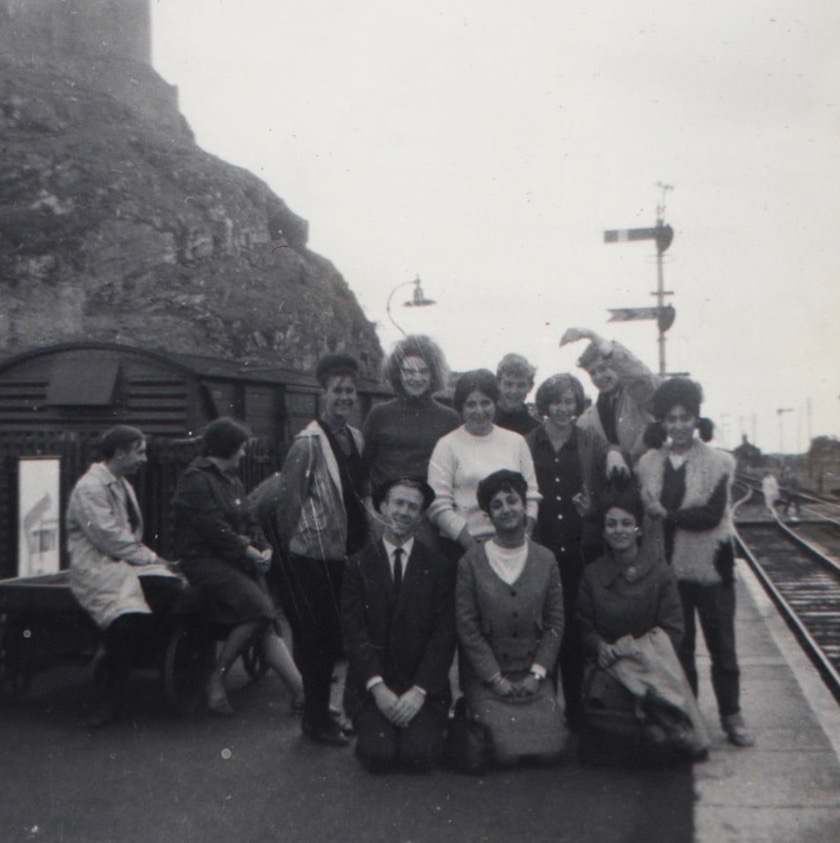
At the train station leaving Harlech Bahá’í summer school for London and dinner in a Restaurant
______________________
Shahla Stee – 13 March 2021
To the ones I love
Once upon a time God looked down from heaven and saw this very cute 6-year-old boy called Ronnie, with a head of curly blond hair, getting ready to go to school, his jacket zipped up to his neck, his school bag on his shoulder, and decided to find him a wife, so He closed His Eyes, wheeled his right hand around and round in the air and put his finger down on the map of the world; it hit Tehran and I was born.
When the boys were young and we put them to bed with prayers and a story, Ron would smile with a twinkle in his eye, hearing me telling them the story of my birth.
I was conceived in Mahallat, one of many villages close to Kashan where my ancestors were born, 110km from Kashan passing Naragh going west. Chahbaz, my brother, was born a year later and we were more like twins than a year apart. I could get us into trouble in the twinkling of an eye and Chahbaz trustingly followed me into all our adventures innocently unaware of possible consequences. We lived in a cocoon with caring parents, grandmothers, aunts and uncles and cousins galore on both sides of the family. Shohreh, our sister, was born 11 years later. We adored her. Chahbaz and I fought over who was to hold her. We played with, fed, and dragged her with us everywhere we went, and spoiled her to death.
My parents were from Kashan on our father’s side and Naragh on our mother’s side. Kashan was once the capital of Persia. Taking the road west less than 65km you would come upon the village of Naragh. They were extremely proud of their heritage, considering themselves way above others who did not belong to the central part of Persia. Some of the family had been forced to move to Tehran a few generations back, getting away from religious persecutions that were so rampant in that part of the country, and have not ceased even today.
The family had built a complex in Tehran called Hayat-Bagh, where those fleeing persecution in Kashan were given sanctuary until they could get established in a place of their own. Rooms were built, all enclosed and shielded from the outside, forming a sort of fortress sanctuary for protection. Rooms faced two large courtyards with a well and washing pool in the center of each, connected one to the other internally. A patio a step or two above the yard fronted all the rooms, allowing for families using the rooms to sit out on carpets and rocker chairs or large mats set against the walls of the rooms on hot summer days. Corner rooms were larger and more prestigious, so were occupied by older members of the family. By the time we were born, our parents’ generation had moved up town close to the university and the new Bahá’í center, and Hayat-Bagh was a thing of the past the older generation told stories about.
Why and how our parents were married is another story.
They were married about the time that dad’s oldest brother Asadu’llah Khan Majidi and family were leaving Tehran to pioneer to Mahalat, south of Tehran close to Kashan and part of the central Province of Iran. Mom and Dad were to help Amoo Jan Asadu’llah Khan and our Zan Amoo Jan Shamsieh Khanum and five children move to their pioneering post and honeymoon at the same time in Mahallat, hence I was conceived close to the ancestral lands but was born in Tehran. I was 11, Chahbaz 10, and Shohreh yet not born when our parents divorced and our lives changed forever. 10 years later, just before Ron and I were married, our parents remarried each other.
Ten years of my early life were filled with school from Madrasi Firdossi to Vali Ollah-e-Nasr and Italian High School in Tehran, to New Era High School in Panchgani, India, to travels in Turkey, Syria, Lebanon, Cyprus and Italy. Then across the continent that took dad and me to Britain, the years 1963-66, were also filled with school, youth service in Romford, Essex, and meeting the love of my life, and our ‘three marriages in a day’ which is another story to tell, and honeymoon in Spain, then moving to Montreal, Canada, to start our new life together. The following 49years were filled with the joy of raising our two sons, seeing our four beautiful grandchildren grow up, and our Bahá’í service work. Needless to say, it fills a book or two to tell all that took place in our lives in those days. We were globetrotters.
We lived in and around Montreal 1966 to 1977, moved to Iran, returned to Montreal in 1979, moved to Egypt from 1982 to 1985, back to Montreal, moved to Beloit Wisconsin and Rockford Illinois, 1994 to 1996, then to China and Singapore, back to Beloit and Rockford from 1998 to 2000, moved to Birmingham Alabama and then back to Montreal in 2010.
Between the years 1996 and 2010 we lived in Montreal, Iran, Egypt, Beloit Wisconsin, Rockford Illinois, China, Singapore, and Birmingham Alabama.
Since the year 2000, so many I have loved, hugged, kissed and laughed with, cried with, talked and consulted with, have left this world for all the worlds of God.
I still laugh and cry with them, talk and consult with them. At times I have to smile to myself as I can almost hear them saying: “Shahla, are you sure this is wise? You know you are not fifteen any more.”
At times I feel jealous as I can see them sitting next to each other on those pink clouds holding each other, laughing and talking, looking down on us with love.
_________________
Shahla Stee (née Azarkadeh)
Montreal, Canada, March 2020 (revised October 2021)
 UK Baha'i Histories
What a thrilling and heartfelt story, Shahla khanum. I find in it the quality of lightning: swift, decisive, unpredictable in its turns; surging towards its glorious destiny; the world always a step behind, striving to keep apace!
Pingback: Hassan Afnan (1926 – 2010) | UK Baha'i Histories
Pingback: Hassan Afnan (1926 – 2010)
Pingback: Hassan Afnan (1926 – 2010) - Bahai Journal