
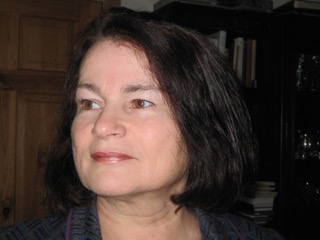
Patricia Jamshidi
I was born on the 13th of March, 1949 in the private wing of the Royal Victoria Hospital, Belfast. The family lore is that I was born on Friday the 13th but, in fact, it was a Sunday. An emergency operation caused my parents to decide not to have any more children. My birth was funded by the sale of a German camera my father had acquired during the Second World War. The resulting £90 paid for private care for my mother, who had been told that due to a childhood illness she would never survive childbirth.
Christened Fanny, my mother was the only girl of nine children born to Lydia Sygne, the youngest daughter of Lord and Lady Synge of Syngefield, County Offaly. My grandmother married Francis Mitchell of Wallcott Birr, who came from a family of solicitors.
My father, Hugh Johnston Montgomery, was the eldest son of a family of two boys and two girls born to Eileen Montgomery, née Hughes, whose family came from Birdhill, Limerick, and Ira Montgomery, whose father had been born into a farming family in County Antrim. My grandfather was a bank manager and my father was born in Cavan in the Irish Republic.
My parents met when my mother was stationed in Omagh, having joined the WAAF in Northern Ireland in response to the Second World War. My father had been demobbed from the army after the war. His parents were then living in Omagh, but on arriving in Northern Ireland he was attempting to go to Dublin when he got sidetracked to attend a party his sister Ruth was having in the town. My mother knew his sister Ruth through the WAAFs (the same Aunty Ruth who reassured dad about the Bahá’í Faith many years later) and had been invited to the same party.
As soon as dad saw mum, he decided to marry her, according to him! He went up to her and in typical dad fashion stated that “as he had done all his duty dances, he could now please himself”. He then asked mum for a dance. He proposed the same night.
Mum, who was 29 or 30 at the time, had just given back an engagement ring to her then fiancé, telling him that he was rushing things a bit and that they needed to get to know each other better. The courtship between my father and mother was not long but entailed on one occasion dad keeping mum out beyond WAAF curfew time, which meant he and the taxi driver had to haul mum on top of the taxi and swing her over the barbed wire fence of the compound where she lived!
Dad, not wishing to let grass grow under his feet, a short time later repeated his proposal on the steps of the Stormont Building where he was working at that time. This time mum said yes.
Due to her poor health, I had only one sibling, my sister Susan, who is one year older than me. She passed the 11-plus school examination and went to Belfast Royal Academy. But I was a child who lived too much in my own world. I never paid attention in school and failed as a result, so I went to a semiprivate school (Princess Gardens School; now Hunter College). I passed my junior certificate and went on to be a nurse and a midwife, becoming a midwifery sister in the Special Care Baby Unit in the Ulster Hospital before I left there to have children.
I was brought up in a family where my mother was Church of Ireland and my father was an atheist or an agnostic (depending on how riled up he was at the time). My mother very occasionally went to church; my father never did. However, dad did agree that mum could send my sister Susan and I to Sunday School “as long as it was to some simple church with no mumbo jumbo in it”. We ended up in the Whitehouse Presbyterian Church Sunday School, a place neither parent ever attended.
When I was eight or nine years old, we had an outstanding Sunday School teacher who really helped me identify with the suffering of Christ. I remember a number of times at that age being overwhelmed with sadness at the reaction of the Jews to Christ. This had a strong influence on me and I was determined that when the classes stopped—as they did when I was ten or eleven—I would attend the adult church meetings on a Sunday. When I reached this age, I went on my own (Susan having followed my father’s atheistic beliefs) and sat at the back of the church. I don’t remember how many times I attended but I don’t think it was many. Attendance was brought to a halt when the Reverend Nutt, standing rigid and red-faced in the pulpit, got himself worked up into such a frenzy that he started shouting at the congregation, saying we were all evil and that as sinners we were all going to hell. Thumping the pulpit to drive home his points, he looked on the verge of having a stroke. I never returned. A few years later, just before I met the Bahá’í Faith, my mother asked if I would be confirmed in the Church of Ireland, but I refused. I had concluded that I would find no answers in established churches.
At night during this time, I would attempt to pray. My prayers were nothing like Bahá’í prayers; more a case of me demanding of God that He needed to help me right now. I asked myself what the purpose of life was. I believed in Christ but not in the Church. Was there no purpose to existence? I thought I might as well be dead, and in fact I was depressed and suicidal. It was a very dark period of my life. I was in this state for some years but concealed it from others. It was at this time that I started grammar school and eventually befriended a girl in my class called June Glover.
Through her work as a teacher, June’s mother was a friend of Peggy Harrison and Grace Pritchard, both Bahá’ís at the time in Bangor, County Down. When I was 15, on one occasion, June, who was staying with Grace in Bangor for the summer holidays, invited some of her class friends down to Bangor for the day. The other girls in the class and I had arranged to meet up in Belfast first to go to Bangor together, but none of the others were interested. June told me to come on my own, which I did. There, June told me Grace was a Bahá’í. I naturally asked her what the Bahá’í Faith was as I had never heard of it. But June didn’t know. I remember feeling quite put out that she could not answer even one simple question on the subject. There was a meeting that night in High Street in Belfast and June asked me if I wanted to attend. I reasoned that if June could not tell me anything I might as well go and find out for myself. Peggy took us up to Belfast and I think on the way we stopped off at Jane Villiers-Stuart’s house on the Shore Road. What I remember clearly is climbing the numerous steep stairs up to the attic, feeling quite shy and nervous, joking that, “If you had second thoughts after struggling up those stairs, you wouldn’t have the will to climb back down again.” June, much more socially confident than I at the time, seemed to have no problems meeting total strangers.
Charles MacDonald was taking the fireside that night on the subject of progressive revelation. The only people I clearly remember present were Beman Khosravi and the Jamshidi brothers—Quadrat, Hushang, and Rustam. June started asking questions after Charles’ talk and, as I was saying nothing, she drew me into the conversation by telling them what I believed in (we had had many conversations on the subject of belief). This overcame my shyness because I no longer cared for anything I had believed in before I entered that room. I had been hit by a spiritual tsunami, and I knew at some level that everything I was hearing was true. It was answering questions I had been shouting at God to help me with (in a very unspiritual manner) every night for the past two or three years. I knew this on a level that was not intellectual. I started to bombard Charles with questions. He had hardly finished the answer to one when I was asking another. When he answered me, I knew he was right. I did not need to question his answers, I just needed to ask more and more questions. At this point Beman Khosravi intervened saying he felt they were giving me too much. I remember feeling angry with Beman and very approving of Charles when he said that he felt they needed to respond to me.
From the depths of despair I was now catapulted into the stratosphere of heaven. The Jamshidi boys walked June and me back to the train station to go back to Bangor where we both were staying with Grace Pritchard. On the train I told June I was going to become a Bahá’í. When I got back to Grace’s home I asked her how I could declare my faith in Bahá’u’lláh.
When I returned home from my stay in Bangor, I sat my parents down and told them Christ had returned and that Bahá’u’lláh was the Manifestation of God for this age. My mother was upset and, in hindsight, I think both of them thought I was being brainwashed by a dubious sect. Mother arranged for the incumbent of the Church of Ireland in Whitehouse, the Rev. Sheppard, to come to the house to talk to me in the hope that I could be dissuaded from affiliation with the Bahá’í Faith.
That meeting stands out in my memory as nothing else. I was then 15 years old. Under Charles MacDonald’s guidance I had written to the Rev. Nutt (at the Presbyterian Church) to let him know I had become a Bahá’í. A few months later he died, and I had no further contact with that church. The Rev. Sheppard (Church of Ireland), however, was at that time a young man and had just taken up his role as minister of the parish. He came to the house early on a Saturday morning and my parents were both present.
We were seated on the old-fashioned settee with its paisley covers in the sitting room. He began by explaining the station of Jesus Christ. I countered by references in the Bible about the second coming. He stated that he would come in a cloud. I countered by saying I understood it to be a cloud of misunderstanding. He stated that only those who came through the spirit of Christ could be saved. I countered that the same spirit was in Bahá’u’lláh. Cornered, he brought up false prophets and I countered with “by their fruits ye shall know them”. Throughout this duel—which is exactly what it was—my father was beaming from ear to ear (an unusual facial expression for him). This, more than the verbal battle, greatly encouraged me. I quickly understood that the minister had no more interest in changing his understanding of the truth than in flying to the moon, but my father was reacting in quite an extraordinary way. The minister, realising he was getting nowhere with me, left the house. I don’t think we even offered him a cup of tea! I turned to my father, hoping that he had begun to understand the station of Bahá’u’lláh and I had a strong desire to teach him the Faith. I realised with amazement that his enthusiasm was not engendered by any understanding of the Faith, but by the fact that his 15 year old daughter had bested a minister of the church, and was beside himself with delight. I was left feeling disappointed and had just had my first taste of the frustration of teaching.
My parents prohibited me from attending any meetings that went beyond a certain time at night; I had to be home by 10 pm. This meant that when I attended an evening fireside, I had to leave at 9pm to ensure I would be home in time. Dad regularly came into my bedroom at night in an attempt to stop me praying. Both my parents asked me not to declare my Faith until I was 17. I consulted with the Spiritual Assembly of Belfast (I was then living in Newtownabbey) and they advised me to ensure family unity and to obey my parents in this matter even though it was my right to declare my Faith. This was a great hardship for me at the time as it meant not attending Feasts. This sadness was further exacerbated by the fact that my friend June had, in the meantime, declared her faith and was able to attend the meetings I could not go to. Interestingly, when I did attend my first Feast, the friends were so used to my attending meetings that nobody even welcomed me into the Faith, as they thought I had always been a Bahá’í, which in essence was true.
My father’s attitude changed to some extent shortly after my declaration (which I count from when I was 15), evidenced by an exchange of information with his sister Ruth, who by then was living in Canada. Aunty Ruth regularly visited Northern Ireland but at that time always travelled by boat. Dad must have written to her saying that I was interested in the Bahá’í Faith. She replied that she had met a lady on the boat who was a Bahá’í and assured dad that if this lady was an example of the Bahá’í community, he had nothing to worry about. This must have appreciably lessened his concern, because the next year he allowed me to attend Harlech Summer School in Wales with money I had saved from doing a summer waitressing job in Belfast. However, this did not mean he was happy with my religious interest. He continued to attempt to stop me praying, and when I did insist on formally declaring my belief at 17, he was very upset.
June Glover (later Hoskins when she moved to Cambridge) and I went to Harlech Summer School together in 1965. It was the first Bahá’í Summer School either of us had attended. The talks were a very powerful draw for me, and I went to every one of them, but found the socialising very challenging due to my intense shyness. At the conclusion of the school, June told me she was not returning with me as planned, as she had made other arrangements. To say this was a shock for me would be greatly understating my reaction to this news. The journey home entailed two buses, one train, and one boat for one very terrified 16-year-old before Belfast harbour could be reached. I was quaking so hard I could hardly carry my case but my pride kept my mouth shut. To my amazement, on the first bus the conductor enquired where I was going and took me to the next bus telling the driver to look after me. The second bus conductor asked a male passenger to make sure I got on the right train. On the train a family shared their packed lunch with me and the man of the family ensured I got to the boat. On the boat (full of soldiers going to Northern Ireland) a man approached me, and stating that it was very unsuitable for a young girl of my age to be in the company of so many men, appointed himself my guardian and sat up beside me the whole night. On no occasion throughout this journey had I the need to carry my own case. To conclude this very odd journey, I had just realised my self-appointed guardian had disappeared and was preparing to disembark, when I heard Jane Villiers-Stuart’s very distinctive voice from behind me asking what on earth I was doing on the boat, and did I need a lift home? Even now, I remember this journey when I think about confirmation.
Shortly after officially declaring my Faith in Bahá’u’lláh at age 18, I started nursing training at the Royal Victoria Hospital, Belfast. This gave me more control over saying prayers, but night duty meant I was sometimes sleepy at Bahá’í meetings. I longed to be more active in the Faith but no one ever asked me to do anything. This changed when the Belfast Spiritual Assembly asked me to go with Auxiliary Board member Dick Backwell to present “The Proclamation of Bahaullah” to the head of a college. I had just passed my driving test, so I had arranged to borrow my father’s car, and was to meet Dick outside the college. Horror of horrors, due to my inexperience, I was late and got there just as Dick was leaving the building, having met the individual and presented the book himself. I was ready to disappear into the ground in embarrassment but Dick was very easy-going about the situation. This is just one of many examples in my life of the ‘pith of self’ getting in the way of service, but life would perhaps be dull without such challenges.
On another occasion, around the same time, the Belfast Assembly asked me to place some Bahá’í quotes in the Belfast Telegraph. I was not used to responsibility and I stood outside that newspaper’s office in bits. It was only the love of Bahá’u’lláh that got me in through the doors and I entered as if going to my own execution! I addressed a lady at the counter and handed over the quotes. The date of insertion was noted, the amount paid, and next I found myself out on the street wondering why I had been in such a panic over it all. I had to reflect that God was dealing with some very substandard material in me and that if the Golden Age were ever to appear, I doubted I would have much of a part in its unveiling!
When I was 21 or 22, I went on my first pilgrimage. Accompanying me by accident rather than design was a young Bahá’í from Northern Ireland, Denis MacEoin. We checked into the same hotel in Haifa, a place called the Vice Hotel. It should have been called the Lice hotel. I could not cope with its scruffy, ill-kempt appearance, so we agreed to ask the local tourist board to re-house us with a local family, which they did. This family arranged for me to be shown around the local hospital where I was cornered by staff and challenged about the Bahá’í Faith. However, mindful that I should not be teaching the Faith in Israel, I only briefly answered any questions asked. Before leaving Northern Ireland I had been given something by Lisbeth Greeves to give to Mr. Ali Nakhjavání, then a member of the Universal House of Justice. The subsequent meeting with the members of the House of Justice had such an impact on me that I could take little of it in but I somehow managed to fulfil my duty. The rest of the pilgrimage was a haze; at times I was not sure I was present enough to cross a road safely. I experienced my return to Northern Ireland as bereavement and it took me many months to readjust to a very different reality. I have been on pilgrimage three more times since then with my family, but that first one nearly took my soul from my body.
You can tell by all of this that I wasn’t much of a social butterfly or brimming over with self-confidence, and I wasn’t much for boyfriends either. However, as I wrote earlier, attending that first Bahá’í meeting in High Street, Belfast was one Hushang Jamshidi. He took me to my first formal meeting and in my early twenties we started dating and later married. Lisbeth Greeves wanted our wedding to be in her house (Altona) but, ever mindful of her husband ‘the colonel’ who did not always welcome a large crowd of Bahá’ís in his home, we decided it was wiser just to have our engagement party there. Every Bahá’í in Northern Ireland was invited. My parents wanted to have a big wedding, but I did not, as ‘Abdu’l-Bahá had advocated simple weddings. I thought about it and compromised. My dress was home-made and dark green. My parents invited 200 guests, and I reasoned that if they wanted to pay for the proclamation of the Bahá’í Faith to 200 people, I was not going to argue.
Hushang and I had four children—my son Kaihaan, two daughters Shohreh and Shirin, and one very precious miscarriage, Aeden, now residing in the Abha Kingdom. I went back to work when my youngest was three, as Hushang had lost his job with the closure of the Grundig factory where he worked. Later, I retrained as a counsellor, supervisor, and eventually a Consultant EMDR (Eye Movement Desensitisation and Reprocessing) practitioner. I worked with trauma victims for many years in West Belfast and am now retired, working in my own private practice.
When my first child, Kaihaan, was six months old, Hushang asked me if I wanted to go to the International Bahá’í Conference in Bahia in Brazil. When I said yes, he answered “Well, get ready, you will be leaving in a few days.” This was the result of an agreement between us. He had attended the Nairobi Conference in Africa, but I could not go as I was pregnant and therefore was to go to the next International Conference. My son was packed into a cardboard box onboard the plane for the flight from Heathrow to Rio de Janeiro and we were off. Being a very sociable baby, when we landed, he was passed round the airport’s admiring staff and loved being the centre of attention. We then transferred to the local airport, involving a slight disagreement with a local taxi driver who was intent on robbing me. I saluted his attempt but refused to give him more than the standard charge despite his theatrical attempts to embarrass me. On arrival at the conference centre I met up with Hushang’s cousin, Jamshid Arjomandi, whom I knew from his time in Northern Ireland. He was by then married and living in Suriname. I was only able to attend one session at the conference due to needing to look after my son. In this session each country was called out and the attendees from that country were asked to stand. I stood when the UK was called but when Ireland’s name was mentioned Jamshid insisted I stood again. One eagle-eyed American boy challenged me, “Why did you stand twice?” I attempted to describe Northern Ireland politics, but as even most people in Northern Ireland can’t explain this conundrum, I had little success. However, I think I convinced him I was not trying to bamboozle anyone. I had some days at the end of the conference where I attempted to take part in the mass teaching campaign being held some miles to the north of the conference centre. But when I got there, they said I could not participate with my child and I had to be content with just talking to them about the project. It was from such work that the Ruhi books emerged. At the conclusion of the conference, Jamshid was planning to travel overland to Belize, while I planned to take a flight. We would meet there and conclude our journey together to Suriname by plane. At the airport was Hand of the Cause Paul Haney. I was suffering with a cold and refused to be introduced but he insisted. Fortunately for his health, I had little time and had to board my plane. I struggled to give the official at the airport my papers with my arms full of Kaihaan. I gave up and, noticing a soldier by the side of the wall standing to attention with his rifle, placed my son into his arms. I will always remember the beaming smile on that soldier’s face mirrored by the beam on my son’s. It was such an enduring picture of oneness.
While in Suriname I had the great privilege of going on some journeys with my son into the interior where we met up with some Maroon people. Some of these meetings were arranged by the then-secretary of the Suriname National Assembly, a lady called Leticia. We struck up a friendship and she would pick us up and drive us to the villages so that she could be present as my interpreter. We made a very odd couple, as she was black as polished onyx and I looked as if I had crawled out from under a stone with flesh that had never seen light, and with a six-month-old baby swinging from my hips. No one had to guess who the boss was, it was definitely Leticia; she had a very commanding presence. I loved every minute of it. This time taught me the sheer joy of teaching when you had a listening ear.
Not long after I returned from that trip, I had the joy of visiting my mother-in-law and father-in-law in Karachi. My husband stayed for a few weeks but had to go back to Ireland to work. I stayed on with Kaihaan for some months. When I first arrived I asked if I could visit a village called Tah Tah, outside of Karachi. It was a Bahá’í village, all of its inhabitants having originally been of the untouchable caste. I was told that because of the political situation there it would be unlikely. However I used a lot of my time in Karachi praying that God would allow our family to pioneer. About a month into my visit, Hushang’s uncle Mehraban, who was serving as an Auxiliary Board member, came to visit. As he entered, he said, “You must have been praying very hard.” I had been but was confused as to how he knew. Then he stated they were going to Tah Tah and that I could come. If the Archangel Gabriel had bellowed in my ear that I would not be pioneering, the message from the Abha kingdom could not have been clearer. The visit was wonderful but sad. Sad because they felt our eating with them was such a big thing and because a young Bahá’í mother there had a child affected by polio, an easily preventable disease. I later learnt that Bahá’í doctors from Karachi were able to visit Tah Tah and give them medical help.
Although our family never did pioneer overseas, Bahá’u’lláh allowed me in later years to take up a post as a community counsellor in West Belfast. This area of the city is very deprived and was the first to be affected by ‘The Troubles’. It is a world within a world. My second client I am sure was sent to check me out from “interested parties” (i.e. a paramilitary group) in the area. In a way Bahá’u’lláh did allow me to pioneer but within Northern Ireland. I felt very privileged to serve in some way the wonderful people I met while doing the counselling work.
Much later on when my oldest daughter Shohreh was 12, the opportunity arose to go to the Bahá’í World Congress in New York. As a junior youth programme was organised as part of the event, I felt it would be good for her. Anne Munro was attending from Northern Ireland, and we agreed to travel together. We first went to Chicago to visit the Bahá’í Temple. My first impression of this was of a building made of lace. The second was how close other buildings and homes were to it. There was a huge space under the temple where an exhibition had been mounted. Shohreh was everywhere at once trying to take in what could not be taken in in such a short period. I too was spinning with sensory overload. The New York conference was a window into a multicultural international future. My spare time was taken up in running around the city and in dropping off and picking up Shohreh from her programme, with little idea of where I was most of the time, accompanied by constant warnings from New York taxi drivers to watch out for thieves.
Further memories of my efforts to bring my children to Bahá’í events found me attending the Southern Irish Summer School in Waterford most years, one of which stands out for me. By then our two older children had left home. I wanted to take my youngest, Shirin, to the school but had left the booking too late, so there was no more room in the dorms. I detest camping, but feeling very virtuous, took my mother’s large tent. Shirin and I spent most of the day erecting it. To say it was a complicated design would be an understatement. Exhausted but successful, I paused for breath and Shirin asked could she invite her friends to share our tent and would I use theirs. I agreed before seeing the other tent, which was the tiniest A-frame imaginable. It poured with rain all that night and I had to keep my arms wrapped around me, because if I didn’t, they would get drenched brushing the sides of the tent. As I emerged backwards in the morning, someone observing me commented, “Patricia your backside is bigger that your tent!” I had been conned by my youngest child!
When I married Hushang, we moved to Castlereagh on the outskirts of Belfast and became part of the Castlereagh Spiritual Assembly, which at different times included George Hackney, Amy and Alec Shields, Stella Brew, Vincent and Madge Crilly, Beman and Marion Khosravi, Betty Reed, and Hushang and myself. Over the years, I have also served on the Regional Teaching Committee, the Bahá’í Council for Northern Ireland, and the Regional Board of Huqúqu’lláh for the UK and Ireland. Marion Khosravi and I were, through the Castlereagh Spiritual Assembly, primarily responsible for setting up the George Townshend Bahá’í School, which ran for many years. It was a natural extension of the children’s classes we were already having for our own families. In later years I have been a tutor for study circles, held devotionals, and run junior youth and children’s classes.
When my father was in his seventies, he and I were in the kitchen of our old home washing dishes together when he suddenly asked if I was as keen on the Bahá’í Faith as I used to be. I replied that I was, if not more so. He then said he wished my sister was a Bahá’í and except for the belief in a God, he found the Bahá’í teachings very commendable. I was astonished and wondered what had prompted this remark. He said there were a lot of books of mine in the attic that he wanted me to clear out, emphasising that he had not read any of them. When I went to sort them out, I found a diary I had kept just after I had met the Faith and just before I became a Bahá’í. It was atrociously written with horrendous spelling but the pain and the joy were clearly evident. I was sure my father had read it. It is interesting to note that through the encouragement of my husband my parents both agreed to drop their plans to be cremated after death and to be buried instead. And because my father would have nothing to do with clergy, both had Bahá’í funerals.
____________________
Patricia Jamshidi
Northern Ireland, October 2016
 UK Baha'i Histories
Dear Patricia,
So lovely to read your story. It brought so many memories to mind of Ireland, north and south, and tears of love for the many friends there who were so important to me during my spiritual awakening in the 80’s.
Warmest love, Jane Helbo (Sadler)
I was at that summer school in 65. We must have met.
Well I do remember the wild Irish girls at the Harlech Summer School in 1965!!!!, love your story and reading of your service delightful.
Touching, humourous, uplifting! You lifted my heart, Patricia. It was lovely too feel throughout your article, your indomitable faith. You must have visited us in Liverpool. Love from Pauline & Isaac
Patricia
I have only just got to reading your wonderful story. I was waiting for a quiet moment to read it “properly”…. in one go so to speak! So now we have Cleo Laine singing, it’s a sunny day and we are having our morning coffee break and it’s just that moment.
Thanks for sharing all this. My memory of dates is so bad but I think I was at the ’65 Harlech Summer School. Anyway your mention of Northern Ireland brought back so many happy memories of my own time in that inspired community.
It was lovely having you and Hushang for a cup of tea (and cake!) in our garden when you visited Inverness with the Macfarlens last year.
Much love to you and Hushang
Liz
Moving story loved it! Love to you and Hushang
Wonderful read. You write so well, with such wit & sincerity. Love to you & Hushang x
Seb Clare