
“But you are a Baha’i!”
These were the words of Ridvan Moqbel. We had arrived within a few minutes of each other at the UK National Baha’i Centre in Rutland Gate. This was my first visit and I was there to attend the weekly information meetings that were open to all. Ridvan happened to be the speaker for the evening! I latched on to him and he made the above comment during refreshments when I told him a little about my background. So I feel it is appropriate that I should start there.
I was born on 14th June, 1936, on my maternal grandfather’s farm some fifty miles from Fort Jameson, a small town in the Eastern Province of Northern Rhodesia, a protectorate of the British Empire. It gained its independence in 1964 and was named Zambia, and Fort Jameson is now called Chipata.
Both my grandfathers were Englishmen, civil servants in the Colonial Service. My grandmothers were both black, but from different tribes. (My father’s mother was the eldest daughter of a local chief. I once met a journalist who told me that as her eldest son, my father could have become the next chief!) My maternal grandfather went into farming on his retirement and registered his marriage to my grandmother. My paternal grandfather married a white woman and migrated to South Africa. My father was trained as a teacher at Church of England mission schools. When I was seven he went to college in Cape Town as an adult student to get formal qualifications. My mother’s family were Roman Catholic but she became Anglican when she married my father. (He was condemned to hell by a Catholic priest when they shared a hospital ward in later years!)
One of my uncles started a school on his farm for children in the family. My father was employed as the teacher. Later it was taken over by the government and became the first school in the country for mixed-race children. Many who came to the school were children of black women who had been abandoned by their white or Asian fathers. In 1946 the school was transferred from the farm to a location on the outskirts of town. It had been the site of a camp for Polish refugees during the second world war. There was a school for white children in the town centre and another for Asian children in the “Indian Quarters”.
[Under the apartheid regime in South Africa, the citizens were classified as whites or non-whites. The non-whites were further classified as Coloured (mixed race), Indian and Bantu, and the Bantu classified by tribe (Zulu, Xhosa, etc). The Group Areas Art allocated separate residential areas for the groups. This was designed to prevent the non-whites from uniting to oppose the system. Naturally these groups were indoctrinated into seeing themselves as different. Lighter skinned people were perceived to be superior and prejudices developed.]
There was no secondary school for us “coloureds”, so ironically I had to go to South Africa to continue my education. I went to a school called Zonnebloem College, run by the Anglican church. It had originally been a wine farm. It was then converted to a school for the children of African chiefs, but had long since been changed to a Coloured school. After two years there I transferred to a government school called Trafalgar High School. Many of the teachers were actively engaged in the political movements campaigning against the apartheid system, and the school had a distinct non-religious character. In 1955 I went to the University of Cape Town (UCT) where I obtained a science degree and trained as a secondary school teacher. Non-white students were not admitted in the halls of residence and could not take part in university sports. A year after I left, the University of the Western Cape was opened for Coloured students and could no longer be accepted at UCT except to study medicine. At about the same time another university was opened in Durban for Indian students. An older university already existed in Eastern Cape, and this was primarily for Bantu students.
While I was at university, Northern Rhodesia, Southern Rhodesia and Nyasaland were brought together by the British government as the Federation of Rhodesia and Nyasaland. Founders High School had been opened in Bulawayo in Southern Rhodesia for “Coloured and Asian” students, and that is where I was posted. The Civil Service had four “Branches”. White teachers were automatically entered into Branch One. I was appointed into Branch Two, at about two-thirds the white salary. After one year I was interviewed by a panel of inspectors and promoted to Branch One. I must mention that when I was interviewed in Lusaka for a bursary to go to university, I was asked what I wanted to study. When I said Physics, a panel member asked if “my people” would be able to understand it!)
The Federation was seen by the African political movements in Nyasaland and Northern Rhodesia as a means of perpetuating white rule dominated by Southern Rhodesia which was a self-governing colony. Fierce opposition arose in the two protectorates and in 1963 the British Government dissolved the Federation. Nyasaland and Northern Rhodesia became independent as Malawi and Zambia. Southern Rhodesia declared unilateral independence from Britain and renamed itself Rhodesia. After many years of conflict between the white regime and the black resistance movements, it became Zimbabwe.
I married May in January 1964. She was the sixth child of a family of eight. The first four were girls. The family were all devoted Anglicans. May had been a student at Founders and was recommended by some of the staff members as my future wife! After our wedding we moved to Northern Rhodesia, where I was posted to a school in Ndola called Llewellyn High School. My daughter Jennifer was born there in 1964 and Susan in 1967. May and I divorced in 1979 and she returned to Zimbabwe. Jennifer remained in Lusaka until she had completed her O levels.
Llewellyn High School had been an all-white school. I and two colleagues from South Africa were the first non-white teachers at the school. Of the student population of some five hundred, less than thirty were non-white. I expected to have disciplinary problems but fortunately this was not the case. The only prejudice I experienced at the school was when the headmaster, an ex-missionary, asked me not to order laboratory equipment from a certain supplier because “they were a bunch of Jews”.
After three weeks at the school, one of the senior students came to me and said he had had several mathematics teachers and I was the first one who made sense! The teacher in the next room often came in to observe my lessons. On a few occasions I was asked to resolve a dispute between him and the students about the correct answer to a problem. The school secretary referred all parents who wanted extra tuition in mathematics for their children to me. When I asked why, she said the students told her I was the most patient teacher they had ever had! Also for the first time I had black students in my classes. (Years later I was in a group of black friends when one of them remarked: “I don’t see Alfred as a Coloured. I see him as just one of us.” That pleased me greatly because former attitudes still persisted. I am very happy to say that both Jennifer and Susan grew up in the same way.)
Growing up on a farm we had no access to church and I had no religious education. When the school moved to town, we occasionally had the vicar come round for services. The Roman Catholics were far more active and had regular visits. The children with Muslim fathers had mainly been abandoned by them. I don’t know, but suspect that they joined in with the Christians. I don’t recall any kind of animosity based on religious differences at primary school, or when I taught at Founders or Llewellyn.
At boarding school in Cape Town, we had prayers in the chapel morning and evening, mass on Sunday and sometimes three services on Feast days. I served at the altar. At Founders we had Christians of various denominations, Muslims, Sikhs, Hindus and Zoroastrians. At Llewellyn we had Jews in addition. Although nominally Anglican, I had lost all interest in church since leaving Cape Town. Meeting and getting to know children and parents from other faiths, I began to question why I as a Christian should consider myself superior to all these other people.
With this background is it any wonder that I got so excited when I first read the principles of the Baha’i Faith!
I first heard about the Faith from my eldest daughter, Jennifer. Her mother returned to Zimbabwe when we divorced, and Jennifer and Susan went to live with her. Jennifer came to visit me in Lusaka. I took her to the Baha’i Centre and to visit Baha’i families living in Lusaka. The lady in charge of media affairs also took her for an interview on Radio Zambia. At the Baha’i centre I was given a small pamphlet with details of the principles of the Faith. These excited me greatly. Of particular interest was the teaching of progressive revelation. I had always wondered why there were so many religions and this was the first time I had an answer.
Jennifer had been a student at the International School in Lusaka. Unknown to me, some of the teachers at the School were Baha’is. (On pilgrimage I met an American family who had taught at the School. They told me she told them that she thought her mother would be interested in becoming a Baha’i, “but my father never”!) She went to a Catholic school in Harare for her sixth form and then went to the University of Michigan in the United States. “Doc” Halliday was a lecturer there and his wife Diane was an administrator. (Through them she met Dizzy Gillespie.) I met both of them when I visited the university. Jennifer became a Baha’i when she returned to Zimbabwe.
I attended my first Fireside in Harare, at the home of the Ojermarks. I had had business dealings with Paul in Lusaka but didn’t know he was a Baha’i. At the fireside I also met someone I had played tennis with in Zambia. When he told me that he was already a Baha’i when I met him in 1964, I instinctively asked “Why didn’t you tell me about it?”.
So I met Baha’is in Zambia and Zimbabwe, and later in the United States, Canada and in the United Kingdom. They were from various ethnic and religious backgrounds but without exception they were all very nice people – open, welcoming and genuinely friendly. This made a very big impression on me, especially having experienced so much racial segregation and prejudice. In Canada I went to several firesides and was invited to many events. If I had remained longer I would probably have become a Baha’i there. As a Baha’i I have visited Baha’i centres in Lusaka, Harare, Johannesburg, Maseru, Addis Ababa and Tokyo, and everywhere I have been welcomed with open arms.
I left Canada in 1991 to return to Zambia. I stopped over in the United Kingdom to visit my brother in the Isle of Man. There I met Eleri and we soon struck up a close relationship. So we decided that I would return to get married after winding up my affairs in Zambia.
I went to Zambia as planned. On my way back to the Isle of Man I stopped over in London and decided to visit the Guardian’s Resting Place. I lost my way but after walking miles I eventually found the main entrance to the cemetery. I joined a large funeral group, thinking they were Baha’is, but discovered it was a Greek funeral.
Eleri is Welsh. Her father went to the Isle of Man as a church minister and she grew up there. When I met her she had a daughter and a son but was separated from her husband. I returned to the Isle of Man in 1992 and we married in June of that year.
There were five Baha’is on the Isle of Man – John Maher, Tony Alexander, Diane Manoucheri and another couple. Most of the meetings were held at John Maher’s home. Eleri came to some of the meetings but she didn’t show much interest . I declared in 1995. The biggest event we had was when a Baha’i from France (André Brugiroux) visited the Island. He had travelled to all parts of the world and he was completing his mission in the only two places he had not seen – Saint Helena and the Isle of Man. He quickly leafletted the town with invitations to his talk and more than forty people attended.
Finding a job on the Isle of Man was difficult, and in 1996 I moved to London to work for a small computer company. Shortly after that I received a letter from a solicitor saying that Eleri did not want any further contact. We divorced in 2000.
The first Feast I ever attended was in Hillingdon. Toby Doncaster came to pick me up. I was subsequently registered in the Ealing community, which had some fifty registered members. Among the members were Earl and Barbara Cameron, Jane O’Brien, Maliheh Pourtabib (at whose home we held most of our Feasts), Ron and Vivian Roe, James Herbert and Gamal, Hoda and Amal Rushdy. I served on the Ealing LSA and was also elected as delegate to National Convention.
In 1998 I moved to Kettering and in 2001 to Brixworth to help maintain the LSA there with Kevin and Mina Beint, Dick and Marny Barton, Pourie Habibi and Sherie and Michelle Snaith. I served on the LSA in Kettering with the Attwoods, Habibis, Joshganis, and Richard Leigh, and was also a delegate to National Convention. Unfortunately, both LSAs were dissolved when people moved to other areas.
I was in the first group trained as Ruhi tutors by Soroosh Zahedi, and subsequently facilitated the full sequence of courses in various locations. I served on the East Anglia School committee for a few years with Hugh and Debra McKinley. David Hofman was a participant one year and I also met Betty Reed. I have attended winter and summer schools and also the Arts Academy on a few occasions. Before the inception of Ruhi courses, I learned a lot about the Faith from the Thomas Breakwell Institute, an initiative of Khosro Deihim.
I joined the UK Baha’i Choir, run by Kingsley and Susanne Swan. In Kettering I was in the Northamptonshire Baha’i Choir, formed by Richard Leigh before he became a Baha’i. More recently I have been a member of the National Baha’i Choir, run by Cosma Gottardi. In 2001 I toured with the Voices of Baha in Europe, performing in Bratislava, Madrid, Barcelona, Thonon-le-Bains and Paris. (In Thonon-le-Bains we saw the building in which Abdu’l-Baha had stayed during His visit.) We then took part in an international choral competition in Wernigerode in Germany, in which we won a gold medal and silver medals. The tour concluded with a performance in the European House of Worship. In 2002 we performed in a concert in Carnegie Hall in New York. In 2012 I spent a month in India and visited the House of Worship in New Delhi.
I was pensioned in 2002. Fortunately, I was in the right place subsequently to get a job at Baha’i Books UK, which is where I ended my working life.
I have been on two three-day visits to Haifa, the second with my daughter Jennifer. In June 2005 I went on pilgrimage. This was without doubt the highlight of my life as a Baha’i. I had a very warm welcome from Mr Javaheri and Mr Barnes, both of whom knew Jennifer. I also met Hands of the Cause Mr Furutan and Mr Varqa. Mr Furutan told me he had donated a book to Radio Zambia when he was on a visit there. Unfortunately I did not get to see Rúhíyyih Khánum, but after she died I had a dream in which I was looking at her coffin and saying to myself that she was not dead.
I have been living in Corby for nearly fourteen years. There are three other Baha’is, Stella Herbert, Michael and Caroline Crosby. Our nearest LSA is Wellingborough, but I also visit Kevin and Mina Beint in Leicester who often host meetings in their home.
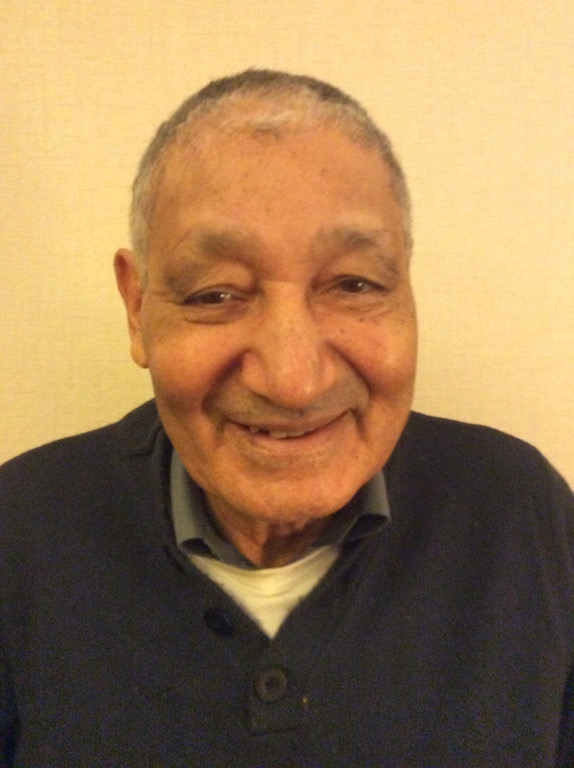
Alfred Sharpe
Northamptonshire, January 2025
 UK Baha'i Histories
Alfred, how wonderful to read this detailed account of your adventures with the Baha’i Faith. Are you still in Southampton? Sending you much love,
Sharon and William
Ps Vancouver Island is beautiful and full of Baha’i activities.