

My parents were Victor and Veronica Priem.
Victor Priem
Victor Priem was born in Riga, Latvia, in October 1925. His mother Emma (Oma) was from Germany, and his father was Latvian. They had eight children, but one daughter died in childhood. Victor was the second youngest child. The family was poor. My grandfather – a skilled tinsmith – went through periods of time when he was unable to work, as he was an alcoholic. Oma brought up the children, three girls and four boys, and made a meagre living sewing, to buy food etc for the family. The children grew up at home speaking German, and learned to speak Latvian at school. As a youngster he enjoyed wood carving. My two elder aunts, Erika and Dagmar, went into service, working for rich families. I remember Victor talking about happy times in the long summer holidays, when he and his younger sister Mirjam worked on a farm in the Latvian countryside. Everything changed when the USSR Red Army invaded and occupied Latvia in 1940. To escape Russian occupation, Victor ran away from home to Germany, aged 14, and was followed by his mother and siblings. As far as I know, they lived in a village near Dresden. During World War 2 Victor was drafted into the Luftwaffe. His brothers fought in the German army. One of his brothers was killed in battle on the Eastern Front.
Victor arrived in England as a Latvian/German prisoner of war. He fought in the Luftwaffe Infantry in the Belgium trenches and was taken prisoner by British soldiers after the D-Day landings. He was interned in Prisoner of War camps in London, Devizes and Brighton. At the Brighton prison camp he became the Latvian/English interpreter. He was befriended by the Reverend R.J. Campbell. Thanks to Rev Campbell’s intervention after D-Day, Victor and some other Latvian PoWs from the Brighton camp were allowed to remain in England. If he had been repatriated to Latvia, at best Victor would have been sent to do hard labour in a Russian gulag.
In the 1970s, when my parents became Bahá’ís, they found out that Canon Campbell, then the Rev. R J Campbell, was the first clergyman in England to welcome ‘Abdu’l-Bahá to address a congregation at the City Temple in London in 1911.
Victor worked as a farm labourer near Brighton for four years and studied A levels in evening class. During that time he was classed as an enemy alien. He later received dual citizenship and went on to study pottery and sculpture at Loughborough College. David Leach was his pottery teacher, the son of Bernard Leach, a renowned craftsman potter. Bernard also wrote books on art and his beliefs as a member of the Bahá’í Faith. Many years later Victor visited Bernard Leach. When Victor qualified as a teacher his first teaching post was at the Knowle School, Hove, Sussex.
Veronica Priem
Veronica was from Hove. Her father, Reginald Corney (Reg), was an accountant who worked for Dirty Dick’s in London, travelling daily by train from Brighton. Reg met his future wife, Bessie, when on holiday in Redcar, on the North East coast. They fell in love and got engaged. Bessie was born in Sheffield. They were married and moved to Hove, Sussex. Bessie had a severe illness when she and Reg were engaged which eventually left her crippled. Back then there was no National Health Service, so Reg paid for a nurse to see her daily and a maid to do the housework. They lived in rented accommodation in Hove, with frequent moves within a small area. Veronica was their only child, born in 1924. She went to school in Hove but was not evacuated during World War 2. She was a keen swimmer off Brighton beach. When she left school she enrolled in the A.T.S. and was posted at Chichester, Sussex. Sadly, her mother, Bessie, died in an accident when her invalid carriage ran out of control down a steep hill and crashed. In later years Reg bought a house in Tudor Close, Hove, where my parents lived after they were married.
After the war, Veronica did secretarial work at the Alliance Building Society in Brighton. She met Victor at the Friends Meeting House, Brighton. They fell in love, became engaged and were married in the Friends Meeting House on 23rd December,1953, though neither of them were Quakers. Sadly, less than a fortnight after their wedding, Reg died. He left his house to my mum and my parents took on the mortgage.
My childhood years
Mum stopped work, and stopped smoking when she became pregnant. She gave birth to me at a nursing home in Hove, Sussex, on 1st January 1958. My sister Rebecca was born at home in Hove on 22nd October, 1961 (I’ll call her Becky from now on). Becky and I were not baptised and the family didn’t go to church.
Looking back over the decades, mum and dad acted on morals which were mainly in line with the Bahá’í principles. I had a secure, privileged, middle-class childhood. I was taught to do as I was told at home and at school, to respect adults, and play nicely with my little sister and our friends. I helped at home, and had housework duties as I grew older, washing up, hoovering, making my bed etc.
Move to Yorkshire
Dad was appointed as Head of the Art Department at Mexborough Secondary Modern School, in the former coal mining area in Yorkshire. My family moved to Conistone, in the winter of 1961/62, which was a bitterly cold winter. We had lodgings in a miner’s home for a few months. The coal miner worked on the night shift, so I rarely saw him, and had to be quiet during the day. The miner’s wife was very kind and friendly. I had my 4th birthday there. Becky was a few months old. But it was a culture shock for mum. She was used to getting credit at the local shops in Hove. The milk maids didn’t take credit, so mum got used to putting out milk tokens from the Co-op. Mum later told me that when she hung up the washing outside, it came in dirty as soot fell on everything. Worse than that, the smog caused severe fog in wintertime. Dad often had a difficult car journey to Mexborough, he couldn’t see more than a yard ahead. I still remember Mum being really relieved to see him get home safely after work.
My family moved to a semi-detached house in Balby Road, Doncaster, before I started school in September 1962. I went to Nightingale School, and loved it there. I decided at the age of five that I wanted to be a teacher when I grew up. I enjoyed playing with my friends who lived in the street. Dad showed me how to make pots and models out of clay. I still have a little pottery hedgehog I made with his help.
Mum’s relatives
My relatives on Mum’s side were the Corneys and the Dewhirsts. On the Corney side, Great Aunt Annie, fondly known as Granny, lived in Cheltenham. She was the widow of one of Reg’s brothers. Every year she sent me and Becky a ten shilling note in our Christmas and Easter cards and on our birthdays. I remember visiting her and Aunty Angela at their cosy home in Cheltenham. Aunty Angela worked as a nursing sister in the Cheltenham hospital, and had previously worked in a hospital in Kano, Nigeria. Aunty Rosemary, Granny’s other daughter, was married to Uncle Vic. They had four children and lived in Dorset. My family enjoyed a holiday staying with them when I was 7 or 8.
When my family moved back to Ripon, we visited the Dewhirst family every year at their home in Leeds, and they visited us. We always had a lovely time with Aunty Sylvia, Uncle Rick and cousin Mandy. My great aunt Marjorie, Sylvia’s mother, lived in Harrogate and we saw her each year, usually at her house. I recall she was tall, thin and dressed in old fashioned clothes. She was a lovely lady.
Ripon
In 1966, when I was six and Becky was rising three, we moved to Ripon, Yorkshire. Dad was appointed as a senior lecturer in pottery and sculpture at Ripon College. It was an all-women’s C of E teacher training college. Dad also taught education and supervised students on teaching practice, often in small village schools. My parents bought a 3-bedroomed house in Primrose Drive. Dad named the house Riga, after his city of birth in Latvia. Mum was a full-time mother and housewife till I was 13. She grew raspberries, strawberries and currants in the back garden, and roses in the front garden. Dad grew apple trees and a Victoria plum tree. He planted a beech hedge. Mum made her own jam and marmalade, and later on baked her own wholewheat bread. She was an excellent cook. There were no supermarkets initially, so the Co-op was the main shop. Mum also shopped at a local butchers and greengrocers in town, and Ripon Market every Thursday and sometimes on Saturday. I went to the corner shop to buy sweets and a comic with my sixpence pocket money. (That was the old pounds, shillings and pence currency.)
Becky and I went to Holy Trinity C of E School. I was happy at primary school, and enjoyed the walk there and back with mum and Becky when we were little. We walked whatever the weather, with torrential rain, snow or hail in wintertime. On cattle market day herds of cows or sheep were driven along by farmers and sheep dogs.
When I was nine or ten, in the late 1960s, mum and dad started going to Quaker Meetings at the Friends Meeting House in Harrogate on Sunday mornings. Becky and I sat quietly with the other children in the main hall for 15 minutes, while silence was observed. Then the children went to another room to learn something about the Quakers’ way of life, do art work or play games. Refreshments were served when the adults came in after the hour’s silence. I remember it was a beautiful new building, with a spotless kitchen and cloakrooms.
My parents gave me a book called “Many Paths – One Heaven” by Nuri Mass. I became aware of the existence of the great world faiths, including Judaism, Islam, Hinduism and Buddhism.
Holidays
The family went on a week’s seaside holiday in Brighton or Littlehampton. Becky and I played on the beach and paddled or swam in the sea. Brighton’s beach has pebbles, but I liked the sand at Littlehampton better.
In 1967, when I was 9, my family had their first holiday abroad to visit Oma and our relatives in north Sweden. The ship crossing took three days and two nights, from Immingham to Goteborg. The cars were firmly chained to the inside car deck to stop them moving around. Mum and I were seasick the first night, but okay afterwards. In Sweden, Dad drove through the rich farmland in the south, and huge forests in the north. At last we reached the remote farm where Oma’s family lived, about 10 miles from Husum and the Baltic coast. The farm belonged to Ossian Sundquist, who had married Tante (aunt) Dagmar. Oma and Tante Erika lived there and Cousin Tabitha, who was 11. We had a loving welcome from all the Sundquist family.
My family visited Stockholm on the way back before we returned to Gothenburg , and sailed back to Immingham.
The Priem family also visited our relatives in Berlin in the summer of 1973. We were overwhelmed by kindness from Tante Mirjam, Onkel Willy and cousins Esther and Lydia.
Becoming a Christian
In 1969 I passed the eleven-plus exam and started at Ripon Grammar School in the autumn. It was a huge change going from primary to secondary school. Everything was a new experience, with new teachers, new friends, homework and new subjects including three sciences and French. I made friends with some girls who were active Christians, and started going to a lunchtime Bible Study group in 1970. I read a Scripture Union booklet daily at home and began to read the Bible. I became a Christian on Saturday 30th January 1971, according to my childhood diary. I reached the point where I believed that Jesus had died for me on the Cross, and prayed for Jesus to come into my heart. I told my parents that evening I was now a Christian. They were surprised, but fully supported me. The teachers at the school Bible Study advised me to join a church. My close friend Helen Rowland invited me to go with her to communion services at Ripon Cathedral on Sunday mornings. I went to the cathedral service for the first time on Sunday 14th February 1971, with Helen. From then on I attended on most Sundays. In August 1971 I told one of the vicars that I would like to be baptised and join the Church of England (CofE). Later on, I became interested in taking Holy Communion. Reverend Hardy visited my parents at home for their approval. On 28th August 1971 I was baptised at the font in Ripon Cathedral by Reverend Hardy, with my parents present. It was a solemn yet happy occasion. The day after that I received my first communion, aged 13. I found it spiritual and uplifting. As I recall, the Bishop of Ripon gave a special dispensation to allow me to take communion. I was a member of the Church of England, and would need to take confirmation classes.
Wiltshire
Dad was given a year’s sabbatical leave from Ripon College to study at Bath Academy of Art, starting in September 1971. The college was situated in Corsham, a picturesque Wiltshire village. The whole family moved from Ripon for a year, and the house was leased to the lecturer who took over Dad’s role at Ripon College. Mum and Dad rented a cottage at Sheldon Manor, a couple of miles from Chippenham. It was half a mile off Sheldon Corner, on Frogwell Lane. Dad used one of the downstairs rooms as a pottery and sculpture studio. As tenants we could use the outdoor swimming pool and go anywhere in the gardens. Becky and I enjoyed having rides on the old pony.
Mum did secretarial work at Bath College of Art, in Corsham Court. This meant a bit more household responsibility for me (aged 13) and my pocket money was increased to 50 pence a week.
School term started two days after we arrived in Wiltshire. I went to Chippenham School, which was for 3rd year pupils up to 6th form. Becky went to Frogwell Primary School. Dad bought a second-hand bike so I could cycle to school and church. I started going to Sunday services at St. Peter’s Church, Frogwell, and went to confirmation classes with two other girls. Rev Hughes was the vicar and he gave me a kind welcome.
Our cats Sammy and Sooty came with us to Wiltshire, in cat baskets in the car. Sooty soon settled in, but Sammy, the white and ginger cat, wandered off after being let outside for the first time and went missing. None of the neighbours or the farmer’s family had seen him. A few days later, I spotted a cat just like Sammy outside The Gables, one of the Sheldon Corner cottages. Mum and Dad called round and asked the Smith family, who lived there, to look out for our cat. A few days later Sammy turned up by himself, safe and sound. If Sammy hadn’t wandered off, perhaps my family would not have met the Smiths.
Later on, Smith’s cat was dubbed ‘Paw of the Cause’ by Ron Batchelor, who first thought up the phrase! Thelma Batchelor thinks the Smiths also told Bill Sears about it, and he had a good chuckle!
Terry and Barbara Smith and their teenage sons Robert, Michael and David were Bahá’ís. Terry and Barbara came to a small party at the cottage in November and mentioned the Bahá’í Faith to Mum and Dad. They borrowed some Bahá’í books from Bath Library and started reading about the Bahá’í Faith. I was invited to go to fireside meetings at their home, which were attended by young people from my new school, and older local people. Terry gave talks about the Bahá’í Faith including how the prophecies about the return of Christ were fulfilled through the advent of the Báb and Bahá’u’lláh, the Forerunner and the Founder of the Bahá’í Faith. A seed was planted in my mind at the firesides. At Bible Study in Ripon I had been told to look out for the Return of Christ. Although I was interested in the Bahá’í Faith, I wasn’t convinced that Bahá’u’lláh was the return of Christ. I continued going to confirmation classes, and was confirmed at St. Peter’s Church by the Bishop of Bristol on 12th December 1971.
During the Christmas holidays Mum and Dad went to a fireside at the Smiths’ house, when Phillip Hinton gave a talk about the Bahá’í Faith. Phillip was a distinguished actor then appearing in a stage production at a theatre in Bristol. After talking with Phillip in another room that evening, both my parents declared their belief in Bahá’u’lláh. It was the norm for new Bahá’ís to sign a declaration card, which they did. They had a joyful welcome as new Bahá’ís. From then on, Becky was brought up as a Bahá’í child and I continued in my Christian faith for a while.
On 1st January, 1972, my 14th birthday, Dad drove me to the Smiths’ house to go to a Bahá’í weekend event in Torquay. Terry and Barbara collected other young people, Jane and Sue, in their VW van. Pat Keeley, a Bahá’í friend from Bristol, took some more youth in his car, David and Caroline Smith (not related to the other Smith family), and Doug. At Torquay we went to the Bahá’í Centre where the Torquay friends were gathered. The youth were split into small groups with the local adult Bahá’ís and were supplied with leaflets inviting people to a Bahá’í event that evening. After a briefing, the groups set off into the town centre. Barbara reassured me it was alright for me to join in, even though I wasn’t a member of the Faith. It was my first experience of proclaiming the Faith. Back at the Bahá’í centre, everyone rehearsed some Bahá’í songs. In the evening, several people from the town came to the event, which Terry opened with a talk about the Bahá’í Faith. A film about the Faith was shown, then I joined in with the young people singing Bahá’í songs. During the course of the evening, I accepted Bahá’u’lláh as the Return of Christ, the Manifestation of God for this age. I told the group I believed in Bahá’u’lláh and wanted to become a Bahá’í, and signed a declaration card. Jane also declared. Barbara gave me a copy of The Hidden Words, which I still have. From then on, I have read from the Hidden Words and the Bahá’í Writings daily. I read “Thief in the Night” by William (Bill) Sears, which answered my questions about the biblical prophecies on the Return of Christ. As the months passed, my understanding of the Faith and living the Bahá’í life developed. I remember Barbara explaining that teaching the Faith is an integral part of being a Bahá’í.
Firesides and Nineteen Day Feasts in Wiltshire, January 1972
My family continued going to firesides at Terry and Barbara Smiths’ home each Friday, and started attending Nineteen Day Feasts and Holy Day meetings. Of course it was years before the internet started, or before personal computers were developed. So, the Nineteen Day Feast letter was a typed document, read out to the friends in groups and Local Spiritual Assemblies.
Many Bahá’í friends who came to the Feasts and firesides, in addition to the Chippenham friends, included Sammi Anwar, Peter Smith, Pat Keeley and Persian friends from Bristol, Peter Stratton, and Beth Bowen, a travel teacher from America, who gave talks on the Faith and sang Bahá’í prayers, playing her 12-string guitar. Ursula Samandari gave a wonderful talk. She was a Knight of Bahá’u’lláh to Italian Somaliland and had lived and served the Faith in several other countries in Africa.
Beth Bowen and Sammi Anwar also gave a talk on the Bahá’í Faith at the college in Corsham. It was well attended by students and local Bahá’í friends.
Leaving the Church of England
Being so young, at first I didn’t realise I would need to leave the Church of England having become a Bahá’í. I talked with Barbara Smith about whether I should continue to take communion at church, or even continue going to church. She told me it was up to me to decide, and to talk with my parents. One evening, Dad took me to Rev Hughes’ home, to explain I was now a Bahá’í and therefore leaving the Church of England. Rev Hughes was very courteous and said I must follow my own conscience. He informed the Bishop of Ripon on my behalf. The Cathedral staff would have been disappointed. They had bent over backwards to accommodate me and now I had joined another religion which, back then, they would probably have called a false religion.
Return to Ripon
When the family were back in Ripon, September 1972, Dad returned to work at Ripon College, Becky was in the 4th Junior class at Holy Trinity School, and I was in the 4th year at Ripon Grammar School. It was great to be with my old friends again. I made new friends too, including Angela Wade, whose family were Seventh Day Adventists. Her father was in the Army, and had married a German lady. We had a lot in common and got on like a house on fire. We’re still in contact with each other.
My family were the only Bahá’ís in Ripon. Mum and Dad held regular firesides, attended by some of their friends and colleagues, and a few of my friends. Dad gave talks on the Faith at home, and in other Bahá’í communities. Michael and Lydia Blakey and their daughter Kirsten were some of our nearest Bahá’í friends, living in Newton Aycliffe, Co Durham. It was lovely to meet them at their home, and they visited us in Ripon. Kirsten and her family remain good friends with my family.
On my 15th birthday in 1973, I formally declared my faith in Bahá’u’lláh at home, after reading prayers with Mum and Dad. I did my first Bahá’í Fast that year. My family regularly attended the National Teaching Conferences and National Conventions.
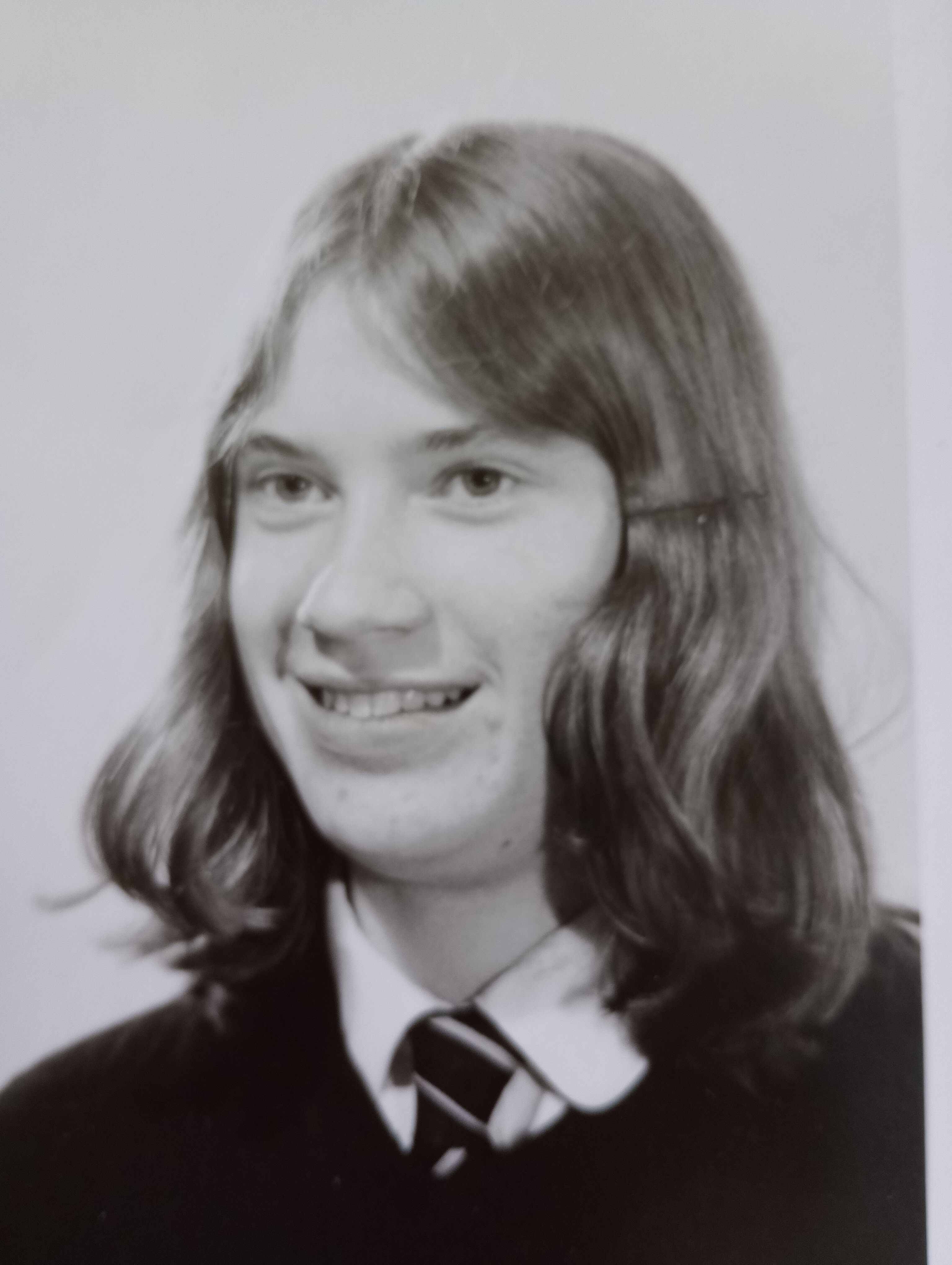
1973 Travel teaching in Orkney
In the summer holiday of 1973, my family went to Orkney for the first time, as there was a Bahá’í Islands project, organised by the Kirkwall Spiritual Assembly. At Scrabster more Bahá’ís boarded the St Ola, including David Hofman, a member of the Universal House of Justice. His niece Colleen had married Ian MacLeod and they had a baby. The Priems stayed in a rented caravan at Scapa Flow. Ruth Smith and Nichola White (Nicky) were in the caravan next to us. It was the start of a lifelong friendship with Ruth.
The local Baha’s included Daryoush and Jackie Mehrabi and their three children, Kalim, Pari and Vahid Mehrabi, and Doreen and Verdun Dunn and their baby. Before we went out to meet people there was a deepening institute on teaching led by the coordinator, Pat Beer, in our caravan. Each morning there was a devotional at 8am. The Bahá’ís spread out in small groups, or pairs to ask people to a Bahá’í meeting at Orphir Community Centre. Three new people came on the night and dad gave a talk on the Faith combined with a slide show.
Jackie, Pari, Ruth and I took the boat to the island of Westray. We asked people we met if they knew about the Bahá’í Faith. Some people were interested, some accepted a poster to advertise a meeting and some refused to talk with us once the word Bahá’í was mentioned.
Pilgrimage 1975
My family went on a nine-day Bahá’í Pilgrimage to Israel, in Haifa and Akka, during the school Easter holidays in 1975. The Persian believers formed one group of pilgrims. The Western pilgrim group was of people from other nations. The two groups were rotated to avoid overcrowding when visiting the Shrine of the Báb and the Shrine of Bahá’u’lláh, the Mansion of Mazraih, the House of Abbud in Akka, the Garden of Ridván and the House of ‘Abdu’l-Bahá in Haifa. As a mark of respect everyone took off their shoes when entering the Holy Shrines, and the Shrine of ‘Abdu’l-Bahá. Silent prayer and devotion were observed. Nearness to God, praise of God, supplication to God, devotion to God was all. Words cannot adequately express it.
The pilgrims were invited to meet the members of the Universal House of Justice. It was a great honour to meet all nine members and shake hands with them. Three Hands of the Cause were then in Haifa, Mr Faizi, Mr Furútan and Dr Giachery. On a personal note, I told Mr Furútan how the family first met our Bahá’í friends, the Smiths, due to our cat straying, and that the Smiths’ cat was nicknamed a “Paw of the Cause”. Mr Furútan’s face lit up, he laughed, and then said “Both cats are Paws of the Cause!”
The foundations were being hewn out of the rock on Mount Carmel for the Seat of the House of Justice.
During our time in Haifa my family met Hasan Ansari, from Tehran. Hasan asked if there was a Local Spiritual Assembly in Ripon. When he heard it was just one family, he vowed to pioneer to Ripon as he wanted Nooshin, aged 10, to be educated at an English school. They arrived in August and spent their first day with us in Ripon. Not surprisingly, Nooshin was very shy at first and only spoke a little English. She enjoyed stroking one of our cats. They had brought gifts from Persia, including a big bag of “Bahá’í nuts” – pistachios! The beautiful inlaid picture frame they gave us is in our front room, in it a photograph of ‘Abdu’l-Bahá.
From the time the Ansaris arrived in Ripon, the number of Bahá’ís grew as more friends moved into the area, including Harrogate. The members of the Bahá’í community over the years included Hasan Ansari, Nooshin Ansari, Elizabeth and Royce Emerson, Barbara Jordan (now Gilbert), Elisabet O’Neill (now Mitchell), Victor and Veronica Priem, Fiona Priem, Enayat Sabeti, Behrooz, Behdad and Behnoos Teimoori-Moggadam (brothers and sister). Behdad is married to Yvonne.
The First Spiritual Assembly of Harrogate was formed later. Ripon was in the local administrative District of Harrogate.
Further education
After leaving school in 1976 I did a year’s Foundation Course in Art at Harrogate College of Arts.
Loughborough College of Art
In 1977 I started a BA course in Textiles/Fashion at Loughborough College of Art. I specialised in weaving, and learned how to set up different types of looms, weave the standard patterns (twill, honeycomb etc) and dye cotton, wool and silk yarn by hand. Once a week all art students went to Art History class. I became interested in “ethnic art”, as it was then called, from all over the globe. In the first year, students did a photography course, which meant taking a reel of black and white photos on a given theme, developing the film and photos. I lived in a student hall of residence for the first year. It was in Ashby Road, near the house my dad had lived in as an art student. In the second year I rented a flat in town with another girl, which was fine during autumn and spring but very cold in winter. The only source of heating was a huge storage heater in the corridor and the flat was poorly insulated. My parents bought me a convector heater. I returned to a student hall of residence in the third year!
The local Bahá’ís, Charnwood Community, were very supportive of students. Feasts and Holy Days were usually held at Les and Jean Woodfield’s home. I met many Bahá’í friends there, including Behbud, a student at Loughborough University, Carol and Geoff Collins and Rob Hain, who was a student at the art college. After graduating I started to train as an art teacher at Brighton Polytechnic in September 1980. I soon found out that I wasn’t suited to teaching secondary school pupils and left after the first term.
During the summer of 1978 I was fortunate to go travel teaching in Norway. Zarin Hainsworth and I flew from Gatwick to Oslo and caught the train from the airport to Vinstra, where we took part in the Bahá’í Summer School. Hands of the Cause Dr. Giachery and Mr. Faizi gave several illuminating talks. We met many Norwegian Bahá’í friends, and Stephen Tomlin and other Bahá’í friends from England.
As planned beforehand, Zarin, Stephen and I made a teaching team of three. We were joined by Rama Krishnan, who hailed from Malaysia, and Hoda, a young Iranian girl. Our destination was Bodo, Norway’s most northern coastal town served by railway, just north of the Arctic Circle, but it was too late for the Midnight Sun. En route we stopped at Trondheim, where we met Ivar, who took us to the local Bahá’í centre. We had a lovely meal in beautiful surroundings.
The next day the travel teaching group boarded the train again and were met at Bodo station by Baldur, an Icelandic Bahá’í. All the local Bahá’í friends gave us a warm welcome. Our original team of three were based at Inge David’s flat. After prayers each morning, including repetitions of the ‘Remover of Difficulties’, Stephen, Zarin and I went into Bodo town centre to teach the Faith. We found that the best approach was to talk to people whom we met in cafes. A young girl, Gro, was interested in the Faith. Her parents were diffident about it but were reassured when they understood that no one is pressured into becoming a Bahá’í, least of all children. Zarin spotted a chance for publicity in Bodo town centre, when a bicycle for six people came to a halt. She asked if the Bahá’í friends could ride it. A photo taken of the whole travel teaching team on the bike appeared in the local newspaper.
York
In January 1981 I transferred to a PGCE teacher training course at the College of Ripon and York St John, at the York campus. The number of places was fixed, but one student left the course. As dad was a lecturer at the college, he arranged an interview with the course leader, who accepted my application. I lodged with Susie Bagenal, a Bahá’í friend resident in York. Feasts and Holy Days were held at friends’ homes, including John and Angie Jameson, Muriel Evans, Trish Castle, John Butler, Marian D’Netto, Denise and Daryoush Mazloom and their three young children Sam, Fleur and Gabrielle. The Spiritual Assembly of York hosted Naw Rúz celebrations in large venues in the city centre, attended by the Mayor of York and many local people.
Marriage with Paul Saunders
I met Paul Saunders at a Feast at the Mazloums’ garden in the summer of 1987. We didn’t connect as friends immediately but I persevered as Paul was a new Bahá’í. He was a mature student at York University, studying Psychology. He became a Bahá’í through his friendship with Keith Mellard, another mature student, and his wife Audrey. Keith and Audrey Mellard were Bahá’ís from Selby, and were then resident in a student flat on the uni campus. Keith told Paul about the Faith, and Paul avidly read Bahá’í books. Paul became a Bahá’í after a short time, though he still went to his local for a drink for a few weeks at the Cross Keys in York. Paul was attracted to the Faith by the teachings on justice and equality. He read the works of Bahá’u’lláh, ‘Abdu’l- Bahá and Shoghi Effendi. He went to regular meetings at the Mellards’ house, and became a Bahá’í after a month.
Paul was born in Northallerton and grew up in Richmond, North Yorkshire as a boy. from the age of 11. He was from a Roman Catholic background, and had been an altar boy.
His dad, also Paul Saunders, was a corporal in the British Army. He was born in London. He served in Aden and the Korean war, and in Germany during the Cold War. His mum, Betty (maiden name Elizabeth Ellen Drummond Elder) was born in Glasgow, but grew up in Mickleton, Teesdale, a remote rural village in the Pennines. She met her husband at a dance, and was married aged 19. Paul was born a year later in Northallerton hospital, and his younger brother Kevin was born in 1959.
Paul was a mischievous child, adept at climbing from the age of three, when his father was posted in Hong Kong. Paul managed to slip out of the house and scale a tall mesh fence surrounding the Army compound. The MPs searched for him in the city, and he was found squatting on a pavement, eating Chinese food with some local people.
When Paul’s father was posted to Hohner, Germany, the family went with him. Paul had a life changing accident aged six, in the early 1960s, when he and some other lads were playing a game of “chicken” on the camp. Paul was the last to run in front of a car. He was just too late. His right arm was severely mangled by the pull-out handle of the car door. Some soldiers quickly got him to hospital. The German doctors could have amputated his arm from below the elbow, but instead used new medical techniques to repair and rebuild the bones and tissue. There followed successive operations for several years to give him some mobility in his right hand, followed by weeks of recuperation in hospital. This meant that Paul missed a lot of schooling from age 6 to 14. By coincidence, when Paul was recovering from a gall bladder operation in August 2017, in Darlington Memorial Hospital, he was treated by a doctor who was trained by the same surgeon who had operated on Paul’s arm in the 1960s.
Paul’s family settled in Richmond, North Yorkshire when his dad came out of the Army. Paul was a teenager by then.
As well as meeting Paul at Bahá’í Feasts, I saw him in York, busking in the Coppergate Centre. He played a traditional hurdy-gurdy. I saw him after I finished work one day, and said Hello. Paul said he had finished busking for the day. He walked with me to Edinburgh Woollen Mills as I wanted to buy a sweater, but couldn’t decide which one. He picked out a light blue sweater which suited me perfectly, and we had a coffee afterwards. That’s when we became friends. We went for walks at the weekend at Sutton Bank in the North York Moors, and a longer walk from Hawnby, around Easterside Hill in the North York Moors. That was the day we realised we were right for each other.
I lived in a modern terraced house in Stamford Bridge, a large village between York and Pocklington in East Yorkshire. Paul lived in a council flat in Acomb, York. We spent a lot of time together at weekends and got to know each other’s characters. One evening we decided to get married. We asked my parents for their consent which they gave readily, and so did Paul’s Mum, Betty. It was a bit trickier with Paul’s Dad, but he consented on conditions I can’t quote, due to his religious and racial views. After that we were engaged as a Bahá’í couple.
We got married on 6th August 1988. Paul and I met up in the Museum Gardens, York, then went for the small civil wedding at the Registrar’s Office. All our parents, Paul’s brother Kevin and his partner, Paul’s friends, and some of the York Bahá’í friends were present. The Bahá’í wedding was held in Ripon, in the hall at the Secondary Modern School. Paul and my dad had arranged the seating in a ‘circle of unity’. Paul’s friends and family from Richmond and York were there. My school and college friends were there. Mr and Mrs Blatchford came from Bude in Cornwall.
Daryoush Mazloum presided as the wedding officer. Marriage prayers were said and readings on marriage from the Bahá’í Writings. Paul and I sang a Bahá’í prayer together. We then said the Bahá’í marriage vow in turn, “We will all, verily, abide by the Will of God”. It was a deeply moving occasion.
A joyous wedding reception was enjoyed by the families and friends at the Spa Hotel, Ripon. Paul and I set off for our honeymoon at Rosthwaite, in Borrowdale, in the Lake District. This was the first of our many visits together to the Lake District.
Our family life
Paul and I have been happily married for 36 years. We had two lovely babies, both born in York District Hospital. Miles was born in 1992, and Clifford in 1995. Paul was the house husband while the boys were at school, and I worked full time as a teacher. For about 20 years Paul did most of the housework and all the cooking while I was the breadwinner. He still cooks for the family evening meal, as he’s a better cook than me! Both our sons were brought up as Baha’i children until the age of fifteen, when they knew they could decide to be Baha’is in their own right, or not. Both boys became Baha’is aged 15, and Miles reaffirmed his faith when he was 21. Although Clifford is not a Bahá’í he is a friend of the Baha’i Faith. He has happy childhood memories of going to Nineteen Day Feasts with the friends in Durham and Chester-le-Street. In Durham Feasts were often hosted by Janet and Husayn Bayat and their family and Margaret Gosden. In Chester-le-Street, Feasts were hosted by Nahid and Mehrab Ahmadi, Kamran and Katrina Ferdowsian, and Fereshteh Ferdowsian.
Miles taught himself to read when he was two and a half. I always read books to both boys from being tiny babies and into early childhood. I sang nursery rhymes and read from picture books daily, as well as saying Bahá’í prayers and brief readings from the Bahá’í Writings. The boys learnt to say the shortest prayers. As the boys got older, about 7 and 10 years old, I read the Harry Potter books at their bedtime. Miles couldn’t wait for the next chapter, so he read it by himself. I had to remind Miles not to let Clifford know what happened next! Clifford had been a reluctant reader till this point, but was so frustrated having to wait to hear the next part of the story, that he began reading it for himself. He became a competent reader from then on!
Both Miles and Clifford enjoyed going to children’s classes at the Thomas Breakwell School, held at the Farne Primary School, Newcastle, on Sunday mornings during term time. Paul and I met many of the North East Baha’i friends and their children there, including Kathleen and John Coates, Ladan and James Herbert, Chris and Zhamac Lee, Sue and Ken Finn, Ruhi Darakshani, Sima (nee Froughi) and Geoff Leetham. The Thomas Breakwell School was disbanded immediately after the National Spiritual Assembly urged Baha’is to carry out their Baha’i activities in their own area, rather than travelling many miles to Baha’i events in other towns. This was due to new guidance from the Universal House of Justice.
Bahá’í Stall in Darlington
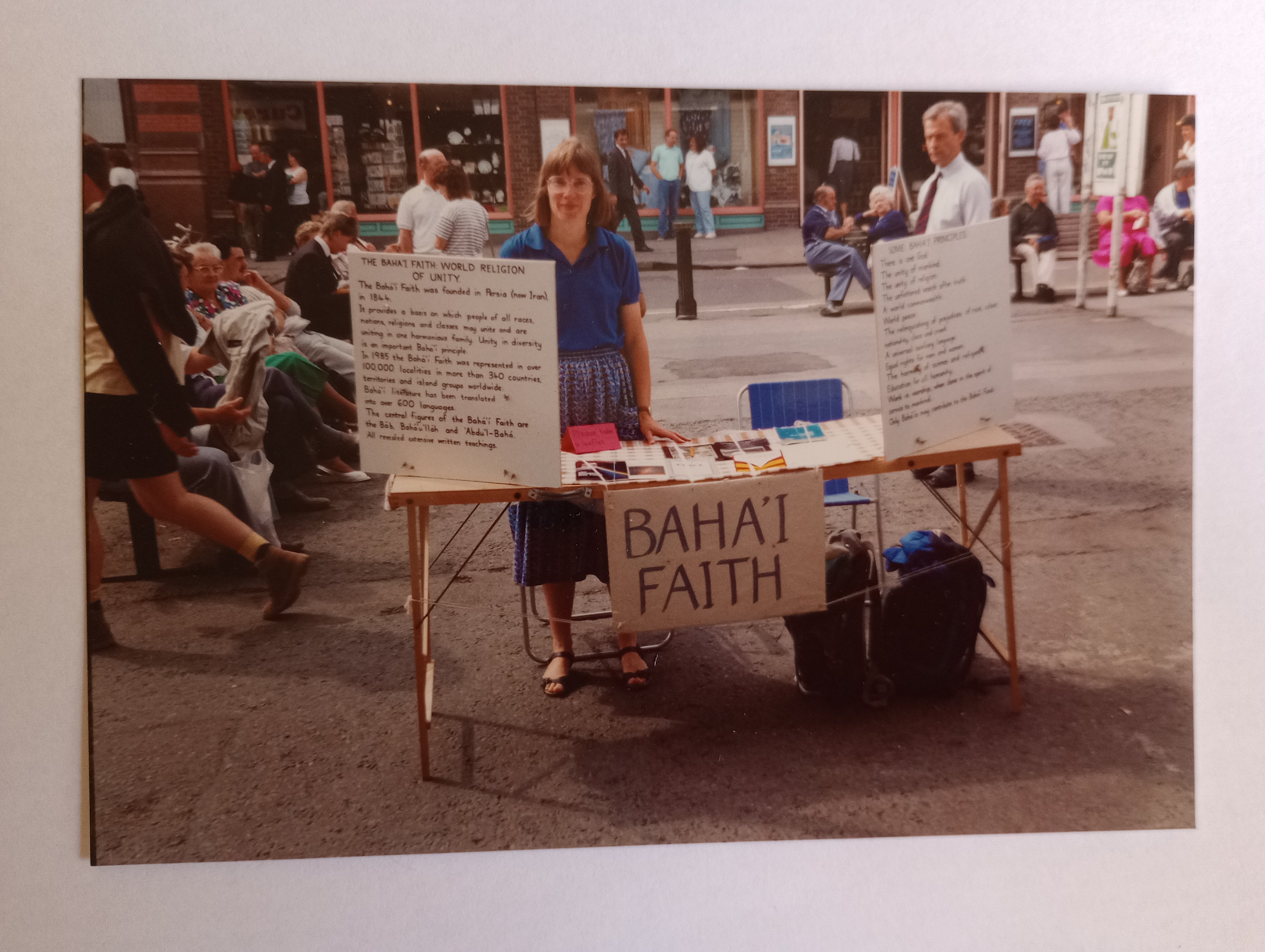
Paul and I teach the Faith wherever and whenever we can. We hold a Bahá’í stall regularly each week in Darlington, weather permitting. It’s a small table in a pedestrianised area with two A4 signs: ‘The Baha’i Faith’ and ‘The earth is but one country and mankind its citizens’. Copies of “The Hidden Words”, “Bahá’í Prayers for Everyday Use”, “What Do Baha’is Believe?” and other materials from the Warwick Bahá’í Bookshop are displayed for people to take. A big thank you to Ann and Paddy Vickers for their dedicated work. Thousands of people have seen it over the years. Some are our personal friends, some regularly smile and greet us or stop for a chat. On one occasion it was a pleasure to have Gillian Bell, a Baha’i friend from Whitley Bay, with us at the stall. On many occasions individuals stop to ask “What’s it about?” and brief or longer conversations ensue. It’s a two-way process. We have met people from all the main faiths, humanists, agnostics and atheists. Paul and I make a point of hearing their point of view. We always encourage people to think and investigate for themselves, and to “Love your neighbour”.
Occasionally there is an antagonistic reaction from a passer-by. However, this is outweighed by many people who are supportive, and pass the time of day, or tell us to keep warm in winter, even if they don’t ask a question about the Faith. Some visitors to Darlington ask the way to a shop or the way back to the railway station. And there are open-minded people who read the words of Bahá’u’lláh and say, “That’s true” and “I believe that”.
Primary school teaching jobs
I worked as a Primary School teacher for 31 years, before taking early retirement aged 55. During my teaching career I taught children of all ages from 5 to 11. At each school I informed the Headteacher and staff that I was a member of the Baha’i Faith. I explained to the Headteacher that Bahá’í Holy Days may fall within term time, but that I would come in for work so that the school didn’t have to bring in a supply teacher for my class. This was appreciated by all.
My first teaching job was at Bedale C of E School, North Yorkshire. Bedale is a picturesque rural town about 12 miles from Ripon. I had a one-year temporary contract from September 1981. The Head Teacher and another class teacher lived in Ripon, so I got a lift to work daily. I taught a class of 8 to 9 year olds and there were 31 children in my class. Most of the children lived on the nearby Council estate, and the rest of the children lived in private housing. It was a bitterly cold winter that year with lots of snow. For two weeks freezing fog set in, and only one northbound lane was open on the A1. We set off an hour earlier than usual to be at work on time. The school children loved playing in the snow at lunchtimes.
In 1982 I was unemployed from September through to December. During this time I applied for dozens of teaching posts, from London up to Scotland. Each application was filled in by hand, and was accompanied by a personalised covering letter. All done by hand with a fountain pen! This was before the days of personal computers! Meanwhile, I did daily voluntary work, assisting in the reception class at St Wilfrid’s Catholic Primary school. Sister Eta, the Headteacher, lived in the convent which was a tall terraced house in the street literally behind my family’s house, so I had known of her since childhood. She kindly gave me a reference for my job applications.
During the summer holidays, I went for a job interview at a tiny village school in Clawton, near Holsworthy, North Devon. It was a few miles from Holsworthy and about 12 miles north of Launceston in Cornwall (pronounced “Larnson” locally). I spent a sleepless night beforehand, but did well during the interview and was offered the job. I had the great benefit of spending the next day with the incumbent Infant teacher learning the ways of the school.
From September 1983 to December 1986 I was employed at Clawton School. I taught all the Infants and the first year Juniors, aged 5 to 8. There were 19 children, so a lot of individual teaching was done for reading, writing and maths. At first, some of the farm children found it hard to understand my accent, and I couldn’t understand their lovely rolling Devonshire accent. All the children took part together in music, PE and RE lessons. Art and science tended to be ad hoc, based on observing and recording the local flora and fauna.
Mr Blatchford retired a year after I started work at Clawton. David Wood was appointed as the new Headteacher. He and his wife Janet moved to a village near Bude. A few years later, Tony and Christine Blatchford travelled from Cornwall to Yorkshire for my Baha’i wedding with Paul Saunders.
Bahá’í friends in Devon and Cornwall
I was the only Bahá’í living in Bude, and there were very few Baha’is in North Cornwall.
Plymouth had an active Local Spiritual Assembly. The round trip to Plymouth from Bude, over Bodmin Moor, was over 90 miles, so I only visited the friends a few times for the Unit Convention and other events.
During this time I met Barbara and David Lewis, and travelled south in Cornwall to meet Diane and Paul Profaska.
In later years my dad visited Bernard Leach, who lived in St Ives, in a flat overlooking the sea. Later on, my whole family stayed with Trudy Scott, Bernard’s secretary, who lived in a beautiful cottage. We were all invited to an evening meal at Bernard’s flat, which was a moving experience I will always remember. Bernard Leach is known as the “Father of British studio pottery” and “learned pottery under the direction of Shigekichi Urano (Kenzan VI) in Japan where he also met Shōji Hamada. They promoted pottery from the point of view of Western and Eastern arts and philosophies. Leach produced work until 1972, and the Victoria and Albert Museum held an exhibition of his work in 1977. The Leach Pottery remains operational and houses a small museum showcasing work by Leach and his students
Dunnington C of E Primary School, 1987 – 1996
Dunnington is a large village about four miles to the east of York. I was a teacher at Dunnington C of E School for 11 years. It was a modern built school, with a large playground and playing field. At first I taught the Top Infant class with about 30 children. Later I taught the Junior classes. I became the Art Coordinator, which basically meant ordering and organising the art materials, paper and card in a central storage area, as well as contributing information and ideas at staff meetings. At that time staff development training was usually carried out at local Teaching Centres. I requested to go on maths teaching courses, as I wanted to gain more expertise in the subject. After this I became the Maths Coordinator at the school.
This was the year before the National Curriculum was introduced in 1988. I remember the staff meeting where each teacher took possession of a large cardboard box, filled with hard-back files for each subject of the curriculum, 14 in all. There was training, of course, and a short period of grace before being put into practice. The National Curriculum ensured that every child in the country had access to the same elements of education. However, schools selected their own teaching schemes and text books.
Stamford Bridge
While teaching at Dunnington C of E Primary School, I lived in Stamford Bridge, a lovely village in the East Riding of Yorkshire, situated on the River Derwent. My parents gave me a deposit to buy a modern two-bedroom terrace house in Roman Avenue South, for which I am very grateful. It had a small garden at the front and a long garden at the back, which was next to a farm field, where wheat or barley was grown. Gardening became one of my interests from then on. I soon met all the neighbours in the street, who were friendly and welcoming.
Before I met Paul, I booked a table in the cafe on Main Street, and advertised a meeting about the Bahá’í Faith. I put posters in the shop and the two pubs but nobody came.
After marrying Paul, we held firesides at home weekly and invited friends and neighbours to come. Often it was a social evening which developed into a fireside because people asked about the sign of the Greatest Name and the photo of the Shrine of the Báb, on our living room wall. Sometimes we had two or three firesides a week. Quite a few people were interested in the Baha’i Faith, but there were no declarations. We made many friends in the village including Katrina, then a teenager, and her Mum, Judith, who lived in a nearby street and we formed a lasting friendship. We are still in touch via social media.
Paul and I also held introductory meetings about the Faith in village halls in several local hamlets and villages. We ran off small leaflets with the details of each meeting and posted them in people’s letter boxes. Paul gave the talks. One lady, Fran W, came to talk at Millington Village Hall. She entered into a lively discussion about religion, and we kept in touch afterwards. When we held a meeting in Stamford Bridge Village Hall one man came in, but didn’t stay long as he was the only other person present.
Our Bahá’í community was small in number but large geographically. Another Bahá’í family lived at Hornsea, roughly 40 miles away. We went to a few Nineteen Day Feasts at their home, and they visited us in Stamford Bridge. We also travelled to Hull to attend the Unit Convention.
Our first son, Miles, was born in 1992 at York District Hospital. He was admired by our friends and neighbours, and loved to bits by his grandmothers, Betty and Veronica. Paul fully supported me in caring for Miles. When Miles was five months old my maternity leave ended. I returned to full time work at Dunnington School. Paul cared for Miles while I was at work. Paul did the housework, laundry and cooking. This meant I came home to a happy baby, and enjoyed being with him till his bedtime. I did my book marking and other school work later in the evening.
The Centenary of the Ascension of Bahá’u’lláh took place in 1992. Paul and I travelled to London with Miles for the special commemoration in the New Southgate Cemetery, near the resting place of Shoghi Effendi. We sat with Richard and Sarah Mellard near the front. Their first son Luca was born not long after Miles’ birth. The two boys enjoyed playing together as they grew bigger.
York
Paul, Miles and I left Stamford Bridge and moved to a 3-bedroom house in Edgware Road in York, February 1994. We lived there until August 1996. During this time, I met lots of Paul’s friends who lived in York.
Paul and I regularly did a Baha’i Faith stall in Parliament Street, in the centre of York. We met many people and made new friends.
Our younger son Clifford was born in 1995 at York District Hospital. Both grandmas came to stay with us overnight the day he was born. It was a unique and delightful moment when Miles first saw his newborn brother. Miles looked awestruck! Miles soon got used to his baby brother, and he would snuggle up to him as he lay on the play mat. As Clifford grew and began to shuffle around Miles often retreated to the playpen. This enabled him to play with his toys uninterrupted!
Darlington for 6 months
In August 1996 we moved to Darlington, Co Durham. I had a new teaching post at Dodmire Junior School, a class teacher, and Maths Coordinator. I was a member of the Senior Management Team for a few years.
For the first six months Paul and I rented a 3-bedroomed semi in Darlington. The boys soon settled in, and Miles started school at Mowden Infant School, literally across the road.
Richmond
We moved to Richmond after the lease ran out, at the end of February 1997. The furniture was put in storage, and we all stayed with Paul’s mother, Betty, in her two-bedroomed flat for a few weeks, until the purchase of a house was completed. It was an old two-bedroom terraced house in Hurgill Road, with a back yard and a tiny strip of garden. Miles started going to a local primary school. However, we weren’t happy with the way some members of staff reacted to Miles being a Bahá’í child and there were other issues. This was before the Human Rights Act was introduced in 1998. We withdrew Miles from the school. Paul homeschooled Miles, and a social worker was assigned to ensure Miles was receiving “Education Otherwise”. The social worker was consistently supportive and marvelled at Miles’ ability and the quality of his written work. During this time, I commuted to Dodmire School in Darlington. Paul drove me there and collected me daily, with Miles and Clifford safely strapped into their child car seats. The third winter was very icy and snowy and there were hold ups on the country roads.
Paul was rushed to hospital with meningitis in June 1998, the Friarage Hospital, Northallerton. I took the day off work, so Betty and her close friend Rita cared for Miles and Clifford until I got home. Rita was a delightful, kind lady, a Roman Catholic. She was a retired teacher who was formerly a member of the Bahá’í Faith. When I returned to work, Betty and Rita continued to care for the boys till I got home. Although Paul was weak after he was discharged, he was able to look after the boys.
Return to live in Darlington
The daily commute to Darlington from Richmond was becoming too much for me after three years. Teachers’ workloads were becoming heavier. The evening hours and weekend hours of schoolwork at home mounted up. Paul and I decided to move back to Darlington in 1980.
At first we rented a three-bedroomed house in Rochester Way, in the Haughton Village area. Paul continued to homeschool Miles. Clifford started going to Springfield School Infants and was very happy there. His Reception teacher was great!
Miles was due to start secondary school in 2003. The two nearest secondary schools didn’t have good reputations back then, and some of my colleagues recommended Longfield School, in the North Road area of town. This led to us buying a 1960s semi-detached house in Drinkfield Crescent, where we still live, within a few minutes’ walk from the local schools. It’s in a friendly neighbourhood and we like living here.
Miles settled in well overall at Longfield School, and the enlightened headteacher agreed to him having a flexible timetable, when Miles came home for an hour or two to do maths work, as he was years ahead of his peers. During GCSE years, Miles attended all the classes, and he used to help his school friends if they were stuck with maths.
Clifford was very happy at Harrowgate Hill Junior School, and later at Longfield. Miles did his A levels studying at home, whereas Clifford went to Sixth Form College and got three straight A’s in maths, further maths and history.
Both our sons went on to higher education and now have jobs locally.
Early retirement
I took early retirement on my 55th birthday. Teaching is a demanding job and I felt my job became increasingly hard to manage. I had several illnesses during my 40’s and 50’s, including several bouts of sinusitis, severe headaches, chest infections, shingles and work- related stress and depression. At first I needed to rest and rebuild my strength and stamina by going for short walks with Paul. Our walks gradually got longer. We did bird watching at the RSPB Nature Reserve at Saltholme on Teesside. We explored the woods and countryside around Durham. I prayed and reflected on life, and found renewed strength and courage from the Baha’i Writings and prayers. Without Paul’s love and support I wouldn’t have recovered as well or as soon.
The whole family joined in Baha’i feasts in Durham and Chester Le-Street Feasts. We took my dear friend Diane Leak to a Naw-Rúz party in Durham. We hold a weekly devotional meeting at home to which we invite people we meet at our Bahá’í stall. However, only a few people have attended over the years.
I have completed five of the Ruhi Books, with different tutors – Anya Bonner, Barbara Gilbert, Chris Lee, Nuha Sabour, Ken Finn. During the Covid lockdown we used Zoom. Nuha Sabour joined in one of the books and we met at her home in Birtley, near Gateshead.
Each year Paul and I support the Darlington Walk for Peace in November. We carry a large Baha’i Faith banner. The route is four miles, and people drop in or out as they wish. The peace walkers meet in the Friends Meeting House, and follow a route through the town centre to several Christian churches, the Jamia Mosque, the Buddhist Atisha Kadampa temple, the Peace Garden and the Sikh Gurdwara. We have made many local friends on the Walk for Peace.
The Darlington Bahá’ís book a pitch in a central park during the annual Darlington Community Carnival in June. It’s an exciting day for children and adults who take part in the carnival parade in town with bands playing, before heading to a park where there is live music, and numerous charity and cake stalls, amusements, food and drink. The Mayor and local dignitaries attend. Many local community and faith groups also have a pitch, e.g. Friends of the Earth, the Sikhs. We know people in several of these groups, many of whom are our personal friends. Paul and I set up our enhanced Bahá’í stall, with the large Bahá’í Faith banner and range of books and leaflets. We proclaim the Faith to many people, and have some great teaching opportunities, as well as a good catch-up with friends.
Since retiring I now have the time to meet up with my women friends in Darlington. Initially I met several new friends through going to local events, e.g. Healthwatch, Volunteers Fairs. I volunteered as an Age UK Befriender for seven years, and became close friends with my Befriendee, Diane, who passed away a few years ago. I meet up with her daughter and another Christian lady for coffee each month.
Recently, in January 2025, I joined the Darlington and District Soroptimist Club. It’s the local branch of a worldwide organisation for women founded in 1921. It is non-political and non-religious. My new friends know I’m a member of the Baha’i Faith. This is a way for me to engage in social discourse.
…………………………….
My deepest thanks to Thelma Batchelor for her encouragement and many gentle reminders to write my Bahá’í History.
______________________
Fiona Saunders-Priem
Darlington
Revised March 2025
 UK Baha'i Histories
Thanks for sharing your lovely story! I love it. I spent a little time with your parents and loved them so much! I am also a Soroptimist, SI Bedford!
Thank you Wendi. I’m glad you knew my parents! SI Darlington is small but active, and I enjoy taking part in meetings and events.
Well done, Fiona! I know it took you a long time to write your story but you have provided a lot of information and have added to the rich history of those who have intrepidly decided to write their Baha’i histories. In time, historians and archivists of the future will richly benefit from all that you have written.
To think that your family inadvertently became Bahá’ís because of your lost cat down at Sheldon Corner in Chippenham! As you have mentioned, it was my husband Ron who so aptly named your cat “Paw of the Cause”!! I too became a Baha’i through meeting Terry Smith in Montreal (before he and Barbara moved to Chippenham to live).