
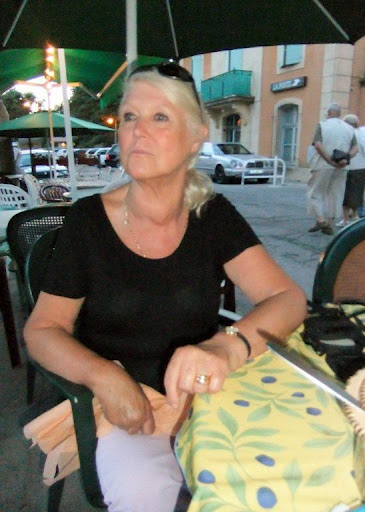
Dianne in 2010
I grew up in Southsea, born to a Norwegian mother and half French, half-English father. I always knew my father as a pacifist, yet he was conscripted to go to war. He didn’t want to fight, he didn’t want to kill anyone. He was shot down while serving with the RAF. It was heartbreaking for me and my mother, but it was his death and what my mother told me of his hating war and wanting peace for us that inspired my thinking throughout my life and led me to the decision to become a Bahá’í.
The first Bahá’í I ever met was my husband, Foad, and this was in 1958 when I was a teenager, studying French `A’ levels at college. We became good friends but we didn’t know then that one day we would get married. He took me to my first Bahá’í meeting and I didn’t have the slightest clue what they were talking about, until a very personable gentleman came on to speak. Having since read his book All Things Made New I now know him to have been the Hand of the Cause of God John Ferraby.
Following that time I went to the U.S.A. and worked as an air hostess with Pan American airlines. In those days it was considered a much sought after and glamorous job. Women were not encouraged to study the sciences but to be nurses and mothers.
In 1965 Foad and I were married at the church in my home town, Southsea, and we then had a Bahá’í wedding at the National Bahá’í Centre in London. I was a Catholic and no one had even suggested that I change my religion. I would probably have refused then anyway because the time was not yet right.
We spent the first few years of our married life in Zambia (1966-72) where both my children were born – our daughter, Mitra Danica, in 1968, in Lusaka, the capital – and our son, Nicholas in 1970 in Kitwe, on the copperbelt. A Bahá’í couple whom I will always remember were Eric and Jessie Manton. Originally they came from Manchester but they had been pioneers then in Zambia for 25 years. Jessie had been a hospital matron but when I knew them they ran a chicken farm in an area between Luanshya and Kitwe. There was no electricity and no running water and they collected water from the river. They had adopted a very retarded daughter, Mary, who became a Bahá’í. I remember the enjoyable firesides we used to attend, along with the Africans, when we would all sit around on potato sacks.
The next three years (1972-75) we spent in Zimbabwe (Rhodesia) and two Bahá’í friends whom I recall in particular were Shidan Fatheazam and his American wife Florence. Other friends were Phil and Pary Harvey. Phil was an instructor with Rhodesian Airlines
No pressure was ever put on me to become a Bahá’í whilst living in Africa since the Bahá’ís were instructed from the World Centre only to teach the indigenous peoples of Africa and not immigrants or contract workers (into which category Foad and I came).
Then the day came when Foad decided that we should go to Persia to see his parents, who had not yet met their grandchildren. In 1976 we arrived in Iran from Africa in our summer cotton clothes and almost froze to death, as outside the Mehrebad airport there was deep cold snow and bare trees (not a leaf to be seen and not a speck of green anywhere). But the family was welcoming and warm enough as we were whisked into various cars though I was anxious because the children were separated from me and with strange people we didn’t yet know. But I need not have worried. I’d never seen real Persian hospitality before, let alone a huge Bahá’í family who had all turned out to greet us like we were royalty. I was quite overwhelmed!
We stayed, and the children went to the British Embassy School since neither spoke any Farsi. I found life quite difficult at first because the traders thought that I was a wealthy American, or German tourist, with my fair colouring, and they immediately hiked up the prices as soon as they saw me, until I learned to bargain.
Driving was rather a nightmare in Tehran where everyone drives without any regard for road laws and frequently traffic would go up onto the pavement to pass a traffic jam, causing the pedestrians to leap out of the way! Traffic lights appear to be invisible to Persians! And everyone watches everyone else to avoid crashing into each other. I have since decided that they must probably be the world’s greatest stunt drivers and that if you can drive in Tehran, you can drive anywhere – except, that is, England because all the bad habits I learned in Iran failed me in my British driving test the first time, despite the fact that I had driven for 17 years in four continents and in numerous countries from dirt roads in Africa to crowded Tehran city. To my utter dismay and irritation, I was not good enough once back in the United Kingdom! We spent three years in Iran – and, as we began to get used to it, other drivers were afraid of me!
Suddenly, things began to change. Demonstrations began with people who had previously been our friends, yelling unspeakable things about Americans and British, and told us all to go home. They grew stronger and shouted threats aimed at the Shah of Persia.
One day we were swimming in the area of the Caspian Sea when news came that Revolution had broken out. Cinemas were burned, shops were wrecked. Foreigners went home and were evacuated by their Embassies. It felt as if we were the only British left. Of course, a few foreign wives remained, keeping a low profile, but we were unable to leave as our children had dual nationality and had to have special consent to leave the country, which by now had no law and order and was in the grip of anarchy.
No one even trusted their neighbour. Soldiers appeared everywhere with guns. They tore down the beautiful dome from the Bahá’í Centre near our house and they took away files of Bahá’í names of the National and Local Spiritual Assembly members.
Early in 1979 the Shah was forced to leave as an exile – sadly, never to return. Food became short. No gas, no electricity, curfew and cold, is how I remember it all. The airport was closed. We became prisoners in our home, afraid to go out. The schools closed and we lived for a long time like moles, piling coats, blankets and everything (even the dog) on top of ourselves and the children to keep from freezing. I’d had enough. We decided that the first ‘plane out would take the children and me back to England, and that Foad would follow as soon as he had helped his parents to move from where they were known Bahá’ís by the surrounding Muslims. Although they were previously their friends, they were themselves afraid to befriend Bahá’ís, and even betrayed where Bahá’ís were living which meant that the committee would come to confiscate their homes and carpets and items of value.
Eventually, in December 1979, and after queuing for three days in the most sardine-packed airport imaginable, we got onto a ‘plane that had no food or water. A very bedraggled bunch of travellers, mostly fleeing Iranians, alighted at Heathrow airport. Suddenly I was surrounded by photographers, flashes and newspaper men, asking questions about the Revolution in Iran. Next a Television crew approached us with the same questions and I found out later that we were shown live on ITN News.
That was the beginning of the next six and a half years when Foad was arrested at the airport in Tehran and his passport confiscated for being a Bahá’í. The children were then aged 10 and 8 years old – they didn’t see their father again for almost seven years until they were 15 and 17. Eventually Foad escaped via Turkey with his sister, Nahid (now in Canada).
It was during this time that I was on my own that I became lonely and I contacted the Bahá’í Centre in London to find out if there were any Bahá’ís in Surbiton. To my delight there were, and Mrs Iran Jolly came round for tea, armed with some books, and we became firm friends. I was invited to all the firesides and to parties at Naw-Rúz and I met other Bahá’ís. Mitra had begun to go to the Wednesday Youth Meetings, coming home with books she had won answering questions. I used to say the Bahá’í Healing Prayer every day because I had a back problem. This prayer was given to me in hospital in Zimbabwe years before by an elderly man, Mr Tehrani, who had been travel teaching around the world, and who had a daughter Pary Harvey, living in Zimbabwe.
After about six months living in England, I decided to really search for the truth of this Faith, so persecuted, and to find out why. So every night when the children were tucked up in bed, armed with my Bible and the books Thief in the Night, Some Answered Questions and All Things Made New, I went through the books with a fine tooth comb and began to get very excited as things began to fall into place. Questions that had bothered me for ages suddenly had answers. It became very clear to me that I was about to ‘declare’ myself a Bahá’í, and the very next day I did. This was in July 1980.
I was unable to tell Foad on the phone about my becoming a Bahá’í as all his mail was intercepted, so I had to contain my excitement. I needn’t have worried as an aunt of his, who had gone to live in Saudi Arabia, rang her sister in Iran (my mother-in-law) and told her that her English daughter-in-law had joined their religion.
Immediately my mother-in-law telephoned me to say how proud she was of me, and how all the family were so happy that I had accepted Bahá’u’lláh. Suddenly the ‘phone went dead – someone had heard – but she didn’t care and phoned again from her sister’s house.
Both our children ‘declared’ on their fifteenth birthdays, and again when they reached twenty-one.
This is how I became a follower of the Greatest Human Being that ever walked the earth. And it is my dearest wish and constant prayer that the Earth really will become One Country and all mankind its citizens.
_______________________
Dianne Andrea Mahboubi (née Gibbs-Dean)
Surrey, September 1992
Dianne and Foad Mahboubi in 1986
Postscript
When the war was over between Iran and Iraq the opportunity arose for the children and me to leave Iran, but there was a ban on Bahá’ís travelling. Foad knew this, but just wanted his family to be safe. He knew that it would be difficult to get himself out, but he had no idea how difficult.
Foad promised to follow us three months later and with this thought I left for England with our two children. My husband was left alone. He lost his business to the Revolutionary Guard. Foad was arrested, and had our family home taken away from him.
With nothing left Foad kept to his promise and tried to leave. He had a ticket booked, but by that time the anti-Bahá’í sentiment in Iran had exploded. At the time it was necessary to fill out a section on the form at the airport to specify religion. There was a space for Muslim, a space for Christian, a space for Jew, but no space for Bahá’í.
Unable to leave, Foad spent seven long years apart from his family in Iran, while I longed for him to join us in England.
He was constantly trying to think of a way out. He and his sister finally decided that the only way would be to travel from Iran to Turkey and hope to get help there. Even with a guide, this journey was extremely dangerous. If the Iranian authorities found them they would almost certainly face execution, and with no money and only the clothes on their backs, it was unlikely that they would make it.
It took two days and nights travelling over treacherous mountains through the Iranian and Turkish borders for Foad to finally reach Van, Turkey. With no passport and no money, it was an extremely dangerous situation.
He was captured. For the police the decision was simple – send him home, or shoot him. Thankfully Foad managed to get a message to me notifying me of his capture and I immediately realised how critical the situation was.
I sent a letter to the then Prime Minister, Margaret Thatcher telling her about our family’s situation and the terrible hardship that we had gone through. I explained that we had been married for 21 years and that for six years Foad had been unable to see his children. While Foad was in Turkey, miraculously I received a personal letter from Mrs Thatcher’s secretary signed by the Prime Minister herself. She said that although she was unable to get Foad out of Iran, she had instructed the Home Office to allow Mr Mahboubi to enter England without his passport. Finally things began to happen. It felt like a dream after so long apart. Foad could have been killed but somehow a miracle had taken place. Not only did Mrs Thatcher get someone to call me here to get the ball rolling, but she arranged for the Turkish Embassy to take him to Istanbul immediately.

Foad Mahboubi
 UK Baha'i Histories
It’s good to see Dianne & Foad’s story here – I wasn’t aware of Mrs. Thatcher’s intervention… So sad that Dianne lost Foad again to illness, but their’s is a marriage for all the worlds of God! This article doesn’t reflect Dianne’s tireless work in the community and interfaith networks.
Thanks Carolyn,
I wrote this many years ago and sent it to Thelma Batchelor who has requested me to write it, I forgot about it until she told me its going to be on line and eventually in a book. I tried to edit it but so much happened since writing it I thought it best to leave it as is.
Very interesting story. Eric Manton of Zambia was on the Assembly of Northampton at the end of the forties, beginning of the fifties, with Clare Gung, Alma Gregory, David Hofman, Betty Reed, all of whom had an illustrious history of service and of course he and Clare Gung pioneered to Africa in the Africa campaign.
Hello Kevin, Yes Eric told me that he was on the LSA I thought it was in Manchester. It was a strange difficult but wonderful life he and Jessie lead since Eric was an electrician by trade and had no electricity. Running water, or any mod cons as most other Europeans had in their hmes then.Philip Hainsworth also knew them he told me.Jessie had a hard time as she was looking after Mary the adopted daughter who was very mentally retarded. I know as I looked after her when she was 21 for 3 weeks when they went to Uganda for the opening of the new Bahai centre there.Her age mentality then was of a 7 year old.She could not be left alone a single moment.
They all used to go and stay in the African mud huts teaching them eating what they ate and helping them with eggs from their farm.
A wonderful familly
Thanks for the history
Dianne
I so enjoyed reading Dianne’s story it was lovely am glad she didn’t edit it tis so much nicer to get the story without frills. She had a sad time as well as exciting life but what a memory to have to look back on. Yes it’s sad her beloved husband passed on but at least she knows now he is “safe”.
Having read her story I feel its going to be a sad time for those who have been imprisioned in Iran for their Faith I pray for them to have strength to cope also I pray for that other Christian minister who was sentenced to death for changing his religion from Muslim to Christianity.
Thank you Dianne. Regards Anne Corvin (from the Dublin community Ireland)
Thanks Anne, I had no idea this was going public onto face book and was surprised how far it’s travelling
from Derek Cockshut:
Very worth reading – thanks Derek
Hello Dianne,
I came to your house in Kitwe 1969/70 with Eric and Jessie one Sunday for lunch. You and Foad were very welcoming and kind to me as I had not been in Zambia very long. I remember the afternoon very well; you were both so happy and I enjoyed it very much. Firooz and Mimi Oskooi came later in the day – do you remember them?
He was an eye surgeon at the hospital. I really am in awe of your continued commitment to the faith. I didn’t realize until after the visit that you weren’t a Bahá’í then because you shone like one! Your story is inspirational and I am so pleased to have met you both.
Loving greetings
Jackie Carter
Hi Jackie, Yes I remember you well you were a nurse and I always wondered what happened to you. Firooz and Mi Mi of course I remember tham both, Mi Mi stayed with us for quite some time when her baby Sayah was born.
Good to hear from you
Love
Dianne
Dear Dianne,
It was like walking down memories lane to read this.
The Saturday you were married in 1965 at the Baha’i Centre I was planning to be at the Centre but as a lot of us had just got back from Wales Summer School I upped out to get to London a little later and went to John Twyname’s party.
Some came over from the wedding to John’s place and Ron was one of them.
Later on that Sunday morning Derek, Najla, Ron and I went to Guardian’s Shrine for prayers and we have that photo of the 4 of us on our way there.
As a matter of fact Foad is related to me.
Mrs. Mahboubi’s mother and my Dad’s mother were sisters.
The Mahboubis lived in Hamedan when I was born and we moved there when I was a baby and before my brother Shahbaz was born.
He was bore in Toserkan.
My mother who is now 89 remembers their time together in Hamedan.
She tells me that Foad had two brothers and a sister.
Abdul Hossien Khan and Lutfullah Khan.
Their father was a merchant in Hamedan.
I wonder if she is remembering it right as I was less than a year and have no memories of our stay in Hamedan.
To top it off we also went to Iran in 1977 and were evacuated by the Canadian Government in 1979.
We remember that period in Iran’s history and knew you were stuck there with few other family members.
Dear Shahla,
I have only just seen this by mistake on face book which I don’t often visit.
I didn’t know Foad was related to you but he had such a huge family that keep popping up. Yes Foad sadly passed away 6 years ago with Cancer.He has a brother Soheil in Teheran still and Shahab in Portsmouth, and Nahid his sister lives in Canada,
. His father Abdul Hussain Khan is buried in Southsea UK. close to my mother who became Bahai a few weeks before her death.
Love
Dianne
Wonderful to read. Dianne was such a blessing in helping my adopted daughter Amy, and her mother Payman Deravi, during her long illness, for which we will always be thankful. Bravo Dianne for being a tireless worker for the Faith…you also taught me how to cook Persian rice years and years ago!
Hallo Dianne
your name sounds familiar to me. When you were living in Iran, were you by any chance living in the area called Tehran-Pars? and did you give English lessons to the Baha’i women in that community? If the answer is yes, I think I met you in Iran and came to one of your classes with my Mum. Sorry to hear about your ordeal and happy it had a happy ending.
Mojgan
Dear Mojgan, I think it must have been Aramesh’s wife also named
Diane Mahboubi but with one N.She lives in Leicester now. Aramesh was Foads cousin son of Lotfalah Khan
Thank you for writing back. Does this mean that Aramesh has passed away. I lived in Leiceter in 1986. almost all the meetings were held in Aramesh’s house. I was a student then and he helped me a lot. Unfortunately, I only got to see Dianne very briefly, because she didn’t attend the meetings at that time. Did the two of you ever live in Iran before the revolution?
It’s just amazing.
Yes we both lived in Iran before the revolution, Diane was there long before we went
Aramesh is still in Leicester. He is 81 years old now and sadly suffering from blood cancer. If you want to see him, please let me know I will give you his phone number. He has always been a very active Baha’i and only recently had to cut down some activities due to his treatment.
Very beautiful, reading through the lines, knowing parts of the story from before, nevertheless, I couldn’t stop reading and remembering. The entire family and Foad are always in my prayers.
Thank you dear Sammy I’ve only just looked at this again after many years and seen this from you. I hope you are well.
Love
Dianne
XX
Thanks Sammy it’s years since I re-read this and so much has happened since then.
You were married to the beautiful Sepideh, Mitra was married to Simon. We have 2 grand daughters, Giselle and Genevieve. I flew with you to Dubai for the wedding of Payman’s daughter and had a wonderful time with you all. It was an amazing wedding; so many people! And now we are in shutdown due to the Pandemic Coronavirus. I hope you are safe and well but don’t know where you are now. Take care and stay safe
Love Dianne
XX