
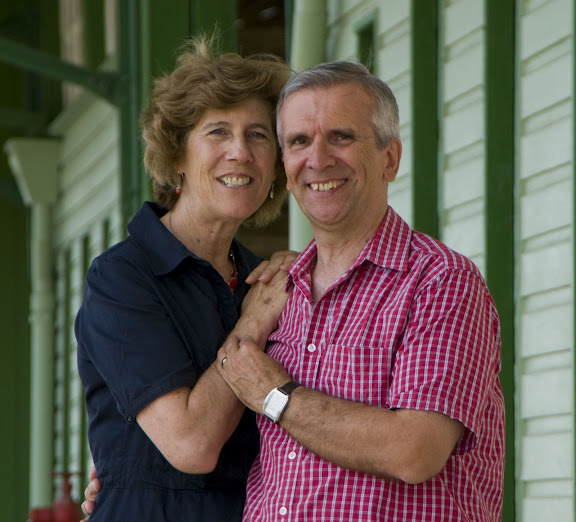
Fiona and Keith McDonald
A Journey Like No Other
I was born in Carshalton, Surrey in 1950 and grew up in nearby Croydon. Religion never meant much to me. My parents sometimes went to church at Christmas or Easter and I went to a school next-door to our parish church, but nothing stuck. About the closest I had got to a religious experience was in 1969 when Crystal Palace were promoted to the First Division for the first time ever after a late-season run, though religious persecution followed soon afterwards when I landed up in hospital having my appendix removed instead of going to Selhurst Park to watch “our” first game in the top flight against the star-studded Manchester United whose team included Best, Charlton and Law. Oh, and I got a bit religious about a girl when I was at school.
In other words, I didn’t have a clue about religion other than knowing that it made no sense for a person to be a Christian because he is born in a particular part of the world and for another to be a Hindu, Muslim, Buddhist or whatever simply because he was born somewhere else. How could one religion be ‘true’ and the others ‘false’ when it was a freak of birth whether or not you made it onto the bus that was going to Heaven or the one that was going to Hell?
I grew up in Croydon. We liked to think of ourselves as being in the more upmarket ‘Surrey’, not ‘South London’, but no-one was fooled. After leaving school at 18, I became a cadet on our local newspaper in September, 1969 just a few weeks after I lost my appendix. As part of the cadetship, I had to work in the paper’s district office at Epsom.
It was Epsom in 1971 where I first bumped into the Faith. One of the local Bahá’ís came into our office (a room really, over a betting shop) to place an ad. He interrupted our afternoon card game but he was a local celebrity because he was an actor and there was a bit of “nudge, nudge, know who that is then?” when he walked in. He was known to all the journalists there as a Bahá’í.
Then on December 4, 1971 I had two religious experiences. First, Palace trounced Sheffield United 5-1, scoring one of the most spectacular goals I had ever seen in the process. Then that evening I went with my mate, Dave, from the opposition paper to a concert in Kingston. A band called Quintessence were playing. I knew nothing about them but Dave, a music guru, recommended them. I’d never been to a gig like it. The band were into a sort of hippie Hinduism and incorporated a lot of chanting into their songs. There was a joy and an indefinable spirit about the whole evening that converted me instantly into a fan. En route, while waiting for the bus, Dave started talking about his religion, the Bahá’í Faith. He told me what Bahá’ís believed and it seemed to make sense, particularly the fact that Bahá’ís regarded all religions as coming from God and no one religion was ‘right’ and the others ‘wrong’.
Would I like to come to a Bahá’í meeting, Dave asked me? Why not, I decided. Oh, a couple of musicians were going to be playing, he added. England Dan and John Ford Coley were Bahá’ís from America currently touring the UK.
So I went along to the meeting at Bourne Hall in Ewell. They sang some great songs. There was a talk. Again, it made sense but I wondered why people needed to believe in God to practise these things.
God was the problem for me. I didn’t know whether I really believed in God or not. At least, the Bahá’ís didn’t portray Him as an old man with a beard up in the sky. In fact, they didn’t portray Him at all, and it was the same with the founder Prophet, Bahá’u’lláh — they weren’t allowed to depict Him or have his photograph because the Faith didn’t want people to worship His image. I liked that idea. But, still, God was a problem.
I kind of believed in something that was vaguely Godlike. After all, the world seemed to run too smoothly to be an accident or freak of nature. But was there something we call God sitting there orchestrating everything and talking to humanity at different times through chosen individuals (prophets)? It was a big ask.
Still, the Bahá’ís were great to hang out with. At that time in Epsom, there were a lot of young people coming into the Faith through the local art school. I just loved being part of this crowd. They were into music — big on Quintessence — and their parties were a blast. For a start, there was no alcohol at these parties because Bahá’ís didn’t drink. I couldn’t imagine it being possible to have a good time at a party without beer and I was very apprehensive about the first party I went to . . . but it turned out to be a fantastic night. Lots of dancing, no awkward coupling, no-one off their heads with booze. Many an evening or weekend, I would just hang out with this crowd and it was the best bunch of friends I’d ever had. Sure, religion was a recurring theme but I didn’t feel I was being brainwashed or that my acceptance of their religion was a condition of them accepting me. We would go up to London together. One time we went to an all-night Quintessence gig at the Lyceum off the Strand and joyously danced the night away.
Another particular experience stands out in my mind. I travelled to Edinburgh to attend the Edinburgh Fringe Festival. While there I contacted the Bahá’ís and went to a meeting. When I boarded the train back to London, it was fairly crowded and eventually chose a seat opposite an older woman. I got out my copy of Paris Talks and started reading. After about an hour, the lady asked what I was reading. When I told her, she knew the book — Sybil Kirkland was a longstanding American Bahá’í from Wisconsin. We became friends, I saw her in London and we wrote regularly to each other. Of all the 500 or so people on the train to sit opposite!
At work, I completed my cadetship and got a new job on a local paper in the Medway Towns, Kent. Leaving my Bahá’í friends in Epsom was hard, particularly as I was going to a place that had no Bahá’ís.
A few weeks after leaving Epsom, Pat, one of the Bahá’ís, asked if I wanted to go with him to the Bahá’í Scottish Summer School at a place called Carbisdale, a youth hostel in a modern castle, north of Inverness at Culrain, Sutherland. I jumped at the chance to be with some Bahá’ís again. We drove from Epsom to Carbisdale, the roads getting narrower and narrower as we drove further north, signs of human civilisation rarer and rarer. Carbisdale was in the Highlands and it felt like I was entering another world.
It was a fairly small gathering of about 50 or so but it remains to this day the best Bahá’í event I have ever been to. I only really knew a couple of people there but I was immediately made to feel like one of the crowd. Everybody was so friendly. There were two Hands of the Cause, I think (Dr. Muhajir and Mr Faizi) and everyone showed them tremendous respect. There was also music. Various Bahá’ís got up and sang their songs in a way that touched me quite profoundly. I can still hear those songs in my head and see the faces, and feel the spirit. Then there was the fun. We had so many laughs, an innocent kind of fun — nothing at others’ expense or with off-colour undertones. There was even bagpipes at dawn.
One of the singers was Fiona, whom I had briefly met once at a Bahá’í meeting in Epsom when she sang. She remembered my jacket and air of aloofness! I became particularly close to her, her friend, Pam, and a former Epsom Bahá’í, Ann. We sat and talked a lot, and, most memorably, they took me out to high tea one afternoon. Talk about bribery and corruption: three gorgeous girls and cake . . . how could I resist? It was at that high tea that I decided it was stupid not to sign a card and officially become a Bahá’í. Back in Epsom one time, I remember someone saying to me: “It’s no good sitting on the side of the pool. The only way to enjoy the water is to dive in.” I decided that these people had something I wanted to experience and I couldn’t truly do that from outside the Faith. Not having had a religious upbringing, I wasn’t really “into” religion and certainly not “into” prayer but I decided that it was time to try and change all that. I declared on the eve of the Martyrdom of the Báb, 1973.
Above all, I saw the Bahá’í Faith as the way to change the world. At that time, we had come through the era of Flower Power with its theme of peace and love, but post-Woodstock it was becoming clear that the hippie philosophy alone was unsustainable. The Faith took things much further and imbued it with the key instrument of Bahá’u’lláh’s Station as the Manifestation of God for this Age. The “proof” of His claim for me was in the exemplary story of His life, much of it spent in enforced exile. There was no hypocrisy; no saying one thing and doing another; no sign of ego, no putdowns of other Manifestations such as Jesus or Mohammed. And this was the glue which held everything together: I had never experienced such a vibrant spirit of love and unity as there was at that summer school: Bahá’u’lláh was the foundation on which everything else was built. And there in the Scottish Highlands over tea and cakes, deep conversations and revelry, all framed by beautiful music, I saw that this was what the world needed.
I moved soon after declaring to Maidstone. It had a budding Bahá’í community and I became a member of its first Spiritual Assembly. I loved my short time in Maidstone. We staged a big Bahá’í concert in the town. Fiona had got together with some young Bahá’í army musicians based at London’s Kneller Hall and a fantastic blind Bahá’í pianist Francis. The Maidstone concert was their debut together. We got a good audience, the music was fantastic and it was a great success.
Working together on this concert brought Fiona and me closer together and we married in December 1974, though I have to say she was even more hesitant about the idea than I had been about becoming a Bahá’í — she turned me down twice! Our first home was in Epsom, the place where my faith was born, and we both served on the Spiritual Assembly. Then we moved to St Albans, where we helped form its first Spiritual Assembly and had our three daughters, Gemma, Anna and Natalie.
During our time together in England Fiona was appointed as one of the first two Assistants to the Auxiliary Board in Europe. She was responsible for the whole of London. I was also involved in a monthly national Bahá’í “tabloid”, Intercom-Bahá’í.
In 1982 we emigrated to Australia, spending our first year in Singleton, a small town of less than 10,000 people in northern New South Wales, where we helped form the first Local Spiritual Assembly. Now-Universal House of Justice member Stephen Hall and his wife, Dicy, were on that Assembly too and he unwisely persuaded me to come out of cricketing retirement to play for his team. I made a duck and dropped a catch. Our Australian child, Philip, was born in Singleton — “Try not to push. I’ll be there as soon as I can,” the doctor said from his morning surgery, where he still had a few more patients to see, as Fiona lay busting to give birth.
In Singleton I was editor of the local tri-weekly paper and during my time there I introduced a well-received weekly page on religion called Credo.
Then we spent a year as isolated believers in Maitland, between Singleton and Newcastle.
Next we moved 4000km across the country to Perth, Western Australia, where we bought a house in the goal area of Fremantle, Perth’s port city. There were a couple of Bahá’ís there but it had never had an Assembly. We helped form an Assembly a year later and we served on it for many years. We moved six years ago to East Fremantle, a small community which had had an Assembly for almost as long as Fremantle but had always struggled to make the nine each Ridván. We now have over 20 and the community is one of the most active in Western Australia with lots of study circles, devotional meetings, classes in schools and junior youth activities.
Fiona has served on the Australian National Spiritual Assembly for 20 years. It meets every five weeks in Sydney and each flight takes four to five hours depending which way the wind is blowing.
I edited the Australian Bahá’í Bulletin for six years and served on the editorial board of the Herald of the South magazine for many years. In 1992 I was chosen as one of Australia’s representatives at the Holy Year commemoration at the Bahá’í World Centre.
Our daughter Anna is living in London and teaching at an international school in Acton; her twin Gemma recently returned to Perth after living for many years in Melbourne and is managing youth and community programs; Natalie, in Perth, is married to Gary, they are both in the West Australian Police and they have a nearly one-year-old son, Jacob; Philip, also in Perth, is married to Naomi with two daughters and a son and he runs his own cabinet-making business.
We have now lived in Australia for 30 years and over the years I have inevitably lost contact with some of those wonderful people from the year and a half that I spent investigating the Faith. Sadly, two of our friends from Carbisdale, Pam Lewis (Poulter) and Wendy Thorn (Scott), died much too young. A few months ago, out of nowhere, I had a Facebook message from Janie, an American who was at Carbisdale and with whom I travelled back to London — we hadn’t been in contact since 1972. And a couple of years ago I had a wonderful reunion in Glasgow with Lindsay Moffat, one of those Epsom Bahá’ís.
Oh, and my other ‘religion’ is still Crystal Palace. It is mostly a religion of endless suffering that requires selfless devotion.
______________________
Keith McDonald
Perth, W. Australia
March 2012
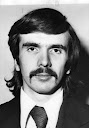
Keith in 1973
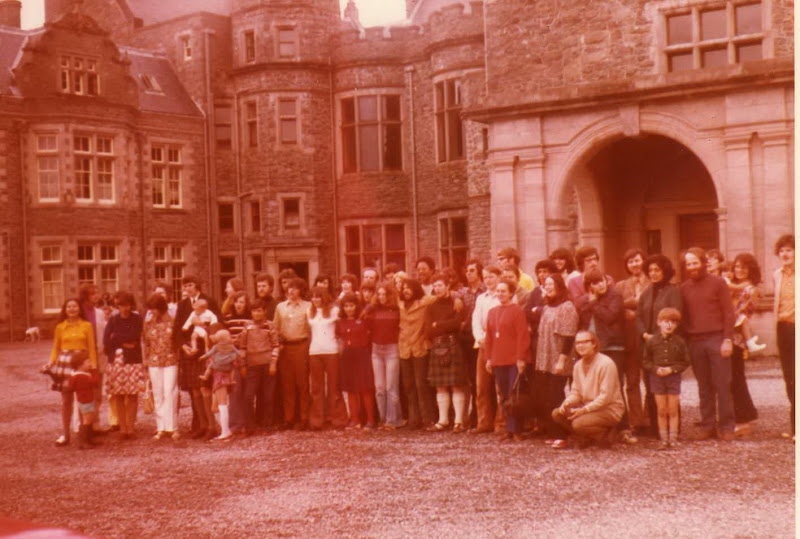
Carbisdale Summer School – 1973

The McDonald family in 2011
 UK Baha'i Histories
Loved your story, my own previous religious experience revolving around Everton Football Club and the mutual endless suffering that requires, that same devotion! Love to Fiona.
Eric Bowers
Sounds like football is a good training ground for the spiritual life! I have a sister-in-law who’s a mad-keen Liverpool supporter, but she’s been a bit quiet lately.
Great story – I also became a Baha’i in 1973 and was a compositor/paste-up artist at various printers – hot metal and paste-up in Surrey newspapers. Now retired in Brighton and a member of the local community.
Which papers? I worked for the Croydon Advertiser and spent most of my time in the district office at Epsom. We’ll be over visiting my mother in Eastbourne in November.
Thanks for sharing Keith, your tales brought back many memories and I enjoyed the informal and slightly cryptic style. I suppose the Baha’i community is a kind of crystal palace too, fragile but open to the light and plenty room on the terraces!
Thank you. Yes, very apt comparison. Lots of room at the Palace. They used to have crowds in the 25,000 + in my day, now they struggle to get 15,000 . . . but they make a lot more noise now.
I saved this for a few hours as I knew I would enjoy it – hopefully Fiona’s is in the pipeline with a few more details?! I recently came across a whole stack of Intercom Bahá’í, which took me back to the days of Public Meetings and Bahá’ís having Fun…
Epsom community nurtured so many new Bahá’ís back in the 70s…
Much love xx
Don’t Baha’is have fun any more?!?! Glad you enjoyed it. I think Fiona’s story may be a while yet.
What a lovely story from Keith and a great picture of the two of them! “Sue” made some recordings of Fiona’s singing before she and Keith were married. I suppose I still have the tapes somewhere. Then I saw Fiona in Australia in one of the NSA’s tea breaks. This must have been 10 or more years ago.
Thank you. Where are you now?
Wonderful history Keith. I’ve always wanted to learn about you and Fiona, and your beautiful children, and then what followed after you left for Australia. Warmest love to you all.
Thank you. I remember coming over on Sunday afternoons to your family for firesides. Good memories. Where are you these days? You were/are in Brisbane weren’t you?
I met Fiona and Keith in St Albans city hospital, both mothers having delivered babies; she another daughter after twin daughters and me another son, having one already.Had I had a daughter, her name would have been Natalie. Fiona an Keith asked if I’d mind them calling their new born ‘Natalie’. I was honoured!
We started a short-lived friendship after leaving hospital.Short-lived because soon after, F&K emigrated to Oz.
We have kept in touch for over 30yrs!……
and I still admire their lifestyle.
Being baha’is has certainly worked for them.
Pam Baladi
Fiona sang at our wedding in 1976. She made a great impression on me when I was a teenager investigating the Faith. My story to follow soon. Anne Iqani
Dads……brilliant! I never knew all those details! Even had a bit of a tear in my eye at the end. Please write Mums one as well. Would be nice to have them both. Love you Axx
I remember Keith finally becoming a Baha’i. Fiona of course was really Fiona ‘Have Guitar Will Travel’ Dunn. It was a surprise when they got married. England Dan and John Ford Coley had come over on a tour to be the opening act for Elton John. They actually performed at an English Dawnbreakers event on that visit. Dan became very well known as Dan Seals, a major US country and western singer. Sadly he passed away recently. I agree with Keith: Pam Lewis and Wendy Thorne were taken from us too soon. Fiona really helped to get music and the arts started in the UK. Obviously Keith has been wonderfully blessed by becoming a Baha’i – just a pity that supporting Crystal Palace was not purged from his system!!!
Derek
Keith: It has been great to catch up on your life after you left the UK. I fondly remember your wedding. Great picture of your growing family. My husband, David and I have been living and working in China for the last two years. Hope all is well, give my love to Fiona.
Dear Keith & Fiona – it is great to see Maidstone get a mention in these pages – so many happy memories of those days. I was at your wedding – warmest love from Guyana – we just enjoyed a memorable Youth Conference (one of the 114) here in Georgetown – 300 plus youth from Trinidad & Tobago, Suriname, Guyana and French Guyana
Really enjoyed your write-up and feel privileged to have met you both. Unfortunately we did not meet again after you left England, we left in September 1970 for Haifa, but we came to England every year to attend summer school for most of the time. The Faith has really made our lives rich and meaningful, how blessed we are.
Hi Uncle Keith. Great story. Its always interesting for me to hear how people who didn’t have much to do with religion end up being Baha’is. I saw Anna the other month. You’ve left a great legacy. See you soon in Australia. – Maya-Rose
What a great story, I remember Fiona singing as a youth in London on many occasions, such fun times. Thanks for sharing.
Hi Keith,
How we remember those days in Epsom.
We now live in Leicester.
Our 3 boys are now men. How time flies.
If you want a roller coaster ride, try being a Leicester City supporter!
Arthur
Loved your story Keith. I was good friends with you and Fiona at Singleton. You were both a shining light in my life through your faith and the manner in which it informed your behaviour.
Dear Keith, I just read your great story here in Boone and will send the link to Janie pronto. I look forward to seeing you both on Zoom soon. Am so glad I found your story before we meet up virtually. Carbisdale was my first summer school too and I too loved it. Had become a Baha’i while working in Uganda in February 1972. I left there in May of 73 so Carbisdale was my first chance to meet British Baha’is. I had three months unexpected paid leave when returning from Uganda, by 1973 it was considered a hardship post by the UK Medical Research Council where I ran the office for their Child Nutirition Unit so I used some of it to spend time at Carbisdale and on to Baha’is in Inverness and the islands. I remember David Hofman telling jokes at lunchtime when I sat near him, such as “What did rheumatism say to arthritis, let’s get out of this joint!” He said that members of the Universal House of Justice members liked to collect such crazy jokes to share after long meetings. One of my favorite quotes is ”laughter is spiritual relaxation”!.
I have now lived in Boone for 35 years. I married an American pioneer, Richard Gray, while pioneering in Cameroon in 1978-9. We were four years there, then four in downtown Toronto where Richard obtained his Ph.D, in Astronomy, then two years in Denmark for his post-doc work, one-year in Washington State then drove across the States in a Chevy Sprint to this small mountain town in Southern Appalachia where Richard had a tenure track position. He retired from this last June but is till busy with research and building astronomical instruments, We spent eight months in South Africa where he had a Fulbright scholarship in 2019-2020 but we had to hurtle home in March of 2020 when Covid arrived on the scene. We loved being back in Africa, especially meeting the local Baha’is of varied backgrounds around Bloemfontein While he has studied the stars and taught undergraduates I am entranced by creating good soil in our backyard. There are, I read recently, more microbes in a handful of healthy soil than there are stars in the universe. And I keep writing.
Thank you again, Keith. I much enjoyed your story and the good pictures. I remember Fiona coming to sing in Carmarthen and staying at my parents’ home where I had a flatlet on the top floor. I remember being at your wedding also. You are both an inspiration.
Mary Perkins Gray.