

Andrew Gash in 2012
In the early part of the War, my father was in a reserved occupation (he was in the ARP, and was involved in rescuing people from bombed buildings—his engineering background was useful in helping him to tunnel to people buried in the rubble). In about 1942, he was called up and commissioned into the Royal Engineers, and posted to the 14th Army in Burma, being torpedoed in the Mediterranean on the way. He was involved in building advanced airstrips during the Burma campaign, and had a mixed command of Indian troops—Jains, Moslems, and Hindus—and at one time had a platoon of Gurkhas attached. He had a hard time and suffered from malaria for the rest of his life. At one time his weight was down to six stone because of dysentery and privations. For years after the War we used to get old soldiers of his command calling to visit us to see how my father was.
When father went into the army, my mother took me to live with my grandparents in Paignton. At the age of six, I was sent to a local boarding school – Montpelier. One of the few memories I have of that time, apart from being made responsible for a dormitory of younger boys when I was seven, was the regular visits of various clergymen who came to collect pennies for missionary work “among the heathen”— as my pocket money was only tuppence a week, I strongly resented these visits.
My father must have come on leave shortly after the War ended, just after one of these visits from clergymen, and I remember asking him what it was like, commanding “heathen” soldiers. My father rounded on me, perhaps the only time he ever did so, and said, “Don’t ever let me hear you call them heathens again—they all believe in God, they just call Him by different names, and a lot of them are far better men than I shall ever be ….” That was the gist of his remarks, he said a great deal more of course, but the conversation left an indelible impression on my mind. My father never became a Bahá’í, but he was always sympathetic towards the Faith.
When my father left the army in about 1947, we moved to Reading, and my father joined one of the government Ministries, I think it was called Housing and Local Government at the time.
I had been baptised into the Church of England and went to Sunday School regularly as a little tot, but later we seldom if ever went to church—partly because my mother took a hearty dislike to the Suffragan Bishop of Reading who used to walk his dog regularly in front of our house, and my mother got fed up with cleaning up after the dog—such are the things that mould one’s life. I was sent to a local Quaker preparatory school, and as a result mother and I attended Quaker meetings for several years. I got a scholarship to Reading School, however, and that is where I received my secondary education.
My parents separated when I was 16, and I left school to earn a living— joining Lloyds Bank for no other reason than the manager had previously told my father he would offer me a job if ever I were interested. I hated the banking environment, however, and when the Suez crisis came in 1956, I volunteered for the RAF, much to the chagrin of my father who wanted me to go into the army. After a year, I managed to get a posting to Shinfield Park which was then the Headquarters of Flying Training Command and was four miles from my mother’s home. As a result, I got a sleeping-out pass and the rest of my service was not too dissimilar to a civilian job, apart from guard duties and the like.
It was while I was on a guard duty—guarding the station armoury (the IRA was busy at that time too) with another airman — that first I heard of the Faith. My companion, whose name I don’t recall now, spoke about the Faith from five until midnight and gave me some books, including Christ and Baha’u’llah. As I had lost interest in religion and Christianity—I was the only member of my intake into the RAF who insisted on affirming my allegiance, rather than taking an oath on the Bible, an act the consequences of which impressed upon me the desirability of conformity in service life—I was not too interested. My companion was being discharged a few days after our stint in the armoury, and so he told me to return the books to a Geoffrey Bridle— which I did—and left it at that. There were five people who became Bahá’ís at RAF Shinfield Park at that time—the first was Paul Adams, who was Knight of Bahá’u’lláh to Spitzbergen; Geoffrey Bridle, who married Marina Nazar and is now at the time of writing (1997) in Australia; two others whose names I now don’t recall (including the one who first mentioned the Faith to me – but may have been called Graham, now I think of it); and myself.
Just before my own discharge, I met, apparently quite by accident, Geoffrey Bridle in Reading one evening (I had been to the cinema to see “The Beast from 20,000 Fathoms”), and for some reason I still do not understand, I invited him home to discuss his Faith. He hesitated, and then came back with me and stayed up late talking, this time about the social teachings. I did not know it at the time but when he left he had to walk home some five miles or so as it was too late for the buses. The next day I got a letter from him several pages long which he had written as soon as he had got home and which summarised what he had been telling me, and inviting me to a meeting with some Bahá’í youth. This impressed me greatly, and I decided to myself at that time that I wanted to become a Bahá’í.
I met the youth a few nights later (one was Ilona Rodgers, Jeannette Battrick’s daughter, now in New Zealand where she is a well-known actress), and subsequently was invited to the Battrick’s house in Twyford. I went nearly every night for several months—it must have been a sore test for the Battricks who sometimes went to bed, leaving Geoffrey and myself still talking (we must have been very insensitive, or very engrossed in the Faith). Jeannette would not allow me to declare at first, she kept saying I should read more before doing so. I also visited Rustom Sabit who was living in Reading at that time, and learned a great deal from him.
I was concerned about the state of the world and had been reading about politics and was interested in socialism and communism at the time—I had even taken out the works of Joseph Stalin from Reading library—but when I mentioned this to Jeannette Battrick on my first meeting her, she demolished my confidence in politics in double quick time and in a thoroughly convincing way. I have heard people say since that as Bahá’ís we should find points of agreement and not dispute with contacts …. well, I am sure it’s good advice, but it certainly wasn’t followed by Jeannette the first time I met her …. and she didn’t put me off.
I had to plead to become a Bahá’í, which I was finally allowed to do in December 1959. I became part of the Reading community and as the local Assembly was below numbers I became an Assembly member by default and was elected Treasurer to boot! John and Valerie Morley were members of the Reading Assembly at that time, and soon I was frequenting their house instead of the Battricks’. I actually knew the Morleys from long before, as John was Berkshire County Drama Advisor, and used to adjudicate in drama festivals in which I used to take part as a member of the Progress Theatre, an amateur group in Reading. Hartmut Grossmann was also in Reading at that time, studying English, so we were the Reading “youth”. Not long after, I was appointed to the youth committee which produced “The Voice of Youth” – a Bahá’í youth magazine at the time. I have to say I had only the haziest idea of what it was all about, or what I was supposed to do, though I think I did write one or two articles for it. Another Bahá’í I met at the time was “Killie” Kilford. She lived in Winchester, was very elderly and known as one of the “ ‘Abdu’l-Bahá Bahá’ís” as she had allegedly met the Master, and had been a friend of Grace Challis, as best I remember.
My mother was concerned about me becoming a Bahá’í and it was the only time she called my father after their separation. He came to visit and I had to explain what I had “got into”. I reminded him of what he had said about the troops he had commanded during the War, and in the end both he and mother accepted my decision, though mother was never greatly interested despite going to a few meetings.
I remember being taken to National Teaching Conference by the Morleys, early in January, 1960. The weather was bad, and John, who was, like Val, one of the Faith’s precious and much-loved souls, used to drive his Morris Minor estate car in a stop-start fashion, constantly accelerating and then slowing down. It was rather nerve-wracking apart from probably stressing the transmission. There were about 100 Bahá’ís at the Conference altogether—it seemed a lot! Charles Macdonald spoke about direct and indirect teaching—I remember him saying that he used to favour the direct method: he would approach people and ask, Have you heard of the Bahá’í Faith, and then tell them about it. But now, he said, he favoured the indirect method: he would go up to people and say, Good morning, have you heard of the Bahá’í Faith, and then tell them about it. Perhaps it was the other way round.
It was the Ten Year Crusade, and an appeal for pioneers to Europe was made. I offered to go to Luxembourg. I had left the Air Force and was working for a retired Wing Commander, whom I had known while in the service, selling goods and services to Service personnel at home and abroad. He offered to make me an agent of his company to 2nd TAF (Tactical Air Force—the RAF in Germany). The Battricks were concerned that I was too new a Bahá’í, but took me to the Dutch Summer School (in 1960). There I consulted with Louis Henuzet, Lea Nys, and Ben Levy who were all on the Benelux NSA as it then was. It was agreed I go in October. While at the summer school, I befriended a Dutch boy, Hermann van Duyn, who shortly after my return to England turned up on my doorstep and stayed for several weeks. He was in some distress, and I learned later that his parents, who were from Den Haag, were considering (and subsequently did) following Mason Remey for a time.
When I left for Luxembourg, the Reading Assembly presented me with a copy of Some Answered Questions which is signed by ten of the friends: John and Val Morley, Ray Newman, Lisa Gray, Frances Bateman, Mary Newman, Michael Blakey, Joyce Kuberski, and Kitty Glover who I think was probably visiting at the time. On my way to Luxembourg I was permitted to stay overnight at 27 Rutland Gate in what was then the little guest room, and I also stayed a night in Brussels with Madame Nys and Ben Levy, who had married her daughter, I think. There was a typhoid epidemic in Dudelange where I was going, and I had had shots against it, which were very painful and made the travelling and carrying of luggage quite difficult. Ben Levy was dealing with all the material from Mason Remey which was coming out at that time, and he discussed it with me, partly because it was the time that many of the French NSA accepted Mason Remey’s claims for a while. It shows how little many people knew at the time, and was partly due to there being so little literature in French— English-speaking Bahá’ís have a duty to use their native language to really deepen in the Faith.
In Dudelange, everything was closed up, and I had to stay in a local hotel. The pioneer there was Virginia Orbison, who had pioneered all through Latin and South America, Spain and Portugal, during the first and second Seven Year Plans, frequently being thrown out of the country she was in at the time, at the instigation of the Catholic authorities. She was a formidable character, though probably not particularly memorable for tact or diplomacy. I was asked by Hand of the Cause Dr Muhlschlegel, to keep in touch with Hermann van Duyn and try to keep him in the Faith and to keep Dr Muhlschlegel apprised of what happened. Hermann was only 17 at the time and it was very difficult for him. I later got a letter from Dr Muhlschlegel that everything was resolved for the good. We used to get regular visits in Luxembourg from both Dr Muhlschlegel and Dr Grossmann. The Bahá’ís in the Grand Duchy were a very diverse lot: Persians, a few native Luxembourgers, some Americans, Germans, British, and I think someone from France though I can’t remember anything about them and it may be they were visitors. I remember consultation used to involve translating across two languages, e.g. from English to German, and then from German to Persian, or variations on that theme. It did teach one to keep to the point.
I attended the laying of the foundation stone of the Frankfurt Temple, and was introduced to Hand of the Cause Millie Collins. The weather was terrible, and the ground and everywhere was a mudbath. While in Frankfurt, I was invited by Hartmut Grossmann to have tea with his parents and Marzieh Gail—a memorable experience!
Marzieh was a truly formidable lady. In later years I was to correspond regularly with her—while I was editing the magazine “Herald of the South”. I was invited to stay with the Grossmanns in Neckargemünd, and spent about a week there. Each evening, the Hand of the Cause would spend a couple of hours talking to me about the Faith and what had happened to the Bahá’ís in Germany during the War. Alas, I took no notes, not realising at the time how great a privilege it was.
For some reason, I think it was trying to fit in pioneers to the best posts, I was asked to move to Differdange, where I shared a flat with Ronnie Bates, until a Clara Weir arrived, an elderly pioneer from the USA, and we gave up our flat to her. It must have been a relief to our neighbours: Luxembourgers were very keen on cleanliness and regularly washed and scrubbed the outsides of their houses and the footpaths as well. When it was our turn to do the cleaning for our block of flats, Ronnie and I used to put on our English cloth caps, put on the Pomp and Circumstance Marches and set to. I only learned much later that our neighbours did indeed think it strange that two men should share a flat—it would have made a lot of difference if someone had researched local attitudes and mores. Our sharing a flat actually reflected badly on the Faith.
Anyway, I moved to an attic room over a bistro, sleeping on a camping bed. The bistro had a bowling alley, and every evening until well into the early hours, any conversation was punctuated by the “whoosh, whump” of bowls knocking over skittles. Serious conversation required an effort. The flat beneath me was occupied by American pioneers, the Marcus family. Les and Audrey have been in Haifa now for many years, and their daughter, who was only very young then, is now in Romania, I believe. Another pioneer in Differdange had been Frances Wells, who had been a notable pioneer in Alaska. She died of leukemia while I was there, and the Marcuses had moved into her flat. Her death actually brought the disparate community much closer together. Another notable pioneer in Luxembourg was Honor Kempton, who at that time lived in Esch-sur-Alzette. Jeanette Battrick had also come out to Luxembourg—she said to keep an eye on me—and had brought baby Sarah with her. I remember I joined the local fencing club to try and find contacts— with only one dubious success. I did learn the rudiments of the foil and epee, though, as the fencing master turned out to be an Olympic medalist.
Among the Bahá’ís I remember from that time were the Bodes—Ed and Mary. They had pioneered to many parts of the world, and had that radiant love about them that instinctively drew people to them—a quality we should all have as Bahá’ís. Ed was very tall, well over six foot, and Mary was very short, less than five foot I would say. She always looked half Ed’s size. They were pioneers in Holland – either Haarlem or Arnhem. Mary had been one of the children at the Convention in New York in 1919 when the Tablets of the Divine Plan were literally unveiled to the delegates (Rúhíyyih Khánum had been another of those children). Another pioneer family in Holland was the Souths (Jean, or Jeanne, and Harold—also from the USA): their son, Scott, about nine at the time, had had an accident on his bicycle and had been taken to hospital. An x-ray showed a fractured skull and the doctors were not sanguine. They phoned us, very distraught, and we said the long healing prayer (and some others). The next day, they phoned again in a much happier mood to say the hospital had taken further x-rays and could now find no sign of a fracture and everything was going to be fine— which it turned out to be.
Returning from a trip to Liege for a Benelux conference, I caught food poisoning after eating steak tartare and was in my attic room for several days unable to move, before I was able to struggle down to the Marcuses, who eventually took me in and let me sleep on their couch. I could take nothing but orange juice for a week or so. I also accompanied Jeanette Battrick when she drove her campervan from Esch or Luxembourg-ville on a midwinter trip overnight through the back roads of the Ardennes through snow and ice to take a Bahá’í family back to their home in Liege. At the time riots were taking place in Belgium during the Belgian pull-out from the Congo. The main roads were already blocked by rioters and the trains were not running, so we had to go a roundabout way over minor roads. The border guards were quite suspicious. We drove into Liege which was like a ghost town—we literally saw not a soul—very eerie. We refused an offer to stay for a meal and turned round and came straight back, seeing only squads of riot police and paras doubling through the deserted streets. That morning, about half an hour after we left, they had in Liege the worst riots of the whole upheaval. It was a hair-raising trip.
As eventually there were more pioneers than needed in Luxembourg I returned to England in about May or June of 1961, and, after consulting with the NTC, pioneered to York.
Golrokh Sabit, Rustom Sabit’s niece I think, was the pioneer there. After a couple of weeks I got a job at Rowntrees Chocolate Works—in the Melanger planning department—planning the quantities of each type of chocolate to be produced. I had a small basement room off Blossom Street for a few months, until Brian Whitehead arrived on my doorstep one evening, announced he had come to pioneer to York, and moved in with me. The landlady quite rightly objected, and we ended up taking another flat by the River Ouse near Cliffords Tower. Malcolm Lee already had a flat in the building, so the three of us shared two flats between us. The building was on uneven foundations and the floors sloped—one side of the building being about nine inches lower than the other. The river flooded in winter so that we could only get in and out through the backdoor.
I met Jean when the York Bahá’ís went to Southport for a weekend school (I think Brian Whitehead hired a van with seats and drove us there). I asked her to marry me that weekend, though it was a week before she agreed. We were married in February 1962, and thus provided the first Bahá’í “married home” in York, which was a goal town of the Ten Year Crusade. I remember we went to the Dalston Hall, Carlisle, weekend school the first weekend we were married—it seemed the natural thing to do to us. However, the rest of the friends seemed surprised we should spend our honeymoon thus: but when David Hofman visited us a few months ago (in 1997), he remembered it clearly and reminded us of it. We had a number of problems from Jean’s parents who lived in Culcheth in Lancashire, and who were very hostile to the Faith, although they gave permission for us to marry. As they would not have Bahá’ís in their house, we had a civil wedding in Lancashire in the morning and then travelled back to York for the Bahá’í ceremony that evening, with my father accompanying us, the only person who attended both ceremonies. For the first year we lived in a flat in Priory Street within the city walls.
The York Bahá’ís were mostly young like ourselves, and we planned the first “teaching week”, an idea which was later copied in many other places. We had a public meeting or other activity ever night for a week, and it was to one of these meetings that Vivien Kendall, later Crook, came. We invited her back to our flat after the meeting and she became a regular visitor before and after she declared. She used to say we drank her into the Faith with constant cups of tea. The York Bahá’ís formed their Assembly in 1962, I think, and we were an exuberant community as well as very young, I recall. About the time we were married, I moved into the newly established computer department at Rowntrees, as an operator for a few months and then as a programmer. At that time, computer skills were in short supply and it was to mean we could move easily to get a new or better job.
We bought a house in Dringhouses, a suburb of York, and had some wonderful, if youthfully boisterous, Bahá’í meetings there. Our daughter, Jeanette, was born in December 1962, just before we moved there.
We went to the first World Congress, although Jean missed many of the sessions through having to look after Jeanette. It is impossible to put down all the memories of that unique and historic occasion at which we saw and heard from the very first Universal House of Justice, heard Rúhhíyih Khánum speak of the Guardian (and how the whole hall spontaneously broke into a chant of “Allah’u’Abha”s when she broke down into tears for a few moments), heard Mr Samandari and the son of one of the Moroccan Bahá’ís who had been sentenced to death, and I remember Alvin Blum, the pioneer to the Solomon Islands (we later got to know Gertrude Blum quite well and she stayed with us in Melbourne at one time, where we happened to have the Australian audio archives for safe keeping and were able to give her a recording of Alvin’s talk, which she treasured for many years).
Eventually, in 1964 I think, we left York as my salary at Rowntrees was not really sufficient to support a family. I got a job with the Steel Company of Wales in Port Talbot, and we bought a house in Nottage near Porthcawl. We were isolated believers, and the Newman sisters used to visit us, as did Marion Hofman, who took us to visit Charlie Dunning—then in a home in Cardiff. I remember we took him some Jaffa oranges and a packet of Players cigarettes in recollection of what the Guardian had done for him when Charlie was on pilgrimage years earlier.
After 18 months we moved to Lancashire, to Warton, where I had got a job with the Guardian Assurance Company (as it then was) at its new computer centre in Lytham. Our nearest community was Blackpool and we were quite involved with many of their activities. Our son, James, was born while we were in Warton. When a Bahá’í family in Blackpool moved house and inadvertently moved outside the boundaries, we sold up and moved in to maintain the Assembly. By so doing though, we used all our money and were unable to take up an offer of a pilgrimage date when it arrived from Haifa. During the next 25 years or so, we had to turn down several more pilgrimage dates until I began to think I was not meant to go, but we did finally make it in January 1994. Now our daughter works at the World Centre—she has been there for two and a half years and is now on an indefinite contract.
A National Teaching Conference was arranged in Blackpool while we there, and Jean, with little help from me, arranged a children’s programme (before that time it seemed nothing was ever done for children at conferences). We missed the conference, but the Hainsworth children, who were quite boisterous at the time, apparently so enjoyed the sessions we prepared that they went to Philip to tell him. When I ducked into the conference at the end, Philip made an announcement of thanks “to the Gashes” … and I think it was from then on that planning for a children’s programme really began. I know I was asked to serve on a Child Education Committee (some such name), although it was Jean who had done the work … I have wondered quite often how often something like this happens.
While we were in Warton and Blackpool, I was put on what was called the New Territories Teaching Committee, (there was an Assemblies Assistance Committee as well) and our committee was responsible for all the new goal areas of the Nine Year Plan. Betty Goode was secretary, and I used to drive down to Stafford, and then go on with her to whichever goal area we were visiting. We used to have each meeting in a different goal town where we would meet with the believers and discuss their plans. One meeting the weather was so bad we went by train—but the heating had frozen in the coaches—so we watched our breath turn to snow and settle into an increasingly thick layer on the coats and other clothing under which we huddled to try and keep warm. On another occasion we went to Bournemouth when the weather was equally bad—the only place we could find open to get a meal was a “bunny club”. We were very glad to eat, but the meal was served in a quite unusual manner with the waitresses displaying a great deal of their attributes—which was perhaps not the best start to a weekend’s committee meeting. I seem to have a lot of memories of that time which involve bad weather. I can remember driving from Blackpool to Carlisle and back in an evening in winter to visit some new Bahá’ís (whose names I don’t recall, but they kept a shoe shop), the motorway was not built then of course, and I had to drive over the notorious Shap Pass through quite heavy snow.
In 1970, my employers (who had just become Guardian Royal Exchange Insurance) asked if I would transfer to one of the overseas companies to help with the merger (I had been largely responsible for merging the computer systems of the Guardian and the Royal Exchange in the UK). A lot of pressure was put on me to go to South Africa, but I refused as I didn’t want our children growing up under the apartheid system. Instead it was proposed I should go to Australia. We consulted with Joan and Ernest Gregory, who were Auxiliary Board members at the time, if I remember correctly, and they advised us that the British Bahá’ís had a goal to send pioneers to Australia—so it was agreed. I was then asked to go out straight away as the company there had a lot of problems with its computers, and so I left at about three weeks notice, leaving Jean to sell the house and arrange for our furniture to be shipped and finally to come out with the children. It was a terrible burden for her, and I vowed I would never do anything like that again. So much for good intentions.
I will not dwell at such length on what happened in Australia. We settled in Melbourne and after a couple of years began to get very heavily involved in the Bahá’í community’s activities. I have already alluded to being on the Audio-Visual Archives Committee. We also became involved in street teaching when the Universal House of Justice sent out to Australia some of the American believers who had started the mass teaching in the American South, notably North and South Carolina. I remember having to return to the UK on business (at which time I attended the first convention of the Bahá’ís of the United Kingdom at which Hand of the Cause, Bill Sears was present) and returning to have to give a talk about the Guardian’s letters to Australia (only recently published) at the Australian Convention in Melbourne. I spoke about how the Guardian had dwelt on the need to persevere and how often he used the word, and afterwards Madge Featherstone came up and said Collis wanted to meet me, as he said I seemed to be one of the few people that had actually read the Guardian’s letters. After this time we got to know Hand of the Cause Collis Featherstone and his wife, Madge, quite well—they became regular visitors to our home, and I stayed several times with them in Adelaide.
In 1973, Jean and I and the children went on a travel teaching trip through the South Pacific, going to New Caledonia and the New Hebrides (now Vanuatu). The Battricks were then in New Caledonia (French owned and French speaking), and we stayed with them. I had prepared and learned by heart a couple of talks in French. In those days, New Caledonia was a very expensive place as it was the height of the nickel boom and New Caledonia was a major producer. Jeannette Battrick was secretary of the Regional Assembly (or NSA) of the South West Pacific, as it then was, and the NSA wanted to produce for each of the local Bahá’ís a commemorative booklet in French and English to mark the centenary of the revelation of the Kitab-i-Aqdas. It was prohibitively expensive to print in the Islands, so we arranged by phone and post for a Bahá’í in Melbourne, George Scott—who had just become a Bahá’í and ran my Company’s printing department—to typeset and print them. On our return from the trip we had a hectic day or so proof reading and, after they had been printed, sending them off. George and Janet Scott were English from Liverpool, and were to be stalwart pioneers under difficult circumstances for many years in Cairns in the far north of Queensland. George had originally wanted nothing to do with religion (after his experiences in Liverpool), but we nurtured him along since Janet was quite interested. Then we had a meeting at which a convert from the street teaching came along, a very flamboyant Indian sculptor named Jason Jannu, who was also to be a good servant of the Faith. Everyone said, for goodness sake keep Jannu away from George, but Jannu got to him none the less! To everyone’s great surprise, it was that that did the trick, and George declared soon after. A good lesson about teaching, I feel.
After New Caledonia, we went to the New Hebrides, staying in a small hut in the grounds of Bertha Dobbin’s old school in Vila, now the Bahá’í Centre. It was very uncomfortable and we all had a nearly impossible task, trying to sleep. Charlie and Barbara Pierce were there then, and I think are still in the Islands. We were considering where to go, when we were asked if we could deliver some books to a teacher on Tanna, an island to the south. We flew down in a light aircraft that was ferrying a spare engine, hung beneath one of the wings, for another plane that had broken down. In those days the airfield on Tanna was a small clearing in the jungle and the airport building (!) was an old three-sided bus shelter with bathroom scales to weigh you before deciding where you could sit on the aircraft. Everything was owned by the plantation owner, Bob Paul. We flew around rather than over the islands, and Jean thought, I am sure, that we were all destined to crash. On Tanna, we stayed in a palm-thatch hut that swarmed with the biggest cockroaches we’ve ever seen … We took the books to the school teacher who was at one of the ‘British’ schools (as opposed to French), who turned out to work for a New Zealand missionary society. We got a dusty reception and he threw the books in his wastepaper basket after we left (so we learned later). But one of his maids apparently rescued the books and took them back to her village where two of the villagers (the first of quite a few I believe) eventually became Bahá’ís. It would be nice to return to find out more of what really happened.
After the Melbourne Teaching Conference, I was put on a new committee, the Community Development Department. As a result, I travelled twice all round Australia conducting deepenings (which seem very much like the programmes for the training institutes which the present Four Year Plan calls for) and, thanks to Jean’s unstinting help with typing, we produced a number of compilations from the Writings on various subjects. Of course, when the Universal House of Justice started to produce compilations, the ones we had made became superfluous. We were also very involved with Aboriginal teaching at the time in the Gippsland area of eastern Victoria, we got to know many of the Aborigines, including Harry Penrith, who later left the Faith as a result of the conflict between the principles of the Faith and political involvement. He later took the tribal name, Burnam Burnam, and was the individual who “landed” on the beaches of England in 1988 to “claim” Great Britain for the Aboriginal people.
I also met with Dr Muhajir when he visited Australia, and it was he who encouraged me to write for the Faith—giving me some books on how to write simply, and on how the learning process occurred. To my regret, I lent some of these to another Bahá’í and I didn’t get them back. But as a result, I compiled Stories from Star of the West which is, I believe, still in print; and also wrote Bahá’í Teachings for Aboriginal and Island Teaching, which Rúhíyyih Khánum described as one of the better books for teaching indigenous peoples, though her tone of voice seemed to indicate that she meant it was the best of a bad bunch! During this time, we were privileged to be able to give to the NSA a piece of land we had originally bought in the Dandenong Hills as a weekend retreat, to be used by the National Assembly as the national endowment for Australia, acquisition of which was one of the Nine Year Plan goals. The Australian NSA was kind enough to allow us to name the property, which we did: “Janamie”—after our two children. I assume the Australian National Assembly still has the site and has not renamed it. Also at this time, Hand of the Cause, John Robarts came to visit, and we had a memorable meeting in our house in Glen Waverley with about 70 Bahá’ís present. Mr Robarts said the room reminded him of the room in Africa where Enoch Olinga had declared.
In 1974 or 1975, I was elected to the Australian National Assembly. It was a difficult Convention as the chairman of the National Assembly had just resigned from the Faith, and the Message from the House of Justice to the Convention called on the Australian community to take spiritual stock of itself …. The NSA met 24 or 26 times that first year, every other weekend. The first meeting of the NSA after Convention, I took a letter I had drafted for the NSA to consider, and they decided to send it to all the Bahá’í community as a matter of urgency. The Universal House of Justice later sent a letter praising it “as a masterpiece of wisdom”—and I remember Collis Featherstone trying to get me to admit I had written it, but I would not, saying only it was from the NSA. I suppose it is now sufficiently in the past to put this down as a recollection.
Alternate NSA weekends were at the Haziratu’l-Quds for “regular” business, the other weekends involved the whole National Assembly travelling around Australia and meeting as a body with each local Spiritual Assembly (eight per weekend) and a general meeting with the community in the area. It was very arduous but I think did a great deal to get rid of feelings of alienation! Midway through that first year, I was asked by the NSA to come and work full time at the National Office and take on the role of National Teaching Committee secretary (i.e. I was appointed secretary, not elected by the committee!). The background was that the previous secretary had just resigned the position (and, alas, she was later to lose her voting rights). It meant I had one weekend in four “free”. As I said, it was a time of great difficulty, but we know we shall get tested in such ways from time to time, and firmness in the Covenant is the only solution—as I learned in Luxembourg. Despite my previous avowal, I had to leave Jean and the children in Melbourne and move to Sydney straight away, leaving her to follow once more. It was disruptive to the children’s education, and moves like this always leave me undecided as to where one’s Bahá’í duty lies—to the Faith or one’s family. Certainly there is guidance about consideration for one’s family, and unless one has the loving support of one’s wife and family, it can be difficult to serve. I always hope I made the right decisions.
The NSA could only pay me a basic wage, and Sydney was (and still is, I believe) the most expensive city in Australia to live in. The result was that Jean had to go out to work, while caring for the children, and the only work she could obtain was as a cleaner for a local family. It was this that gave her, I am sure, her present problems with her back. It would be remiss in the extreme not to pay tribute to the support Jean has given me over the years for without her efforts I would never have been able to do most of the things I have done in my Bahá’í life.
I made some further trips around Australia, visiting isolated believers (such as the Darwin community just after Cyclone Tracy had devastated the town) and trying to resolve various problems in other, remote, localities. I have been held up on a dirt road through swampland by a crocodile lying across the road—it was not inclined to move and no-one in the car felt like getting out to change its mind. I have travelled right across the top end of Australia and been as far north as where the bitumen road runs out. I have slept in some funny and uncomfortable places and eaten equally strange food. It was all experience I would not have missed, but nowadays it is a pleasure to be in semi-rural England with all its comforts, even though it seems harder to teach the Faith.
During this time the NSA was also having troubles with the Temple property— with both its maintenance and with the activities that should have taken place in and around it. To be brief, the NSA decided to dissolve the various committees involved with the Temple and appoint me Temple Activities Co-ordinator with sole responsibility for everything to do with the Temple (reporting to the National Assembly, of course). Interestingly, although the decision was at best on the fringe of acceptable Bahá’í administrative practice, the Universal House of Justice waited two years, or thereabouts, and until most of the difficulties had been solved, before gently reminding the National Assembly about more normal procedures and practices. To digress, it seems to me that, as Bahá’ís, we are often too eager to leap in and “fix things”, sometimes it is wise to give situations time to heal or correct themselves, though there are also times when inaction can be equally fatal. “Wisdom” is a rare quality, and very elusive. Anyway, to return to my thread, there were some major maintenance problems with the Temple, and when the concrete ring beam under the dome began to spall, and pieces of concrete fell (about 80 feet) into the auditorium nearly hitting the caretaker, I had to close the Temple for safety’s sake. It was not a popular decision.
Most of the structural problems were as a result of economies made when the Temple was built. New drainage had to be put in (to stop the basement flooding), foundations had to be put under the steps surrounding the building (they had been built without footings over builder’s rubble), a new three phase power supply brought in, and a means of access to the inside and outside of the dome installed (there was no way of access put in when the Temple was built). A consulting engineer, John Quittner, was called in (he had designed the access to clean the Sydney Opera House windows after it had been built—which shows that any project, even something as prestigious as the Opera House, can overlook basics). Cost was an over-riding consideration with the Temple, but a system was devised. I remember going up and down many times to the top of the dome in a 40-gallon drum welded to a self-climbing winch, which was attached to a cable suspended from an old railway sleeper which was laid across the lantern opening. When the system was completed I was able to get in a pod on the end of a beam suspended from the lantern and clean the inside of the windows for the first time since the Temple had been built. In the right circumstances, working for the Faith can be just as exciting as any outward bound course. During this time, Rúhhíyih Khánum came to Australia—she had been taken sick in Japan and came to Australia to go to a well-known homeopathic clinic. She consulted several times with the National Assembly and met with the friends. Her comments about the Temple were very forthright—it was a new insight into Bahá’í consultation being free, frank and loving.
After two and a half or three years, the National Assembly agreed to release me from full time work (though I remained on the National Assembly for a couple of years more). I was lucky to get a job straight away with Phoenix Assurance (as it then was) as I was one of only half a dozen people at most in Australia with the qualifications they were looking for. Fortune or Bahá’u’lláh shone on me, I was promoted rapidly and, as a result of mergers and take-overs, within three years I was Assistant General Manager of a greatly enlarged Group with power of attorney for (I think it was) 11 of its 14 companies and with three external directorships.
The National Assembly had been given a goal to re-establish the magazine “Herald of the South”, and had had some notable failures (I remember going to consult with a couple of committees which had not got going). About a year after leaving the National Assembly (I was not able to go to Convention one year—and I was not re-elected! A lesson of sorts, which I am reluctant to spell out!), I was appointed to a new “Herald of the South” committee, which was a joint committee of the Australian and New Zealand National Assemblies, and this time we got it going, the first issue coming out in October 1984. It was the first full colour magazine in the Bahá’í world. With committee members drawn from a span of five time zones, and the furthest north some 2500 miles from the furthest south, meetings were problematical. Editorial functions were carried out in Australia, typesetting was done in New Zealand (proof-reading coming back to Australia), and printing and despatch was done in Singapore – all the result of picking the most economic places to do things. The committee only worked at all because duties were divided between members, and no-one tried to do the job of someone else—it boiled down to trusting each other. Again, I feel there is a moral in all this somewhere.
In 1989, I raised with my employers (by then become the Sun Alliance Group) the possibility of returning to the UK, and, to be brief, I was offered a position in the Overseas Company of the Group in London, which controlled some sixty territories, doing the same sort of things as I had been doing in Australia. As a result, we returned to the UK in February of 1990 and settled in Hildenborough, part of the Tonbridge and Malling area. Our children had both returned to the UK, and we were close to Jean’s father, who was getting very frail. Unfortunately, a year later I became ill with what is now called Chronic Fatigue Syndrome and I have not worked since. Such little as we have been able to do since from a Bahá’í point of view is recent and probably well enough documented. I was pleased in a perverse sort of way, though, when a year or so ago, a locally well-known evangelical wrote to the local paper saying that I and my Bahá’í beliefs were well known to local Christians—only another 87.5% of the population to go!
I have been very fortunate to get to know a great many well-known and distinguished Bahá’ís and to be able to participate in some interesting and fascinating facets of the growth of the Faith. The teaching work here seems at last, as I write, to be moving a little, so who knows what the next few years will bring? I think of all the things I have done, the one that gives me most satisfaction or pleasure when looking back, is having pioneered in the Ten Year Crusade to Luxembourg—if only because, to me at any rate, it is the closest link I have to the Guardian and his plans. All the above is how I recall things. No doubt my memory may have played tricks on me about some things, but I hope nevertheless that all this is of some use or interest. The Faith is now so resource-rich compared to when I became a Bahá’í—for instance there were only three children’s books when our children were growing up, now there are hundreds
… let us hope we make good use of everything we have.
____________________________
Andrew Gash
Kent, January 1997
_____________________________
Postscript 2012
Since writing the above in 1997, we have moved to the Isle of Wight and our daughter has returned from Haifa. I have been fortunate in being able to draft a number of statements on various subjects for publication by the National Spiritual Assembly (having been asked to do so!). For several years – until about two or three years ago – I drafted answers to various questions which various people or organisations had directed to the NSA. I also drafted a few statements for the Board of European Counsellors – I hope they have proved useful. My health, like Jean’s, has not improved over the years and there seems less and less we are able to do now for the Faith. As I read over this account, I wonder if it is of much value to anyone, but anyway, for what it is worth, it is some sort of record.
——————-
Andrew Gash
Isle of Wight, April 2012
Note: Andrew’s wife Jean passed away on 9 February 2017 on the Isle of Wight. Andrew passed away on 18 May 2024.

Andrew in Luxembourg, 1960
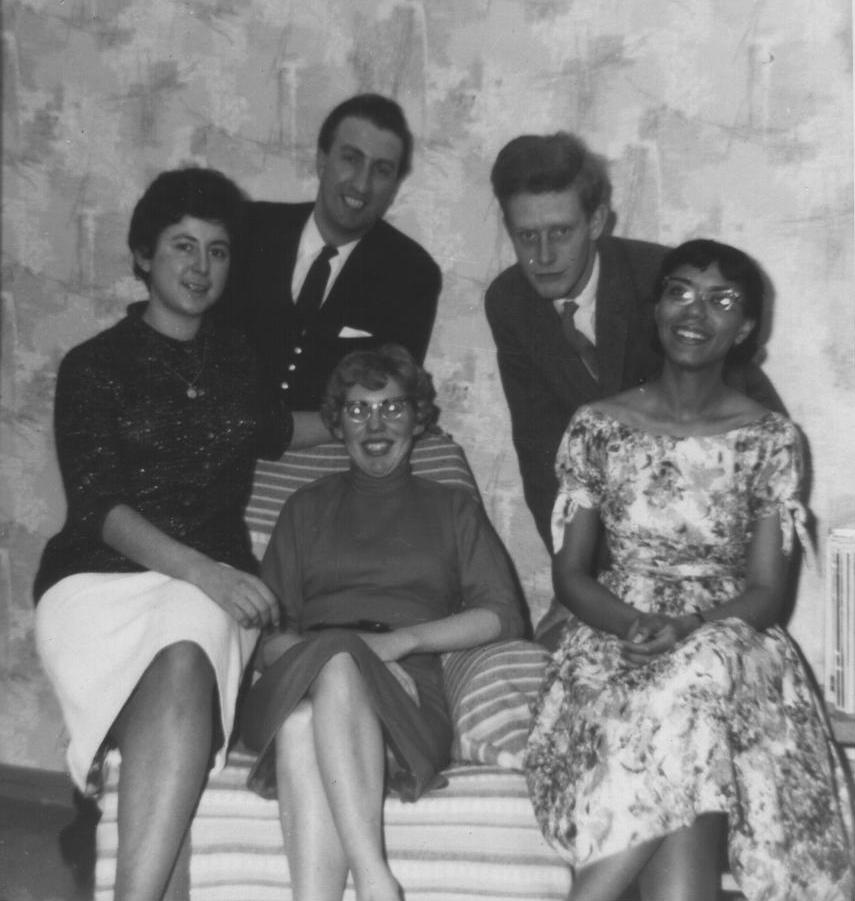
With youth in Luxembourg, 1960

Holy Day celebration in Luxembourg
 UK Baha'i Histories
What a fabulous, rich and frank account of so much early Bahá’í History…
Worth waiting for 🙂
What an exciting life you’ve led, full of service. You are truly blessed. Thanks for sharing.
Dear Stella, We remember you and the Tonbridge and Malling community very often with much affection and love. Jean sends her love too, and we send you our fondest greetings, Andrew
What an interesting life of service, Andrew, we have missed you here in Sydney! Thank you so much for sharing your story, I have certainly enjoyed every bit of it and hope that one of these days you will get a chance to come back here for a visit and see the Temple in all its glory. The grounds have expanded greatly since your time, and it’s getting more and more visitors all the time, a well-known mark on the tourist maps!
Dear Ho San, Jean and I remember you and Mariette with much fondness. I still recall the time when you tried to encourage us to move to Lae and you tried to persuade me to apply for a newly established post at the university there — Baha’u’llah was kind though and they didn’t accept my application!
Nice bits about Reading, where I declared in 1968….A very active life, indeed……
Thanks dad. Although I already knew a lot of it and was part of some of it! it makes me appreciate what wonderful and worthwhile lives you and mum have had, and so lucky to be part of the relatively early history of the Baha’i administration. xx
This archive’s project is such a gift to us…..reading about your life and your service….much the same thing… allows me to ‘know’ you although I don’t think we have ever met. Maybe some day….Thank you so much for sharing your part of the history of our beloved Faith.
Ref: Andrew’s remark above … Another Bahá’í I met at the time was “Killie” Kilford. She lived in Winchester, was very elderly and known as one of the “ ‘Abdu’l-Bahá Bahá’ís” as she had allegedly met the Master, and had been a friend of Grace Challis, as best I remember. It was she (I can’t think who else it can have been) who used to tell the story of Shoghi Effendi, while he was at Oxford, going to a Bahá’í meeting and leap-frogging over the chairs “to liven up the Bahá’ís”.
______________
Susan Golden Kilford (Killie) did not become a Baha’i until 1923 so she would not have met the Master. I have just checked the origin of this story with Lois Lambert (daughter of Alma Gregory) who says …
“I have written my mother’s story below which probably was the origin of the story Andrew heard, but much changed. Alma’s story was of when Shoghi Effendi was playing tennis in their house in Wimbledon, and vaulted over a settee beside the court. My mother never told me what he said that day and I have only ever read or heard of loving encouragement from the beloved Guardian for the British believers.
One of Alma Gregory’s very precious memories was when she was fifteen or sixteen. Many visitors would come to their home in Wimbledon, which had a spacious garden with a tennis court. One day, during the time that Shoghi Effendi was studying at Balliol College in Oxford, Alma opened the front door when the bell rang and found Shoghi Effendi smiling at her, carrying his tennis racket, and wearing tennis whites. She remembers that he was full of joy and youthful exuberance that day, at one point vaulting over a settee beside the court in the garden. He was so happy to be at Oxford studying to be the better able to be of service to his beloved Grandfather, Abdu’l Baha. This memory was one which she treasured because it was only a few short months later that Shoghi Effendi was grief stricken by the devastating news of the passing of the Master, and learned that he had been appointed to be the Guardian of the Baha’i Faith. Yet within a few short months this radiant youth had fully taken up the reins of Guardianship, and was guiding the world step by step towards the establishment of the New World Order of Baha’u’llah.”
Dear Andrew – your services were a great example during my younger years. You always had to talk cricket with me, I remember our conversations well. Thank God you wrote your story down, you are a significant person in the development of the Australian Bahá’í community in the Formative age. I found your story both moving and inspiring. With thanks and love, Arvid.
Gosh Arvid, your memory is better than mine! Cricket eh? We have so many happy and special memories of our time in Australia. When Jean and I wrote our ‘histories’, we thought they’d languish on some dusty shelf slowly being eaten by silverfish, we never imagined them being on the computer. Isn’t it wonderful how the world is developing? Warmest Baha’i love, Andrew
Pingback: Liz Emerson (née Morley) « UK Baha'i Histories
Wow Andrew what a wonderful account!
Thanks so much for the vivid memories of Reading and of the Congress…so much more has come back to me now. Thank goodness some of us have good memories!
You’ll remember me as Liz Morley (in Reading) and I can remember you and Geoff and some others coming to our house from Shinfield RAF for firesides. Happy days. I had no idea where your life had taken you. In the last few years I have met up a few times with Marina and Geoff in Ewell when visiting one of our sons.
Recently I came across a photo of you with Jeanette Battrick and children taken at the Grossmann’s in Neckargemund while I was staying with Hartmut and Ursula (I was 17yrs).
In 2011 Royce and I had a trip to New Zealand but we were able to stop off in Sydney for a few days and visited the Temple and in Auckland we stayed in Ilona and David’s garage flat when we were in NZ visiting one of our daughters.
Sorry to hear about the PVF. We have some family experience of the debilitating effects… Consultant Dr Darrel Ho-Yen in Stornoway wrote a useful book “Better Recovery from Viral Illness” …worth a read!
Love and thanks for a wonderful account
Liz
Dear Liz,
Yes, I remember you very well, thank you for getting in touch again as it were! Jean and I are now (March 2013) in the early stages of selling our house in order to downsize to what is called assisted living accomodation — the process seems so very complicated and tiring. I think on balance it helps to remember the times when we were young, full of energy and active in order to see us through!
Much love and happy memories,
Andrew
Pingback: Brigitte Beales (Ferraby) | UK Baha'i Histories
What an incredible life of service Andrew! Do you remember being one person on a panel at a youth conference in a temperance hotel in Newcastle upon Tyne on the weekend of October 17 & 18 in 1961? I was invited to the Saturday evening meeting by Toulou Lamei, and went not knowing anything about the Baha’i Faith, in fact when my mother had asked me what it was, I told her “some queer oriental thing!”. Toulou had promised to bring me books to read, having invited me about 3 weeks beforehand, but I never did receive any, hence my reply to my mother.
There were a number of panel members, including a humanist, I think a Catholic representative, possibly a Jewish member, I’m not sure.
One thing that had me puzzled was that one of the panel, a young red haired man, kept answering the questions which agreed with my own beliefs, which I had never discussed with anyone. That young man’s name was Andrew Gash. After the evening’s meeting ended, Toulou invited me back to the nurses’ quarters; we were both working in the anaesthetic department at the RVI doing a post grad course. There was a Persian man by the name of Hooshmand Fatheazam, who came back to the quarters, and he told the history of the Faith. I was so engrossed that I missed the last bus home, and had to stay the night with Toulou. The next day there was another meeting in the afternoon and evening, and I just caught the last bus home, getting home just before midnight. My mother was sitting by the fire waiting for me, I hadn’t been able to let her know I missed the bus on Saturday night, and although she didn’t say anything I know she would have been worried out of her mind, especially with what I had told her. I had to be up early to catch the 6.20am bus for work on the Monday, but there and then i related the whole story of the weekend, the history, teachings, everything I had learned, and finished up by telling her “You realize I have to be a Baha’i, don’t you?” At this, my mother burst into tears, and said “What did I do wrong?” I told her she had done everything right, otherwise I would not have been able to recognize the truth. For the next three months I attended firesides at Joe and Mary Jamieson’s home twice weekly, and bought books on all of the religions, as well as Baha’i books – Release the Sun, Thief in the Night, Prescription for Living, and many others, so that when I formally declared I would know enough to be able to teach the Faith. My formal declaration was on January 11th 1962, in the home of Joe and Mary. I was able to attend only one day of the Congress in 1963 as i was a pupil midwife in London, and we only had one 24-hour period off duty per week. On one of my days off I went to Rutland Gate and offered my services. I was shown into one of the upstairs rooms where there was a tall ladder, and it was my joy to wash the walls of that room in readiness for an occupant.
In 1964 I migrated to Australia, a plan which had been initiated some years earlier when, as a student nurse, my friend and I met an Australian couple in the guest house, and they said “Come to Australia” and I said I would when I had finished my training and my midwifery training, and that is what happened. I was surprised when I saw your name in a publication; I didn’t know you had come to Australia, and then I saw years later that you had returned to the UK.
Incidentally, my mother became a Baha’i in May 1965, just before coming out for my wedding. Val and I were married by Jeff Rodwell in the lounge room of his parents’ home. Jeff was a member of the NSA, and Pam Ringwood had been instrumental in having Baha’i marriage recognised not long before we were married.
The address of my parents-in-law was the first registered address of the National Spiritual Assembly, as the incorporation was achieved under company law at the time in Queensland.
Our Baha’i life has been nowhere near as diverse as yours. We moved to Ipswich (Queensland) after we were married as it was a goal city, and apart from a time in Richmond NSW when Val was in the RAAF, and a stint in Stanthorpe when we bought an orchard, thinking we would establish the Faith there, we lived in Ipswich until moving to Woody Point, on the Redcliffe Peninsula in 2008 after I retired. Collis and Madge Featherstone’s daughter Kaye Waterman lives in our community. Madge passed away in February 2009 when she was 98. We have a busy Baha’i life here, and count ourselves very lucky to be able to live in such a lovely spot and still be able to be active. I must admit however that we don’t have quite the energy we used to have; last weekend we had our monthly devotions on the foreshore on Saturday, and on Sunday we had a sausage sizzle to raise funds for the deputization fund which is supporting the young people in the pioneer houses. For the next couple of days I was tired!
For some reason, your name came into my mind today, and I felt I needed to look you up. I owe you a debt of gratitude which I have not had the opportunity to express to you, for being there on the stage and answering those questions.
Thank you Andrew
Nancy Millway (was McCallan)
[comment posted by Jenny on behalf of Andrew Gash]
Dear Nancy – Yes, I remember the meeting in Newcastle very well — I was very nervous beforehand! I also remember meeting you during a visit to Brisbane (when you were in Ipswich) when you reminded me of that meeting. Jean and I have recently moved to an Assisted Living apartment for the over 70s in a complex in Newport, Isle of Wight — time does move us on and slow us down …. With much love, Andrew
Dear Andrew,
It’s an absolute delight to stumble over your name again many years after having lost touch with you––possibly due to having experienced a middle of the night home invasion in which my computer (containing all my email addresses) was stolen.
You may or may not remember me, as we ‘met’ on a Baha’i Group-discussion line back in the ’90s, and subsequently exchanged occasional emails. I always appreciated reading your take on different issues. On the personal level, in particular I recall you sharing your very touching account of the death of your beloved dog, an account that the Herald of the South editorial board had declined to publish – an unfortunate decision in my view, as grief that must be borne without assurance of reunion can be perhaps even more poignant than the loss of a dearly-loved family member.
The memories come flooding back: your happy surprise at having so enjoyed the theatre dramatization of George Gershwin’s music that you had not been particularly keen on attending, as well as finding that aromatherapy provided some relief from your physical ailments. Life has such delightfully subtle ways of nosing out our sometimes hidden biases, doesn’t it? 😉 I’m so sorry though to learn you have not recovered from the CFS and wonder if you ever explored the possibility that the underlying cause might be due to a slowly acquired allergy?
What a wonderful initiative this posting of bios is on the part of the UK Baha’is! Aside from spelling out your long record of service – not to mention Jean’s – it puts a very human face on things, and underlines for the reader that firmness in the Covenant enables very ordinary human beings to accomplish extraordinary things. How wonderfully inspiring is that?
I noticed the last acknowledgment of your post was written “on your behalf” so hope that doesn’t mean your health has taken a further nose-dive and you are no longer able to respond independently. I helped celebrate my sister’s 87th birthday today, and recently acknowledged my own 80th, but thankfully, we are both pretty well still self-sufficient. Overall good health is, as ‘Abdu’l-Baha would deem it, “light upon light”.
Hope that you and Jean both enjoy your final years together, bathed in perpetual light of that kind. 🙂
Warmest regards to you both,
Norma
Canada
Pingback: Cathy Cardell | UK Baha'i Histories
Pingback: Jeanette Lock | UK Baha'i Histories