
Part 2
SOLOMON ISLANDS
After leaving Haifa in October 1970, where I had signed my declaration card in the Shrine of the Báb, we flew on to Hong Kong, looked up some Bahá’í friends there, and after three days flew on to the Solomon Islands in the South Pacific. We changed flights in Port Moresby, Papua New Guinea, for the onward four hour flight in a Dakota to Guadacanal (“many rivers”) regrettably best known for the fierce fighting which took place during World War II. Honiara, capital of the Solomon Islands, was to be our home for the next two and a half years. The flight to Guadalcanal was one we will never forget as we flew over vast stretches of ocean with nothing else in sight until we began to approach Honiara. Then small islands became visible and waving palm trees stretched their fronds beside the aquamarine water of the Pacific Ocean. It was an idyllic location. We were provided with a government bungalow on Lengakiki Ridge overlooking the ocean and we stayed there until March 1973.
Although I had pursued the Faith for a number of years, I was a newly-declared Bahá’í, and once settled in Honiara we began to participate in Bahá’í activities where I had my first experience of encountering Bahá’ís from another part of the world. Also, my work offered me the opportunity of visiting some of the other islands in the Solomons chain of islands.
The first Christmas in the Solomon Islands saw us embarking on a teaching trip to the island of Sawa, to the far north of the island of Malaita. First we flew in a very small plane to Auki, Malaita and from there we took a truck to the north tip of the island before being paddled in a canoe to Sawa. (For further details see “Stories from Pioneer Post” pp.190-4).
At this point in my story I need to recount that on my short three day visit to the Bahá’í World Centre I had experienced a strong feeling while in Haifa that I would be ‘known by my camera’. I mentioned this to Thelma and thought no more of it. However, whilst in Hong Kong I decided to purchase a good (Nikon) camera with the little money that we had with us.
Shortly after my arrival in Honiara I had the rare opportunity of purchasing some darkroom equipment. As a National Serviceman I had previously acquired photographic knowledge and some experience of photographic printing etc. To enable me to take and to print photographs in Honiara I was able to import from Hong Kong all the photographic materials I needed. Because of my travels around the various islands I was able to take photos of the local population. In 1971, when Prince Philip Duke of Edinburgh visited the islands, many and various were the opportunities of photographing the islanders who came from far and near to meet him. I took black and white photos of local islanders wearing their national dress (which was more often than not very little at all in the way of dress)! They paddled their canoes, the women wearing their grass skirts and the men little more than a loin cloth. The photo opportunities were immense.
As a result, and combined with visits to other locations, such as Laulasi in Malaita, I was able to take a considerable number of photographs which I was able to process, in temperatures of soaring heat, in the bathroom of our house on Lengakiki Ridge. (The Solomon Islands is only a few degrees south of the Equator). We would then sell these photos in the local Mendana Hotel. Occasionally tourist ships would visit Honiara and then the tourists would call in at the hotel. In the course of two years we sold approximately 7,000 photo-postcards. I also had the opportunity to take photographs of many of the children of local expatriates and so I did in fact become ‘known by my camera’
The highlight for us in the Solomon Islands was when our son, Simon, was born in Honiara in June 1972.
During our time in the Solomons we were very fortunate to meet some of the Hands of the Cause.
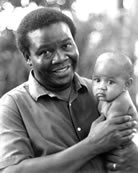
Enoch Olinga
In December 1970 we met Enoch Olinga at the Bahá’í Centre in Honiara. I took a black and white photo of him holding a Solomon Islands baby. This photo has appeared in many Bahá’í publications since that time.
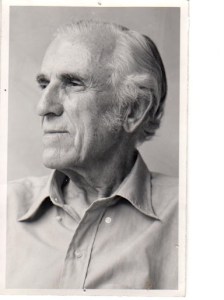
John Robarts
John Robarts visited Honiara in March 1972. His visit was especially good for us and one we have cherished in our memories ever since. I took a portrait photo of him and when he returned to Canada and discovered that his wife Audrey really liked the photos, he requested more copies; and so I sent him the negatives. He informed me that he had a number of them printed off to give to friends. Another Hand whom we met was Collis Featherstone who visited more than once. Also, very briefly, we met Dr Muhajir in the Bahá’í Centre in Honiara.
Boxing Day 1972 – We were resting on our beds after lunch when Thelma “heard a voice in her ear” saying that I should offer my services as a photographer during the approaching International Convention to be held in Haifa at Ridván 1973. As a result, she wrote off on my behalf to the Universal House of Justice offering my services and in due course I received a reply asking me to arrive there by Ridván and to stay for a few weeks (it turned out to be five weeks) working in the Audio-Visual Department.
Travels – to Tehran
We left the Solomon Islands in March 1973 and with our nine month old son we spent the next 4½ months travelling home back to England via New Caledonia (where we met up with UK pioneer Jeanette Battrick; Owen was away at the time); Sydney, Australia, for 10 days where we stayed with close friends Ho-San Leong whom we had known when he was studying in London and Birmingham) and his wife Mariette (née Featherstone); we visited Bahá’ís in Singapore and then Kuala Lumpur; we travelled on to Penang by taxi through many miles of rubber plantations, and stayed with the Sundrum family for a few days; from Penang we flew to Tehran where we met with a member of the National Spiritual Assembly of Iran. By then it was about 18th April and I was advised to fly off without delay to Haifa as it had been requested that I arrive there by Ridván. Thelma remained in Tehran and stayed with the Bagha family for a month before joining me for the last nine days of my time in Haifa. During the very short time I was in Tehran we had the bounty of being taken to visit the House of Bahá’u’lláh by a Bahá’í who was a relative of somebody we had met on our travels in Australia. At the time we did not realise how privileged we were to have visited this holy spot. It was only later, on returning to England, that I was to discover how few Bahá’ís in Iran had ever had this privilege themselves.
So I flew off alone to Tel Aviv, leaving Thelma and Simon behind in Tehran. On arriving in Haifa I was taken to the Audio Visual Department and met the Bahá’í friends with whom I was to work for the next five weeks.
Service at the Bahá’í World Centre
The Audio Visual unit was headed by Lacey Crawford, overseen by Dr. David Ruhe, member of the Universal House of Justice. Kiva Films was also there, represented by Rodney Charters from New Zealand (later Rodney was to become one of the founding members of the Local Spiritual Assembly of the Mole Valley [Leatherhead, Surrey], Mark Sadan and David Walker (USA). These friends, with the addition of Anthony Worley, later sailed up the Amazon with Rúyíhhih Khánum to make the documentary of “The Green Light Expedition”.
At the time I did not realise the immense importance of the job with which I was entrusted and it is only in later years that I have really come to appreciate this enormous privilege. We had faced a number of difficulties in the British Solomon Islands and it was a wonderful reward to be able to have the opportunity of serving in such privileged surroundings.
My job involved taking photographs of the Hands of the Cause. I was asked to meet and take the portrait of each Hand present at the International Convention in 1973. Whilst taking a portrait photo of William Sears, and in conversation with him, he mentioned the subject of prayer. I told him, rather sheepishly, that I always selected the shortest prayer. He reassured me in a loving and also a funny way that my prayers were powerful! To me that was such wonderful encouragement! Ever since I have been able to bear in mind that it is the sincerity with which a prayer is said rather than the length of it. His words of wisdom are still with me today.
Towards the end of my stay in Haifa, Thelma was invited to join me with Simon (aged 10 months) and at the end of those nine days (five weeks for me in all), we continued our travels home, stopping off and visiting Bahá’í friends in Cyprus, Italy and Malta on the way. One day we were walking along the sea-front in Sliema (Malta) when, totally unexpectedly, we happened to encounter the three Newman sisters (Bahá’ís Beatrice, Mary and Flo) from Pontypridd. We arrived back home in England in July 1973. Very sadly my father died suddenly and unexpectedly the day after we returned home and never got to meet his only grandchild whom he had been looking forward to seeing so much.
England
In September of that year I rejoined my government post in Chessington and during the next couple of years, and with my own hands, I built a large extension onto my house in Leatherhead with the money I had earned from selling photographs in the Solomon Islands. This was in anticipation that we would soon encounter “entry by troops” and that a large room would be necessary to accommodate the explosion of new believers! I am pleased to say that in the ensuing years this room has very often been used for big Bahá’í gatherings although we haven’t had the anticipated increase in numbers of new believers.
In 1974 we were able to help form the first Local Spiritual Assembly of the Mole Valley. In order to make up the nine members, three young students from Epsom Art College moved into the area. The Local Spiritual Assembly continued to function through the years, with new faces, until the boundary changes in 2001.
In the three and a half year interlude we were home in England, our daughter Suzanne was born in June 1975.
Three and a half years later I applied for and was offered a post in Nepal (seconded to the Ministry of Overseas Development) and in December 1976 I took up the post in Kathmandu.
Kathmandu, Nepal
On our way out to Kathmandu we were able to make another three day visit to the Bahá’í World Centre. We met with a member of the House of Justice who told us that on our arrival in Nepal we should not make contact with any Bahá’ís there until they made contact with us due to the sensitivity of the times. We were told that David Walker was a pioneer in Nepal (from the USA) whom I had met when I served in Haifa at the International Convention in 1973. David and his wife Penny had preceded us by six months and together we shared our pioneering lives there for the next eight and a half years. (The Walkers remained as pioneers in Nepal for another decade).
En route to Kathmandu, we stopped off in New Delhi where we visited Charles and Yvonne Macdonald. Charles was setting up and working for the Indian Publishing Trust at the time.
On arrival in Nepal we were accommodated in a hotel in Kathmandu for the first month. It was while we were staying there that we first experienced the dreaded bowel problems that were to plague us for the nearly nine years that we lived in Nepal. Such health problems plagued other expatriates too and also, of course, the Nepalese population.
We were shocked by our first impressions of Kathmandu. Many decades earlier the first English visitors to the area had referred to Kathmandu as ‘a city of temples built on a dunghill’ and not much had changed. Everywhere there were heaps of rubbish lying around in the streets along with human excrement. This was because the local houses generally lacked sanitation. However, the houses rented by the expatriate community did have sanitation; disposal was by means of a cesspit.
We had been staying in the hotel for about three weeks when one day a local Bahá’í, Mr Chandra Man Golay, surreptitiously came to make contact with us. A couple of days later, Bharat Koirala, who was at the time the local Manager of the Gorkhapatra Newspaper (the main government-run newspaper for Nepal) also came to visit us. Thus, with caution, we were introduced to some fellow Bahá’ís.
We learnt from Bharat Koirala that it would not be wise at such an early stage to say that we were Bahá’ís as the situation was a little awkward at the time. Just before we arrived, some Christian missionaries had been sent out of Nepal for proselytising and it was the government’s policy to be wary of any religion other than Hinduism and Buddhism. Hinduism was the predominant religion in Nepal although in Kathmandu there was a more equal number of Hindus and Buddhists who lived in harmony with each other. The King of Nepal was regarded as a Hindu god by the majority of Hindus and it was generally believed by the uneducated population that he had been born from a cow! At that time in Kathmandu cows roamed freely about the streets and it was considered a punishable offence if any vehicle was to hit a cow – the crime being that of cow-slaughter!
In Kathmandu, in an area known as Jhatta Tol, there was a small Bahá’í Centre situated in a narrow side street, tucked away behind the Nook Hotel on Kantipath. Soon after Christmas 1976 we were gradually introduced to a very small community consisting of a few steadfast local Bahá’ís along with a small number of pioneers. Bharat Koirala was married to the one and only Persian Bahá’í, Mahsheed (whose brother Bijan and his wife Anne we knew in Epsom). Their two infants, Samir and Shabnam, were similar in age to Simon and Suzanne and the four of them grew up happily together as Bahá’í children during the nearly nine years we lived in Nepal. We soon began to make deep and lasting friendships with the Bahá’ís in Kathmandu – friendships that remains today more than 25 years after leaving Nepal.
Before arriving in Nepal I had absolutely no understanding of the problems that beset the country. Upon arrival, however, I discovered the chaotic mess that everything seemed to be in, e.g. the telephone system didn’t work; electricity was more off than on; nothing ran to time or even ran at all; it was impossible to hold official meetings as the right people would not turn up. It was impossible to get a decision out of anybody and, if we got one from the Nepalese officials, it was never carried out. The Nepalese government department I worked for, the Nepalese Food Corporation, was in a permanent state of crisis. Records were never kept, or if they were, they were promptly lost. It was the general policy in those days for the officials to try to cream off the aid money for their own benefit (sadly, a common practice).
At a higher level nothing got done unless the individual involved got some personal benefit. Nobody could take a decision and if they did, and it went wrong, they denied making it! I quickly realised why Nepal had not made much progress in the way of development despite the huge amount of foreign aid that was pouring into the country. This was the first time I had experienced corruption of this kind and I had to learn how to deal with it.
After about 18 months of working hard – and achieving precisely nothing – we went home on leave to the UK. Thelma meanwhile had been suffering from some sort of medieval typhus and been in hospital for several weeks in the local missionary hospital. She was as thin as a rake and our family back home was shocked when they saw how thin we were and realised how ill we had been. They were surprised, including our own family doctor, when they discovered that we were intending to return for a further tour of duty.
The reason we wanted to return was to continue to assist the development and growth of the Bahá’í community in Nepal. We weren’t the only ones suffering from poor health. Life was difficult especially when our children got sick. So, feeling at one with the small number of Bahá’ís living at that time in Kathmandu, we didn’t want to desert them just because life wasn’t easy for us.
Little did we know, when we first arrived in the country, that we would be staying there for almost nine years and also that we would be suffering from so many unusual and strange illnesses, mostly from stomach complaints such as diarrhoea and giardiasis. We always say that if somebody had told us before we left England just how sick we would be during our years in Nepal, we would never have gone. However, we are just so glad that nobody did tell us that because in no way would we ever wish to have missed out on nine fantastic years spent as Bahá’í pioneers in that beautiful country and with such wonderful Bahá’í friends as we had there in Kathmandu. It was a privilege to have lived in Nepal and for us those years spent in Kathmandu have always been, and we know will continue to be, the most significant of our lives. We loved the Nepalese people for their gentleness and kindness and we were saddened to see how they suffered because at that time Nepal statistically was the fourth poorest country in the world.
Our children were very young when we went to Nepal. Simon was 4½ and Suzanne only 18 months old. Unfortunately they certainly suffered their fair share of illnesses but over the years they made some wonderful international friends. They started their education at the British Primary School (which expatriate children mainly attended with a sprinkling of Nepalese children also) and later they attended the American International School. For them it was a real international setting and apart from there being so many nationalities at both schools, there were also representatives of every world religion which was a good lesson for them growing up as Bahá’ís.
I suppose one disadvantage was that they were constantly faced with their friends leaving Nepal and returning to countries across the world and who they were unlikely to see again. Today, with email and facebook, the loss of these friends would not be so great, but it was testing for them then. I remember one day that a young friend of Suzanne’s was soon due to return to Australia. Before leaving Kathmandu the family was staying in the Yak & Yeti Hotel. As we said goodbye to them, and as they went upstairs in the lift, Suzanne thought that travelling in a lift was the same thing as going to Australia!
______________
Being raised to the station of a ‘temporary’ minor god
I would like to include here an incident which touched and moved me greatly about mid-way during my nine year tour of duty in Nepal. I was often shocked to see the very little amount of food that the Nepalese workers on site brought with them for their lunch, bearing in mind the heavy manual work required of them. In Nepal there was no machinery such as a bulldozer or heavy machinery to help the workers dig the trenches or level the site for the foundations of the huge grain stores I was responsible for constructing. I therefore made the decision that with all the rice being stored in the grain stores under construction, I would introduce a very primitive method of feeding – free of charge – for all the labour force on my site (some 300-400 Nepalese). This was achieved by allowing some women on the site to cook large quantities of rice in huge metal containers. To the rice they would add local vegetables bought from the farms around the site.
So I was able to feed all the labour force with rice, dahl (lentils) and vegetables every day for nothing. The rice was taken from sacks that had been broken and therefore unable to be stored in the grain stores. This practice became very popular and was well received by my labour force who earned very little money for their labour and normally would have been unable to afford to buy such a meal.
My labour force consisted of men, their wives and children and their grandparents, who worked on the site in order to have enough money to survive. I really felt for my labourers as they had nothing. To turn children away from any work because of their tender age meant depriving a family of precious extra pennies. It used to concern me greatly that a whole family had to work on my site as labourers (especially small children) when my own children were at school or playing with their toys at home.
Some months after this project commenced, my Nepalese foreman specifically asked me to visit the site. On this occasion, and much to my surprise, my labour force had prepared a makeshift platform, raised and made out of bricks, on which they asked me to sit. As was their custom, they slaughtered some goats in my presence and then every one of my labour force on the site walked past me in single file. I was required to place a tikka (a mark on their head) on their foreheads by dipping my thumb into a wet red powder mix.
I was just given enough time to inform Thelma of the event as it unfolded. She quickly drove down in her car to take a photo of this event as I sat there garlanded with flowers! I was being honoured by my Nepalese workforce who wanted to show their appreciation for my having provided each of them with a regular lunch. (Also in the past I had often been able to arrange medical treatment for them when sick or injured).
In the Hindu religion there are hundreds of gods for all sorts of things. At that moment I was being raised temporarily to the station of a minor god! It was their delightful way of giving appreciation for what I had been trying to do for them in assisting their lives to be a little easier. It humbled me.
I still recall this event with great affection. In my quieter moments I recall this special occasion and am mindful of my privileged position in being born in a country where so much is provided for everyone and life is so much easier.
_____________
Then, in the summer of 1985, my contract ended. We were heartbroken at having to say goodbye to our very special Bahá’í friends in Kathmandu and to the many other Nepalese friends amongst whom I had worked. The nearly nine years spent in Nepal and, in addition, the two and a half years spent in the British Solomon Islands, had taken its toll in as much as I found myself very much out of date with the codes and practices of Structural Engineering in the U.K. I felt like Rip Van Winkle coming down from the mountain after falling asleep there for seven years ( I had been out of the country for a total of 11½ years)!
Having been away from my department in the UK for such a long time, I had missed out on promotion and all the work colleagues I knew before I had embarked on my pioneering career, were now senior to me. Also, coming back from Nepal, where I was responsible for a staff of some 400, it came as a shock to me to return to my department in Croydon to find that I was now a small cog in a very big organization. The general morale of the department was considerably lower than when I had left it in 1970, and for the next three and a half years I just sat it out until I took early retirement. I was completely out of touch with the design practices etc. as everyone had progressed to using computers whereas when I had left the UK in 1970 we were using slide rules. My time came for retirement and I happily walked away from the department and never regretted it.
I think that working overseas gave me a totally different perspective of the world and its people. I had seen great suffering in Nepal due to lack of food and poor health facilities afforded the local people. I had witnessed the great hardship which the Nepalese people suffered (i.e. the corruption of the officials preventing the much needed aid programmes developing and serving the population they were initially designed for). My period overseas also made me aware of how fortunate I am to have been born in a developed country. Before my travels began I had taken all the advantages that prosperity provides with a minimum of concern for people in other parts of the world.
One of the major differences on returning to England was encountering the lack of general spirituality of those around me. As Hindus and Buddhists, the Nepalese people had a strong belief in their religion, and however much superstition may have crept into their beliefs, they conducted their lives accordingly. Finding myself back in this country I very much missed the warmth and dedication of our Bahá’í friends in Nepal. Local community life back home was a big let-down and couldn’t in any way compare with the spiritual upliftment we always felt amongst our friends in Nepal. It took us at least a couple of years to feel ‘at home’ again in the Bahá’í community. In 1986 we went to a summer school in South Wales and then gradually we became part of the wider UK Bahá’í community again.
As a family we regularly went to summer schools and spring schools and to Bahá’í conventions and conferences. We used to encourage our children to attend all sorts of youth gatherings and we would host many youth weekends in our home. Those youth connections are still going strong.
Now writing in 2012 and looking back over the years, we realise how many times we have been blessed. Both our children, on leaving school, served for a year at the Bahá’í World Centre. Afterwards they both received a university education and eventually left home to work in their chosen professions.
Bahá’í Service in the UK
For a number of years I was fortunate to have served on the Venues Committee (from approximately 1988 – 2004) with Bob Watkins, Malcolm and Parvine Lee and others. I was also responsible for the maintenance of the Haziratu’l-Quds for several years and, more recently, I have been serving on the Bahá’í Properties Committee. But the service I have found the most fulfilling is the privilege of having served on the Committee for the Care of the Guardian’s Resting Place (for most of the years since I have been home from Nepal). At the start I was asked to assist David Lewis who, as an architect in the early days, had been responsible for the design, construction and procurement of materials for the Shrine and the surrounding area. When David was no longer able to carry on with the work, I took over his responsibilities for the ongoing maintenance until, a few years later, the NSA appointed a committee and I was asked to serve as a member. Over the succeeding years I have especially appreciated my close association with Mr and Mrs Alaee in their respective roles as custodians of the Guardian’s Resting Place at the New Southgate Cemetery.
Visits to Haifa
I have been very fortunate to have visited Haifa on a number of occasions – I have been on three nine- day pilgrimages and several three day visits; also 10 day visits on each occasion when Simon and Suzanne were doing their youth service in Haifa. How I became a Bahá’í God only knows, but it’s been a wonderful life!
———————————-
Ron Batchelor
Surrey, September 2012
Ron passed away on 8 February 2025, shortly before his 96th birthday.
 UK Baha'i Histories
Well done Ron, I knew you had been around so to speak, but this is a rich life well lived in the path of Baha’u’llah.
Thanks, Ron, for the interesting details! It’s so good to get a glimpse of one’s friends’ lives from the beginning, and how they came to be a part of the Bahá’í life. I knew you and Thelma had been in the Solomons and Nepal but had no idea of what it was like in those places. Great job! Warmest love, Sylvia
Thank you for your kind words. You and ‘Sue’ played a part in the 60’s in helping me to become a Baha’i during those wonderful days of Harlech summer schools.
An amusing event I always recall in Harlech was when you were playing “3 Blind Mice” on a piano that had one leg missing!
It was good to see you in South Africa when we were visiting Val Rhind and that time you showed us around the newly purchased Baha’i Centre in Jo’burg. We’ve also met up a few times when you’ve been visiting England. So hopefully it won’t be so long till we see each other again.
Thank you Ron. It’s so engrossing and riveting once again. Absolutely fascinated by your Baha’i history Ron and Thelma. Totally thrilled that you took so many photographs of the Solomons too. Amazing how in just a few decades this country has changed so dramatically in so many ways, though still unchanged in others,
This doesn’t disappoint :-))
What a treat Ron, it’s left me breathless! We remember well your visit with us in 1973 and it was such a happy reunion, and we just enjoyed your stories of the Solomon Islands. Never a dull moment in your island life!
And later in 1978 we had the golden opportunity of visiting you and family in Nepal. Kathmandu was definitely an eye opener, so different to Papua New Guinea where we were living at the time. When we left you Mariette became very ill and we almost didn’t make it back to Lae. It took here more than a week to fully recover.
Once again we must express our deep appreciation and gratitude to you for sharing this important part of your Baha’i life as a devoted pioneer. You were given the opportunity of service and you rose to the challenge!
It reminds me of this verse “As ye have faith so shall your powers and blessings be, this is the balance, this is the balance..”
Dear Ron, I think that your narrative is fascinating to say the least!! You achieved what others longed to do but couldn’t. More power to your elbow. Love Ron
Hello Ron,
I always remember that you and Vivian years ago so much wanted to pioneer. I count myself as one of the lucky ones who was able to go. However, you must never be downhearted that you didn’t pioneer since you put your whole heart and soul into the desire to pioneer and that longing will be registered in the Abha kingdom. When we’re all there (in the Abha kingdom) jokingly someone will say “Where’s Ron Roe?” and the answer will be that he’s gone pioneering!
Thank you for your kind response to my story. I’ve always considered you one of my good Baha’i friends from all those years ago when we first met at 27 Rutland Gate.
I look forward to seeing you again.
Your good friend, Ron B.
Hurrah! Can’t wait to find time to read it.
It was wonderful to hear your stories before and I am so happy I and others can now read them. A well-lived and well-told life.
Thank you Rod for your kind response to reading my story. It was a bonus meeting you recently in the PRC. We wish you many happy years of service there and we look forward to seeing you again when our paths next cross.
Ron.
We live these days in Wyoming USA. For a number of years I served on a Regional Baha’i Council, first the Council for the Western States and when the Region was subdivided the Council for the North Western States. I had to fly to every meeting normally from Jackson Hole Airport. The Western States meet mainly in Los Angeles, which flying via Salt Lake City. One Sunday I boarded the flight in LA and found myself seated next to a man who was busy reading medical papers. I could not help noticing they were about sicknesses caused by altitude. I asked him where he was going he said Jackson, although he lived most of the time in Colorado. I said I could not help noticing your medical papers are about sickness caused by altitude. He said yes it is my specialization. We exchanged thoughts about living at altitude and the effects on the human body. I said have you always lived the US. He replied no we spent many years in Nepal. I said well I have friend who used to live in Nepal. Their name is Batchelor. You mean Ron and Thelma he said with a look of astonishment . Yes I replied I knew them before they were married. He said our children played together in Nepal good friends where are they now. Are you a Baha’i he asked. Yes I am and the conversation continued. One of the best plane rides. Just shows how small the world is and how connections to the Faith continue.
Hi Derek,
What you have written above we have never heard before. Why didn’t you tell us earlier and then we might have been able to identify the friend you met on the flight who had lived in Kathmandu? Now we will probably always wonder WHO it was! God works in mysterious ways, as always!
If you’re in Burnley now, please encourage those ‘old Burnley-ites’ to write their stories. I know it would fill volumes but they need to get started! WAITING FOR YOURS!!
Ron
Really loved reading this. Thank you so much, Ron. 🙂
Such a joy to read your account of life and service in the Solmons and Nepal. You and Thelma are such a blessing for who ever you are with! Lots of love to you both Rita and Viv xxx
Nothing like having a “minor God ” amongst your friends. Always fascinating to read about a rich and eventful life. People like and Thelma enrich all our lives and our community is justly proud to have you around for many more years to come.
Thank you Jagdish! You were one of the first to write your story, and I’m very pleased that I’ve done my own now.
You know I like to call you “the brain of Muswell Hill”! I remember with fondness the first time we met when, with Thelma, we went with you to see the play “The Importance of being earnest” at The Haymarket Theatre in London. It was a long time ago now! You remarked at the time about my malapropisms! I have always been a grand master of this art, particularly since I learned what the word meant as described by you at our first meeting! I have never been the ‘wise owl’ that you are so I remain contented to stick with my malapropisms.
We value enormously your constant friendship over the years and look forward to seeing you and Bella again soon.
Ron.
Such an inspiring family history! Lovely, Ron.
Thanks,
Brendan.
Thank you Brendan. It was nice meeting you again recently in Oxford and renewing our acquaintance. I always remember with great affection the stories you told about George Townshend at the last Irish Summer School we attended.
At the time we were unable to pronounce Ahascragh correctly but since at Oxford you weren’t too hot on the pronunciation of Cadogan Gardens, we’re now on equal terms!!
Ron
Once again, thank you all for your very kind comments about my story. Special days, special friends every one of you. Thank you so much. Ron
Yes Ron, an amazing and inspiring saga of adventure and sacrifice. Compared with you I feel I haven’t been much further than Goole Docks … but as I grind my way towards writing my own somewhat pale account I seem to have been abroad just a little bit as a result of being a Baha’i.
By the way, I notice you have not mentioned your Sainsbury’s lunchbag skiing performance on Mount Carmel in February 1983; as I hope to include a little humour in my history I shall be covering that unique spectacle. Bravo Ron. See you over cornflakes in 2012.
All the best.
Uncle ArtIhur.
Dictated by Ron …
Dear Arthur,
My version of the story of the Sainsbury’s bags is this … While living in Kathmandu I had a pair of shoes made by a local Nepalese shoe-maker. The soles of the shoes were made out of old car tyres! While wearing these shoes on pilgrimage and standing on Mount Carmel in heavy rain, my shoes began to leak as the soles (note the spelling of soles!) were smooth and had no grip or tread on the slippery slope. I therefore proceeded to slide slowly down the hill, with my umbrella up and passing by pilgrims in prayer who looked rather surprised at my stately descent! As I had no other shoes with me, I decided to insert plastic bags into my socks in order to prevent my feet from getting any wetter. Later, as I walked into the Shrines, my socks still wet, I was conscious of the squelching noise my feet were making with my wet socks rubbing against the plastic bags!! Hopefully not too many of the other pilgrims in the Shrines were disturbed!
Are you still practising your flying or are you now qualified to take me up as a passenger in the airbus?!
Cornflakes in 2013?
Cheers!
Ron
Many thanks for your response, Sir Ron, especially the details concerning the plastic skiing. I will refer to same in my ‘istry but wondering now how to give it a fresh slant (pardon the pun) after your excellent account. Feeling slightly squelched. Arth.
PS. Airbus? At my age I’m not even allowed a minibus any more. Cornflakes this year I hope – a cereal more my style than the Archers … 🙂 .
well done Ron and Thelma – I only wish I could write as comprehensively as this. These wonderful years you have had indelibly etched on the paper now, as an inspiration to us all. We still remember your generosity and helpfulness when we were visiting, just as a family you welcomed us. 🙂
Thanks Ron well done!
Dears Ron and Thelma,
What a wonderful story bringing so much joy to the heart. What an introduction to this fantastic website….yours was the first I read….now I am hooked!!!
Thank you for this. Much much love
Simin Liggitt
Ron passed away arounf 7pm on Saturday 8th February 2025. He was 95 years old and had led a truly blessed and full life. Ron was a very precious and radiant soul. Ron had the ability to bring laughter and joy to everyone he met and was the embodiment of “(Be…. a joy to the sorrowful, a sea for the thirsty, a haven for the distressed, an upholder and defender of the victim of oppression. Let integrity and uprightness distinguish all thine acts….”
The world has lost a little of its sparkle, but your example will continue to inspire, and memories of you make us smile and laugh. Thank you dear Ron.