
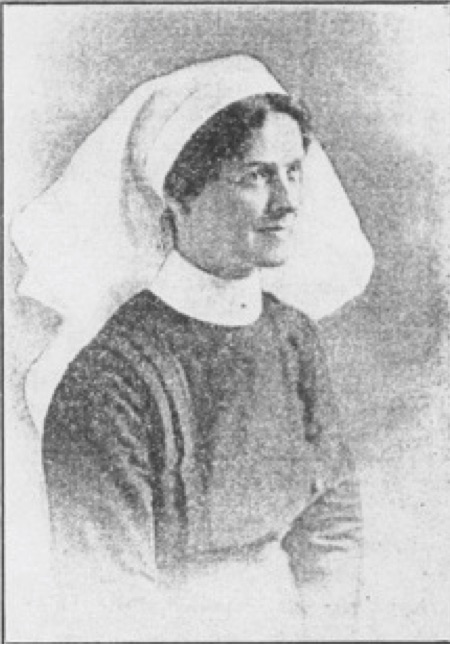
The following story of Sister Grace Challis was researched and written by Janet Fleming Rose.
The life of Sister Grace Challis was a life of service and also a life of great contrasts. She served on the fledgling NSA of the British Isles for at least 15 years, almost from its inception, most of the time facilitating consultation as its chair. She was described by friends as having a “sweet face and gentle manner” which made them “feel at ease” (1) and yet she had an air of authority which enabled her to chair meetings and earn the respect of the Assembly’s members of both sexes. She chose a nursing career, serving and caring for patients dying of the dreadful disease tuberculosis but she was an astute businesswoman who ran successful nursing homes efficiently and profitably.
Grace Challis was a nurse working in the Home Sanatorium in Southbourne near Bournemouth when she learnt about the Bahá’í Faith from Dr Esslemont who was the Chief Medical Officer there. At the time Dr Esslemont was writing “Bahá’u’lláh and the New Era” and Grace attended many meetings on the Faith held in Dr Esslemont’s study in the sanatorium. She was attracted to the new teachings and prayed fervently that she might accept the new faith if it was the Will of God. (2)
In a letter to Dr Lutfu’llah Hakim, Dr Esslemont wrote that Grace had a dream and a vision of ‘Abdu’l-Bahá shortly before He ascended in November 1921: “On the Saturday night, Nurse Challis had a vivid dream about the Master – dreamt that He was in great trouble, and she and I were trying to help Him. On the Sunday, she felt very depressed and wondered whether Abdul Baha [sic] was all right. She told me about her dream and her feeling troubled about the Master.” He goes on to describe further dreams experienced by Grace and a Bahá’í friend: “On the Monday night, Mrs. Dunsby had a dream about the Master but a happy one, in which He comforted and reassured her. On the Tuesday night, Nurse Challis also had a vision of Him in which He looked very happy and told her: “Let not your heart be troubled, neither let it be afraid!” These visions of Him after His Ascension have greatly comforted them both.” (3)
It is not clear whether Grace was already a Bahá’í when she had these dreams – it seems probable that she felt very close to the Faith and the whole spiritual experience was a confirmation for her because it’s recorded that she accepted the Faith shortly after at a meeting called to inform the Bournemouth Bahá’ís of the Ascension of ‘Abdu’l-Bahá. (4) Prior to her declaration of belief in the Faith she had as a young woman become a member of the Society of Friends and been an active Quaker. In 1915 she was listed as a member of the Quakers at the local Bournemouth Quaker meeting and this listing continued throughout the years 1916 to 1921. In fact she was still on the local Bournemouth Quaker lists until 1923. It may have been her election to the NSA of the British Isles in 1924 that caused her to finally relinquish her Quaker membership. (5)
Grace was 39 when she accepted the Bahá’í Faith and became a devoted Bahá’í, “a shining example to all who had the great privilege of knowing her”. (6)
She was born in 1882 in Hackney, London to James and Caroline Challis. Her father was a commercial traveller, later the manager of a chemicals factory. The 1891 census records the family living in Hackney. Grace had an elder sister Edith, one year older than her, a brother Frank two years younger and a sister Fanny five years younger. (Tragically, Fanny died in 1895 aged seven.) The family had a servant, Agnes, and neighbours included a solicitor, a commercial clerk and a gentleman “living on own means”, so the general impression is that the family was comfortable but not wealthy.
In 1892 and 1896 two siblings were born: Dorothy and Bernard. However, in 1899 Grace’s mother died and it appears that Grace, aged 17, took on the responsibility of caring for her younger siblings.
According to the 1901 census her father was by then a widower, her elder sister Edith was working as a shorthand typist and Grace was living at home without employment, so presumably now the home-maker and carer for the family. By this time the family had moved to live in Hampstead, London. The family had a general domestic servant, Caroline, and was living in a London street alongside neighbours who worked as solicitors, a tea dealer and a lady “living on own means” with a companion.
In 1903 James Challis married his second wife, Ethel Maude England who was 22 years younger than him. One child, Maude Gladys, was born from this second marriage in 1903 and a second daughter Joan Mary in 1919. It may have been around the time of her father’s second marriage that Grace left the family home. In the 1911 census Grace’s sister Edith is recorded as aged 29, single and working as a clerk in a shipbroker’s office. Younger sister Dorothy is 18, single (she married a few years later) and working as a shorthand typist. Grace’s brother Bernard, although only 14, is already working as a clerk and messenger in a drapery. Maude Gladys, the child from James Challis’s second marriage was away staying with her grandmother in another part of London.
There is no sign of Grace Challis on the 1911 census. It may be that she was away from home at the time and just missed being recorded. But it is also possible that her non- appearance was deliberate. The 1911 census was the opportunity for a mass protest by suffragettes who maintained that because they had no vote they should not be recorded on the census. Their slogan was “If women don’t count, neither shall they be counted”.
Many women (and sometimes men as well) refused to be recorded on the census form, some defacing the form with comments such as “No voters – only women here” and some deliberately stayed away from home that night so that they would not be counted. It is just possible that Grace had suffragette sympathies and joined the protest in this way.
It is not known when exactly Grace Challis began her nursing career. She may have trained at one of the London hospitals during the early years of the 20th century or it’s possible that, prior to becoming a nurse, she may have worked as a shorthand typist [stenographer]. Her sisters Edith and Dorothy both followed this career path and may have encouraged Grace to do the same. With the invention of the typewriter new careers were open to educated women which offered an alternative to being a governess or “lady’s companion”. Many young women took the opportunity to learn shorthand as well as typing and to work in offices for the first time.
However, we do know that by 1915 with the onset of World War I Grace was living in Bournemouth. The fact that in 1915 she was recorded by the Society of Friends living at the Tollard Royal Hotel, Bournemouth and in 1916 at the Balmoral Hotel indicates that she was probably billeted at these large and prestigious hotels while working in a local hospital for the war effort. In subsequent years of World War I she was listed by the Quakers as living at a private address in Southbourne, Bournemouth. The Home Sanatorium where Dr Esslemont worked as Chief Medical Officer was located in Southbourne, Bournemouth so we know that by 1917/1918 Grace was living very close to the sanatorium where Dr Esslemont was working. We know from Dr Esslemont’s letter to Lutfu’llah Hakim that by November 1921 she was working at the Home Sanatorium and this is confirmed when in 1922 and 1923 she is listed on the Quaker records as living there.
At the beginning of the 20th century tuberculosis (TB) was an urgent medical problem throughout Europe and North America. The BCG vaccine was developed in France in 1921 but vaccination only became widespread in the UK, USA and Germany in the 1950s. There was no reliable cure until the isolation of streptomycin in the 1940s. The main treatment in the late 19th and early 20th centuries was by the sanatorium movement which began in Germany in the late 1870s and encouraged fresh air, rest and healthy diet for patients. (7) The movement spread throughout Europe and the USA and it was at just such a sanatorium for TB patients that Dr Esslemont and Nurse Challis were working in the early 1920s. Bournemouth, situated on the south coast of England with bracing sea air, must have seemed a perfect location for such a sanatorium.
In 1923 the owner of the Home Sanatorium died and the sanatorium was closed. Inevitably, both Dr Esslemont and Nurse Challis now found themselves without employment. (8) In 1924 Dr Esslemont went to Haifa and served as secretary to Shoghi Effendi until 1925 when, terminally ill himself with tuberculosis, Dr Esslemont passed away. Grace Challis’s response to the crisis of the closure of the sanatorium where she worked was to decide to open her own nursing home at West Moors in the Bournemouth area. This shows considerable initiative and determination for a single woman to take on such an enterprise in the 1920s and it appears that Grace was able to plan the enterprise and make a go of it despite early setbacks.
The story of the nursing home is taken up by Susan Golden Kilford (Killie) who knew Grace Challis for many years:
“It was in 1923 that I first heard the word Bahá’í mentioned. My friend Dr Entwaite and myself had returned from South Africa the previous autumn and owing to the great slump and the necessity to find jobs for demobilised soldiers after World War I, we could not get back into office life in London. We decided to take a small drapery business as I had some knowledge of the trade and in the spring of 1923 found what we were looking for in the three small villages of West Moors, East Dorset. Close by was an empty house called Ferndown Lodge, and after we had been a few months at the shop, it was taken as a small private Nursing Home for TB patients. One or two patients who were well enough came in and out of the shop; but no one mentioned the religion of which the owner of the Home, Grace Challis, was a member.” (9)
Grace would have found the early years of running her own nursing home difficult. It appears that in order to fill the nursing home, thereby giving it the air of a successful and credible home she offered places there to Bahá’ís on a reduced rate. In August 1925, not long before he passed away in November of that year, Dr Esslemont wrote to George Simpson, an early British Bahá’í and member of the NSA of the British Isles: “I asked Sister C. recently how finances were and she told me that at present her expenditure on the Home is considerably in excess of the income. She had a good time in the Spring which gave her a balance on which she has since been drawing, but she has also had to use a small private income in order to make ends meet.” Dr Esslemont continues in his letter to intimate that Grace was charging one of the Persian Bahá’ís a much reduced rate, her rooms were not all full and she had taken other patients at a discounted rate. He suggests that the London Bahá’í group might like to contribute towards the Persian TB patient’s treatment and that the Bournemouth Group might also give a little help, adding “Sister Challis is doing such fine work for the Cause that I think she deserves all the help and encouragement we can give her.” (10)
A month later Dr Esslemont wrote to George Simpson again noting that the Persian patient was much better and was “steadily recuperating. I am glad the London friends contributed the £10. Last letter I had from Sister Challis, she told me that several applications had come and there seemed a good prospect of her being able to fill her vacant rooms.” (11)
So it appears that Grace had sufficient business acumen to realise that an empty nursing home was unlikely to attract patients and that it was a good idea to take patients at a subsidised rate in the early stages in order to fill rooms. Also the subsidies from the London and Bournemouth friends must have helped.
It is interesting to note that Dr Esslemont refers to Grace as “Sister Challis” as well as “Nurse Challis”. David Hofman later remarked that Grace had been Dr Esslemont’s head nurse and “supervisor” at the Home Sanatorium, so she seems to have been in a position of authority at the Home Sanatorium and may well have been styled “Sister” before she took on her own establishment, but certainly after she started her nursing home in Ferndown Lodge she was always known as “Sister” Challis. (12)
Grace was busy not only tending to her patients and building up her nursing home but also in serving the Faith. Killie resumes the story:
“One Saturday evening a man I knew came into the shop and asked me if I knew what a Bahá’í meeting was and went on to say that one of these meetings was to be held at Ferndown Lodge next day and a special train was to bring Bournemouth people to it. When I discredited the idea of the Southern Railway receiving a special train for this meeting my disgruntled friend rushed off to bring me the late edition of the Bournemouth Echo in which there was a small paragraph which ran:
‘The usual Sunday meeting of the Bournemouth Bahá’ís will this week take place at Ferndown Lodge W. Moors, and a convenient train leaves Bournemouth West at 4 o’clock. Tea 4.30 Meeting 5 p.m. All Welcome.’
“Any passengers coming for the meeting on that train would have to pass our house and we were curious enough to watch – one lady passed and as we strolled up the road we saw Grace Challis welcome the lone lady (Miss Cheesman) with a kiss before they went into the house. I should not have thought any more about it had not Sister Challis come into our shop the next day and I asked her what the name Bahá’í stood for. She was in a hurry so told me very little, but she invited me to come to the next Sunday meeting at her house. I did not go, but in the course of a week or so she sent me a card of invitation to attend a meeting at which Dr Esslemont was to be the speaker. I accepted and went. I found myself one of a company of eight or ten people and the atmosphere was a warm friendly one. Sister Challis served tea, her sweet face and gentle manner made me feel at ease.” (13)
Dr Esslemont also mentions that Sister Challis set aside a room at the nursing home especially for Bahá’ís. (14) Dr Esslemont visited Ferndown Lodge several times before he left for Haifa. In a letter he wrote to George Simpson in January 1924 he remarked that while he was staying with Mrs Fry in Verwood, Dorset “Ruhi and I walked to West Moors (5 miles) yesterday afternoon to see Mrs George who is at Sister Challis’s for this week and next.” (15)
In the April-June 1925 issue of Bahá’í World Fellowship magazine there is a column concerning “Grace Challis’ Sanitarium [sic]. Dorset, England”:
“Another beautiful activity is in the Home of our Bahá’í sister, Miss Grace Challis, who has formerly assisted Dr. Esslemont in his Sanitarium in Bournemouth. When Dr. Esslemont gave up this work to follow more closely in the path of the Kingdom, Miss Challis felt urged to continue to heal the physical diseases, while pointing out to the patients the spiritual way to happiness and life. In her sweet way our sister writes: ‘I came to West Moors from Bournemouth nearly two years ago. I was the only Bahá’í, but I knew it was at the Master’s call that I was led and enabled to start this little Home. Right from the first it was dedicated to His Service, and then He sent Louie Yates to me as a patient, and together we prayed and tried to spread the teachings.
“I usually have about eight patients here, some rather ill and others at convalescent stage. I want to call this the “Garden of Healing” because my whole desire is that it should be a place of healing for spirit, soul and body. Physical healing does not always come. God sometimes prepares His children by healing their spirits for service beyond – but spiritual healing is open to all who will receive it from the Great Healer, and I pray earnestly that all who enter this Home may partake of that healing! We hold weekly Bahá’í meetings, and we have some happy times. The patients, who are up, love to come, and all are deeply interested, also others from the village come, sometimes friends from Bournemouth, which is eight miles away, come over and we have united meetings in the garden when the weather permits. We have had the privilege of having Friends from London to visit us and to speak at the Sunday meetings. Dr. Esslemont has been here several times. He first introduced me to the Bahá’í Teachings. Then Mrs. George, of Chelsea, comes, and sometimes Mrs. Slade. This unity and love are great outstanding features of the Bahá’í Revelation, and one longs for all to share in it. May we all be pure, willing channels through which our dear Master may pour His blessing on others. It is for us to faithfully scatter the seed – and our beloved Master will see that in His own time it will spring up and bear fruit. In the power of the Holy Spirit all things are possible – “and as we have faith so shall our powers and blessings be.’ ”
“Note: This is a Bahá’í Home, and our sister invites the traveling Friends to sojourn with her. The love-task she has undertaken is glorious, and any aid, or news from the Gardens will cheer her heart and help her in her glorious work for suffering humanity. Our prayers will help her, too.” (16)
Killie comments that during “the early days at West Moors, Sister Challis had many wonderful Bahá’í visitors and as her bedrooms were taken up by patients she often made use of the spare room in our house. Amongst the most beloved of these was dear Martha Root and her secretary Dulcie Turnbull.” (17) There exists a photograph of Sister Challis seated next to Martha Root in the garden of Ferndown Lodge surrounded by smiling friends and a number of children.
Another Bahá’í visitor was Effie Baker from Australia who served for 11 years at the western pilgrim house in Haifa:
“Following several exciting weeks in London Effie travelled to West Moors, Dorset, to visit Sister Grace Challis at Ferndown Lodge, ten miles distant from Bournemouth, where she treated tuberculosis sufferers. Both Effie and Margaret Stevenson became good friends with Sister Challis. In Bournemouth in the first week of June Effie met London Bahá’ís Nancy Musgrove and Mr Coles, with whom she drove to see New Forest. She also attended a 19 day feast and a Bahá’í meeting on the lawn at which Mrs George spoke. Together with Grace, Effie spent some time gathering wild flowers before returning to London on June 8.” (18)
All this Bahá’í activity did not go unnoticed in the village of West Moors. Killie writes:
“I remember the local clergyman calling on me when Sister Challis first opened her Nursing Home. He was very fussed and annoyed because she had some “queer religion”. I was not a Bahá’í at the time but had seen enough of Grace Challis to know that whatever her religion might be, she lived it every day of her life. Her home was full of joy and happiness in spite of all the suffering being borne by her patients. Years later I met that clergyman again and he said ‘I don’t care what her religious views are, Sister Challis is one of God’s saints.’ ” 1(9)
It was in 1927 or 1928 that Sister Challis moved her nursing home to the village of Broadstone just outside Bournemouth. Killie describes one of Sister Challis’s many acts of kindness:
“Sister Challis moved to a larger house at Broadstone and offered me to put my caravan in her extensive grounds. Just as I was about to take a post in Bucks, Sister had a blind and TB gentleman come as a patient and she begged me to take him over and act as his secretary nurse companion. This I did, and in trying to make this poor broken man happy I regained my own health thanks to the loving care of Sister Challis.” (20)
The nursing home in Blandford Road, Broadstone was a larger building with a much bigger garden, so we can deduce that her business was now doing well. She named the new nursing home “Rizwan”. The Bahá’í activities continued at Rizwan and the stream of Bahá’í visitors continued unabated. Killie relates:
“During those years many distinguished Bahá’í visitors stayed at “Rizwan” the name given to her Home at Broadstone by Shoghi Effendi. As Sister was always very busy with her patients it fell to me to entertain her visitors to a great extent and I learned a great deal about the wider aspects of the Faith from such wonderful teachers and lecturers as Mrs Mary Hanford Ford of New York, Miss Louise Drake Wright of Bastore, USA, Mrs Elizabeth Cowles of Montreal, Miss Effie Baker of Haifa who kept the European Pilgrim House on Mount Carmel until the Guardian’s marriage, and many others.” (21)
Killie also relates that Mrs George of London (Mother George) “was often at “Rizwan” and was much loved and liked as a speaker at Sunday meetings held in summer on Sister’s large lawn.” (22)
In addition to Bahá’í meetings for adults Sister Challis also ran children’s classes at Rizwan. The newsletter Mashriqu’l-Adhkar c.1927 has a list of “Gardens” or children’s classes around the world and lists a class with the title “Healing” run by Miss Grace Challis in Broadstone. (23)
Sister Challis was elected to the NSA of the British Isles for the first time in 1924 in a by- election. Dr Esslemont had gone to live in Scotland for three months after the Home Sanatorium closed down and the Bournemouth friends elected Sister Challis in his place. (The system of elections for the NSA was different in those days.) In a letter dated December 1924 to George Simpson written on behalf of Shoghi Effendi Dr Esslemont comments on “Sister Challis, new member of NSA”. (24)
An example of the system of NSA elections occurred in 1926: “…the Assembly agreed that when the delegates elected the nine regular members of the National Assembly each year they should also elect an equal number of substitute members who in the absence of the regular members could attend the meetings and have the right of speaking and voting…Bournemouth elected Sister Challis with a Miss Kilford [Killie] as substitute.” (25)
She served on the NSA, frequently as its chairman and also as its secretary, throughout the rest of the 1920s and 1930s. Killie gives us an insight into Sister Challis’s devoted services on the NSA:
“She was the Secretary of the National Spiritual Assembly for some years, and the NSA of that time used to meet roughly once a month. All the week before all NSA meetings Grace would be arranging the work of the Home so as to give the nurses the least trouble during her day in London. If everything was in order by the time the taxi came to take her to Poole Railway Station she would go off quite happy in the faith that as she was going on the business of Bahá’u’lláh, He would take care of her patients during her absence. Nothing ever went awry while she was gone, but once she was prevented from going by an upset of hysteria of a patient and the taxi was sent away. Grace was quite calm and said that for some reason Bahá’u’lláh did not wish her to go. She was right – later in the day another patient had a fatal haemorrhage and died in ten minutes.” (26)
She also served on the Local Spiritual Assembly of Bournemouth for many years, frequently as its secretary. According to Killie:
“The Bournemouth group at that time consisted of Sister Challis – Secretary; Mr King – Treasurer; Mr Lane, Mr and Mrs Forrest, Mrs King, Miss Pinchon, Miss Cheesman, and myself. Sunday meetings were held at “Rizwan” Broadstone and Local Spiritual Assembly meetings at Mr King’s house in Bournemouth. Public Meetings were held at the Town Hall, Bournemouth when such speakers as Mrs Mary Hanford Ford drew large audiences.” (27)
David Hofman recounted some of his memories of Sister Challis:
“She was chairman of the NSA for two years (when I came over in 1936). She was a wonderful woman, always wore nurse’s uniform and she was absolutely dedicated and was always reading prayers.” (28)
In every photograph available to us we see Sister Challis wearing her nurse’s uniform with the “veil” type of headdress, looking not only saintly but very imposing. In early photographs her headdress is light in colour while in later photographs it is dark, giving the appearance of a nun’s habit.
Her Bahá’í activities were not confined to Dorset or to NSA meetings, however. She seems to have been a regular visitor at Walmar House, London where she was happy to address audiences:
“The Wednesday evening meetings at Walmar House continued with outside speakers and a small number of new faces who joined the audience. … Monday afternoon prayer meetings were held consistently at four o’clock …The Young People’s Study Class also met regularly, Holy Days were commemorated, and informal afternoon teas included addresses from Lady Blomfield and Sister Challis.” (29)
In May 1930 she received a letter written on behalf of Shoghi Effendi inviting her to visit Haifa on pilgrimage. (30) It’s not known whether she did go on pilgrimage but she later gave a photo album to Killie containing a collection of photographs and postcards of Haifa and ‘Akká taken in the 1930s and this seems to indicate that she might have gone. A Greatest Name and a silver coin blessed by ‘Abdu’l-Bahá were presented to Sister Challis by Shoghi Effendi but it is not known when she received these. (31)
She certainly met Shoghi Effendi several times. In September 1920 he stayed at the Home Sanatorium for a few days and she would have met him if she was already working there. In July 1921 Shoghi Effendi stayed for about two weeks at the Home Sanatorium so she would definitely have met him on that occasion and in December 1921 after the Ascension of ‘Abdu’l-Bahá Shoghi Effendi was invited to stay a few days with Dr Esslemont in Bournemouth, trying to recover from the shock of the Master’s passing. (32)
Sister Challis resigned from the NSA in the early years of World War II. Killie records that during the war most of Sister Challis’s staff had had to go elsewhere for wartime duties so this left her almost alone to carry on running the nursing home. “When war broke out in 1939 her staff had been absorbed in war duties, so with a house and huts full of patients Grace was left to carry on more or less alone. The strain of that awful five years undermined her health.” (33) Also around this time she succumbed to tuberculosis, so continuing to run the nursing home would have been a tremendous strain for her.
In the summer of 1948 she entered the Brompton Hospital, London, a hospital renowned for treating patients with tuberculosis. It seems she hoped to see some of her family and old friends in London during her last days but sadly she died there on 23 October 1948 aged 66. Her Bahá’í funeral took place in the cemetery at Bromley-By-Bow conducted by Mrs Slade and Dr Lutfu’llah Hakim. She had made her will in 1933 and nominated her brother Frank to be her executor. She left a gross estate of £5580, a considerable amount of money in those days. After tax the money was divided equally between her sisters Edith, Dorothy, Maude and Joan and her brothers Frank and Bernard. She bequeathed her gold wristlet watch to her sister Edith. (34)
Her obituary was published in the British Bahá’í Journal in January 1949 and described her as “one of [the British Bahá’í community’s] best beloved believers whose pure and radiant example has made many converts to the Faith.” It summarised her many achievements and services to the Faith and quoted one of her favourite utterances of ‘Abdu’l-Bahá:
“Turn your faces away from the contemplation of your own finite selves, and fix your eyes upon the Everlasting Radiance; then will your souls receive in full measure the Divine Power of the Spirit and the Blessings of the Infinite Bounty”.
It concluded that Grace Challis’s life was lived in fulfilment of that promise. (35)
Her services to the Faith speak for themselves: her long and dedicated service on the NSA, her membership of the Bournemouth LSA, her public talks, her Bahá’í children’s classes and her warm invitations to the local community to join the fellowship she offered at meetings in her homes. The last word should go to Killie who knew her so well:
“I had lived five years in the Nursing Home of Grace Challis and in all that time I knew her for the saintly woman she was. She lived her life day and night for her patients and drew her strength day by day from God to enable her to carry on… The example of the selfless life of Grace Challis is ever before me. She lived her life in the service of God, in her devotion to those suffering patients and when anyone died (as so many did) she took them to the very gate of the Other Side.” (36)

The National Spiritual Assembly of the Bahá’ís of the British Isles, 1939
Back row L to R: Hasan Balyuzi, David Hofman, Marguerite Wellby, Alfred Sugar, Arthur Norton.
Seated L to R: Constance Langdon-Davies, Grace Challis, Mrs K.V. Brown, Joe Lee
References:
1) UK Bahá’í Histories: Susan Golden Kilford (Killie) (1883-1967)
2) Obituary of Grace Challis British Bahá’í Journal January 1949
3) Letter of Dr Esslemont to Lutfu’lláh Hakím, 8 December 1921. Quoted in Ethel Jenner Rosenberg by Robert Weinberg pp.192
4) Unfolding Destiny of the British Bahá’í Community pp.471-2
5) Quaker monthly meeting records in Society of Friends archives, London
6) Obituary of Grace Challis British Bahá’í Journal January 1949
7) “History of tuberculosis” en.wikipedia.org
8) Bahá’í World (Bahá’í Yearbook 1925-26) p.133-36
9) UK Bahá’í Histories website Susan Golden Kilford (Killie) (1883-1967)
10) Letter of Dr Esslemont to George Simpson 15th August 1925
11) Letter of Dr Esslemont to George Simpson 17th September 1925
12) From a recording of David Hofman made by Adam Thorne in 1992 (unpublished)
13) UK Bahá’í Histories website Susan Golden Kilford (Killie) (1883-1967)
14) Quoted in Ethel Jenner Rosenberg p.231
15) Letter of Dr Esslemont to George Simpson 3 January 1924
16) April-June 1925 issue of Bahá’í World Fellowship Vol 2 No. 1 p.25
17) UK Bahá’í Histories website Susan Golden Kilford (Killie) (1883-1967)
18) Ambassador at the Court: the Life and Photography of Effie Baker by Graham Hassall Chapter 7, online at Bahá’í Library Online
19) UK Bahá’í Histories website Susan Golden Kilford (Killie) (1883-1967)
20) Ibid
21) Ibid
22) Ibid
23) The newsletter Mashriqu’l-Adhkar c.1927 p.3
24) Letter of Dr Esslemont to George Simpson written on behalf of Shoghi Effendi 11 December 1924
25) Quoted in Ethel Jenner Rosenberg p. 241
26) UK Bahá’í Histories website Susan Golden Kilford (Killie) (1883-1967)
27) Ibid
28) From a recording of David Hofman made by Adam Thorne in 1992 (unpublished)
29) Quoted in Ethel Jenner Rosenberg by Robert Weinberg p.281
30) Letter written on behalf of Shoghi Effendi 10 May 1930
31) Now in the UK National Bahá’í Archives
32) Shoghi Effendi in Oxford by Riaz Khadem p.77, p.113 and p.133
33) UK Bahá’í Histories website Susan Golden Kilford (Killie) (1883-1967)
34) Will of Miss Grace Challis, UK Wills & Probate Service
35) Obituary of Grace Challis British Bahá’í Journal January 1949
36) UK Bahá’í Histories website Susan Golden Kilford (Killie) (1883-1967)
All births, marriages, deaths and census records were researched on ancestry.co.uk
 UK Baha'i Histories
Dear Janet,
I hadn’t read this article about Sister Challis since you first sent it to us for UK Bahá’í Histories. Lovely to read it again and to appreciate all the research you’ve done about this lovely lady.
t. x
Love reading about the early days of the Faith in the UK.
Pingback: The Rizwan TB sanatorium in Broadstone, its matron and her Baha’i faith – Poole's Health Record
Went looking for information on Grace Challis after seeing her in the photograph of the NSA in the new “Glimpses of a Hundred Years of Endeavor” film and was especially wanting to find out why she was wearing what seemed like a nun’s habit! Thank you, dear Janet, for your great research and the vivid account of her life.