
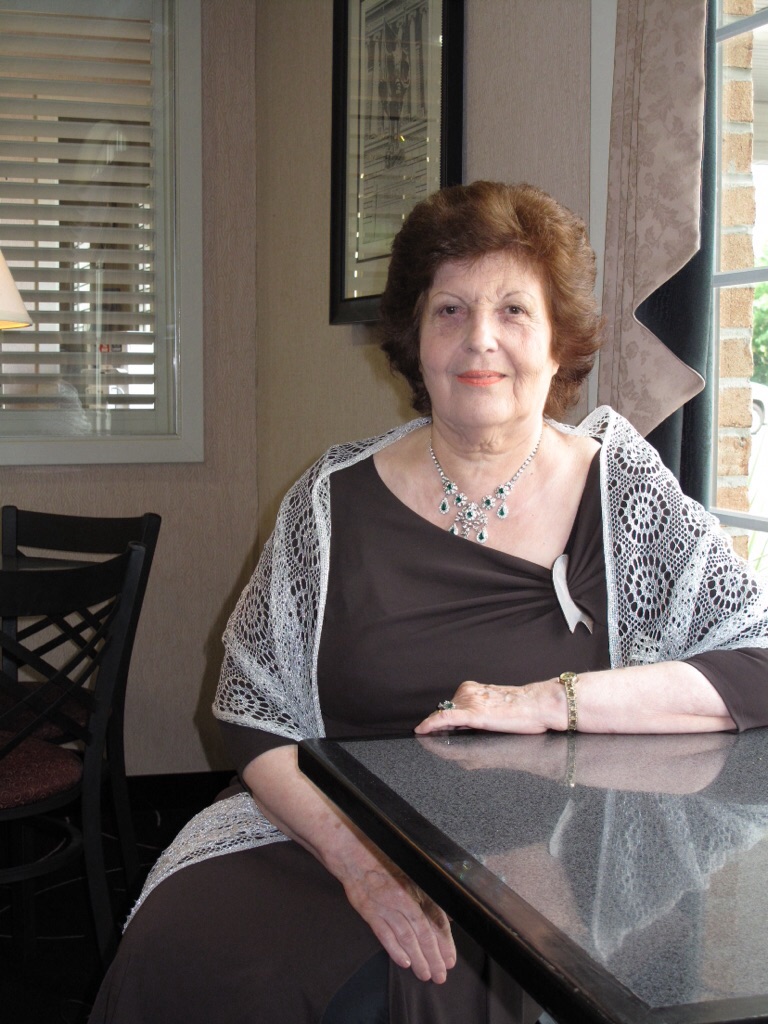
My maiden name is Mottahed. I was born in Shiraz, Iran. I am a fifth generation Bahá’í from my father‘s side and fourth from my mother’s side.
Being a Shirazi, my paternal great-grandfather, together with a large number of his family, knew the family of Siyyid Ali-Mohammad through business. After hearing the tremendous claim of the young Siyyid, they were very curious to find out about it themselves. They went to Vakil Mosque where the Báb publicly announced His Mission. I have been told that around 50 members of the family were present on that historic occasion and they were so moved that most, if not all, embraced the Faith of the Báb. Later on, when Baha’u’llah’s claim reached Shiraz, they became Bahá’ís.
My maternal great-grandfather, Mirza Ata’u’llah, was from the town of Abadeh in the Province of Fars, in the south of Iran. Mirza Ata’u’llah had been given the title of Siraju’l-Hukama by Muzaffareddin Shah, which means the Light of Physicians. Years later, a short account of his life was documented in Mr Balyuzi’s book, ‘Eminent Bahá’ís in the Time of Baha’u’llah’ (p.29). He heard about the Bahá’í Faith in Isfahan when he was studying to become a physician. Through a friend, he was invited to the home of two prominent Bahá’ís. This meeting brought the Bahá’í Faith to his attention.
Those two Bahá’ís, who were later martyred for their beliefs, were “The Beloved of Martyrs” (Mirza Muhammad-Husain) and “The King of Martyrs” (Mirza Muhammad-Hasan). It was the “King of Martyrs” who taught him the Faith. After finishing his studies, he returned to Abadeh together with his brother and another man. In fact, he was the first Bahá’í of that town.
As a child, brought up in a Bahá’í family, I attended Bahá’í children’s classes which were very well structured and organised in Iran. These classes ran side by side with our formal school education and continued as far as grade 12.
As a junior youth and youth I became very much involved in the activities arranged for these age groups. A very strong Youth Committee and its sub-committees were among the many other committees catering to the needs of a large number of youth in order to help engage them in the life of the Bahá’í community.
As a youngster I remember I had been appointed to serve on some of these sub-committees for organising deepening meetings and producing a ‘wall magazine’ where news items and articles were written for the youth.
The Spiritual Assembly of Shiraz had designated a large room for youth activities in a building next to the Bahá’í Centre. The room served as guest accommodation for travel teachers, pilgrims etc. Special gatherings such as social events, musical evenings, plays, deepenings and the like were also held in this room for the youth. The wall magazine was pasted on the wall of the room.
Hand of the Cause of God Mr. ‘Ali-Akbar Furútan, on the instruction of the beloved Guardian, visited Shiraz during 1954-55. As part of his mission, Mr Furútan had to visit some of the surrounding towns, in particular the town of Nayriz, which is quite well known to the Bahá’ís and particularly those who have read the early history of the Faith. Nayriz had frequently been a centre of persecution and martyrdom of Bahá’ís.
Mr. Furútan had been asked to visit that town for the purpose of encouraging and deepening the friends. That visit was during the autumn season. It was unusual to have lots of rain at that time of the year. There was just one road between Shiraz and Nayriz. Unexpectedly the road had become flooded and very muddy, making it nearly impossible for any public transport or private car to travel from Shiraz to Nayriz for some months. However, this situation delighted the friends in Shiraz as they were able to host Mr Furútan for a longer period than he had originally anticipated. His long stay in Shiraz made it possible for the friends to take part in many deepening classes, lectures and talks on various Bahá’í subjects, all conducted by him. The teaching of the Will and Testament of ‘Abdu’l-Bahá was one of the very important topics that Mr. Furútan undertook because it was the Guardian’s wish for the Community to be deepened in understanding that important document. His addresses were so interesting and enlightening that nothing else mattered to me except going to the Bahá’í Centre after school to listen to and learn from his vast knowledge on every aspect of our beloved Faith. In his book Hikayat-i-dil, ‘The Story of My Heart’ first published in 1977, Mr Furutan has given a detailed account of that stay in Shiraz.
I can easily say that meeting Mr. Furútan and learning from him was a turning point in my life. As a Bahá’í child and then a Bahá’í youth, I had attended Bahá’í classes and learnt about the Faith from these classes but it was Mr. Furútan who really changed my outlook and showed me the world-embracing mission of the Faith, that we were not merely a bunch of persecuted people in Shiraz, Nayriz or indeed any other place in Iran. The Faith was far far greater than that. His addresses really brought to my mind, and the mind of so many of the youth who had the privilege of attending his lectures and classes, that the Faith is destined to spiritually conquer the whole planet, and in the fullness of time will usher in the Golden Age of human endeavour, the Most Great Peace. He encouraged the Bahá’ís, the youth in particular, to go pioneering to places far and wide. At that time we were at the beginning of the Guardian’s Ten Year Spiritual Crusade. Inspired by Mr Furútan, I can say with confidence that a large number of youth responded to the call of the beloved Guardian and went pioneering to different parts of the world. I felt the same. I really wanted to pioneer, but in my mind I wished to combine pioneering with my academic studies.
Right from my childhood I acquired a special affection for England because the school I went to was run by an English lady known as Khanum Ella (Ella Gerard) whose parents or grandparents came to Shiraz as missionaries. She had established the Mehr-Ayin school for girls, which soon gained a reputation as the best school in that city. It was natural that I got to know about England and the way of life there through her.
At that time, I met my future husband Bahador Haqjoo, who had studied at Birmingham University as an engineer and had just returned to Iran. We were married in 1955 and went to live in Abadan which was an oil refinery town in the south of Iran. We both wanted to go pioneering to fulfil the goals of the 10-Year Crusade. Before meeting me, Bahador had thought of going to Brazil as it was one of the countries in need of pioneers. Some of his friends had already successfully established themselves in their pioneering posts over there. After a great deal of thought, we decided to go to England where we knew the language and could combine studying and pioneering together. Whilst waiting for the arrangements for our move, I was asked to serve on some committees of the Abadan Spiritual Assembly such as the ‘East and West’ and the Teaching Committee.
Additionally, when one of the children’s teachers became ill, I was asked to take over his class, which presented me with a very interesting opportunity to teach children where some of them were not much younger than myself! It was a highly enjoyable experience.
We arrived in England in July 1957 and my Bahá’í administrative life duly started the next year when I became 21 years of age.
Initially, we were hoping to go to Newcastle University as I had heard through our friends who were living there about the need for pioneers. However, to my disappointment I was accepted as a student by Manchester University. Manchester was one of the five Northern English Universities that accepted the High School Persian Diploma.
My disappointment was because Manchester already had a well-established and active Bahá’í Community and they were not in need of pioneers. When Shoghi Effendi was studying in Oxford in 1920, the Manchester community was honoured with a visit from him. We thus went to live in Manchester, but we were still determined to follow our dream of pioneering to a goal area. After consultation with the Manchester Assembly we learnt that they had extension goals for the 10-Year Crusade, namely, Eccles and Cheadle and Gatley Urban District Council.
I was still not 21 at that stage but we started working towards moving to our selected goal area, Cheadle and Gatley, which had six Bahá’ís residing there. Our move from Manchester, together with the move of another Bahá’í, Marjorie Lucas, would form the very first Spiritual Assembly of that area.
I started helping Bahador to start a children’s class in Manchester. I was appointed to serve on a Youth Committee where other members were Jimmy Habibi, my brother Parviz Mottahed and Ronald Bates, who was a new Bahá’í then. Some years later Ron went to serve at the Bahá’í World Centre in Haifa for 22 years until his retirement. We tried to organise events for the youth, encouraging them to attend the firesides and Sunday meetings at the Manchester Bahá’í Centre. The meetings were quite regular. There were firesides at somebody’s home every night of the week and a public meeting (devotional and talk) every Sunday evening at the Bahá’í Centre. Deepening classes were also organised by the Assembly. Attending these gatherings helped me a great deal to learn about our Faith and familiarised me with the Bahá’í literature in English, particularly the Writings of the Guardian. I learnt a great deal from people like Louis Ross-Enfield, a very knowledgeable Bahá’í who was a member of the National Assembly and Secretary of the Manchester Spiritual Assembly. We used to attend his deepening classes. A very important personage that we learnt a great deal from was Mr. Alfred Sugar. At that time he was in his early nineties. We moved to our pioneering post in 1959 to be present in the area in time for the formation of the new LSA at Ridván, and then we moved to our new house in the September.

First Spiritual Assembly of the Bahá’ís of Cheadle and Gatley Urban District Council
Formed at Ridván 1959.
Standing from left to right: Alice Smith, Elizabeth Yool, Robert Yool, Betty Yool, Marjorie Johnson.
Sitting from left to right: Bahador Haqjoo, Shahla Haqjoo, Marjorie Lucas, Clifford Johnson
Bahador, who did a post-graduate course at the same time as I started my degree course, finished his course at that time and was then invited to join the staff of Manchester University Institute of Science and Technology (presently known as UMIST). In his new role of teaching at the Chemical Engineering Department he had the opportunity to do research towards a Ph.D. Degree.
During my undergraduate years at the University, with the help of Bahador and another student, Kianoush Kouchekzadeh, we started a Bahá’í Society in Manchester University. To my knowledge it was the first university Bahá’í society in the country. We had many activities at the society which led to several declarations. We met many students who were interested in learning about the Faith. We invited them to our Wednesday evening firesides where many well-known Bahá’ís such as Mr. Sugar, Ian Semple and many others were invited as guest speakers. Friends like Bob Hallam, Brian Whitehead and Dorothy Green became Bahá’ís through the Bahá’í Society. We also had many other activities e.g. weekend schools organised by our newly formed LSA.
In 1972, due to changes in local government boundaries, Cheadle and Gatley Urban District Council was absorbed into the Stockport Metropolitan Council together with many other small areas around it. As a result of this change, our Assembly became known as the Stockport Spiritual Assembly. Stockport became one of the 10 Districts of Greater Manchester.
Our life from the time we came as pioneers to Cheadle and Gatley is much connected with the history of the Faith in that area, as can be seen on the Stockport Bahá’ís website.
I have also served on some National Committees such as the Summer Schools Physical Arrangement Committee. After the Iranian Revolution in 1979 when a large influx of Persian Bahá’ís arrived in the UK, a Persian Affairs Committee was formed to which I was appointed to serve, and I was elected as its secretary for a few years.
In the late 1970s and early 1980s, I also served as an Assistant for the Auxiliary Board members for Protection and Propagation for the north of England, Madeline Hellaby and Joe Foster.
Our early days in Manchester
As I mentioned earlier, we arrived in England in July 1957. We attended a summer school in Liverpool in August 1957. We were introduced to Mr. Habib Habibi, a Persian Bahá’í living in Manchester. Habib introduced us to a charming couple from his community, Betty and Harold Shepherd. When they heard we were looking for accommodation in Manchester they mentioned that they had some flats for rent and one of them was vacant at the time. They said we could go and have a look at it. To their surprise we said we would take it without viewing it. The fact that the flat was theirs and that we would be living next door to them was quite sufficient for us.
The moving message of the Guardian to the British Bahá’í Community was read and discussed at that summer school. We arrived in Manchester a few days after the summer school. It was a blessing to live next door to Betty and Harold, to get to know them and their children, Brian and Ann. Their successful firesides were held on Friday evenings, which we attended regularly.

Fireside at the Shepherds
Sitting on floor left to right: Marjorie Lucas,Betty Shepherd,Pamela Johnson,
On the settee left to right: Mrs. Kettlewell, Marjorie Johnson, Marjorie Jonhnson’s
sister-in-law, Harold Shepherd, Alice Smith
Standing: Brian Dilworth, Marjorie Johnson’s brother
We got to know the rest of the Manchester friends and learnt a great deal from the people who attended the firesides, particularly in the subject area of teaching the Faith. Betty and Harold had a car, which was rare in those days, and they used to take us to other firesides and Sunday meetings.
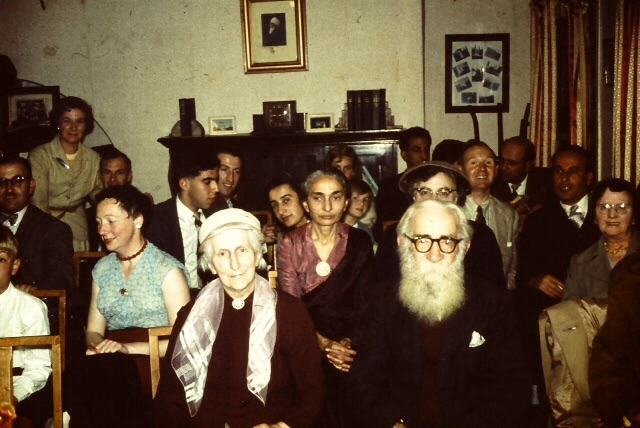
Sunday evening meeting at the old Bahá’í Centre, Manchester
Front row left to right: Louis Ross-Enfield, Lilo Jessen, Mrs.Sugar, …, Mr. Sugar,
Back row: Marjorie Lucas, Harold Shepherd, Parviz Mottahed, Ron Bates, Jimmy Habibi, Ann Shepherd, Pauline Senior, Habib Habibi
Our poignant memory of those early months in Manchester was the sudden passing of the beloved Guardian on 4th November 1957, an event which shook the entire Bahá’í world. To this day when I think about it, and visualise how we heard, I cannot help myself from shaking. Betty knocked on our door late at night, which was unusual for her and said ‘I have got something to tell you. I’ve got bad news.’ We could not think what had happened. She said that they had received a telegram from the National Office that Shoghi Effendi had passed away, so you can imagine how we felt at that time. We attended the funeral a few days later. One always thinks of the mistakes one made in life, things where one says “I wish I had done this or not done that”. Not going to Haifa during the lifetime of Shoghi Effendi was one regret for us. After my parents went on pilgrimage to Haifa in 1955 they encouraged Bahador and me to apply for pilgrimage and to go and meet the Guardian. We replied that we had just started our studies and were working in a new country and our hope was to first render some service to the Cause, no matter how small, in order to make the Guardian happy, and then we would go and see him. Of course, that was a mistake and I will regret it for the rest of my life.
Sadly, my husband Bahador passed away in 2018. We worked closely together for the Faith for many decades as a team. I still live in Cheadle.
____________________________
The Yools
The Yool family had become Bahá’ís in 1936. The account of their introduction and acceptance of the Faith is quite interesting. Young Betty was very friendly with one of her school mates called Helen Chessell. There were certain dates in the year that Helen used to say to Betty that she could not play that day as she had to go to a meeting with her parents. Betty was curious but never asked what kind of meeting Helen was going to. Also during the occasions that they played at Helen’s home, she noticed some Eastern type artefacts, and a frame round some unusual writing caught her eye in particular. As Mr. Chessell had travelled to India, Betty thought they were souvenirs from that country. Later on when the two families got to know each other, Betty got her answers about the Greatest Name, and the whole family were then introduced to the Faith. The Chessells were one of the early Bahá’í families of Manchester. The Yool family became very interested and declared in 1936. Betty was 16 years old at the time.
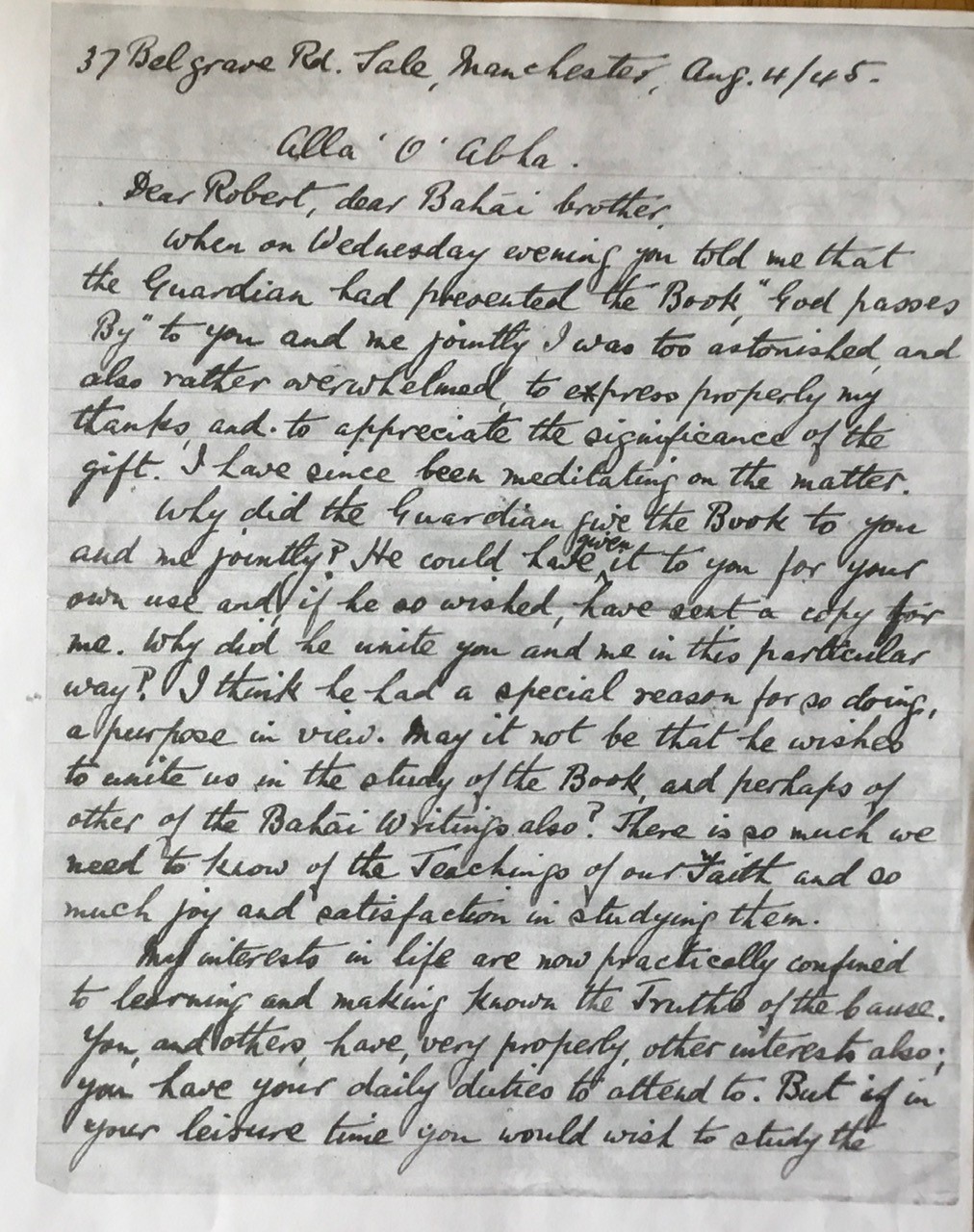
Robert Yool had joined the Army in 1915 and was on the Regular Reserve from 1924 which was renewed every three years. After becoming a Bahá’í in 1936, he had decided to end his service at the end of 1939. World War 2 started before the end of the year and he was recalled to the Army on 1st September 1939. Being committed to the Army, he could not ask for non-combatant service. The account of Robert’s life in the Army and his historic visit to Haifa during the War, quoted from his father’s letter to the Bahá’ís of Manchester, has been presented to the UK Bahá’í History archives by Betty. Robert returned home at the end of the War. To his delight he received a copy of the book ‘God Passes By’ from the Guardian as a joint present to him and Mr. Alfred Sugar, a prominent Bahá’í of Manchester. The book, and Mr. Sugar’s letter to Robert, has been donated to the Afnan Library. [See images at the end of this narrative.]
In Robert’s absence during the War, Betty and Mrs. Yool enjoyed being involved in the Bahá’í Community life of Manchester. Betty’s work was stationed in the Longsight area and she had the opportunity to see other Bahá’ís such as David Hofman and Joe Lee.
It was such a pleasure for Bahador and me to work side by side with this wonderful family in our newly formed Assembly and its many arranged activities. Betty was a very capable secretary and she was the Assembly’s secretary for a number of years. She loved travelling and travelled to many parts of the world including Iran as the guest of my parents in Shiraz. They also arranged for her to visit Isfahan and Tehran as the guest of family and friends. Visiting Bahá’í Holy places in those cities of course was the main part of the agenda. On her return to the UK she had a three-day visit to the Bahá’í World Centre in Haifa too.
Betty’s birthday was on 27th September, coinciding with the Feast of Mashiyyat (Will), and the family always hosted this Feast. In later years when the Community grew in size, it was not possible to hold the Feast at Betty’s home. Bahador and I offered to host this Feast on their behalf, and to this day I host it in their memory and for the Community. It is known as Betty’s Feast!
The Johnsons
Clifford Johnson was a very devoted, sincere, active, spiritual and fair-minded person. Before hearing about the Bahá’í Faith and the concept of Progressive Revelation, during his life in India he had met the Muslims and learnt about the Teachings of Islam. With his logical mind he thought that God’s revelation should not end with Christianity and he accepted The Islamic Faith. On his return home as a devout Muslim he became an active member of the mosque in his locality. He heard about the Bahá’í Faith when in response to the invitation of the Manchester Bahá’ís he accompanied the Imam of the mosque to the World Religion Day celebration. The Manchester Bahá’ís celebrated this event annually in the Mayor’s Parlour of the Manchester Town Hall. The Mayor himself opened the meeting and welcomed the representatives of different Faiths who were invited to talk on the subject of “Contribution of Their Faith to World Civilisation”. Clifford became very interested and got many books about the Bahá’í Faith and later attended the firesides. It did not take him long to accept the Bahá’í Faith as guidance from God for the New Era. He was a very active member of the newly formed Assembly and the Community until his departure to the Abha Kingdom.
Alice Smith:
Clifford introduced his sister Alice to the Bahá’í Faith. She was a Christian Scientist. She attended the firesides at Betty and Harold Shepherd’s home and accepted the Faith.
Marjorie Lucas:
She was a new Bahá’í when we first met. She had accepted the Faith through her friendship with Margaret Nelson (now Sullivan). She was staying with the Shepherd family at the time. Living next door in their flat, we became very close to Marjorie. She offered to move to Cheadle and Gatley to form the Assembly in 1959. Luckily she got a job as a housekeeper to a wealthy family in the area.
Carolyn Kettlewell.
Mrs. Carolyn Kettlewell, Clifford’s mother, was a kind, spirited, feisty and very smart lady with a nice sense of humour. She outlived Clifford, Alice, and their brother who lived in South Africa, and she is buried in the same grave as Clifford in the Cheadle Old Cemetery.
Frank and Minnie Worsley:
Other members of the community were Frank and Minnie Worsley, who became Bahá’ís in Manchester, attending the firesides at the Habibis’ home and taking part in the activities of the surrounding areas. When Cheadle and Gatley and many other areas became part of the Stockport Metropolitan Borough, one of the ten districts of Greater Manchester, Frank and Minnie were welcomed with open arms into the Stockport Community. Frank served as secretary of the LSA for a number of years.
Before the Worsleys became part of Stockport, I remember serving with Frank on a joint Social Committee of Greater Manchester arranging two main events, Naw-Rúz and the Birth of Bahá’u’lláh celebrations, for the entire area. These were truly successful events still remembered by those who participated.
Shahla Haqjoo
Manchester, October 2020
Copy of letter from Alfred Sugar to Robert Yool re: the gift of “God Passes By”, from the Guardian.


 UK Baha'i Histories
Dear Friend,
Just the briefest of replies to say, a) thank you; and b) I declared in Liverpool on 14th July 1975. I have the prayer book given to me on that day here beside me; and perhaps more to the point I have a tiny packet of dust from the house of the Bab inside the cover, still intact.
With loving greetings,
Richard Poole
Such an amazing story, and I do like the addition of other members of the community at the end too. Thank you for telling us your story xxx
Dear Shahla, it’s a long while since our paths crossed, but I remember you and Bahador well.
What a beautiful account, with so many familiar names and precious stories. Wonderful and heart-warming.