
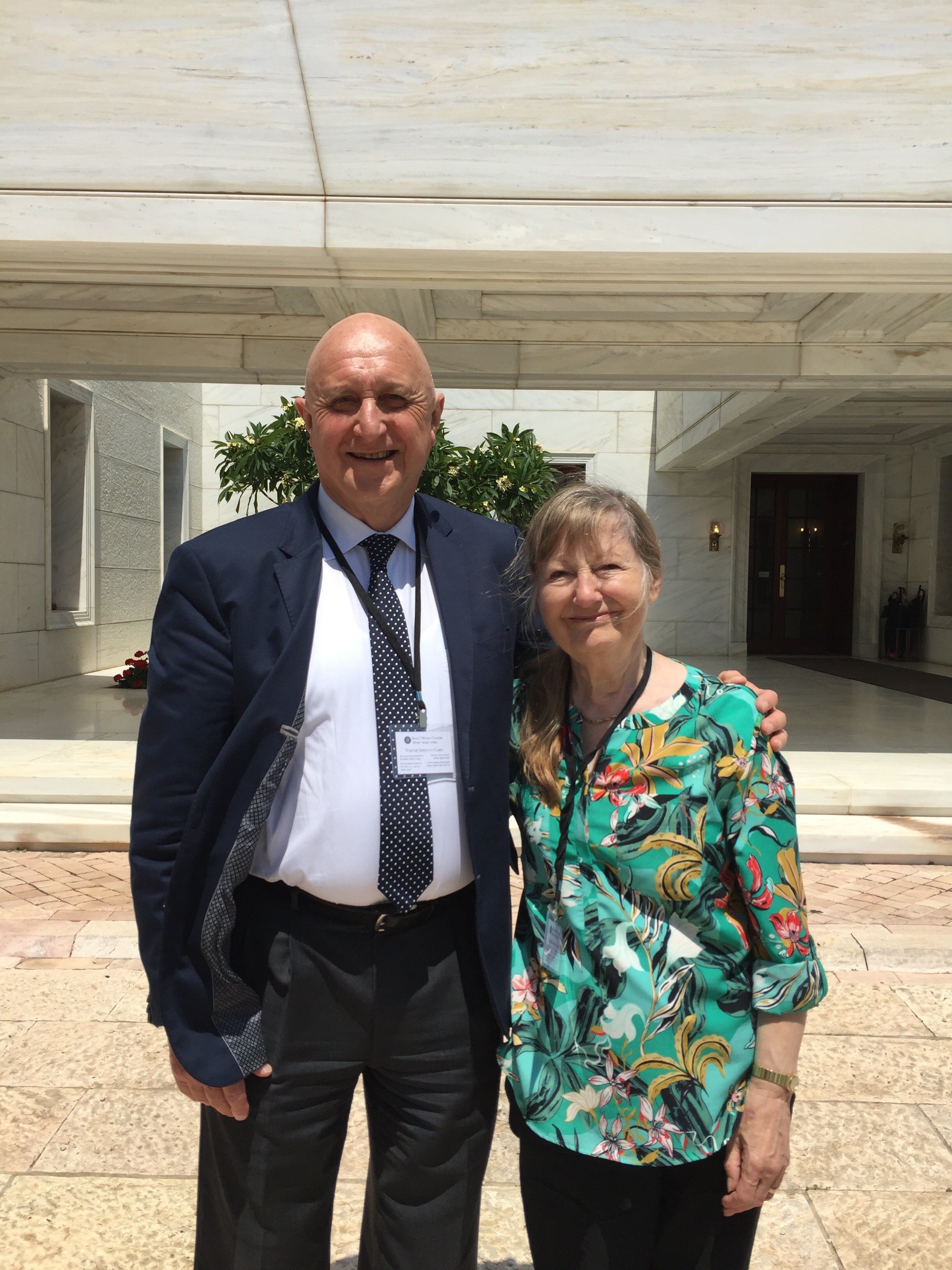
Early life
We were both born during the Second World War into middle-class families in the Yorkshire mill towns of Dewsbury (Margaret) and Huddersfield (Gerald).
Margaret attended the local girls’ grammar school and was always one of the brightest in her class. She was captain of the hockey team.
Her family were regular attendees at the local Church of England church, St Marks. The vicar had two daughters but, according to the elder one, if he could have had a third daughter, it would have been Margaret.
My parents having moved to Dewsbury when they bought a business there, I attended the neighbouring boys’ grammar school, and my first recollection of Margaret was when she captained her school’s quiz team against the team from my school, which included me. The girls wiped the floor with us, and Margaret was by far the most knowledgeable member of both teams and was almost single-handedly responsible for our humiliation. This was a tendency which continued throughout our lives and was particularly noticeable in the last ten years or so when I watched University Challenge with her nearly every Monday night.
One of the more remarkable friendships we formed in the early part of our relationship was with a French family who live in the small village of Hermes, in the Département of Oise, just north of Paris. They looked after my maternal grandfather when he was injured in the trenches during the First World War. The granddaughter, Claude Bokkelandt, corresponded with my mother off and on until I started learning French at school, when my mother passed the correspondence baton to me.
Margaret and I were, by chance, selected by our respective schools to attend an Easter course in 1959 at the Sorbonne in Paris. We were already friends, so we naturally made the most of our time in Paris by visiting major tourist attractions together. On one of the weekends, we decided to catch the train to Hermes and visit the French family. They were delighted to welcome us – the first-time representatives of the two families had met for more than forty years! The friendship has continued to this day, although sadly both parents have in the last few years passed away and we have recently been maintaining contact with their son and daughter, as well as one of their grandchildren. Their son has visited us many times in both England and New York, and is very familiar with the Bahá’í teachings as a result.
Margaret breezed into university, without trying very hard, and ended up with a law degree from King’s College, London University, again without trying very hard. Her degree course was extended to four years because of a serious car accident in our first year, when we were passengers in a car driven by one of our friends. This resulted in a fractured skull and six months’ recuperation for Margaret.
I was reading Modern Languages at King’s and we both made many good friends there. A small group of us maintained a very close friendship and have met, though irregularly, ever since. Notable reunions were at the Twickenham Sevens, the Stoke Park summer balls, the fiftieth anniversary of our first meeting, the Giggleswick School Quincentenary, our Ruby Wedding Anniversary and, sadly, four funerals, not including Margaret’s, which was blighted by Covid lockdown restrictions.
After graduating, Margaret worked for a firm of solicitors in Westcliff-on-Sea, Essex. We were married soon after at St Mark’s Church, Dewsbury, by the above-mentioned vicar. Three clergymen attended our marriage. The other two were the vicar of my church from the other side of town, and the vicar of the church where her father, an accomplished musician, was organist and choirmaster.
During our time in Essex, I taught French and Latin at a private school in Leigh-on-Sea. I played rugby and cricket, and Margaret, who always had a keen interest in sport, chose to be the scorer at our cricket matches. One of our friends from King’s College was also working in the area at the time and was a member of the same cricket club. Another member of the club was Norman Cuddeford, a BBC cricket commentator, of whom Margaret was a great admirer, and who became a lifelong friend.
Meeting the Bahá’í Faith
Our respective upbringings in the Church of England had a positive impact upon both of us during our childhood and early adolescence. The grounding this gave us in terms of spiritual and moral values, and belief in a deity and in Jesus Christ as God’s representative on earth, was almost certainly the reason why the teachings of the Faith resonated so easily with us. Accepting Bahá’u’lláh as the messenger of God for today seemed to us to be a logical progression of what we had learned at Sunday School and understanding progressive revelation, we could see, was the key to unblocking religious prejudice and misunderstandings.
However, religion played no part in our lives during the years after we left school, as we went through University and then both worked, first in Essex, and then in London. I was running a public relations firm in London when an advert for a new employee resulted in my taking the job applications home and going through them with Margaret. She looked through my pile of rejects and picked one out to add to the short list. I objected, on the grounds that it was written on pink gingham notepaper, and the name of the individual was very foreign! Margaret insisted and, following a couple of interviews (shows how unenthusiastic I was about the choice), Mahnaz Alá’í, a Bahá’í, was appointed.
A year or so later, in 1973, following frequent after-work visits to our New Bond Street office by Margaret, and lots of interactions with Mahnaz and her sister, Shahnaz, and their mother, Ghodsieh Alá’í, we decided that we wanted to become Bahá’ís. One evening after work, Margaret and I sat in Mahnaz’s office and Margaret asked Mahnaz “would it be presumptuous of us to want to become Bahá’ís?”.
Little did we know of the effect this was to have on the rest of our lives! The most immediate evidence of this was the difference our new Faith made to our relationship with each other. We had by this time been married for eight years and our marriage was such that Margaret was not interested in having children. Embracing the Faith had a dramatic impact on our lives together and this was soon manifest in the birth of our daughter Romilly. We never forgot our first Naw Ruz as Bahá’ís when Margaret found out she was pregnant and was able to share the joyful news with our Bahá’í friends when we celebrated Naw Ruz together. We also spent a short time at the Iranian Embassy’s Naw Ruz celebration – quite a culture shock for Margaret and I.
The Alá’í family, which is spread around the world, rapidly became our extended family and had an impact on so many important aspects of our lives. The youngest of six children, Mahnaz would, in due course, introduce us to all her siblings and other branches of the family. Mahnaz and Shahnaz, the only survivors of the six siblings, have been for many years our closest friends, together with their families, and remain a great comfort to me since Margaret’s passing.
The well-known black actor Earl Cameron, plus Mahnaz’s friend David Vaillancourt, were an important part of our lives during this period.
Earl was at that time working with the Nigerian Black Arts Festival to be held later in Lagos. A contingent came to London to promote the Festival. Earl, as Chairman of the UK Committee of the Festival, asked Mahnaz to help with promoting the Festival in London, and Mahnaz involved me. This was a memorable time during which we met the members of the Hausa tribe, together with Chief Anthony Enaharo, who was a member of the government of Nigeria. We also met Dizzy Gillespie, who was in London at the time, and came to the Roundhouse for the press briefing on the Nigerian visit. We met Dizzie many times and I even had the honour of accompanying him on an interview he gave to a popular radio programme. At the start of the interview, the DJ asked Dizzie what he wanted to talk about. Dizzie put his Bahá’í prayer book on the table in front of him and said: “This is what we’re gonna talk about”.
One of our early encounters with Dizzy was in late 1974. We were invited to an event at the home of Phillip and Ann Hinton, in Epsom. At one point, Dizzy took our baby daughter Romilly (born in October 1974) onto his knee and, holding her close to his face, puffed out his enormous (trumpet) cheeks and expected her to react nervously. On the contrary, she loved it.
One of the memorable parties at the Alá’í home was attended by Hand of the Cause General Alá’í, together with Jimmy Seals and Dash Crofts. What an honour and privilege it was to meet these distinguished individuals.
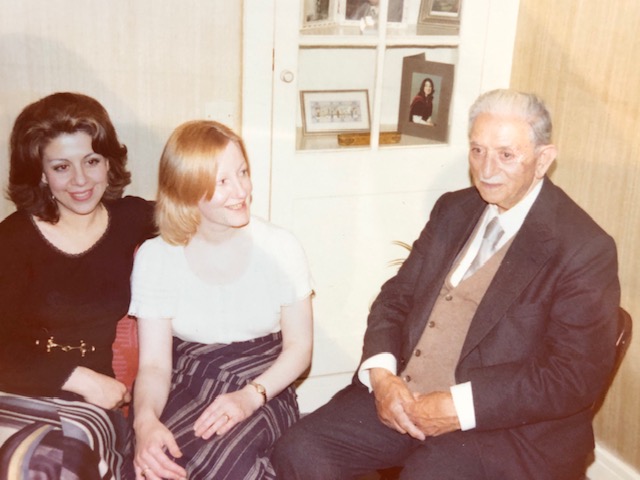
Suhayl Aláí, brother of Mahnaz and Shahnaz, who had been in Samoa since 1955, was on his way through London in 1973 to the International Bahá’í Convention in Haifa. We met briefly in our office and he suggested to me that we should investigate life in the South Pacific. This thought, planted a couple of months before we became Bahá’is, was filed away for eighteen months or so before Margaret and I, responding to a call for pioneers from the Universal House of Justice, decided to investigate his suggestion. As already mentioned, we now had a baby daughter, so Margaret sent me off on an exploratory trip to the South Pacific. At Suhayl’s suggestion, I visited Port Vila, New Hebrides (now Vanuatu), and Noumea, New Caledonia, before meeting Suhayl in Suva, Fiji. Suhayl and I decided that one option would be for me to run the company he had already established in Suva.
When Margaret met me at the airport on my return (accompanied by Mahnaz), we sat down in a local hotel and debriefed on my trip. Before we left the hotel, the decision had been made. We were going to pioneer to Fiji.
One of the first things I did after that was to sign up for flying training so that I could obtain a pilot’s licence. I felt that this would prove to be particularly useful in Fiji, where there are one hundred inhabited islands, with extremely poor communications but with small airstrips on many of the islands. After I had obtained my pilot’s licence, we decided to pay a farewell visit to my closest friend from school, who lived with his wife in the Netherlands. Margaret had no hesitation in agreeing that I should fly us there. Off we went in a twin engine Cessna 310, baby of six months in the back seat with her mum, and arrived safely in Monchengladbach, Germany, the nearest airport to the town where our friends lived.
The final event we attended the day before our departure for Fiji was the wedding in London of Shahnaz to Hossein Amánat. This resulted in lots of emotional farewells from many of those present.
Less than six months after my exploratory trip, with baby Romilly in a carry basket, we jumped on a plane and, via Montreal (where Mahnaz’s future husband David Vaillancourt was now living), Vancouver and Honolulu, we arrived in the South Pacific.
For another perspective on this period in our lives, please see Appendix 1, written by Mahnaz Alá’í and entitled “From Bond Street to Fiji”.
Settling in the Pacific
We spent the first week in American Samoa, where Suhayl and his wife Lilian were then living. Margaret soon settled into a quite different, much more simple life. Suhayl and I went to Fiji where we sorted out my work permit and I found somewhere for us to live.
As soon as she arrived in Suva, the capital of Fiji, Margaret did everything she could to adapt to our new lives. We started to learn Fijian and Margaret threw herself into that with great enthusiasm. She soon became involved in publishing Bahá’í prayers and writings in Fijian and, whilst not fluent, she was soon able to proofread and knew enough to recognise when something needed correcting. Later she took on the administrative work of the Bahá’í national office, as well as carrying out the work of the Bahá’í Publishing Trust. By then our son Daniel had been born (Taniela to our Fijian friends) and, with two young children, Margaret could not have coped without a truly wonderful lady called Melania who was our housegirl. Melania, who became a second much loved mother to the children, lived in a separate, local style dwelling (bure) in our garden, together with her husband and three children. Our children spent as much time in the bure with Melania’s family as they did in our house and spoke Fijian as their second, if not their first, language.
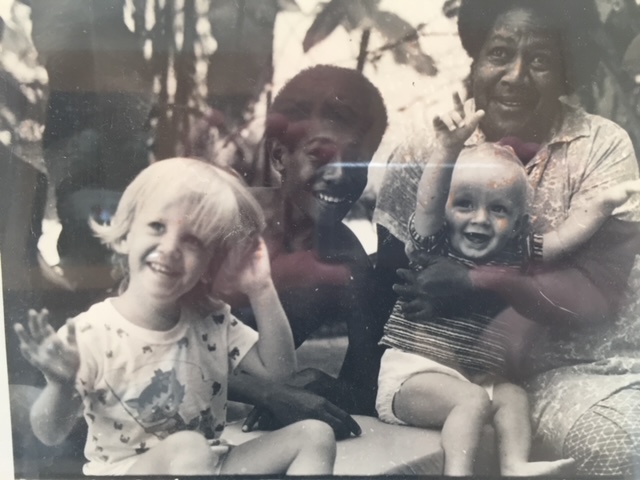
We both embraced Fiji, the people, the language, the culture, the villages, the islands, with great love and enthusiasm and Margaret, to the end of her life, resorted to Fijian music and Fijian language prayers whenever she needed to recharge her batteries.
Both our mothers (note, not the fathers!) made the long journey to the other side of the world to visit us, drawn especially by the birth of Daniel.
We travelled extensively in Fiji, mainly using my pilot’s licence to fly in a single engine 4-seater Piper Cherokee, which enabled us to visit Bahá’í communities in many of the outlying islands. We were always warmly welcomed in the small villages and enjoyed the warm hospitality offered to us.
One of the most dramatic experiences we had was when the four of us visited Lakeba, a chiefly island, renowned as the ancestral home of paramount chiefs, 150 miles due east from Suva. After an overnight stay in Waciwaci village with our friend Jioji Toka, a group of us, half a dozen Fijians plus the four of us, set off in a rowing boat with outboard motor heading across 30 miles of the Pacific to a tiny island called Vanua Vatu. (Not to be confused with Vanuatu)
The journey was pretty scary. The children were three and two years old but Margaret, who was a doting mother and hated boats, did not think twice about such a daunting journey. Halfway there, having lost sight of Lakeba behind us, and not yet in sight of our destination, the outboard motor packed up. We wallowed in the swell, as the waves tossed us around, and soon the children (and poor Margaret) became extremely ill. Poor baby Daniel was so ill that the colour drained from his face and we became very worried. The ordeal lasted for several hours, and we were beginning to wonder if we were going to make landfall before dark when one of our Fijian friends managed to fix the motor and we were able to resume our journey.
There was no way of communicating with Vanua Vatu, so our arrival was a great surprise to the villagers on the island. It is typical of the island and village culture, not only of Fiji but of the other small island countries of the Pacific, that we were welcomed with great joy by the people of Vanua Vatu. For the duration of our stay (three or four nights from memory) we hardly saw the children who had a wonderful time playing with the local children.
Another example of our children embracing the Fijian way of life was when Melania took them to her village for the weekend. They were totally accepting of the village way of life, and we have always believed that this period of their lives was a major contributor to the kind of people they have become.
A special period was the time spent in Fiji by travel teacher Ardeshir Forudi. He spent most of his time in Sigatoka, a town in the west of the main island, Viti Levu. He spearheaded the teaching activities in Sigatoka and the surrounding area, and established a teaching institute, which became the focal point of many activities. We made many friends there, with both indigenous Fijians and with Indian farming families. It was a very difficult journey from Suva, which, because of the unmade, pot-holed and rutted road, made a journey which today takes little over an hour take three or four hours depending upon the weather. Margaret wrote about our experiences there in a piece entitled “Impressions of Sigatoka”. She shared this with friends and relatives, some of whom were so moved by what she wrote that they still talk of it to this day.[1] See Appendix 2 for a copy of this piece
In January 1977 Margaret travelled to New Zealand, along with other local friends, to attend the International Teaching Conference. The Universal House of Justice was represented at this Conference by Hand of the Cause Mr Faizi. I stayed behind to look after the children. Half way through the first day of the conference I received a message from Margaret that the conference was such a wonderful experience that she did not want me to miss it. She told me to ask Melania to look after the children to allow me to catch the first possible flight to Auckland. The conference was a truly inspiring event which encouraged us to pursue the 5 year plan goals with great enthusiasm on our return home to Fiji.
A highlight of our time in Fiji was the visit in March 1977 of Mr Faizi. Despite poor health, Mr Faizi undertook a busy and highly successful programme of activities, including meeting top educationalists, addressing university students and talking to Bahá’í gatherings. His visit coincided with a visit by a musical group from the Indian Cultural Centre. Margaret arranged the programme for a musical evening and an inspiring talk by Mr Faizi. This resulted in a warm friendship being established between Mr Faizi and one of the Indian artists, Charka. When we took Mr Faizi to the airport at the end of his visit, Charka was there to bid him farewell.
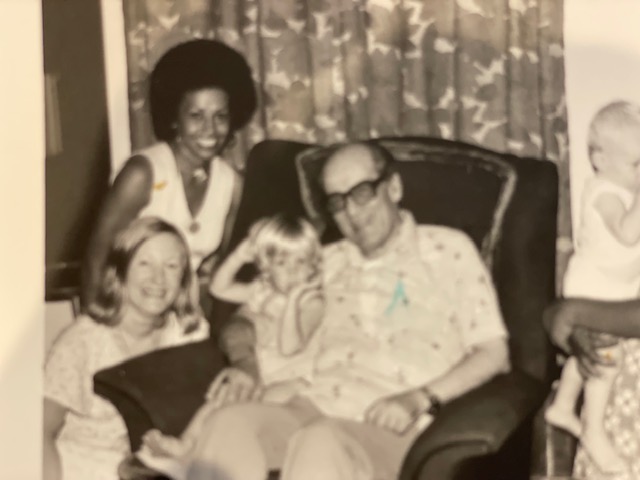
Through Margaret’s interest in Indian culture and music, we became close friends of Charka, who later visited us at our home in New York.
The journey through the Pacific was to be one of Mr Faizi’s last trips before he passed away. He was struggling with diabetes and spent much of each day in bed in his hotel. Margaret visited him every day with food and ensured he took his medication.
On one occasion I had the honour to be invited to visit the chiefly island of Bau, which is even higher in the chiefly pecking order than Lakeba (see above). This island was, and still is, the headquarters of the Council of Chiefs, which was the dominant power in the country before the cession to Britain in 1874. The importance was emphasised by the reconstitution of the Great Council of Chiefs in Bau on 24 May 2023, following a lapse of eleven years during which the body was not recognised in the Constitution.
We had too many visitors from overseas for me to relate here, but I have to mention the visits of Mahnaz, who spent some time with us on her way to Samoa, and of Shahnaz’s husband Hossein, who was on a visit to nearby Samoa as part of the Temple project, of which he was the architect. We were always delighted to welcome these visitors and enjoyed sharing our Fijian experiences with them.
As a member of the National Assembly, I went to Haifa in 1978 to attend the Fourth International Convention. Suhayl also attended as a Counsellor and his wife Lilian was there as a delegate from Samoa. This was such a great honour and privilege. Not only the stimulating Convention sessions and the election of the House of Justice members, but witnessing the Seat of the Universal House of Justice under construction, including the moving ceremony of the placing by Amatu’l-Bahá Rúhiyyih Khánum of the casket containing dust from the Holy Shrines in a niche above the front entrance in the outer wall of the council chamber. She was assisted by Hossein Amánat, the architect, and by Azíz Khabírpúr, resident construction engineer.
My trip was also blessed by a visit to Iran. Hossein Amánat invited me, along with Tinai Hancock, a Fijian who was then a delegate from New Zealand but later was to become a Counsellor in Australasia, to be guests of himself and Shahnaz in Tehran on our way back to the Pacific. We had the great privilege to visit the House of Bahá’u’lláh in Tehran and were overwhelmed when Shahnaz suggested we should also visit the House of the Bab in Shiraz. I have always treasured memories of this visit, made even more special because of the destruction of this most holy place the following year by religious fanatics.
I then travelled to Delhi and had the privilege of being the guest of Charles and Yvonne Macdonald. We first met them in London, when Charles was the Secretary of the National Assembly.
Another highlight of our time in Suva was the visit of Victor de Araujo, Bahá’í International Community (BIC) representative at the United Nations. I was secretary of the National Assembly and was given the responsibility of arranging his itinerary. Victor and I had meetings with a number of government officials, ambassadors and UN agency officials, and Victor was able to explain the work of the BIC to these dignitaries.
Our last few months in Fiji were blessed by a visit in February 1979 by Amatu’l-Bahá Rúhíyyih Khánum, and her companion on her travels, Violette Nakhjavani. They were in the Pacific for the laying of the foundation stone of the House of Worship in Apia, Samoa. We met them there and I managed to persuade Rúhíyyih Khánum to change their onward itinerary to include Fiji.
These two ladies left a lasting imprint in Fiji, as they did in many other countries of the world. Margaret arranged the itinerary for their visit, organised interviews by Fiji Radio and the Fiji Times, and spent time helping the two ladies in many other ways, especially one of Rúhíyyih Khánum’s favourite leisure pastimes – shopping. The highlight of the Suva shopping experience was Cumming Street, where many of the Gujurati traders had their shops. Rúhíyyih Khánum loved bargaining, and one or two proprietors of the major shops, friends of ours through Suhayl who had been visiting Fiji for some twenty years, were up to the challenge. Rúhíyyih Khánum’s visit lasted just over a week. I was their driver as they visited other communities far from Suva, including Sigatoka, and Margaret accompanied us, explaining all the local customs and way of life as we went.
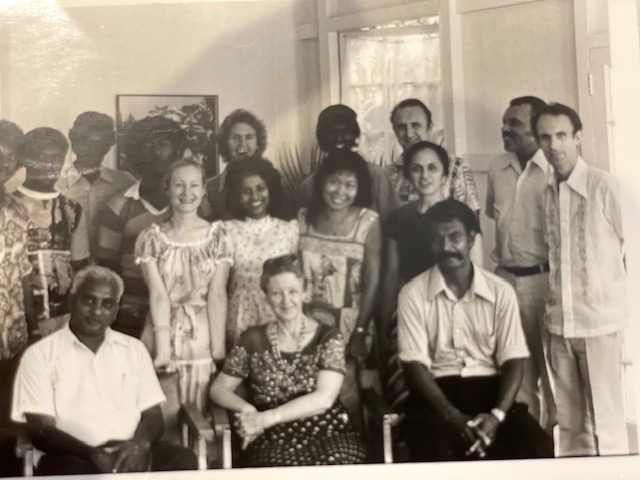
When we saw them off at Nadi airport, Rúhíyyih Khánum looked at us both very sternly and told us on no account were we ever to leave Fiji. A couple of weeks later, two unconnected things happened. First, I was told that I could not renew my work permit – localisation of jobs was a top priority of the Government – and secondly, we were asked to serve at the Bahá’í International Community United Nations Office in New York. Margaret was devastated. Her love for Fiji and its people was very deep and she had been very happy to hear the wishes of Rúhíyyih Khánum a couple of weeks earlier.
We left Fiji with fond memories of many exciting activities and of many friends, Fijian, Indian and Chinese, as well as other pioneers and visitors. Notable among these were many distinguished Bahá’ís such as Dr Muhajir, Collis Featherstone, Chellie Sundram and Dr Peter Khan. Suhayl Alá’í was a regular visitor. His support and encouragement had a major impact on all he met.
Margaret’s time in the Pacific came to an end with a trip to England, where she was to spend a few weeks before we embarked upon our new life in New York. During that time, I was in Samoa, working with Suhayl. I saw Margaret off at Nadi airport on the flight to Honolulu and beyond. She had her hands full with the two children, then aged four and three, and this was borne out when she lost young Daniel in San Francisco airport!
Serving at the United Nations
There was no television in Fiji when we lived there, and relatively few cars: most people got around by bus or on foot. The night sky was a star chart of constellations, the tallest building in Suva was four stories high, and a trip to the shops almost always meant running into someone you knew.
Even to an English couple raised in smoky Yorkshire mill towns, educated at gritty northern grammar schools and, more enjoyably, at London University’s King’s College in the heart of the metropolis, the abrupt transition from the sedate and leisurely pace of the Pacific to the noise, traffic, bright lights and bustle of New York and its suburbs took some getting used to.
However, we readjusted and, after weathering some major tests and difficulties in the first few months, settled down to build a new life for ourselves and our two children—five-year-old Romilly and her brother Daniel, not yet four.
The Islamic revolution in Iran, which coincided with our arrival at the UN office in 1979, resulted in a major escalation in the persecution of the Bahá’ís in Iran. I was given the task of representing the BIC at all major UN human rights meetings, as well as liaising with other NGOs and intergovernmental bodies. Another aspect of the work was liaison with governments, both at the UN and in national capitals, which we did in cooperation with many National Spiritual Assemblies.
A particular feature of the early work was presentation of the persecution to the European institutions. We worked with the nine National Assemblies whose governments were members of the European Economic Community (now the European Union with a much larger membership) to persuade the members of the European Parliament to adopt a resolution in support of the Bahá’ís of Iran.
This resolution, along with a resolution of the United Nations Sub-Commission on Prevention of Discrimination and Protection of Minorities, adopted in the same month at a meeting which I and another BIC colleague attended, were the first international evidence of support for the Bahá’í case.
There followed in the months and years to come resolutions of the Council of Europe Parliamentary Assembly, of the UN Commission on Human Rights, of the UN Economic and Social Council, and of the General Assembly, all of which came about through the efforts of the BIC and of National Assemblies.
In addition to the written material, mainly generated by Margaret, the work involved considerable travel and absence from home for long periods. My son recently reminded me, without any bad feeling, that I was not at home for seven of his birthdays, because his birthday fell during the Commission on Human Rights annual meetings in Geneva.
Margaret was, on one occasion, asked by the Universal House of Justice to accompany me during my work in Europe. Margaret arranged, and I attended, meetings with ambassadors and Council of Europe officials which laid the groundwork for the above results. This also included meeting with some of the National Assemblies in Europe. During Margaret’s month-long absence both sets of grandparents in England were delighted to share responsibility for the care of the children.
We also had the responsibility of engaging with the representatives of the world’s media based at the UN, notably the BBC, Reuters, Associated Press, Agence France Presse, the national American networks and leading national newspapers from many countries. This resulted in widespread media coverage in many countries.
The amount of written material involved in carrying out the work was voluminous, and Margaret, working mainly from an office at home, produced all this material in what has been described as “her calm professionalism”. Given the time difference between New York and the Bahá’í World Centre, this often entailed working through the night in order to produce documents on time, whilst consulting with members of the Universal House of Justice.
A major project which landed on Margaret’s desk was to write, and then produce, The Bahá’ís in Iran: A Report on the Persecution of a Religious Minority. It documented the persecutions, examined their historical background and motivation, discussed and refuted the false charges customarily levelled against the Bahá’ís by the Iranian authorities, and briefly explained the major principles of the Bahá’í Faith.
Its appendices contained copies of the resolutions adopted by international bodies and national parliaments in support of Iran’s Bahá’ís, international media coverage of the issue, official documentation from Iran testifying to discrimination against the Bahá’í community since the start of the Islamic Revolution and a chronological summary of arbitrary arrests, executions, murders, kidnappings and disappearances of Bahá’ís in Iran since 1978.
Following its publication it was distributed to National Assemblies throughout the world. Soon afterwards, French and Spanish versions were also shared with relevant National Assemblies.
We developed close working relationships with many of the government delegates, especially those who served on the Commission on Human Rights. Jaap Walkate from the Netherlands was one of the first to take a close interest in the plight of the Iranian Bahá’ís. We worked with him over many years, became close friends with his family and visited them at their home in Leiden. Another delegate who played a key role in the human rights arena was Richard Fursland of the UK, a friend with whom we have stayed in contact to this day. The Head of the UK Mission at the UN at that time was Sir Anthony Parsons, who was very knowledgeable about Iran, having served as UK Ambassador in Tehran in the period immediately preceding the Islamic revolution. At the end of his posting in New York, Sir Anthony became foreign policy adviser to Margaret Thatcher at 10 Downing Street. I have no doubt that his knowledge of Iran and of the experience of the Bahá’í community there, as well as his knowledge of the persecutions gained during his time at the UN, had an impact on the support of the UK government of the human rights of the Bahá’ís in Iran.
Other close relationships we enjoyed included African delegates such as those from Senegal and Togo, Asian delegates from China, Bangladesh and Malaysia, and Pacific islanders, especially those from Fiji.
I established a particularly warm relationship with Judge Abdulaye Dieye, the Senegal member of the Human Rights Committee, a panel of eighteen high-ranking independent legal experts from different countries. The function of the Committee is to monitor the performance of nations, including Iran, that are signatories to the International Covenant on Civil and Political Rights (ICCPR). I spent many evenings with Judge Dieye when we were staying in the same hotel during UN human rights meetings. We became good friends.
One of Judge Dieye’s legacies was his chairmanship of the Commission on Human Rights Working Group which completed the drafting of the text of the Declaration on the Elimination of All Forms of Intolerance and of Discrimination Based on Religion and Belief. The Declaration was adopted by the General Assembly in 1981.
In April 1981, Victor de Araujo and I were invited to a reception hosted by the Senegalese Mission to the UN in honour of Judge Dieye, who, in addition to his many UN roles, was Secretary General of the Supreme Court of Senegal. Two days later, we hosted Judge Dieye at a private lunch, during which he asked many questions about the Faith. He remarked to Victor that, right from the first meeting in Geneva, he had felt “a great warmth between himself and Gerald and was delighted to meet him again”. Victor’s smiling response was that “Gerald is not like an Englishman”.
Very sadly, the relationship with Judge Dieye was short lived, since he died suddenly on 18 March 1983, in Dakar, Senegal, aged forty-five.
Margaret and I organised a memorial gathering at the UN, on 6 April. As Chairman of the NGO Committee on Human Rights I had the honour of chairing this event, which was attended by leading human rights officials and diplomats, as well as by NGO representatives. The government of Senegal, represented by the Permanent Representative (ambassador) to the UN, was very appreciative of our initiative. The then President of Senegal, Abdou Diouf, responded warmly to our letter of condolence.
Early in June 1981, Margaret attended the two-day PPSEAWA (Pan-Pacific and South-East Asia Women’s Association) Conference held at Saratoga Springs in upstate New York. She arrived just as the opening ceremony—held at the town’s stunning Performing Arts Centre—was ending and the delegates, all in national dress, were filing out. “All very beautiful,” her diary says, “especially the Koreans, who looked like butterflies.”
She linked up briefly with the Fiji delegation and later lunched with two ladies from Samoa. A late arrival from Korea sought her help in placing an international telephone call and, as they sat chatting, asked her about the Faith. After Margaret had spoken, the Korean lady was quiet for a while then said: “I have come a long way for this conference but if I don’t attend a single lecture, it will be worth it because I met you.” She said she was dedicated to raising the next generation to be good world citizens and asked to be put in touch with Bahá’ís in Korea.
One of the joys of working at the BIC UN office in New York was the frequent visits by dignitaries of the Faith, including members of the Universal House of Justice and Rúhíyyih Khánum. She came to visit the office during private visits to New York, her birthplace. Margaret was always thrilled to meet her, and they had lots of wonderful private chats, the first one of which was when she made it clear that we were forgiven for disobeying her instruction to stay in Fiji. Peter Khan, then a Counsellor in Australasia, and his wife Janet, stayed with us on a few occasions during their commitments with US academia on the East Coast.
Our longer-stay guests included our closest friends Shahnaz (née Alá’í) Amanat, her sister Mahnaz, and their families. The Amanats, and their three infant children, had been forced to flee Iran several months earlier when Hossein’s name appeared on the government’s black list as the architect of the Shahyad (better known by its post-revolutionary name of the Azadi Tower).
Our dinner guests during this period included eminent scholar Dr Iraj Ayman, Jens Lyberth, international spokesman for the Inuit nation, and many less well-known Bahá’ís. We also entertained members of Senegal’s mission to the United Nations, Fiji’s deputy UN Ambassador and his family and Bahá’í and non-Bahá’í friends from across the globe, including the girl who taught us Fijian and the Church of England vicar who married us.
We had become acquainted with Meherangiz Munsiff in London, before we went to Fiji, and she had also visited us in Fiji. When she was passing through New York, she asked to see us and came to dinner along with Zia Sorabjee. Zia, who later, as Zia Mody, became a prominent lawyer in India, invited me on a separate occasion, to join her for lunch with a good friend of hers, Ambassador Olara Otunnu of Uganda, a distinguished figure in UN circles.
We, in turn, were hosted by others, not least Mildred Mottahedeh, who was as kind as she was doughty. Mildred had been elected to the International Bahá’í Council that preceded the election of the first Universal House of Justice, had been the first person appointed to represent the Bahá’í International Community at the United Nations and, as an expert in Chinese furniture and porcelain, had later played a major role in furnishing the Seat of the Universal House of Justice.
Mildred invited our whole family to her beautiful home in Connecticut and, noticing that our five-year-old daughter was admiring a porcelain bowl, said “Yes, dear, it’s lovely isn’t it, but put it down carefully – it’s Ming!” She nevertheless invited us all back several times and also entertained the two of us at her Manhattan apartment on UN Plaza. One of the side-dishes she frequently served has often appeared on our dinner table under the title “Mildred’s Vegetables”.
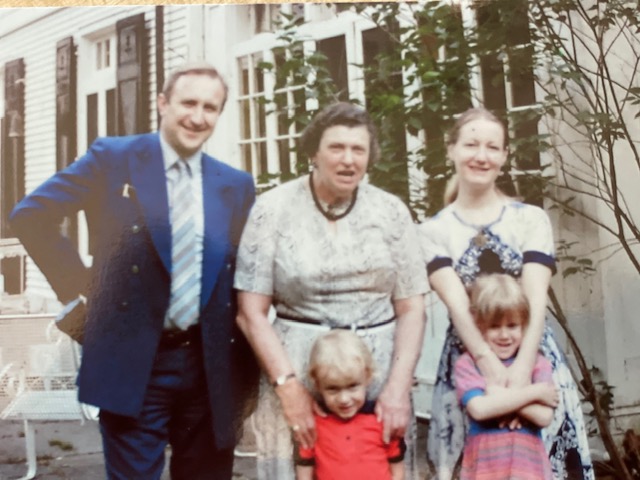
We and the children also spent many happy hours with Elahe Varqa, her husband, Klaus Schmeil, and their two young daughters, both at their home and ours, as well as at various leisure locations. Elahe and Klaus were to become our closest friends in America.
A young French friend, Frank Bokkelandt—a medical student and the great-grandson of the family who had hosted my grandfather during the First World War—came to stay for a fortnight, much of which he spent exploring Manhattan. The highlight of his trip was the tour I gave him of the United Nations which, as he spoke little English, he described as “fantastique”.
We were both fully engaged in the activities of our local Bahá’í community, Greenburgh, hosted Feasts, firesides and fortnightly LSA meetings at our home in Hartsdale, took our children (and often their non-Bahá’í friends) to Sunday children’s classes at the Wilhelm Bahá’í Properties in Teaneck, New Jersey—a site graced by the presence of ‘Abdu’l-Bahá in 1912—and did our best to attend all and any Bahá’í events to which we were invited, including giving talks at the New York Bahá’í Centre and elsewhere.
With two young children attending different pre-schools at different times of day, Margaret met many other mothers and our home quickly became a ‘coffee and chat’ venue for uprooted and often lonely young women, especially from the Far East. Yoko and Noriko from Japan, Meh-Li from China, Min-Ju from Korea and Isabel from Peru were our most frequent visitors and conversations often turned into informal firesides.
On our wedding anniversary during our first year in New York, we celebrated by dining out. On our return, we found the middle-aged babysitter close to tears—not because the children had been difficult but because she had been so moved by their devotion during their bedtime prayers and by what they had told her about the Bahá’í teachings on peace and unity.
Next day, we all rushed off to a Summer School in Poughkeepsie, where I gave a talk on BIC and the United Nations and Margaret gave a light-hearted one on the ups and downs of pioneering in the tropics. The Knight efforts were well received but were inevitably overshadowed by the typically brilliant talk on the Lesser Peace given by Peter Khan.
At the end of June 1981, I was asked to give a talk at a memorial service for the martyrs held at the New York Hilton. This was the first public talk of this nature that I had given and it was a very challenging and moving experience. In October 1981, Margaret and I, with the children, travelled to Toronto and stayed with our close friends Mahnaz and David Vaillancourt, who had married at the Wilmette House of Worship in 1978. During our time in Toronto I gave a UN-day talk to an audience of 250 at the Bahá’í Centre; gave an interview on the situation of the Bahá’ís in Iran to the national radio station CBC; briefed the National Office staff on BIC activities; met with the Canadian Director of UNICEF; and, along with the NSA Secretary, flew to Ottawa for meetings with senior officials in the Ministry of Foreign Affairs and other high-ranking government officials. The final meeting was with the Chancellor of the University of Toronto, George Ignatieff, who had formerly represented Canada at the UN.
Shortly after our return from Canada, we were delighted to re-establish contact with a special friend from our Fiji days, who had tracked us down to BIC and, having lunched with me at the United Nations the previous week, came to spend a day with us at our home.
He was all-India classical dance champion Satya Narayan Charka, a brilliant exponent of the kathak style, whom we had got to know when, along with prominent Indian musicians, he was sent by his government to serve for a time at the Indian Cultural Centre in Suva. Charka later performed to great acclaim in other countries. In later years, he was to be accorded the title of Pandit—meaning a great exponent and teacher of his art—and became Director of the East-West School of Dance in New York State.
Along with Charka—who was rather tired after dancing until almost midnight the previous evening— we entertained Narsi Raniga and his family and a very impressive Jamaican lady, Jackie Wynter, from the UNESCO office in Geneva. Conversation was lively as, after a lunch of fesenjan and vegetarian dishes, we reminisced about Fiji, pored over our Fiji photographs, listened to island music and talked about the Faith.
Our time living in New York was blessed by visits from many relatives and friends. Both our parents came to visit, and both really enjoyed the experience and were deeply impressed by both the United Nations, and the work of the Bahá’í International Community. We took my parents to visit the House of Worship in Chicago, a visit which they cherished, and to Toronto to visit Mahnaz and David. Shortly after Margaret’s parents’ visit, her father became seriously ill and passed away at home. Margaret was able to cross the Atlantic and be with him during his last days.
There is no doubt that the main event of the non-Iran work whilst we served in New York was the official visit to the United Nations of Rúhíyyih Khánum in October 1985, on the occasion of the International Year of Peace. The highlight of the visit was the meeting with the Secretary-General, Perez de Cuellar, to whom Rúhíyyih Khánum presented “The Promise of World Peace” on behalf of the Universal House of Justice. This visit, which lasted several days, is recorded in Bahá’í World. As usual, Margaret’s hand and pen were busy in the background, oiling the wheels and making it all happen smoothly, including press briefings and luncheons with ambassadors. I was privileged to be present at all these events.
1985 also saw our nine-day family pilgrimage to the Bahá’í World Centre, which was the first time that Margaret and the children had visited Haifa.
We served the last year of our BIC service at the office in Geneva. The work and responsibilities were the same as they had been in New York, but the children had an interesting year in schools where the first language was French. They both enjoyed the proximity of the ski slopes, especially Daniel whose class spent every Thursday afternoon skiing.
In 1987, at the close of our period of service at BIC, we were invited to visit the World Centre. We had the bounty of meeting with House of Justice members and visiting the Holy Places in Haifa, Akka and Bahji. A special thrill, and privilege, was the invitation I received to join some of the House members for a game of golf at Caesarea.
Back to England
We very much wanted to return to Fiji, and the House of Justice encouraged us to do this.
I therefore went on a trip to Fiji in early May 1987 to take soundings on the possibility of employment. I had many fruitful discussions with high level contacts during my visit and was optimistic that opportunities would arise in the near future.
I left Fiji for New York, where I was due to attend UN meetings, on 13 May. On my first day in the office, I had a call from the Fiji Mission to the UN telling me that the first military coup had just taken place.
As a result of this momentous event, Fiji was in chaos and we had to abandon any hope of an early return.
We therefore returned to England and settled down in Buckinghamshire, where we have been ever since.
Our first few years back in England were difficult for us both, but thankfully the children settled down very well in Amersham, both attending the local grammar schools. Life in the South Pacific had by now become a distant memory but those wonderful days came back vividly in our memories when we had a visit at our home by around fifty Pacific islanders, who were on their way back home following a visit to the Bahá’í World Centre in Israel, in 1992. The leader of the group was Suhayl Alá’í. During our time in the Pacific, Suhayl had become a brother to me and it was a very special thrill to be able to meet him again after such a long gap. He readily agreed to my suggestion that we should hire a coach to bring the party to our house from their hotel in London. The party included islanders from all over the Pacific who had represented their local Bahá’í communities at the event in Haifa to commemorate the centenary of the passing of Bahá’u’lláh. Many of them were known to us from our time in Fiji and the visit was very emotional. You can imagine the impact the sight of these islanders had on our neighbours as they alighted from the coach in their local costumes.
Sadly, this visit was the last time we saw Suhayl. He passed away in Samoa in 1995. I attended his funeral and saw him laid to rest, alongside Hand of the Cause Dr Ugo Giachery, who had passed away a few years before, in the grounds of the Apia Bahá’í House of Worship. This beautiful setting was a fitting tribute to the role Suhayl played in the relationship with Malietoa Tanumafili II, the first ruling monarch to become a Bahá’í. Suhayl served the Faith in the Pacific for forty years, twenty of them as a member of the Board of Counsellors for Australasia.
A highlight of our life in the late 90s was the visit of Tinai Hancock. On one of her evenings in London she invited us to join her for dinner with her close friend Adi Koila Mara[2], whose husband, Ratu Epeli Nailatikau, was at the time High Commissioner to the United Kingdom. Adi Koila is the daughter of the first Prime Minister of Fiji, Ratu Sir Kamisesi Mara, who served the country with distinction for thirty three years, first as Chief Minister, then Prime Minister, and then President. Ratu Epeli was formerly Commander of the Royal Fiji Military Forces, later High Commissioner to the United Kingdom, and then, from 2009 to 2015, President.
Following our dinner with Adi Koila and Tinai, also attended by Adi Koila’s friend the Princess of Tonga, we were taking Adi Koila and the Princess back to the High Commissioner’s residence in Hampstead when we were stopped by the police. They said they wanted to breathalyse me. However, they did not have the breathalyser kit with them so told me we would have to wait until one arrived. I said “You cannot keep us waiting like this. I have some VIPs in the back of the car, namely the Princess of Tonga and the wife of the High Commissioner of Fiji”. They gave me a very strange look and said “That’s a good story sir”. We had to wait twenty minutes before we were given the all clear to proceed.
On arrival at the official residence, we were joined by Ratu Epeli. This was the first time we had met but we soon struck up a very friendly relationship which resulted in us playing golf together.
Around the millennium, we had a wonderful trip to Portugal between Christmas and New Year with our two mothers. Neither had been to the Algarve before and both had a wonderful time. A particular thrill for them both was a horse drawn carriage ride around Seville, which we visited on a day trip.
Football played an important part in our lives during this period. For many years we would travel to Huddersfield to watch most home games. Apart from enjoying the football in the magnificent new stadium, this enabled us to keep in touch with our roots by meeting relatives and friends from the area. Margaret adopted Huddersfield, my home town, as hers, and was able to emphasise this because of the many occasions she travelled without me when I preferred to play my beloved golf! On these occasions she was often accompanied by our daughter Romilly.
Highlights of our lives in the early twenty first century were the marriage of Romilly, our Ruby (40th) wedding anniversary and the births of our two granddaughters Amber and Olivia. Our Ruby wedding event was spectacular with the programme highlight being singing by Sarah Fox, a distinguished opera singer who has performed with many famous orchestras. On this occasion she was accompanied by the English Chamber Orchestra, who played a number of pieces which were Margaret’s favourites, including Mozart’s Eine Kleine Nachtmusik. On our second date, when I was invited to Margaret’s parents’ home, she played Eine Kleine, which has been our joint favourite ever since. It was played at her funeral and at her memorial service.
Sarah Fox is the daughter of two of our friends from our days at King’s College, who attended our Ruby wedding celebration, together with many of our other friends from King’s.
The children having grown up and left home, we moved from Amersham to Marsh, near Aylesbury. The highlights of our time there were the wonderful parties and Bahá’í events we hosted. Memorable also were the weekend get-togethers with our King’s College “gang” which we hosted for a few years.
Meanwhile our son Daniel was combining work with many successful exploits on the golf course including a few years as captain of the Oxfordshire Golf Club First Team. We were both very proud of him when, in 2010, he won the Club Championship, playing off a handicap of one.
2013 witnessed the passing of Mr Hushmand Fatheazam. The news of this event had a profound impact upon Margaret and me. Mr Fatheazam had been, along with Mr Nakhjavani, the two members of the Universal House of Justice with whom we had worked closely during our work on the defence of the Bahá’ís of Iran at the United Nations. We decided that I would go to the memorial service held at the Continental House of Worship in Frankfurt. There I had the privilege of hearing the eulogy delivered by Mr Nakhjavani, a close friend of Mr Fatheazam. They had served together on the House of Justice since its inception in 1963 until they stepped down in 2003.
Grandchildren
The proximity of our two grandchildren, Amber born in 2006 and Olivia in 2008, brought much joy to our lives. They often stayed overnight and we were able to watch them closely as they went through each stage of their development. We were able to take them on various excursions, one of which resulted in our temporarily losing little Olivia who had wandered off to a different part of Cotswold Wildlife Park! The fright that gave us was reminiscent of the time Margaret lost three-year old Daniel in San Francisco airport.
Fiftieth Wedding Anniversary
In 2015, to celebrate our fiftieth wedding anniversary, we went on a world tour. Margaret was never a good traveller but that did not stop her living in four different countries on three continents so it was not going to stop her doing a nine city, seven country, world trip, in five weeks. As usual with our lives since we met the Alá’í family, they had a huge influence on this trip.
We first visited Vancouver, where we stayed with Shahnaz and her husband, Hossein. Shahnaz and Margaret had a very close relationship. Dinner each evening in Vancouver was shared with Shafigheh Fatheazam, her son Shahab and his family. Imagine our joy on renewing contact with Mrs Fatheazam, whose husband had been our main liaison during our time at BIC dealing with the persecution of the Bahá’ís in Iran.
Next stop was Apia, Samoa, where our itinerary was orchestrated by Mahnaz from England. A significant part of Mahnaz and Shahnaz’s childhood had been spent in Samoa, where their brother Suhayl and his wife Lilian had lived since 1955.
A true Samoan feast was organised for our last evening in Apia, at the home of Pua and Afemata Chang, both of whom have sadly passed away since our visit. Pua, daughter of the first Samoan Bahá’í and a pillar of the community, had been close friends with Mahnaz during their childhood and had maintained contact ever since. As usual, Margaret was one of the first on the dance floor, and there was nothing she liked better than island music.
Samoa had always been a special place for us, given the closeness to Fiji (in a Pacific context) and the fact that frequent visits had included the laying of the foundation stone of the Temple by His Highness Malietoa Tanumafili II and Rúhíyyih Khánum in early February 1979. We have always felt a close affinity with the Temple because, soon after he was asked to design it by the Universal House of Justice, Hossein Amanat had stayed with us in Fiji on a visit to Samoa to present the Temple design to the Malietoa . As already mentioned, Suhayl is laid to rest next to Dr Giachery in the Temple grounds and frequent visits to the Temple and to Suhayl’s resting place were a feature of our stay in Apia.
Next, we arrived in Fiji, where we spent our 50th wedding anniversary. On our anniversary evening we attended the Nineteen Day Feast in Suva, along with about 100 other friends. This was a truly joyous occasion, given that, when we lived in Suva back in the 1970s, we were lucky if there were more than a dozen attending the Feasts.
This was Margaret’s first visit to Fiji since we left in 1979, so emotion overflowed as we met old friends. Melania’s family was high on the list, and visiting her resting place with her family was full of memories.
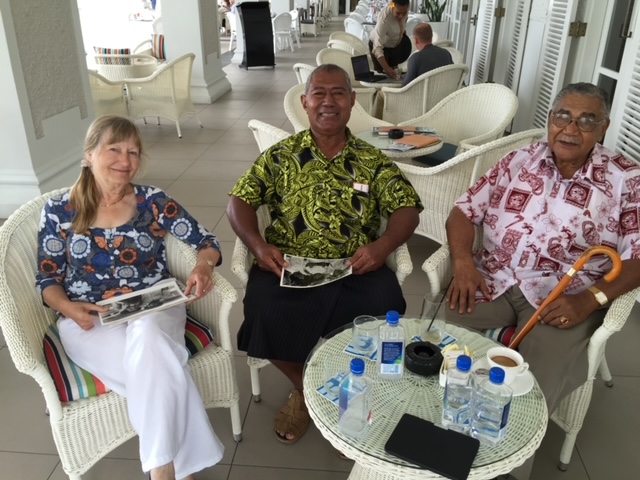
We had the great pleasure of meeting again Timoci Serevi and Jone Salele, both of whom stayed in touch over the years. We also met Timoci’s wife Lavinia. All three have sadly passed away since our visit, Timoci on 11 May 2024.
Another highlight was the time we spent with Fong Ming and his family. Ming had been a prominent businessman in Suva during our time there. Suhayl and I knew him quite well and, when we left to head for New York, we sold the business which I had been running to Fong Ming. The business is now run by his son Dennis and it has become very successful. Fong Ming insisted that we visit his home and family, and also insisted on giving us a car for the duration of our stay.
An invitation to lunch from Adi Koila, whose husband, Ratu Epeli, was then the President, did not unfortunately take place because Margaret was suffering from a virus which kept her in bed for the weekend. This illness also prevented us travelling to Vanua Levu, the other of the two main islands in Fiji, to visit Jone Salele, who, as a young man, had made many visits to our home in Suva.
One of the many moving experiences of our stay in Fiji was the visit to Tinai Hancock’s resting place in Tavakubu, near Lautoka, on the western side of the main island, Viti Levu. Accompanying us on this visit was Jioji Toka, one of my closest friends, who, during our time in Fiji had lived in his family village on the island of Lakeba, 150 miles east of Suva.
Next stop Australia
Our next flight was from Nadi to Brisbane, where we were met by Suhayl’s daughter Sitarih. We spent a whirlwind couple of days with her and her mother Lilian at their home on the Gold Coast. We visited one of Suhayl’s boyhood friends, Ardeshir Forudi, who was close to death in hospital. We had been very close to Ardeshir from 1977 when he had been travel teaching in Fiji. Whenever he was in Suva, he stayed at our house and we often travelled to the villages and other islands with him. Some of the most moving moments of our entire Golden Wedding trip were during the time we spent with Ardeshir, his wife and son, together with Lilian and Sitarih.
We then made the short trip to Sydney. The main purpose of our visit was to see the House of Worship and also spend some time with Naysan Faizi and his wife Zohreh. We had become close to Naysan, son of the Hand of the Cause, and Gloria, who was an Alá’í, in the year or so before we left London for Fiji. He had worked for a graphic arts studio in the same building as our office in New Bond Street.
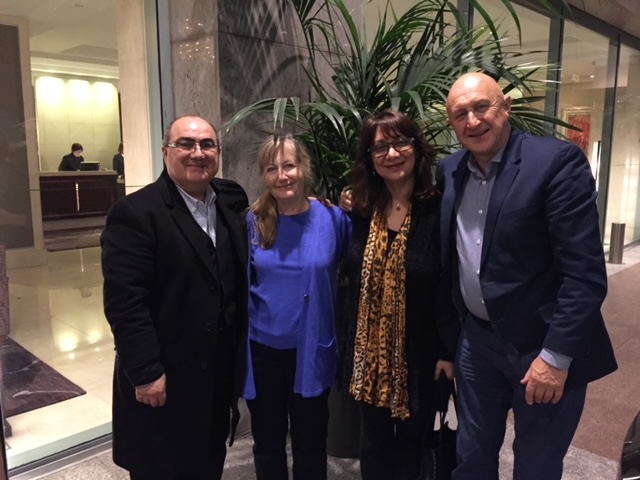
Needless to say, Margaret loved visiting the House of Worship for the first time (I had visited when on business trips to Australia from Fiji) and was overjoyed to spend an evening with Naysan and Zohreh.
Being a music lover, Margaret was also thrilled to go on a tour of the Opera House, where we were lucky to witness a full scale rehearsal in the main auditorium. The only bit of Sydney which we did not enjoy was the seagulls dive bombing our lunch as we sat on the Opera House terrace.
Hong Kong/China
There followed an overnight flight to Hong Kong, where the highlight of our visit was the afternoon we spent with Taraneh, daughter of Shomais and Abbas Afnan. Shomais, an elder sister to Shahnaz and Mahnaz, had met my parents and, after we left England and while we were in Fiji, my mother became close to Shomais and embraced the Faith.
Next was Shanghai. A truly wonderful three days. Shahnaz had insisted that we should go to Shanghai and had suggested to her son, Aref, that we should be invited to stay with him and his wife Helen. If whirlwind had applied to the time with Sitarih in Australia, the time in this lovely city was truly action-packed.
As well as eating in some exceptional restaurants and visiting many interesting parts of the city, we spent much time answering Aref’s questions about our time with his uncle Suhayl during our stay in the Pacific. This was especially poignant because the twentieth anniversary of Suhayl’s passing occurred during our stay.
We spent a memorable evening with some young Chinese friends of Aref and Helen. More of that later.
From Shanghai we flew to Beijing, which we enjoyed very much. A visit to the Great Wall at Mutianyu was followed in the evening by dinner at the home of Sean and Tebby Hinton, along with Masoud (son of Shomais) and Nasrin Afnan.
We enjoyed a very interesting visit to the Forbidden City, and had the dubious pleasure of a visit to Tiananmen Square. My attempt to elicit smiles from the security personnel were eventually successful when a policeman and woman allowed me to capture their smiles on camera. Margaret often expressed concern that my iPhone might be confiscated, with the loss of all the pictures of our trip to date!
New Delhi
This was a fitting final stop on our five week world tour. The main purpose of this stop was to visit the Bahá’í Temple, often known as the Lotus temple, because of its design. Thanks to an introduction from Mahnaz to Mr Shatrughun Jiwnani, who was at the time the Director of Public Relations at the Temple, we were given a special welcome by the friends who were staffing the Information Centre.

We experienced the bounty of attending a service in the Temple, which was truly memorable. We met many interesting people.
Chinese friends
It would not do justice to the last few years of Margaret’s earthly life if I did not mention our Chinese friends.
On the second evening of our stay in Shanghai, Aref and Helen invited some young Chinese from their Ruhi study circle to join us for dinner. It so happened that all six of them were women. What a delightful evening we had, much of which was spent talking about Uncle Suhayl, about whom the guests had already heard a lot from Aref.
As a result of acquaintances made that evening, our lives have been enriched by young Chinese we have met in this country and who are now good friends. Nan Chen (Nancy), one of the six, told us that she was due to start her studies in Germany in 2016 and that she would be in touch with us when she arrived. Nancy came to visit us in July 2016. During her stay, we went to Oxford and she contacted some Chinese students to whom she had been introduced by an academic in the field of international infrastructure. This resulted in a meeting with Sisi Hu and Yin Yang, now good friends, both of whom later completed their PhDs and moved on, Sisi to Harvard for further studies and Yin to London where he was working until he returned to China in August 2023 to take up a new appointment in Guangzhou. His role will involve occasional visits to the UK. We can therefore look forward to seeing him again in the not-too-distant future.
Typical of Margaret that she became involved in a project which Nan, Sisi and Yin launched soon after our first meeting. This was an international infrastructure conference with distinguished speakers. Margaret was asked to edit and produce the report of the meeting, which was in English. She became an integral part of the team and formed close links, friendships and working relationships with the original three plus other young Chinese who were involved.
Recent years
One of the most colourful and memorable events of this time was a Pacific Islands party, where we were honoured to welcome Earl Cameron and his wife Barbara. Earl and his first wife, Audrey, who sadly passed away in 1994, had become friends before and after we became Bahá’ís. They pioneered to the Solomon Islands in the late 1970s. Earl recounted fascinating stories of life in Honiara, whilst Margaret was in her element talking about her beloved Fiji. Mahnaz recounted tales of her early life in Samoa.
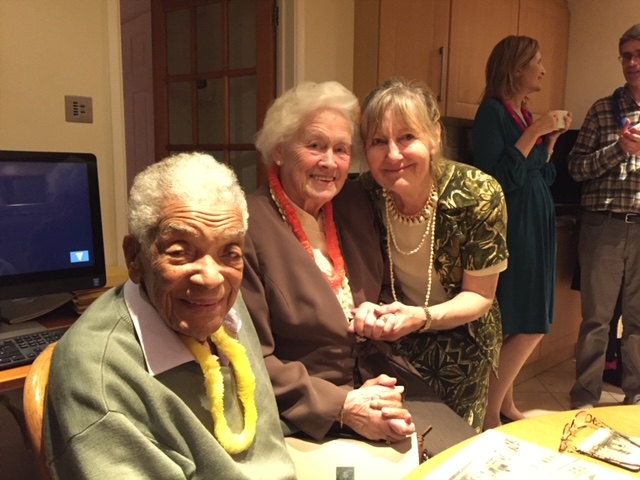
Later, in August 2017, we hosted a 100th birthday party for Earl. Mahnaz, a close friend of the Camerons, co-hosted this event. Margaret’s signature was always firmly imprinted on these events, as she shared her love for humanity with all our guests.
The Bicentenary of the Birth of Bahá’u’lláh in 2017 gave Margaret an opportunity to use her communication and writing skills to produce a nine-panel exhibition which was used at many of the events held to celebrate that historic year.
The year 2017 also included Chinese New Year in Chinatown with our Chinese friends and a wonderful, memorable weekend visiting Mr Nakhjavani and his daughter Bahiyyih at their home near Strasbourg, France. This was one of the highlights of an eventful year which included dinner with our Chinese friends in the pub where the then UK Prime Minister David Cameron had entertained President Xi in 2015, a visit to our home by Mrs Fatheazam, the F A Cup Final at Wembley when Margaret’s beloved Huddersfield Town won promotion to the football Premiership League, and a lovely evening at the Persian conference when Margaret enjoyed the wonderful piano solos by Dorothy Khadem-Missagh and had the opportunity to talk to her afterwards about her music and her career. Margaret in her element!
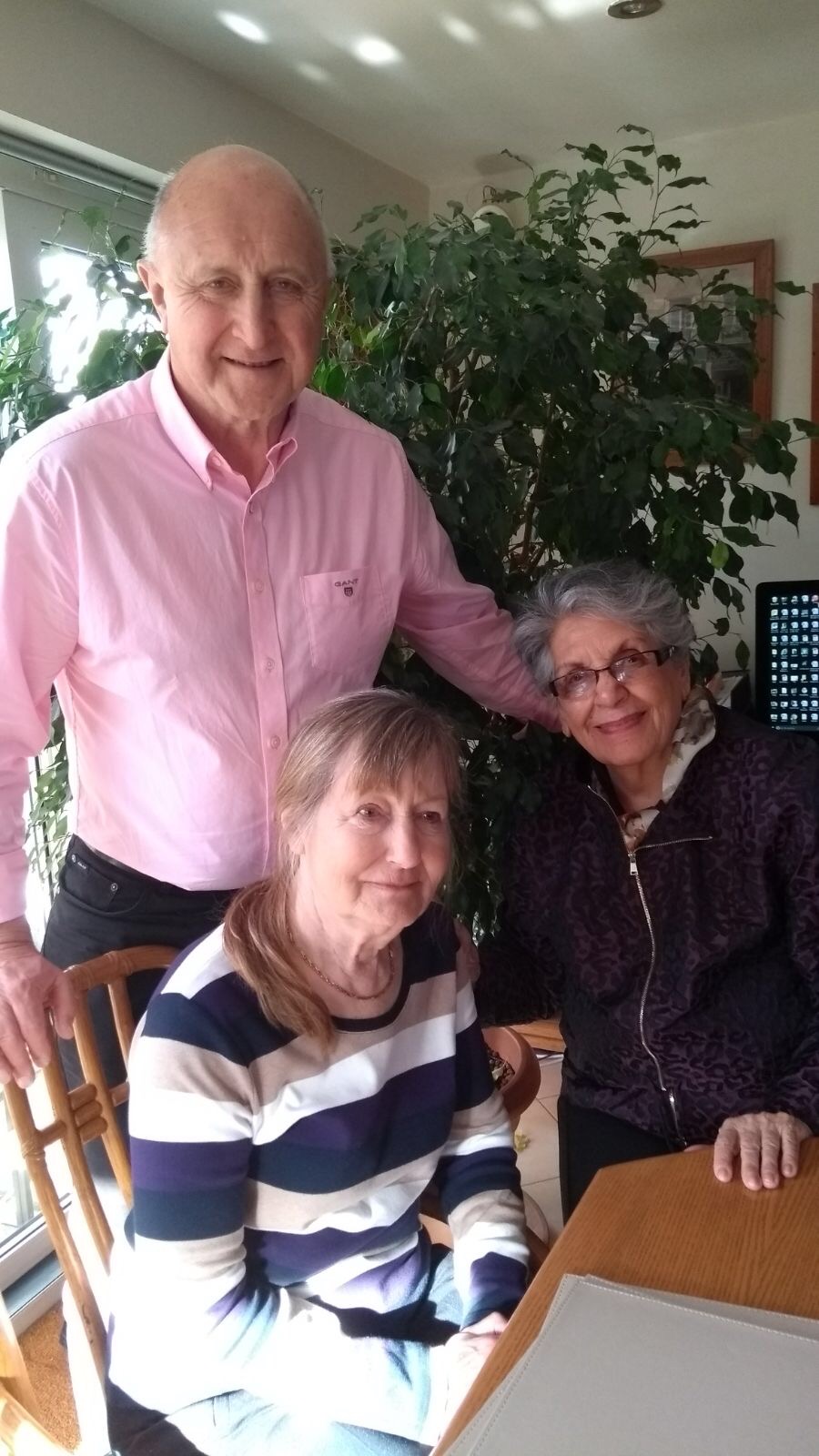
We were once again in Chinatown for the Chinese New Year in early 2018. Other notable events included a visit, with Mahnaz and her husband David, to 17 Royal York Crescent, Bristol, where the custodian, Nahid Donald, gave us an informative tour of the house where ‘Abdu’l-Bahá had visited in 1911 and 1913, and a visit to the Bahá’í World Centre in Israel, accompanied by Shahnaz and Hossein. For Margaret and I this was our first visit to the World Centre in more than thirty years and we were thrilled to visit the new Arc buildings in the company of the architect and enjoy the Terraces in all their glory.
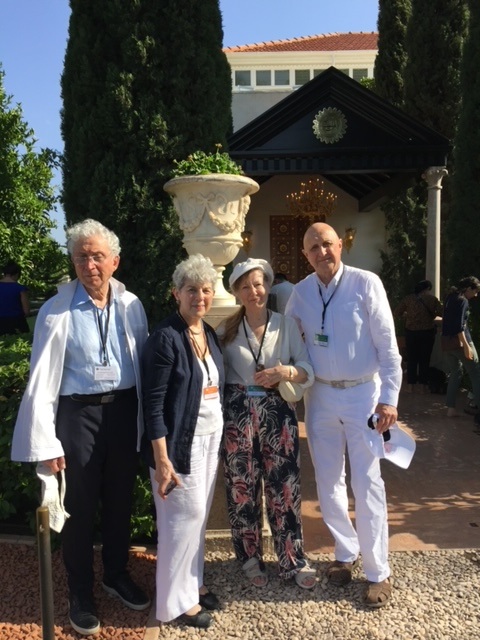
We were included in an invitation to dinner at the home of House of Justice member Stephen Birkland and his wife Nadjla. It was a real privilege to spend an evening with these impressive individuals.
During our time in Haifa, we were honoured to receive an invitation to meet with Universal House of Justice member Mr Shahriar Razavi in his office. He told us that he had spent some time as a young man in the BIC Geneva office just after our term of service there had ended in 1987. Mr Razavi is a member of the policy committee that deals with the BIC UN offices, and he told us that he was looking forward to a visit to the newly refurbished BIC UN New York office which was about to be officially opened later that month. Margaret was able to discuss with Mr Razavi the memoir she was writing of our time at BIC, which included the sensitive issue of the campaign to draw attention to the persecution of the Bahá’ís in Iran. We left Haifa with our batteries recharged.
In July a close French friend of ours – Claude Bokkelandt – passed away at her home just north of Paris. We travelled to the funeral and renewed our friendships and close ties with the younger generations of the family which had looked after my grandfather when he was injured in the trenches during the First World War.
In November we welcomed Nan Chen, visiting from Germany. During her visit we went to the Resting Place of the Guardian with David and paid another visit to Oxford with other Chinese friends, including Yin Yang. An evening at the Hintons with a group of twenty-five Chinese who were touring the world to spread a message of love and unity was unforgettable. As usual, Margaret was in her element sharing views and experiences with the Chinese visitors.
In late December we attended the Persian Conference with Shahnaz and Hossein, where Margaret was again in her element meeting such disinguished personalities as Shapour Rassekh (whom we knew from our BIC days, and now sadly passed away) and Shahin Fatheazam, the brother of Hushmand, as well as old friends.
2019 was an eventful year for both Margaret and myself.
There were a number of joyous events hosted by Shirin and Behnam Tahzib at their new home in Sutton, near Oxford. This culminated in a Summer Camp where Margaret and I celebrated our decision to “home front pioneer” to Haddenham to help with the teaching efforts. We also had the joy of welcoming our two granddaughters who took part in the youth classes.
The months immediately leading up to October were hectic, as we sold our house in one day to the first enquirer, found a new house within a week and instructed solicitors to complete the process. Given that our house in Marsh had been much bigger than our new house, and that there was abundant storage, downsizing proved to be a big challenge, especially for my dear wife, who hated throwing anything away. The painful process resulted in us discovering possessions we had not seen for fifty years! October 15, our move day, soon arrived and the new challenge was unpacking all the boxes.
During our first couple of months we entertained new friends from the locality and this was building up very well until the shock of the pandemic and lockdown began to hit in February 2020. Notwithstanding lockdown, we entertained new neighbours on our patio and began to form new friendships. Following the first lockdown, we spent many evenings on our patio, and then on theirs, with Kuldip and Davinder, our next-door neighbours.
At the end of December 2019, we once again attended the Persian Conference. We had booked to stay for the whole event but unfortunately, Margaret was taken ill and we had to return home. I was able to attend the last day of the conference when a memorial service was held in honour of Mr Nakhjavani.
The memorial service was also attended by Khosrow and Ruth Moqbelpour, old friends from Samoa. A few days later, together with Margaret and David and Mahnaz, we all visited the Guardian’s Resting Place.
Margaret’s last months
Sadly, Margaret’s health started to deteriorate quite rapidly during the year and eventually, in October 2020, she was diagnosed with terminal cancer and given only months to live. She first became aware of this on 6 October, her birthday, when I took her for a consultation with a specialist at Stoke Mandeville Hospital. Following the consultation, she overheard the specialist discussing her case with colleagues. She did not respond to hearing this news and came home with me without saying anything. We all enjoyed her birthday celebrations the following weekend. This included a visit to the Guardian’s Resting Place with Mahnaz, David and their son Saleem.
It was not until after our daughter’s birthday on 15 October that Margaret told me of her terminal diagnosis. She was apologetic, and said how sorry she was that I was going to be left on my own. A few days later, we had official confirmation over the phone by the specialist and a week or so later a meeting at the hospital gave us more detailed information and the prognosis.
I think we both handled the situation very well and impressed the medics with our stoicism, which, we explained, came from our belief in life after death. I found a suitable cemetery, Stratton Memorial Garden, in Princes Risborough. In early December, Margaret and I went to see the plot and said some prayers. Margaret was happy with the beautiful setting of her resting place, under a large sycamore tree and with a backdrop of the Chiltern Hills a few hundred yards away.
That was the last time Margaret went anywhere. Her cancer included a brain tumour which was diminishing her eyesight as well as her ability to walk and to concentrate. She spent more time each day in bed. In late December, she became confined to her bedroom, and soon afterwards, to her bed.
Visits by friends were, because of Covid, restricted, but Romilly and Daniel were frequent visitors and we had much cherished visits from our extended family, represented by David, Mahnaz and Saleem.
It was a blessing that Margaret, in the first two or three weeks of January, was still able to appreciate these visits. She particularly treasured visits from Romilly and Daniel. We often spoke about how lucky we were that they had always lived in close proximity and that they had not done to us what we did to our parents who only had a long-distance relationship with their grandchildren when they lived in distant countries during their childhood.
From early January 2021 until she passed away on 6 February, her condition worsened daily but we were able to keep her at home because of the wonderful care given daily by the Florence Nightingale Hospice Home Team.
The nurses and carers became an integral part of our lives during those few weeks. Some of them would, for example, pick up the prayer book or the Hidden Words and read from them as they sat with Margaret. At a stage when Margaret was not able to say more than a few words at a time, one of the carers opened Margaret’s prayer book at a well-worn page and began reading. To her amazement, Margaret recited the rest of the prayer without pause!
On another day, I came back from my daily walk and went to Margaret’s bedroom to find that the carer was playing a video of the Hidden Words on YouTube. She told me that she loved it and had been inspired to look for it because she had been browsing through the book on Margaret’s bedside table.
Margaret passed away thirty minutes after midnight on Saturday 6 February. I was holding her hand as she took her last breath.
I will always be grateful for the wonderful messages received during this time from the Universal House of Justice and the National Spiritual Assembly.
During the last few years of her life Margaret took great satisfaction from editing UK Bahá’í. I believe that the last edition she was involved with was the one published in August 2020. She worked on this with Rob Weinberg. I will never forget the coincidence of Rob, later in the day she passed away, trying to get in touch with Margaret to ask her to work on the March 2021 edition.
Margaret’s funeral and memorial service
Margaret passed away whilst the Covid restrictions were in place. The children and I decided that we would have a very small family funeral and a memorial service befitting Margaret’s life later in the summer when the Covid restrictions were due to be lifted.
The funeral therefore only included close family, and some very close friends, plus one of our new neighbours.
It proved not possible to hold the memorial service later that year, because of all the Covid uncertainties.
We held a beautiful and truly memorable memorial service and celebration of Margaret’s life on 31 July 2022, which would have been our 57th wedding anniversary. Around 115 of us gathered at Bradmoor Barn in Haddenham for readings from the Bahá’í Writings, as well as from the Hindu and Sikh Scriptures (which were read by some near neighbours). Some of the Bahá’í readings were delivered in Fijian by Joe Mar, a Fijian who now lives in England with his wife Sarah.
This was followed by stories of Margaret’s childhood by her brother Paul, and memories by Daniel (on behalf of his sister and himself), by Shahnaz and Mahnaz, and by myself.
Also present from Fiji was Meli Bosetikina, now a corporal in the British Army. Meli is the great grandson of our dear Melania, who was a second mother to our two children during their early childhood in Fiji. The French family from the first world war was represented by the great grandson – Frank Bokkelandt – who had visited us many times, both in UK and New York.
Excerpts from words spoken by Mahnaz Ala’i-Vaillancourt at Margaret’s memorial, July 31, 2022
A few years ago in Brixton Village, near where we live in London, I saw a banner with the word “saudade” – a Portugese word which means a profound longing for something that is gone or lost. (No exact equivalent in English!). However, it also portrays a strong feeling of presence – but the presence of absence.
Around the same time, at the Serpentine Gallery in Hyde Park I saw a poster saying “Her absence filled the world”.
Both these had an impact on me, and came to my mind quite strongly as I was thinking of what to say at dear Margaret’s memorial. That day, I am sure those who knew Margaret well, and who loved Margaret, could feel her absence filled the room, and our lives.
Margaret was much more than what met the eye, certainly at first. She appeared as a fairly conservative lady, even quiet, living a fairly traditional life – until you got to know her a bit better…
In fact, while Margaret did like tradition, classical music (as well as Queen!), classical literature – actually she also loved adventure, loved new experiences, and was game for anything. The way she not only adapted to Fiji, but adopted it, became part of it, is testimony to that!
She had a wicked, and a very dry, sense of humour. So dry it was arid. She could have been the poster child for world famous British sarcasm (not always understood by everyone).
Some of my most cherished memories with Margaret are late nights at their home in Marsh, after the gentlemen had gone to sleep. We would talk endlessly, and laugh even more. Sometimes Margaret would literally be so doubled up with laughter, to the point of tears, that it was difficult to stop!
Margaret was intelligent, erudite, laser-quick & bright, and accomplished much in her life of service to humanity. In her personal life, she had many wonderful qualities – but one which stood out was the profound and unshakeable love for her husband Gerald (despite any shortcomings! – just using some of her British humour!)
Of course Gerald not only loved, but truly respected & appreciated Margaret and took very good care of her, right to the end. They cherished, and sometimes challenged, each other – in equal measure. Together they raised two wonderful children – “having them is the best thing I ever did”, she told me on one of our visits in the last few weeks of her life.
Margaret loved music of all kinds, a passion she and I shared. But of course she was much more knowledgeable… wonderful to hear some of her best-loved pieces at her memorial.
One of her favourite classical composers was Gustav Mahler, and one of her favourite pieces from Mahler was his Fourth Symphony. This incorporates a song called “The Heavenly Life”, which represents a child’s vision of heaven.
“We enjoy heavenly pleasures
and therefore avoid the earthly stuff.
No worldly tumult is to be heard in heaven
All live in greatest peace.
There is just no music on earth than can compare to ours…
The angelic voices gladden our senses so that all awaken for joy!”
I am sure dear Margaret passed away with both peace & joy!
Epilogue
I sign off on this story of our lives together, over three years since Margaret passed away. She told me she knew I would miss her, which is very much the case, but she also said that she was worried I would not be able to cope without her. I am trying, and I think succeeding, to prove her wrong on the latter point. I continue to work, which keeps me occupied and stimulated for a good part of the working week, and my family, close friends (including extended family) and Bahá’í activities mean that I enjoy life to the full. Memories of our long life together are however very much a feature of every day.
____________________________
Gerald Knight
Buckinghamshire
June 2024
[1] The wonderful experiences we had in the Sigatoka area illustrate the importance of the Institute teaching process introduced by the Universal House of Justice in 1996. If those materials had been available in the late 1970s, the teaching work led by Ardeshir Forudi would no doubt have produced more lasting results.
[2] Tinai’s close friendship with Adi Koila can perhaps be explained because Tinai was herself from a high ranking Fijian family. Her full name was Miriama Tinaitabuavou Vutikululu Hancock.
Appendix 1 From Bond Street to Fiji by Mahnaz Alá’í-Vaillancourt May 2024
I first met Gerald Knight in early 1972, when I applied for a job with him. I met his wife Margaret shortly afterward.
My father had passed away about three years previously and I had gone to live in the
United States. But for reasons beyond my control, I came back to England sooner than planned, and I needed a job. In retrospect I understand that – as usual – there was a greater plan at work.
I started to look for a position in the field I wanted to work in, public relations, even though the little experience I then had was already a few years in the past. I kept applying to various places – without success. (In those days, you had to search for jobs in The Times classified section.) One weekend, while out of London, I had bought The Times but had not had a chance to look at it.
On my return, on Sunday evening, I started checking the jobs section, and the role which caught my interest had a deadline of the next day! I did not have a typewriter, and there were no computers in those days, so my applications were always handwritten and sent by post. And regardless: any application would not arrive on time! On closer inspection, we realised that the address of this office was close to where we were living at the time, so I could take my application and deliver it by hand.
But there was another problem: I had no paper. We searched high and low, and the only piece of paper I found was a writing pad, for letters, which I had been given as a Christmas present. The paper was in pink gingham with an outline of a rose in the corner; so inappropriate, so unprofessional.
What did I have to lose? If I did not apply, I would have no chance at all. And even though with this paper I probably stood little chance, either, still it was better than nothing. I wrote my application letter and delivered it that evening. I honestly did not expect any response – I cannot remember if I even apologised for the type of paper I had been forced to use.
I did follow up by telephone after the initial acknowledgement of my application. And so I learnt that persistence does pay because I was very surprised when I was asked to attend an interview!
Gerald Knight interviewed me twice before offering me the job – a job which I should not have been offered in a rational world. One of the first things Gerald asked me to do was to write to all the applicants who had not been successful. While doing this, I realised that most of them were much better qualified than me; and yet, there I was.
Now here is what Gerald and Margaret told me had happened when they received my letter on the pink gingham paper…
Gerald had taken all the applicants’ letters home to go over them with Margaret (she did not work in his office, but he wanted her opinion – and she was also the one taking the calls).
Gerald’s immediate reaction was to throw it into the “reject” pile. Not only because of the silly paper but also because my name was so “foreign”.
But Margaret was not particularly impressed by any of the other applicants. She apparently picked up my letter again and said to Gerald that perhaps he should take another look. And she was the one who had spoken to me on the ‘phone, when I first followed up, and knew that at least I did not “sound” so foreign!
And so that was how I came to work with Gerald Knight! Almost from the very start he knew I was a Bahá’í, although I cannot remember the circumstances of telling him this. Both Gerald and Margaret were friendly from the beginning, inviting me to their housewarming party not long after we had met, and to subsequent evenings at their home. Margaret worked in the City but would often come to our office to drive home with Gerald, and so I came to know her at the same time. They had no interest in religion so there was never a conversation or any questions about the Faith.
Within a few months, Gerald left the company to start his own public relations consultancy, which he asked me to join. A new chapter in our working life began: this time on prestigious Bond Street in London. Here our client list grew and we were very busy – we had quite a lot of working lunches. Over these, discussions would sometimes turn to social issues, such as men and women, race, inequity, justice, and so on.
I should say at this point a little about Gerald and Margaret’s personalities. Gerald was always warm, generous and outgoing, but it quickly became apparent that he was also quite racist, sexist, and any other “ist” that you can think of! Margaret had a wonderful sense of humour, she was quieter and more gentle, and did not appear to have these prejudices, but there seemed to be something missing…
My lunchtime discussions with Gerald would at times get very animated. And although the Faith was not mentioned, he must have known my viewpoint was that of a Bahá’í .
Gerald and Margaret would often drive me home, as it was on their way to
Beaconsfield, Buckinghamshire, where they lived. If my mother was in London, she would occasionally invite them in for a bite, and over time they also became close.
I found out later that when I would be away and my mother was on her own, they would sometimes stop by to see her. During these visits, I found out, she would show them old family photographs and tell them our family history, especially that of my paternal grandfather; a drama all its own!
We all became closer friends as time went by. Gerald and Margaret met some more of my family. Gerald briefly met my brother Suhayl, who lived in Samoa, when he stopped by our office on a visit to London. (Later they became very close, during the Knights’ time in the Pacific, working together professionally, and of course in serving the Faith.) My sister Shahnaz was hired by Gerald’s company for a specific project. And she and I would invite Gerald and Margaret to our parties, which were typical loud London parties of the time, except without alcohol! Our friends were a mix of people. But the Bahá’ís had wisdom. Gerald and Margaret had no interest in religion, as I mentioned, so there were no unsolicited conversations about the Faith.
The other thing about Gerald at the time was that he enjoyed his drink! There was never a meal without alcohol before, during and after! (And by the way, he also smoked up to 60 untipped cigarettes a day!)
At one memorable party (which we had somewhere else) someone had spiked one of the bowls of punch. Gerald and Margaret arrived fairly early and by mid-evening Gerald was already a bit tipsy. A good friend of mine, David Vaillancourt, who Gerald had already met, and who had often joined us on previous social occasions, was also at the party with one of his flatmates.
Gerald came to find me, and asked “Why didn’t you tell me David was a Bahá’í?!”
I simply said: “You never asked me!”
Unknown to me at the time, Gerald had been quizzing David on the Faith for about 45 minutes! I don’t believe there was any further conversation about the Faith that night, but Gerald continued to drink! Towards early morning, I left to drive David home (his flatmate was long gone), but we stopped to go for a walk through Hyde Park. When I returned a couple of hours later, Gerald and Margaret were still there, with my sister serving black coffee so that they could drive home.
The following week, Gerald invited David and I, and my sister Shahnaz, to a goodbye lunch for her. The project she was working on had finished and she was going to Samoa a few days later to help my brother Suhayl for a while. Gerald had his customary gin and tonic before lunch, looked at the wine list, then closed it and ordered water. The three of us hastened to remind him that we had no objection to him drinking. We encouraged him to feel free to have wine, but he almost became impatient with us, insisting that he did not want any.
Little did we all know that this was to be the last drink Gerald would have before he and Margaret became Bahá’ís – which was some weeks later! And that day marked the beginning of a relatively short period of intensive direct investigation of the Faith by Gerald and Margaret.
Most of this consisted of both of them asking many questions, usually in my office after work. I would often not get home till around 9pm to be greeted by my mother saying “Have you been working until now?!” No…
There may have been some conversations with David too, and during this time they met Earl Cameron, so Gerald would have also spoken with him.
Through my friendship with Earl and Audrey Cameron (I had served on my first Local Assembly with them, when I was 21) our company was hired by the UK Committee for the International Black Arts Festival, of which Earl was chairman. To promote this Festival, a Nigerian troupe of dancers and musicians were visiting the UK, and we assisted in organising their tour and publicising their events.
Gerald and Margaret’s investigation continued and then came a request for books. I must admit I was a bit slow getting some appropriate books for them – so the request almost turned into a demand before they went on holiday for a week when they would have time to read.
On return from their break, and after reading those books, the “evenings” in my office intensified! And then one evening Margaret asked: “Do you think it would be presumptuous of us to want to become Bahá’ís?” What a declaration!
You can imagine the delight and jubilation in my heart. But I tried to keep a cool British exterior and simply said:“ Not at all!”
Soon after, I had to go on a trip overseas, and my mother was assigned the task of taking the Knights to their first Nineteen Day Feast. Oh, where to take them? That is another story – except to say that Gerald had just given up his heavy smoking because he knew my mother hated smoking. He said he had given up drinking for Bahá’u’lláh and smoking for my mother!
At the Feast, Margaret was asked to read the first prayer. She related to me later that she was so anxious, not having a clue how to do this (standing, sitting, kneeling?), as she and Gerald had never been to a Bahá’í meeting.
A reminder: apart from a few people in my family, plus David, Earl Cameron (for a shorter time), and friends at our parties (even though they did not know at the time which ones were Bahá’ís), Gerald and Margaret had not met any other Bahá’ís. Nor had they been to any firesides or other Bahá’í gatherings.
Both Gerald and Margaret had been transformed – in different ways. Gerald had let go of his prejudices as he wholeheartedly accepted the oneness of humanity. And Margaret was now a “happy and joyful being” – a phrase from what was to become one of her favourite readings.
They investigated the Bahá’í Faith together, joined the world-wide Bahá’í community together at the very same time, and always served the Cause together.
Things didn’t stop there!
In 1975, Gerald and Margaret took to heart a letter from the Universal House of Justice, in which it once again urged Bahá’ís to arise as pioneers.
Not only had Gerald and Margaret accepted the oneness of humanity, which transformed their worldview, but now they turned their material lives upside down to help make that truth a reality. Gerald closed a thriving business (and I lost a job!), they sold their beautiful home to finance their journey, and with a young child, they left England for Fiji.
Even though they were now on the other side of the world, their years in Fiji brought us even closer together, as part of my childhood was spent in the South Pacific, on the island of Samoa, where my brother lived until the end of his life.
Gerald and Margaret became part of our family and a true brother and sister to me.
A few years later, at the request of the Universal House of Justice, Gerald and Margaret went to serve at the Bahá’í International Community UN office in New York. They were instrumental, both at the United Nations and around the world, in the work the BIC undertook to defend the Bahá’ís in Iran immediately after the 1979 Islamic Revolution.
Great strides were achieved at this pivotal moment in recent Bahá’í history – for the protection of the Bahá’ís in Iran, and raising the Faith to a higher level of recognition around the world.
These are just the facts. Gerald will have to tell you about their spiritual journey which led them to declaring their faith, which propelled them to pioneer to the other side of the world, which in turn led to all these adventures opening new horizons in their lives, with amazing opportunities for service, all of which they rendered with great dedication and devotion.
I feel immense gratitude to have Gerald and Margaret Knight in my life.
Appendix 2 Impressions from Sigatoka by Margaret Knight 14th February 1978
The waters of the Sigatoka River toss back the sunlight in dazzling splinters. The sky is a cloudless blue. A light morning breeze clatters the palm fronds and sends little scurries of dust chasing along the footpath. We quicken our steps as we turn the corner – left at the bridge, down the riverbank road, past a handful of small, sun-bleached shops, verandahs crowded with laughing, lolly-sucking children. And suddenly, there it is – our pride, our joy, our miracle! Banners flutter overhead, blue on white. “The Bahá’í Faith”. “Ye are the fruits of one tree…”. We pause to admire the new signboard above the door: “Bahá’í Teaching Institute”. Exactly three weeks old, and established to serve the hundreds of new believers and the still-searching souls in the mass teaching areas of Nadroga and Ba. The first regional teaching centre in Fiji – but not, we whisper excitedly, the last.
The first session of the Weekend Deepening Institute is already under way, pioneers from Suva presiding. With the help of a felt-board they are explaining the inter-relationship of the institutions of the Faith. Clarence Raj and Jone Salele translate into Hindi and Fijian. Smiling faces turn our way. A huge wave of love rushes out to meet us. We take off our shoes and enter. A little bit of shuffling and a space is created for us near the door. We smile and sit. All eyes swivel back to the felt-board and the session continues. Questions are asked – good questions. One of us is invited to explain the nature and form of Bahá’í elections. This is translated, sentence by sentence. More questions.
A break now, and a sudden rising and swirling – a flowerbed come to life. With arms outstretched our radiant new brothers and sisters rush to embrace us – Bahá’ís for a short time, but so deep in love with Bahá’u’lláh. A tangle of arms, hairs, sulus, sarees. A babble of voices. “Alláh’u’Abhá!” … How good to see you! … Namaste! … Ni sa bula! … So glad, so happy! … Alláh’u’Abhá!” Many new faces since last time: new Bahá’ís, new friends to know and love.
The class continues. The friends discuss elections and raise the question of LSA boundaries in the Sigatoka Valley, an area of small, scattered communities with no formal boundaries. After consultation, it is agreed that the matter should be referred to the National Spiritual Assembly. Everyone is delighted. Bahá’í administration in action! New concepts, new horizons – new understanding.
Travelling teacher Padma Wong – tiny, vital, brilliant as a butterfly – darts out of the kitchen and calls us to lunch. We sit on the floor and enjoy our mutton curry and Fijian vegetables. Almost all the food we are eating was donated by the friends. Young boys bring us dishes of water; the cooks appear with second helpings. Someone has already started on the washing up. Everyone is eager to serve. Little children come and go, are petted, kissed, gathered up into the nearest pair of arms.
We take stock of our surroundings. The inside of the Institute has been newly painted a soft, fresh green. Colourful teaching charts and posters decorate the walls. At the far end, illuminated prayers and photographs of Bahá’í Holy Places encircle a portrait of ‘Abdu’l-Bahá Eye-catching mobiles twirl slowly in the lazy noonday breeze. In the kitchen, nailed to the wall, is a smart new collecting box: “Bahá’ís only please”. The new believers have insisted on setting up a local fund to help with the cost of running the Institute and continuing the teaching work in their area. In one corner lies a pile of freshly trimmed wood – the makings of a bookcase for the Institute’s Bahá’í library. Another project inspired, financed and carried out by new believers. The meeting room is not very big, not very small. Just now, it seems exactly right. The Institute used to be a shop: one in a row of small wooden shops. Hard to imagine now.
Feet pound on the verandah and Kanda Swamy Achari comes rushing in, beard aquiver, to tell us of his latest teaching successes. It takes a while to calm him down and start the afternoon session. We’re talking about Baha’u’llah’s teachings on women, and the role they play in Bahá’í community life. The many women present listen intently as the translators speak. They smile with pleasure, or nod gravely in agreement. Someone suggests a regional Women’s Conference and everyone agrees. Kanda Swamy declares that he’ll tell his wife she’s got to attend, and is shouted down amid laughter.
A great cry of welcome greets the members of the National Assembly, who arrive en masse from their meeting down the road. Last night, the Assembly and Auxiliary Board Members met with the National Teaching Committee in the upstairs room here at the Institute, to share in the wonderful spirit of Sigatoka and to talk of future plans.
Sweet black tea is served and everyone socialises. The red Land Rover – a familiar sight on the Nadroga roads – drives off in a cloud of dust, hospital bound, to seek attention for a believer with a septic foot. Some of the friends adjourn to the store next door to enjoy its speciality milk-and-sugar ice lollies. This shop never seems to close. The storekeeper and his family are all new Bahá’ís.
More and more people are coming into the Institute now, among them some who are not yet Bahá’ís but who come regularly, attracted by the love and unity of the friends and the beauty of the Bahá’í teachings. They are warmly welcomed and drawn into the gatherings. Later in the evening, two of them declare.
The red truck appears, unloads a neatly bandaged and smiling Bahá’í, picks up a fresh driver and takes off again, crammed with passengers, to visit one of the friends who is sick.
Night falls like a velvet curtain and the lights go on in the Institute. There’s a whisper, an expectant murmur, and everyone sits down. Padma and Wing are going to sing for us. The first chord brings a dozen Fijian children tumbling into the room. The song rises up, clear, joyful, full of love. “Welcome, brothers, welcome – Welcome, sisters, welcome – Welcome to the home of Bahá – Welcome, welcome, Alláh’u’Abhá …”. We look around the room at the smiling, upturned faces. “Welcome, brothers…and welcome, sisters”. Tears are very close.
Our eyes travel slowly and lovingly from face to face, storing up memories against the time when we shall have to leave this enchanted spot. A little Indian girl with dancing eyes nestles against us and sings like a nightingale. Over there, Ram Krishna, whose dazzling spirit leaps from his eyes. He rises before dawn so that he can work for eight hours on his cane farm and devote the rest of his day to teaching the Cause. Closer, three shy Fijian girlswith matchless smiles edge forward on their knees, drawn by the music. Ram Subhag Singh beams at us paternally. He it was who was blessed with a dream of a Holy Man, who accepted the Faith as the fulfilment of his dream, and who wept bitterly when he was given a picture of ‘Abdu’l-Bahá, crying “This is the Holy Man I saw in my dream!” There, Jone Salele from Lakeba Island, steady as a rock, smiling as usual, who has pledged himself to stay in Sigatoka for three more months. In one corner, two young Indian mothers with cameo faces sway gently in time to the music, lulling their exquisite babes to sleep. Harnam Singh, tossing back his long hair, devours the scene with his eyes. He enrolled yesterday and is on fire with the Faith. And so many many others…
One face we can’t forget. In our hearts she’s “the Mother”. An elderly lady in the white saree of a widow, grey haired, parchment skinned, deep eyed. She comes to the Institute every day and sits for hours, quiet, self-contained, immensely dignified. She’s smiling a little now, soaking up the warmth of the love of the friends, the hardships and sorrows of her life almost forgotten – but not quite. Opposite sits her daughter, victim of a barbarous attack by a drink-crazed husband. Her one remaining arm lies useless in her lap. Her little daughter claps and sings, too small to comprehend the tragedy. Her young son, Najendra – grave, enquiring, utterly devoted to the Faith – sits, as always, close to Wing. His self-appointed task is to teach his mother and grandmother a prayer, because neither can read. This little family has found strength and comfort in the Cause. Pray God that He will help us to help them.
Too soon, the evening is over. It takes us an hour to say goodbye. Padma and Wing are limp with exhaustion after their weeks of devoted service at the Institute, but they wouldn’t dream of hurrying us. We drift out into the road, hands clasped, entwined. How hard it is to part!
Just a few of us left now, standing on the riverbank, gazing down into the water. For about the hundredth time today, someone says: “If only Mr. Forudi was here…”. Yes, if only he was here. Because the Institute is Mr. Forudi. It represents the efforts, the dedication, the self-sacrifice of his weeks in Sigatoka. But most of all, the Institute stands witness to his overwhelming love for the Cause and for his fellow man – a love which has now been translated into tangible form. We hope and pray that Mr. Forudi will come back to Fiji. But if that is not to be, then this Institute, this home of love, will stand as his memorial. Praise be to God. Thanks be to God.
 UK Baha'i Histories
What an amazing story. We met Gerald when he visited the New Hebrides (now Vanuatu) in 1975, and then interacted with them both when they managed the Baha’i Publishing Trust in Fiji. But we did not know about their invaluable work for the Baha’i International Community in New York, particularly in their defence of the persecuted Baha’i community in Iran. Margaret and Gerald – we salute your for your valiant efforts to support the dear friends in Iran and your ability to write and speak about the persecutions in international fora.
I could not stop reading this most inspiring account until I had reached the very last words. My deepfelt thank you for bringing Fiji alive for me again. I met some of the friends mentioned throughout this wonderful account of pioniering to Fiji, including the precious Mr. Forudi. I spent three month in Fiji in 1983 at the Lautoka side. While studying in Hawaii, the Counsellors offered me the opportunity to serve in the rural area of Lautoka, assisting the Fijian and Indian friends in the procss to complete the construction of a rural Baha’i Center. I stayed in the bure of an indian Baha’i family. I also spent a short time in Lomaivuna on the Suva side. How much I wish I had met the Knight family in Fiji, they were already gone when I arrived. Such blessings they were given in the service of our precious Faith. Paula van den Boogaart, now residing in my native Germany.
What a beautifully written life story. It kept me reading until the end without stopping. Grateful thanks. Marina
A magnificent Baha’i history. So much detail and activity recorded over a period of a few decades. Brilliant!
Que de souvenirs émouvants…
Et que de réponses aux questions que je me suis si souvent posées !
Longue vie à toi, Gérald, mon ami.