

Forty Years of Faith
Early Life
In the 1950s, both my mother and my father had left Ireland to live and work in Chicago – my mother worked as a nurse and my father as a carpenter. As is probably a common story for many Irish in the US at the time, my parents met at an Irish dance. After my sisters were born in the US, they returned to Ireland in the early 1960s, where I was born in Limerick, followed by my younger brother. When I was 5, a car accident left my father with a broken neck, keeping him in a wheelchair for the rest of his life. I vividly remember visiting him in the hospital during his long recovery.
While my mother was a traditional Irish Catholic, my father had become suspicious of religion and leaned towards socialism. Growing up in our liberal household was rare in the conservative landscape of 1970s Ireland. Education was highly valued, and my dad, in particular, encouraged independent thinking and the importance of investigating truth. His conviction to stand by his beliefs, even if they went against the norm, influenced our upbringing significantly.
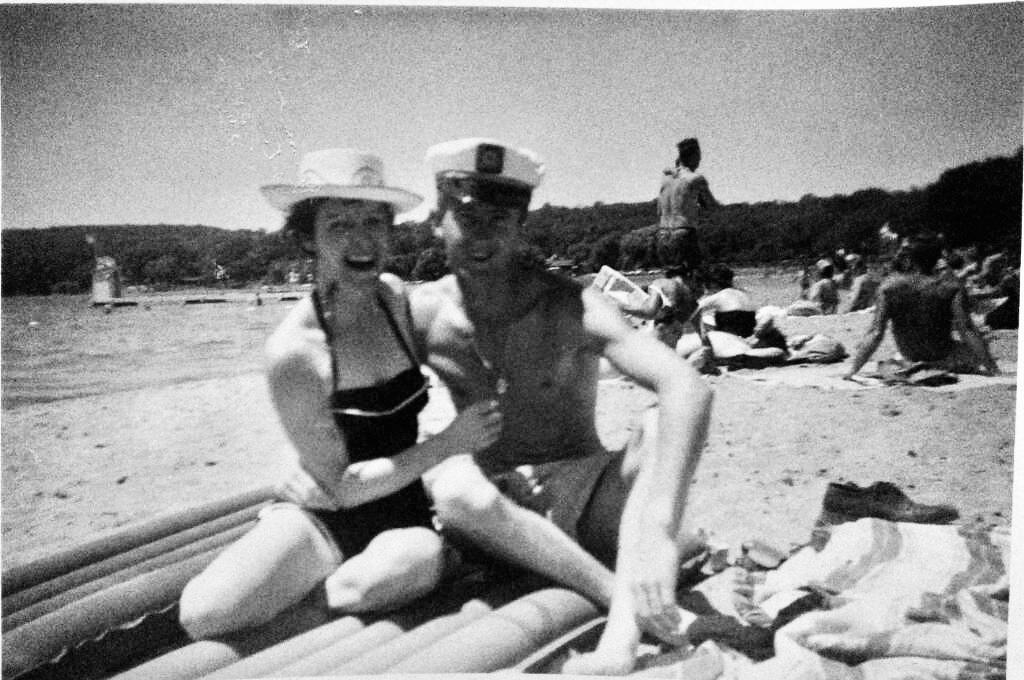
Entry by Troops in Ireland
Our family’s journey into the Bahá’í Faith started with my elder sister’s curious attendance at a gathering in the 1970s. Initially sceptical, she found herself drawn to the discussions and later had a profound dream about Baha’u’llah. With both my sisters and more friends in Limerick embracing the Faith, I grew up immersed in its teachings and community.
In my early teens, while I actively joined youth events, I didn’t necessarily find myself deeply attracted to the teachings. What attracted me and kept me coming back were the gatherings with great music and cool older people.
At 14, my sister invited me to a talk by Adib Taherzadeh, and I was captivated. He was an exceptional storyteller, and his charisma was amplified by the novelty of encountering a Persian.
It wasn’t until I was about 16 that I went to my first summer school in Dublin. I found it enjoyable, but I wasn’t deeply engaged in the spiritual side of things—as usual, I was more focused on the music and the socialising.
I remember hearing about concepts like progressive revelation and the equality of men and women, and they resonated with me on a logical level. Catholicism, on the other hand, felt ritualistic and disconnected from my experiences. So, around the age of 16, I made the decision to stop attending mass.
I only found out much later in life that my mum, concerned, asked my sisters to guide me spiritually. She worried that without the structure of the Catholic Church, I might become lost to the world.
Looking back now, I find it fascinating how my mother embraced the idea of her children exploring different beliefs, even though it must have been challenging for her given her own upbringing and the social landscape of Ireland at the time.
At one point, we had a visit from the local priest, who was clearly concerned about losing parishioners. My dad, who had little respect for the church, promptly showed him the door, defending our right to choose our own path.
So, while my sisters were actively practising the Faith, I was more like a casual observer, just taking it all in.
Embracing the Faith
But, I did start reading. Bahá’u’lláh and the New Era helped things make sense to me.
It was a week after my 18th birthday in January 1984, that I felt it—the undeniable urge to declare my belief in this faith. It just…made sense to me.
I remember it; as I ascended the stairs I told my sister I was a Bahá’í.
There was no grand epiphany, no dramatic moment of revelation. Just a clear and quiet understanding that this was what I believed.
The Limerick Spiritual Assembly gifted me a prayer book, which, unknown to me at the time, held a serendipitous connection. It was printed by the Broadwater Press, a printing company based in Welwyn Garden City—my future hometown. And not just that, it was printed by my future next-door neighbour.
I was still attending school, a place run by priests. My goal was simple: get through my final exams without attracting too much attention to the fact that I was a Bahá’í. I very much wanted to avoid being summoned to the headmaster’s office and subjected to scrutiny for my decision.
But of course, it was obvious to my friends. While they started drinking, I abstained. I found solace in the growing network of Bahá’ís. Many of my sister’s friends and their siblings had also embraced the Faith, forming a supportive community that felt like an extension of our family. Through them, I found encouragement and strength to navigate the complexities of being a young Bahá’í in a world where our beliefs weren’t always understood.
I became more involved in activities, serving on the National Youth Committee when I was 19 and attending events like the National Convention.
Whilst a student I worked in a petrol station. Between filling up tanks and attending to customers, I deepened myself by reading. It was the figure of the Báb that truly captivated me. I remember I had a green book of His Writings that I’d sneakily read during my shift.
The Irish Bahá’ís loved the stories from Nabil’s Narrative. Many of them became very knowledgeable about the early history of the Faith. The very small Persian Bahá’í community in Ireland was inspirational. I was awed at how these people were descended from the early martyrs and how they’d sacrificed so much for the Faith — many were in Ireland as pioneers. This was all against the backdrop at the time of martyrs and persecutions in Iran so it was especially touching.
Moving to London
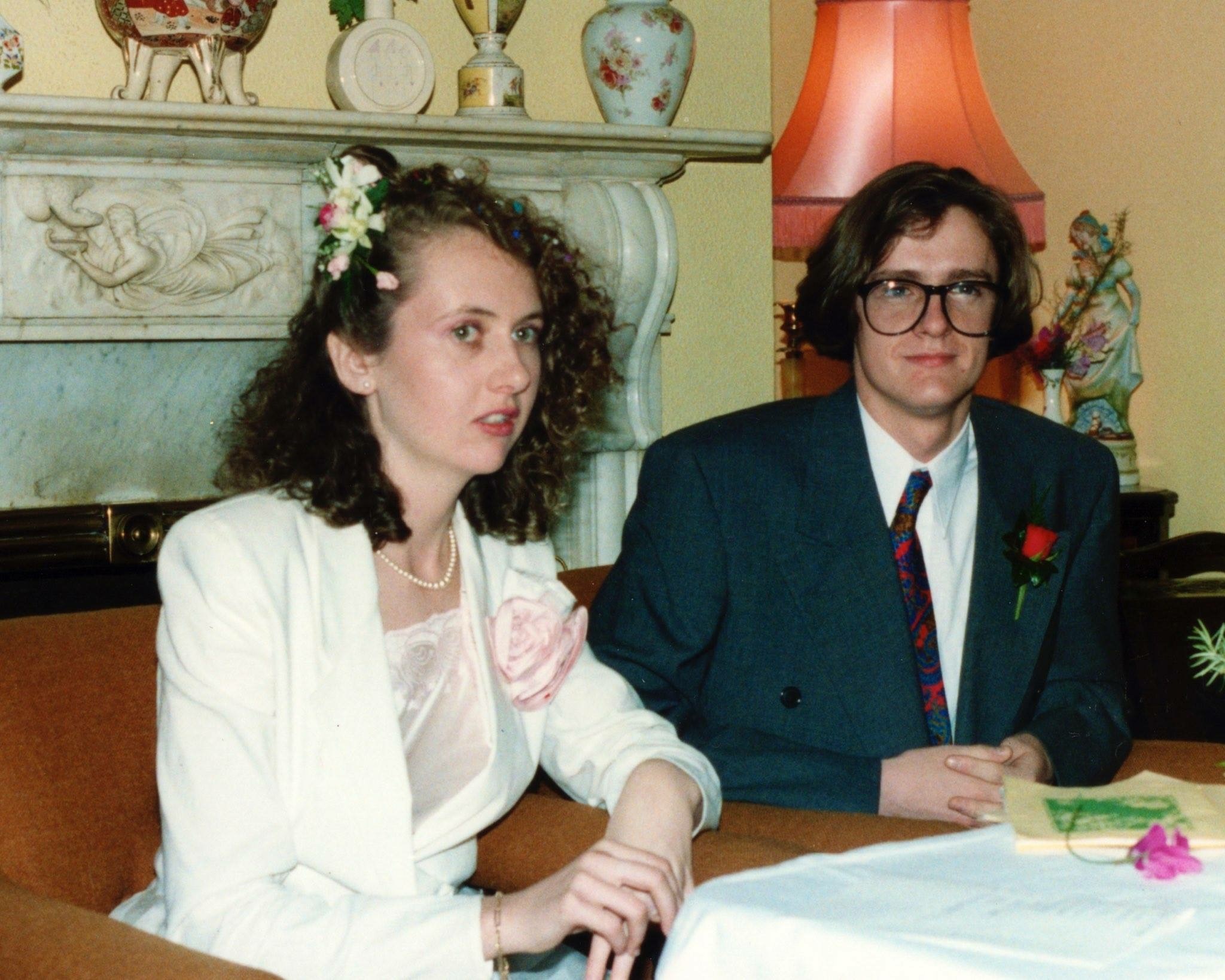
In 1987, after completing my engineering course, I made the decision to move to England. Niamh, my late wife, and I had begun seeing each other in Limerick and both decided to make the move. I would make the journey across to London to visit her in her flatshare in Clapham while I lived with my aunt in Potters Bar. In September 1988, we married.
When we asked for consent to be married, my father-in-law was initially sceptical of the Faith, but Niamh’s sisters worked expertly behind the scenes to assuage his doubts. Throughout the rest of his life, having met dozens of Bahá’ís, particularly the older Persian ladies who fussed over him, he softened greatly. To the point where he requested that my son read a Bahá’í prayer at his funeral.
Niamh herself had been searching for spirituality and became a Bahá’í in 1989 when she was 22 – a result of the loving friendship of many.
USSR – 1990
Niamh and I were both keen to serve, and calls were made for travel teachers to the USSR. It was the dying days of the Soviet Union.
The journey to Russia in 1990 was both exhilarating and challenging. As we embarked on travel teaching, we found ourselves immersed in a world on the brink of transformation.
At the time there was rationing and Niamh and I were very hungry. But we were told by Lois Hainsworth not to tell the Russian Bahá’ís we were hungry as they’d do everything in their power, at their own expense, to feed us!
Our journey took us from the bustling streets of Moscow to the tranquil countryside of Belarus, where we witnessed firsthand the aftermath of the Chernobyl disaster. Visiting orphanages and collective farms, we were confronted with the harsh realities of life under Soviet rule.
We engaged in conversations with people from all walks of life, from Orthodox priests to schoolteachers. There was certainly a receptivity at that time. I’m still in contact with some of the converts from that period.
Cyprus – Summer 1991

Cyprus presented a special opportunity for travel teaching, regardless of the obstacles stemming from previous efforts to spread the Faith in the region. The historical presence of Mírzá Yahyá, exiled to Cyprus, and the impact of covenant breakers held profound significance for us during our visit in August 1991.
We encountered a variety of people, including a particularly fanatic born-again Christian who followed us around as we taught the Faith on the street. We sought to foster a renewed receptivity to the teachings. We were accompanied by a supportive group of fellow believers, including Farang Wren and Owrang Moshtael who became lifelong friends.
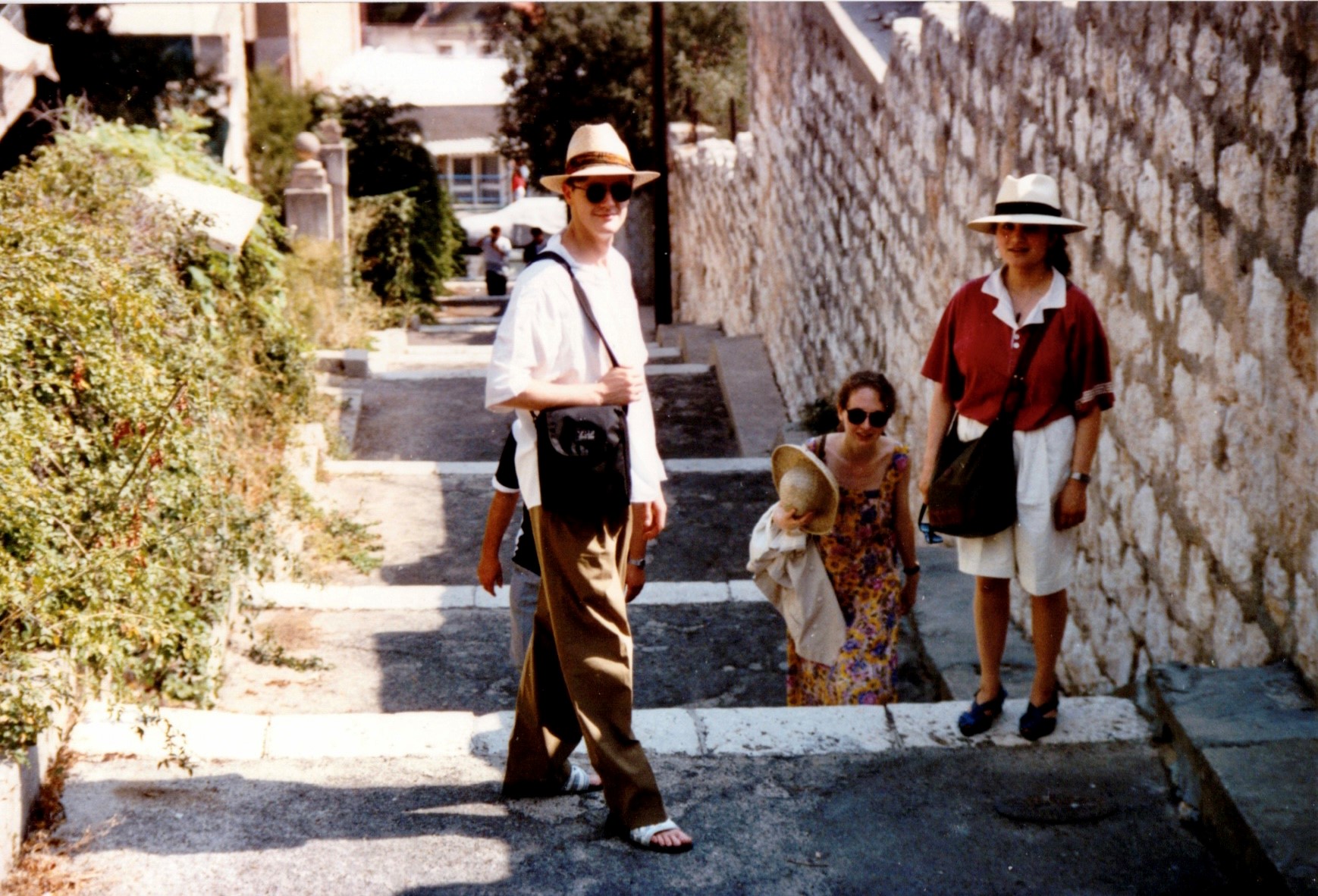
Pilgrimage and dinner with Rúhíyyih Khanum – Autumn 1991
After our time in Cyprus, we felt incredibly honoured to receive an invitation to visit the Holy Land.
At the time, the terraces were being built. It was the first time I had been to the Holy Land.
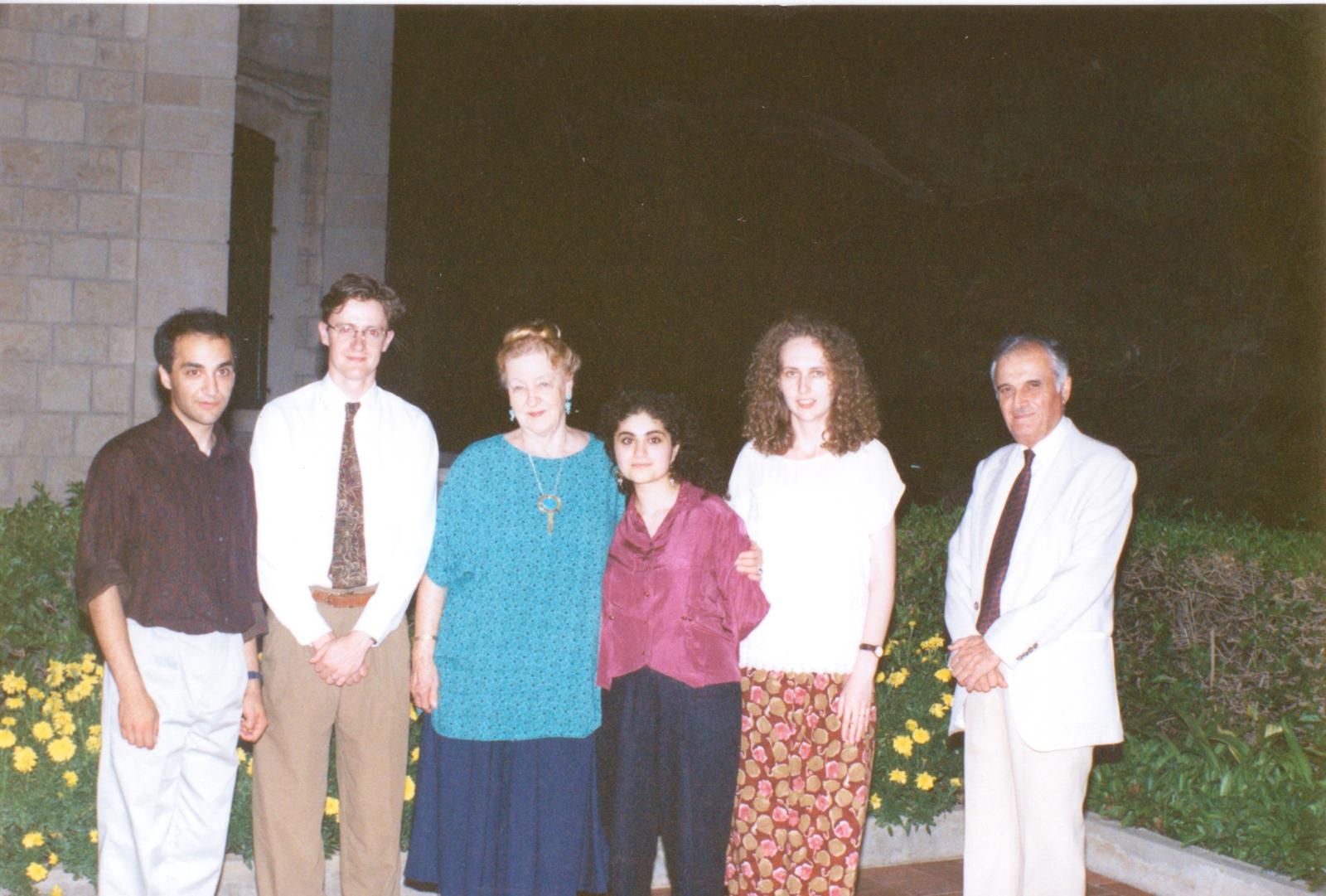
We were invited to the House of `Abdu’l-Bahá for dinner by Rúhíyyih Khanum
Visiting Rúhíyyih Khanum, the wife of the Guardian of the Bahá’í Faith, was a surreal and humbling experience for us as young believers. We were filled with a mix of excitement and nervousness at the prospect of meeting someone so significant within the Bahá’í community.
Despite our initial giggles, we were warmly welcomed and invited to join the conversation. Rúhíyyih Khanum radiated grace and wisdom, the sense of being in her presence had a lasting impact on us.
Niamh spoke to Rúhíyyih Khanum about homeopathy, and Rúhíyyih Khanum told her Shoghi Effendi consulted a homeopathic doctor – inspiring Niamh to study the discipline back in the UK.
I remember Mr Nakhjavani also being present – I was struck by his quiet dignity.
Rúhíyyih Khanum showed genuine interest in our experiences as travel teachers in Cyprus, and she was keenly interested in the impact of covenant breaking on the island.
I realise today how lucky I was to have such close contact with her.
Reflections
Looking back on my 40-year journey in the Faith, I am struck by the profound impact of numerous influential figures who have helped shape my path. It was my sisters who initially ignited my interest in the Faith, while my brother-in-law, Pat Murphy, played a pivotal role as a mentor, sharing not only his musical talents but also his deep understanding of the teachings.
The vibrant community of Limerick introduced me to kindred spirits who enriched my knowledge, offering insightful explorations into its history alongside luminaries like Adib Taherzadeh.
My wife Niamh emerged as a formidable teacher in her own right and advocate of the Institute Process. My son Nathan has followed in her footsteps, serving in the Holy Land, as well as in various communities of London and Hertfordshire.
I have been privileged to serve this faith for 40 years.
Martin Rainsford
Ridván 181 BE (April 2024)
Niamh passed away on 31 July 2019
 UK Baha'i Histories
Dear Martin, your story is priceless history and will be kept
Just read this for the first time; what an amazing life you have had. Many confirmations and blessings, and a really fascinating experience of different countries and cultures.