
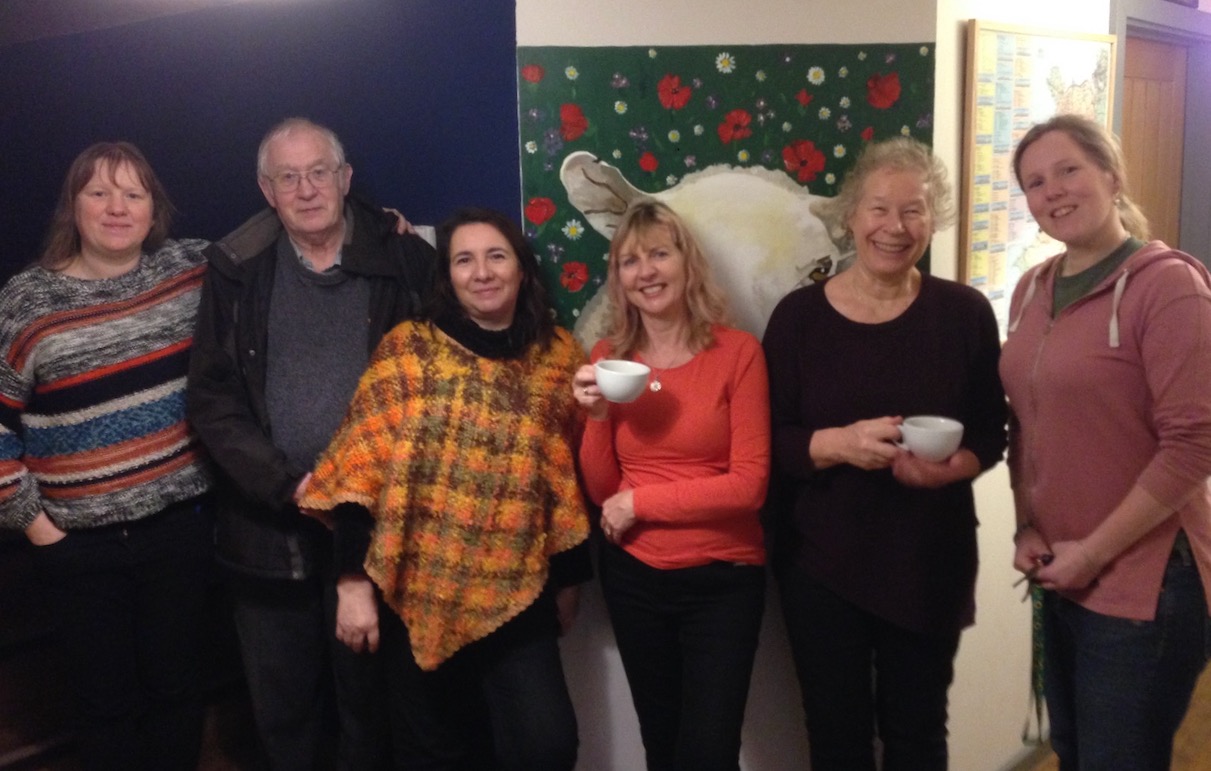
Eric Fosbrooke (second from left) with friends at the Welsh Winter School in Merthyr Tydfil, Jan 2020
I was born in Stockport, Cheshire, now part of Greater Manchester, in 1947. My first memories were of waiting in queues, dank streets and people in long dark clothing towering up above me. Faith and religion related to ‘the Church’, a place I was taken to on Sundays, a day my father did not go to work.
When I was about four years old, I was taken to Stepping Hill Hospital to have my tonsils removed. Painful and frightening, yes, but an interesting experience all the same. I had a disability in that I couldn’t speak without a stammer, which I was to have for sixty years. I developed meningitis and had painful penicillin injections every three hours. I remember being incredibly bored so I read and re-read every comic that I had over and over again. Eventually I started looking at words, strange groups of letters, and for no reason the letters quite literally started to make words, sounds and sense. As I had already read everything that I had, newspapers and the Bible were the next step, although difficult to read as the language was way beyond any experience that I had ever been subjected to. The words were fun and interesting. I read stories I have never forgotten, discovered a world I did not know existed, and somehow developed a hunger for facts and information. At one point I read a manual for an electric iron that would not work. My parents were very surprised that I was able to finish sentences in other people’s conversations relating to wiring and electricity.
One Sunday morning, we were taken to the Methodist Church just before harvest festival. My elder brother went off to the children’s service, leaving me in the church with my parents. My mother told me that after the service there were sandwiches and a tea for children and that I would have to find my brother and wash my hands. I commented that Jesus had said that the washing of hands was unimportant(#1).
My mother and father were enraged and started slapping me on my legs because in their eyes I was being offensive in church. The minister and bishop came over to speak to my parents and asked why they were slapping me. The slapping stopped instantly. My mother replied I had answered that Jesus said the washing of hands of hands was unnecessary. The bishop commented, “He did say that.”
The bishop then turned to me and asked, “Who told you that? Someone told you that, didn’t they?”
For a few seconds I was afraid but then I answered, “No one, sir, I read it for myself.”
The bishop then said, “Are you trying to kid me that you could read the Bible? You cannot yet be five years old.”
I stood up (about 3’ tall) and picked up the Bible from the pew and read the first page. By this time, we had created a little crowd of onlookers who eventually cheered and cried. They slapped me on the back and caressed my shoulders.
The bishop then turned back to my mother and asked, “Did you teach him to read from the Bible?” My mother answered, “I was not aware that he could read.”
The bishop turned again to me and asked, “Do you know the meaning of the word ritual?”
I took a guess: “Things people do for no reason?”
He asked about God and Jesus, about the differences between them.
I said, “If God made everything, it follows that God made Jesus.” I added, “Jesus had a special relationship with God.” I was drawing on memories of the radio programme, ‘The Brains Trust’. I’d quoted Malcolm Muggeridge (one of many radio presenters who converted themselves into religious turmoil).
The bishop commented, “Many men my age could not answer that question.” He then quoted Scripture concerning ‘babes and sucklings (which I found less than flattering), and spoke to me as if I were an adult, explaining that it wasn’t the physical act of hand washing but the ritual itself that was unnecessary in the eyes of Jesus. I never had any fear about viewpoints where I could read information for myself. His final comment was, ”I have to preach a sermon tonight; with your permission I will use what you have told me today. What you have said has uncovered a matter that has been on my mind since I was a young man in college.” He eventually wrote a letter to my parents asking them to meet him. My father went to meet the bishop, but I was not invited. I don’t know what my father was told, but he seemed very pleased and overwhelmed by the interview.
I noticed, in the church and also in my school, that there were people who trotted out phrases such as, “Children should be seen and not heard” and “Spare the rod and spoil the child”. Thankfully these people were in the minority. One woman in church screamed, “Thrash the devil out of that child, he should not speak in church!” But the bishop said, “Be silent, there is something much more important here than a child speaking in church.”
After the Coronation in 1953 we moved to Ringwood in Hampshire where I attended school and church. In 1954 I was dimly aware of two girls in my junior school, Elisabeth and Pat Brown. Elisabeth used a wheelchair and had a leg in plaster; I was to meet her again in 1965.
My mother worked as a ‘Home Help’, assisting patients newly released from hospitals or disabled due to age or infirmity. When a patient of hers died, her sister came to live with us whilst she made funeral arrangements and cleared out the patient’s home. This lady used to tell fortunes from tea cups. When she handled my cup, she dropped the cup, breaking it. She told my mother a blinding light shone out of the cup and she was afraid.
The only other religious issue I was ever involved with was the subject of Confirmation and the Apostles’ Creed. I didn’t feel that I could accept the words as having any religious authority. I did feel sympathy towards the Nicene Creed, but this seemed to be for Catholics, who had to go to confession.
In November of 1957, my mother asked me to take my father a cup of tea. She said he probably had an attack of malaria and was late getting up. I took the tea upstairs and my father attempted to take the cup. He fell like the proverbial sack of potatoes, tipping the tea all over the place. I screamed to my mother to ‘phone for an ambulance. But she was too afraid to do so. I went to a ‘phone box and pressed the button but the operator told me that an ambulance would only be sent on a GP’s reference. I knew that unconsciousness needed immediate medical intervention so I went to my school friend’s house. I never saw my father again. The practice in those years was for children not to be involved with deaths or funerals. It was just not spoken about when children were present.
In 1958 I was digging in my garden. I had a small piece of land, about 10 ft by 10 ft, to plant vegetables and anything I found unusual in the chicken feed. The first thing I discovered was maize (corn on the cob) which was generally unknown in those years. I extended the garden by digging into an unused bank of earth. There was a noise like a jet plane and the sky turned black like smoke, only it wasn’t, it was a thousand million wasps. I screamed with the full force of my 12-year-old lungs and our dog came running over barking furiously. There wasn’t an inch of my body that wasn’t coated with insects; I couldn’t move for fear. I heard a clanking noise getting close as my next-door neighbour came with two buckets of water and an old coat, at great risk to himself as the sky was black with hornets. He later told my mother that I had turned bright yellow. They were wood-wasps, much larger than ordinary wasps and capable of really painful stings. They had no natural enemies and there were thousands of nests throughout the garden.
Mr. Green tugged at my T-shirt and I took it off. “Where them jaspers get you then?” he asked.” My entire body was unblemished pink. Embarrassed I said, “Didn’t sting me, that was lucky!” He answered, “No son that weren’t lucky,” that were miraculous, bloody miraculous.” He kicked at the exposed comb as he walked away with the clanking buckets.” These things are a bloody curse.” He sat on his gates all day telling the neighbours about the incident.
_________________
I spoke to Elisabeth Brown and her sister Patricia in the Coffee House in Ringwood, probably in the summer of 1965. They invited me to a party in their home near Christchurch. The party took place in October 1965, and if there was a courtship or something like that, I don’t remember. I started taking Elisabeth to the pictures and we were married in 1968. I was partially aware that the Browns were Bahá’ís.
At this time, the National Spiritual Assembly asked for Bahá’ís to enter book shops and ask for Bahá’í books. One day we went into a bookshop in Westbourne Arcade where Elisabeth asked about Bahá’í books. We discovered that the owner had once bought the entire Bahá’í library. It would have been housed in the ‘Bahá’í Reading Rooms’ on Old Christchurch Road. Sadly, the building had fallen into disrepair and the Bahá’í Local Assembly accepted a tiny sum of money for the lease. In the Bahá’í book of visitors to Bournemouth there is a Tablet from ‘Abdu’l Bahá to the Spiritual Assembly of Bournemouth as a town and place. I do not know of any other towns that have a direct Tablet from ‘Abdu’l Bahá. Many years later I discussed the issue of the Bahá’í library with Donald Pierce, once a local Bahá’í. He said they were aware the books were missing but they did at least know what had happened to them.
In 1969, the LSA asked if I would serve on a youth committee. Being as I wasn’t a Bahá’í, I was a little surprised. We hired a hotel, The Roundhouse Hotel, and invited all the local civic dignitaries. Although the members of the committee were very young, one had to note that they had a confidence and belief far beyond their years. I was taken to many firesides and meetings of all kinds. Often I would meet Margaret and Stuart Sweet, who gave me some Bahá’í Writings which I still have. A couple we also met were David and Barbara Lewis, living in Winchester but originally from Cardiff. They were well educated, stimulating and supportive.
Elisabeth became pregnant in 1968 with our first child. She was a remarkable child filled with contributions and inspiration from the Bahá’í communities of Bournemouth and Poole. I’m sure every parent feels those amazing forces as they watch and feel a child grow and develop.
There was an event in Poole, Dorset, to celebrate the election and establishment of the first Spiritual Assembly of the town. An elderly couple near Wharfdale Road, Bournemouth, had volunteered to hold a ‘tea’ for attendees and I went early with my friend Jim Elliott. Because I knew the area, we arrived before the main group of visitors. Jim and I went into the dining room and started to eat the sandwiches, cakes and biscuits. The elderly couple fell into each other’s arms and sobbed loudly. So we said, “Sorry, is it because we’ve been eating the food? Is someone or something frightening you?” They answered, “No, no sorry, it has nothing to do with the situation, we will get you more cakes,” and they rushed in with two or more ‘Battenberg cakes’.
The Bournemouth Secretary, Jeanne Harper, came into the room and she said, “I’m going to ask you both to be very grown up. What’s happened is that these people have just volunteered to hold a meeting and they are unused to large numbers. There are at least a hundred cars parked outside, perhaps two hundred. They knew young people would come into the Faith in large numbers because the Guardian had told them so. Put yourself where they are! They have never had a meeting before with more than three people and now there are two hundred people coming through their front garden. I arranged this, and I am overwhelmed myself!” Jim and I went outside and there were cars as far as the eye could see. When we tried to go back into the house there was no room. There must have been every Bahá’í in the South of England there.
I came into contact with very many well-known Bahá’ís, I very quietly read and reread every Bahá’í book in the Browns’ bookcase but the knowledge did not make me a Bahá’í. I was, in fact, quite determined not to be converted. Some contemporaries of mine became Bahá’ís. Other Bahá’ís questioned my reticence saying, “Your friends are leaving you behind.” But I was fairly confident that when I became a Bahá’í it would be for ever.
Once, in 1968, we went to a Bahá’í meeting in Dunbar Road in Bournemouth. It was just about the most prestigious address in the area. I don’t remember the purpose of the meeting. It was held by Betty Reed who addressed and greeted us all individually with “Allahu-Abha”, anointing us with attar of roses. I did not wish to be assumed to be a Bahá’í just by association, so I went to a bookcase and selected several volumes, intending to challenge these beliefs. Many of the books were in Persian or Arabic and I had no knowledge of either language. However, I found one Book in English, ‘Gleanings from the Writings of Bahá’u’lláh’. I opened the book at random and my eyes fell on the Tablet to Shaykh Mahmud. I felt myself condemned by the words and was afraid. I felt myself to be in error of the authority and challenging the representatives of God and ‘sharing their food and drink’.
At this point Mr Azizi came into the room. He knew full well I wasn’t a Bahá’í, but he just asked if he could help me. He had a sense of humour and fun which transcended language, demonstrating how to hold and read the Arabic and Persian texts. I noted that the volume’s printing and binding were of the highest possible quality. His voice and rendition of the Writings were poetry even though I could not follow the language he was speaking. He was a peerless man, gentle and humble. He was murdered by enemies of the Faith in Iran during the 1970s. (His name is recorded on the walls of ‘Foundation Hall’ in Wilmette.) I don’t know, but I assume this may happen to every believer who gives their life for Bahá’u’lláh. The original Foundation Hall is beneath the Wilmette Temple. I went there in 2012 and asked if I could mop some of the floors. They said “No, because it’s somebody’s job. If you want to work, read a couple of guide books and you can work as a guide”. So I did a shift there daily for two weeks. It was called being a ‘Greeter’.
Whilst I was there at Wilmette, the original Tablet of Ahmad was opened and cleaned. At the Wilmette International Conference in 1953, the grandson of Ahmad, Jamal, handed the original Tablet to Jinab-i-Varqa, the Guardian’s representative at the Conference. The Bahá’ís there gave me lunch every day and presented me with a prayer book on my last day of serving there.
I went to summer school in 1969-1970 at Coleg Harlech in North Wales. At the summer school I was tempted by an activity listed as ‘Dawn Breakers’. I only went because I knew ‘Dawn Breakers’ was the name of a musical group. It was in fact a talk by Shomais Afnan concerning the Fort of Shaykh Tabarsi. There were only two of us in the room; myself and a Bahá’í from Swansea, Denver Morgan, who had his hair combed down over his eyes. Shomais spoke with such eloquence, poetry and love, in a way I have never seen bettered in the Bahá’í Community. She spoke as if it were the most precious story in the world, which of course in reality it most certainly is. That night I had difficulty in sleeping, turning over the drama of the words and facts. Although I knew the story and how it ended, somehow she made it so alive and pertinent. At one point some Iranian Bahá’í youth came into the room and Shomais criticised them loudly in Persian and English for their behaviour and lack of manners and respect in turning up so late. She said, so firmly, “What would ‘They’ say, if ‘They’ knew you couldn’t be bothered to turn up on time?” I made a panicky mental note, to arrive on time; even though the words could not have been aimed at me in any shape or form! In 2016 I entered the building, Colleg Harlech (now sadly derelict and awaiting demolition) ignoring the danger signs, when I was faced with a choice of how to use my time.
Elisabeth and I bought our first home together in Poole, Dorset, in 1969. Our reason for moving was the establishment of the first Spiritual Assembly in Dorset as at that time Bournemouth was in Hampshire. Two months later there was an Local Spiritual Assembly meeting in my house and that is when I chose to declare.
People have often asked how I can be sure that this is the truth and the will of God. See through the eyes of humility is what I always feel as there is little point in quoting bits of scripture at each other. I’ve often heard it said that newly-declared Bahá’ís are subject to tests of faith, but I can’t say that was an experience I ever shared. I was more than fortunate to be placed near the ground that the Guardian had walked on close to Bournemouth. Many outstanding Bahá’ís lived in that place and at those times. And for some unknown reason I was honoured and blessed to be there.
My parents used to take us on holiday to Boscombe every year. Once, in Spring, 1951, when I was in the Royal Arcade there, I shouted to my parents that I remembered this place. It happened that Shoghi Effendi was behind me and he commented to my parents and his companions, “Isn’t it wonderful to see the enthusiasm of children?” My parents related the story of the church and my reading of the Bible to him (they were not Bahá’ís). He told them that he suspected he may have done the same thing himself. Later that day I passed the Guardian again at Tuckton Tea Gardens.
‘These favours have We bestowed upon thee as a bounty on Our part and a mercy from Our presence, that thou mayest be of those who are grateful.’ Baháu’lláh
Being a Bahá’í in reality means that your life has just begun. I was only 22 or 23 years old and I had a life to face. We went to the Bahá’í Youth Conferences in Padua and PlÖn, selling our house; so we had nothing to come back to. I still have my attendee’s badge; we travelled with some lovely Bahá’ís, Susan Anvar and Glyn Eynon.
The first thing was to consult on where we were to live. We consulted with the National Assembly and they asked us to go to South Wales. We were in a position whereby I could get a job almost anywhere in the country and buy a house almost anywhere too. So at the end of 1972 I ended up on Llanelli Railway Station. I was just 25 years old. Well-meaning colleagues directed me to derelict houses that were for sale for £1,000 pounds or less. I was assured that they were a bargain and they probably were, but the degree of work was well beyond my capabilities physically or logistically. As for the job, I was driving anywhere in South Wales from Pembroke Dock to Newport and totally unable to read road signs (the Welsh language was difficult) or ask for directions. The company saw any form of training as a total waste of money and time! In 1977 our marriage ended and I was very much on my own and life was very difficult.
Soon after, I visited my mother and having experienced many difficulties, my mother thought I would obviously leave the Bahá’ís and go back to the church. I said that one of the reasons I had become a Bahá’í was because of how I had been influenced by my parents. My mother was mystified at this remark. I related many stories from my childhood of how my mother and father had gone into houses where the owners were in need, and redecorated them for nothing. They recharged radio accumulators for the blind, as in those days many elderly people had no electricity. The accumulators were glass and I used to deliver them after school. On one occasion my mother went to protect a derelict woman who was being abused by a group of youths. I related all these stories and many more and said, “You cannot understand the things He (Bahá’u’lláh) wrote, if you could understand you would believe too.” She never mentioned it again.
I did a few Open University courses. I was happiest with science but to get a job I would have had to leave Llanelli and go to university to take a degree. I saw an advertisement in a newspaper asking for volunteers to drive into Romania and take aid to the Russian border. I volunteered and was accepted after I had been interviewed by the Chapel Committee. They had never heard of the Bahá’í Faith. The bus was owned by the chapel and it was filled with aid. I wrecked the engine of the bus, and got back on three cylinders. The company and engineering staff of S.W.T. (South Wales Transport) volunteered to rebuild the engine and refinance the operation. My line manager and engineer came on board and came out with us, firstly to Romania and then into Bosnia during the Balkans war. The bus was parked at the depot and the engine and transmission totally rebuilt. When one drove into Romania it was total chaos; the people manning the border wanted us to pay to bring aid into their country! Or provide cigarettes, chocolate, etc. The ‘taxes’ they collected were probably their only income.
Eventually, in about 2001-2, we went to Mostar in Bosnia instead. The company S.W.T. said we could have all the fuel we could carry, so we filled the whole boot with 50-litre oil drums and filled every container we could find. The Serbs tried to shell us, unsuccessfully. The police came and made us take cover in the ditches while shells exploded around us. They could only do this in the dark because the Americans’ A10 attack aircraft turned their guns into rubble during day-light. When we went into Mostar we saw the Serbs had thrown all the buses off the cliffs, down hundreds of feet. I went to a camp where the rape victims lived. it was pretty grim.
Val, who owned one of the buses, asked me to wash down the windows on her bus so I walked to the river to get water, holding a plastic bucket. My feet slipped down the slippery bank and I was in the freezing water amongst the ice floes. I shouted and screamed as loud as I could but nobody heard me. I swam into the bank but there was a powerful current. Twice I failed to get out. I knew I had no strength for a third attempt so I dug my fingers and feet into the frozen mud and crawled out onto the ice. My friend Tony said, “Get your clothes off, all of them.” I was wearing three uniforms which floated well. I stood in the car park in my underpants and Tony rubbed me down with a rough blanket. It was –10˚C. Our doctor friend came over and I was enveloped inside her fur coat. Tony took some clothing out of the aid stocks and Val said, “He’s not having that, it’s aid! Tony said, “One more word, and you are on your own.” Val disappeared. When she returned, she announced that she had booked us all into a monastery, with steaming showers and hot food! When we found the place, it was unbelievable, it would have been ancient to Charles Dickens! Wooden bed frames with sacking slats. It was -16˚C when I got back onto the bus. I just got into my sleeping bag with three blankets. When we woke up the whole area was coated with frost. There was a guard sleeping outside and I watched him as he just stood up and dusted the frost from his clothing.
In about 2005 I attended a Bahá’í meeting at the university in Swansea. Viv Bartlett was giving a talk on Mirza Yahya. Part of his talk related to a ‘gift of speech’ which Bahá’u’lláh had conferred upon him (Mirza Yahya). Viv waved around a ball point pen as he spoke, calling it the ‘gift of speech’ and he gave me the pen. The whole room exploded into laughter as the audience knew I could not speak without stuttering a little. The next day I went into work and people commented that I no longer had a speech problem, so I suppose I must have been cured! Most Bahá’ís never noticed I had a speech problem anyway.
In 2012 I was honoured to have a full pilgrimage. In 2013, I decided to retire from work. I thought retirement would be good for my health, but it wasn’t. I felt really ill. By 2014 I retired to bed and felt like I was dying. I was sick almost constantly. Eventually I went to see the doctor who thought there was nothing wrong with me and prescribed Ibuprofen for leg pain. The leg pain was really thrombosis (blood clots) but no one knew. A friend visited me and thought I was ill and insisted I went back to the GP for a second time. This time I saw a different doctor, who sent me for a whole list of tests. The hospital would not let me leave. They did a scan and found blood clots.
After two weeks they sent me to Morrison in Swansea. The doctors who examined me were Muslim and chanted a prayer as they worked; I knew the words by heart. They were very surprised, and asked if I were Muslim? Obviously I said I was a Bahá’í. One of the doctors then asked about units of alcohol. I said I had not drunk alcohol since I was eighteen which would have been around the time I started to attend firesides. The doctor then said, “If you are telling the truth you will heal in half the time that ordinary patients would take.”
I was to later learn the prayer they chant is a prayer revealed by the Imam Husayn. They chant this prayer as they deal with new patients. It is from this prayer that the Báb chose the names of the Bahá’í months. They discovered I had total kidney failure and from then on, every other day, I was taken for dialysis and was told that I would have to do this for life.
My daughter has a large home and when she visited me, she said I could go and live with her in Ipswich and that my house could be sold. At the end of October 2014, I left Morrison and went home to Swiss Valley, Llanelli. Every other day an ambulance or minibus brought me back into the hospital for dialysis. In October 2014 the sister on the dialysis ward came to me and drew the curtains. She said, “I can’t do this any longer, do you know why this machine constantly breaks down?”
“Reverse the flow!” I ventured.
“No, no,” she said, “your kidneys are working too well.”
My brain struggled! ”I cannot tell you,” the nurse said. “I am not a doctor. I am going to get a doctor.” She then disappeared. Eventually I looked out through a crack in the curtains. The whole ward was in turmoil, people stood in groups whispering, staring and pointing at my bed.
After about 45 minutes, the sister came back with a young man in a white coat, who introduced himself and I asked if I could leave the ward. I walked around all the dialysis wards. I noticed a pattern, young to old. Black spots on the toes of patients, accompanied by missing toes, and then missing feet, followed by missing legs! After an hour I went back to the ward. I bit through my left hand because otherwise I would have sobbed. I couldn’t believe I might get out of this. I was shocked beyond reason.
The sister held up the charts that the machine prints after every patient. She said, pointing out the graphs, “I’ve known for several weeks, but I couldn’t say anything, as it might have been a false hope.”
The doctor said he was not a nephrologist but that I was going to have to see one to treat this seriously, saying that if I was ill I was to phone an ambulance at once, and not to mess about. He said we were to give this case three days and it would be obvious if I needed to continue with dialysis. Then the tubes were taken out of my neck.
At first I had to go along every day, then every week. There were a couple of scares, but I got better and stronger. I had to take steroids and learn to handle withdrawal symptoms. They called me ’the man who stood up and walked away!’ Morrison has been a dialysis centre since the 1960s. There are only three patients who ever walked out and I am one of those three.
At one point the specialist had told me that I could think of returning to work! However, I was 67 and had already taken my pension so I knew this was unlikely. I had previously asked one of the Muslim doctors, “How do I get out of this?” At first he had said that there was no way without a transplant. Then he had answered me with a verse from the Quran: ‘Be patient for your patience is with the help of Allah.’
In 2018 I ended up with a clean bill of health.
I was lucky and blessed.
Why me?
____________________
Eric Fosbrooke
Llanelli, South Wales
December 2021
#1: Matthew 15:19-20: ”For out of the heart come evil thoughts, murder, adultery, sexual immorality, theft, false testimony, slander. These are what defile a person. But to eat with unwashed hands does not defile anyone.”
 UK Baha'i Histories
I began making corrections but, reading through the whole story, I have concerns about this one, there are passages that don’t make sense, and it seems to be disjointed and random …. I have no particular recommendations but, in my opinion, it needs careful editing, if it is to be used.