

Irene Jane was born on 1 October 1946 in Cardiff, Wales, the daughter of Oswald Matthew and Rose (née Le Gray) Jones. A second generation Bahá’í, Irene had one sister, Valerie Margaret, who was two years older. Three years after the death of their father in 1948, Rose and her two daughters left Cardiff and settled at the family home in Chiswick, London.
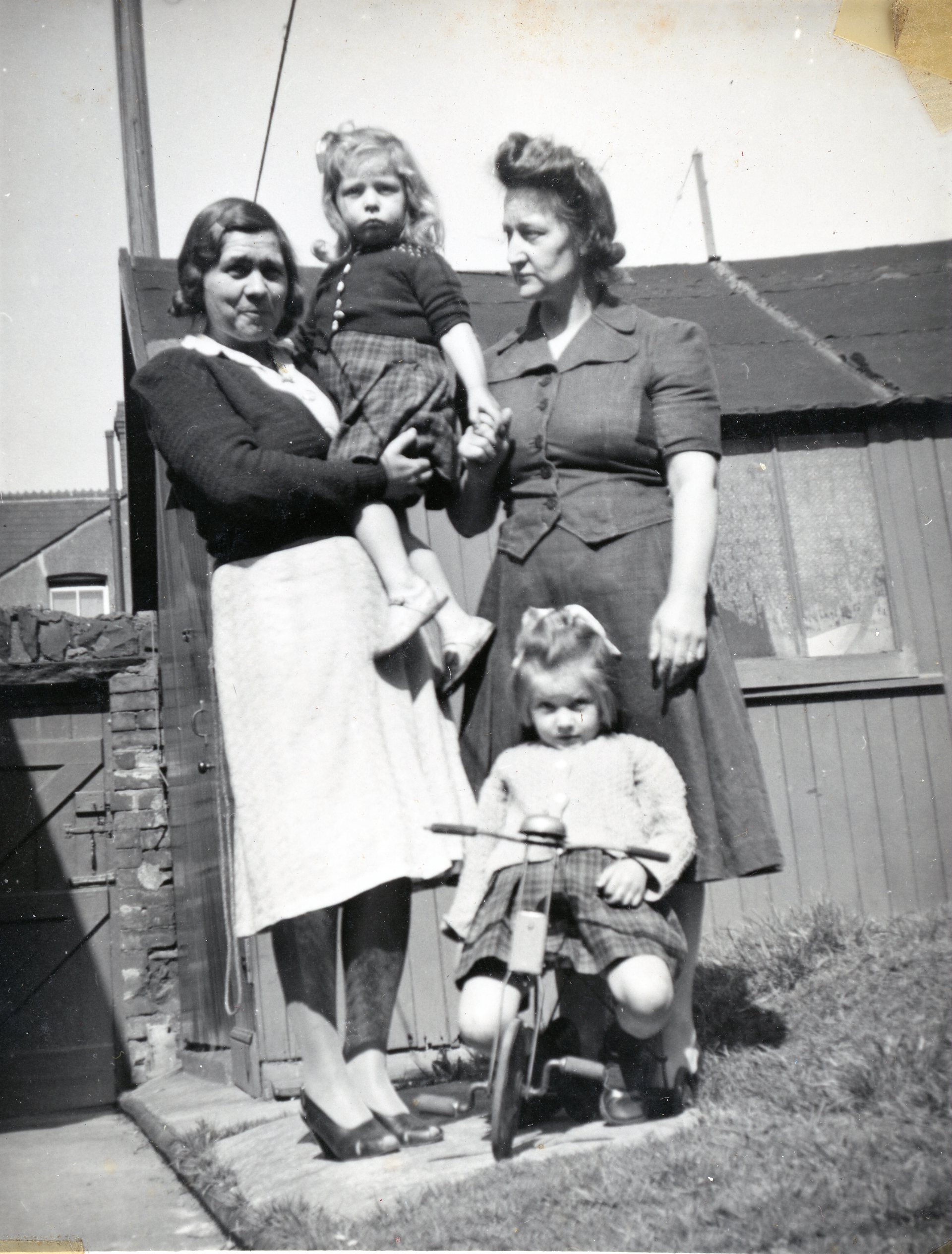
At the age of 11, Irene and her family attended the funeral of the Guardian of the Bahá’í Faith, Shoghi Effendi, at Southgate Cemetery. A few years later, she began to attend various Bahá’í meetings in London and declared her faith in Bahá’u’lláh on her 15th birthday. She was an eager participant in every activity. She served on the South of England Bahá’í Youth Committee and at the age of 17 she gave her first public talk at the youth summer school in Berlin, Germany in the early 1960s.
Irene attended various schools in Chiswick where she completed her A- levels. She earned a Bachelor’s degree with Honours in Education and Teaching at Bulmershe College, Reading, and upon graduation she served as a home-front pioneer by taking a teaching position in Aylesbury.
In 1969, Valerie and Irene went on Bahá’í pilgrimage, which was a life-changing experience for them both. They had the privilege of meeting two Hands of the Cause, Mr. Paul Haney and Mr Ali Akbar Furútan, who encouraged them to pioneer internationally. Both agreed. Initially Irene was hesitant to leave her mother alone in England. With Mr. Furútan’s loving insistence she promised to pioneer, hoping to obtain a post in Zambia with Valerie. Instead, an opportunity arose as a secondary school teacher at King George V Secondary School in Tarawa, the capital of the British colony Gilbert and Ellice Islands (now the separate and independent island nations of Kiribati and Tuvalu, respectively), located in the mid-most heart of the Pacific Ocean and which was another UK pioneering goal at the time. After consulting with the British Overseas Goals Committee, she left for Kiribati in 1970.
Once in Tarawa, Irene would soon immerse herself in local Bahá’í activities. She held weekly gatherings at her home, in which she also housed travel-teachers. Her close association with the local Bahá’ís was frowned upon by the expatriate community as “fraternization with the locals”; some of them referred to her disdainfully as “that Bahá’í woman.”
Under the direction of the National Spiritual Assembly of the Bahá’ís of the Gilbert and Ellice Islands, Irene was tasked, among other services, to prepare a 15-minute radio programme every Sunday on the teachings of the Bahá’í Faith. Because the programme had to be broadcast in the local vernaculars of Kiribati and Tuvalu, she sought assistance from local residents and seekers who spoke both languages. These were Falai-Riva Taafaki, Falai-Riva’s mother, Alieta, and three of his brothers, Pasoni (the first Tuvaluan Bahá’í), Uaelesi and Tauaasa who were already Bahá’ís. Falai-Riva soon declared himself a Bahá’í. He and Irene got married in February 1971.
The couple left for the Ellice Islands (Tuvalu), where Falai-Riva was in charge of agricultural development. To Irene’s surprise, their government quarters had no running water, plumbing or refrigeration, and electricity was available for half a day. Irene took these hardships in her stride without complaint. Following the devastation of Hurricane Bebe in 1972, the family, now including an infant daughter, Munirih Rose, returned to Tarawa.
In 1972, Falai was awarded a British Council scholarship to pursue postgraduate studies at the University of Reading in England. The family hoped to return to being pioneers in the islands after Reading University. However, major political changes in the island colony led the family to change its plans. In 1975, they received a letter from Dr. Ray Johnson, the principal of the New Era International Bahá’í school in Panchgani, India, inviting them to serve at the school. An addition to the family was now one-year old Jane Harriet, born in Hammersmith. Irene worked from 1975 to 1978 as a special needs teacher and then as director of curriculum development.
In 1978, the family returned to England where Falai completed his Master’s degree at Reading University. They returned to India in 1979 where, until 1985, Irene was the principal of the New Era primary school. Irene’s deep study, understanding and love of the Bahá’í teachings on child education greatly uplifted the quality of the primary school’s teacher training and curriculum development programmes. Visual and performing arts became integral components of the curriculum, no less important than English or Maths.
In the 1980s Irene authored two books published by George Ronald – Thoughts, Education for Peace and One World and Horse of the Moonlight. Both books became favourites for families and rich resources relied on by educators.
In 1984, Falai was admitted to the University of Massachusetts at Amherst to undertake a doctoral degree. Irene, Munirih and Jane joined him in 1985 and Irene began her post-graduate studies starting with her Master’s in Education. Irene was appointed by the National Spiritual Assembly of the Bahá’ís of the United States to the National Bahá’í Education Task Force and served for a time as its chair. In Amherst, she was elected to the Local Spiritual Assembly and served as chair for some years. During the same period, she served as an assistant to Auxiliary Board member, Mr. Strickland. Falai and Irene’s third child, Justen Thomas, was born in 1987 in Northampton, Massachusetts.
Irene completed her Doctoral thesis on Education in 1990 with distinction. Her dissertation was on “Collegiality and women teachers in elementary and middle school settings: The caring relationship and nurturing interdependence.” The family lived in Stamford, Connecticut, where Falai worked as a Mottahedeh Development Service Foundation consultant. Irene taught and supervised student dissertations at Cambridge College in Springfield, Massachusetts. She continued her service on the National Education Task Force, which developed the U.S. National Spiritual Assembly’s Core Curriculum for Spiritual Education program. This extensive program involved teacher training of children and junior youth and an abundance of resources including the 2005 publication, Foundations for a Spiritual Education: Research of the Bahá’í Writings.
In 1993, the government of the Republic of the Marshall Islands asked the National Spiritual Assembly of the Bahá’ís of the Marshall Islands to adopt the full administration and management of all seven public elementary schools in the capital city, Majuro. Under its community-based governance policy, the government had offered the same opportunity to all churches and faiths in the country. Except for an attempt by the Marino’s Catholic group on the island of Likiep, no other religious bodies took up the challenge. The government then invited the Bahá’í Faith to assist. The National Assembly referred the request to the Bahá’í international governing body, the Universal House of Justice, for guidance. The Universal House of Justice asked Falai to visit the Marshall Islands and seek a meeting with President Amata Kabua on his vision for his country. Soon after Irene and Falai were asked to go to the Marshall Islands and develop a plan of action for the administration, management, and academic improvement of the schools. This entailed a five-year comprehensive plan, complete with an academic curriculum integrated with a moral education and teacher training component. Irene singly developed this plan, which the leadership of the government immediately approved with a commitment of support. It was the first elementary school curriculum the country had ever had.
Irene and Falai were then invited to the Bahá’í World Centre in Haifa, Israel, to consult on the plan’s implementation and management. They were asked if they would move to the Marshall Islands as managers of the public schools soon to be administered and managed by the Bahá’ís, as requested by President Amata Kabua. They were also encouraged to appoint a team of suitably qualified and experienced Bahá’í educators well known to them as having the professional capacity and dedication to serve on the school management team.
To ensure an initial means of livelihood in the Islands, Irene secured an Asian Development Bank (ADB) consultancy at the College of the Marshall Islands (CMI). In November 1994, husband and wife and seven-year-old Justen moved to Majuro. While engaged in her ADB work, Falai was offered a position as special consultant to the Office of the President of the Marshall Islands. At the end of her one-year consultancy, Irene was appointed Secretary of Education, in which capacity she served for just over one year. In 1996, she became Director of the University of the South Pacific (USP) campus in the Marshall Islands, with its regional headquarters in Fiji. At that time, the fledgling USP campus consisted of a few rooms tucked away in the corner of the CMI campus. She soon obtained funding to build an independent facility fully equipped with administrative offices, lecture rooms, a computer lab, and a satellite for distance learning. She hired local staff, expanded academic programmes, revived culturally-oriented research and the revival of many forms of local knowledge. Enrolment soared and soon the facility could no longer accommodate the rapidly-expanding range of activities. Irene worked tirelessly to secure funding to purchase a larger complex and renovated it into a fully-fledged regional campus.
The new campus and its flourishing capacity and nation-building programmes drew much praise and appreciation from the government and families, and became the model of USP distance-learning campuses. By the time of Irene’s retirement from USP, over 300 Marshallese had graduated with various degrees, from nurses and teachers to those occupying the highest positions as Cabinet Secretaries, ambassadors, attorneys, financial managers, policy makers and advisers in the government. Irene’s success contributed greatly to achieving the goal of the country’s national policy for skilled and professional human resources.
Irene was committed to supporting and reviving Marshallese culture and arts. By cultivating genuine friendships and relationships, she gained the trust and confidence of those with traditional skills and knowledge who shared age-long skills with Irene with joy and enthusiasm. These efforts were always collaborative in nature and born out of the interests of the local population. Areas of focus were the use of local medicinal plants and the revival of traditional fine weaving. She co-authored two publications with her very dear friend and colleague – highly esteemed and culturally knowledgeable Maria Kabua Fowler: Traditional Medicine of the Marshall Islands: The Women, the Plants, the Treatments and Clothing Mats of the Marshall Islands: The History, the Culture and the Weavers. Both publications continue to attract high demand today and are popular ethnological resources in Pacific cultural studies. Irene’s commitment to the resurrection of the art of traditional Marshallese weaving, Jaki-Ed, was in close collaboration with committed persons and friends, Marylou Foley from Hawai’i, and Maria Kabua Fowler and Irojlaplap Michael Kabua from the Marshall Islands. This revival is celebrated annually with an internationally-attended auction that supports Marshallese weavers.
Her many years of service to education gained the confidence of government leadership and the local population and she became a trusted leader and member of the community. Once, she and her husband were invited to attend a ceremony on an outer island. Her husband recalls the time when a group from the island community came to the airstrip to say good-bye, calling out “Good-bye Dr. Irene, we love you! Thank you for all that you have done for our children and family and for the country.”
In 2019, Irene was appointed President of the College of the Marshall Islands (CMI) – the only national college in the country. During her tenure, the CMI campus and programmes of study expanded in conjunction with its strategic plan. It was here that she felt especially joyous with the trust and confidence placed in her by the Board of Regents to chart a fresh future for the college. Irene’s dedication to local capacity-building and workforce development enabled CMI to go from strength to strength. Her love and dedication to the college were reciprocated by the college’s staff, faculty, and students. Upon her passing, they stayed with her remains day and night until her funeral and held a most touching night-long vigil in her honour. They assisted her family and the National Assembly in the coordination of her funeral and burial with utmost love, generosity and dignity; and comforted the family in their time of grief most memorably.
Irene’s faith as a Bahá’í was well known. Audacious, she never hesitated to share the teachings of Bahá’u’lláh with anyone. She once remarked to a Counsellor for Australasia that all that she knew about education had come from ‘Abdu’l-Bahá’s Writings. She was completely devoted to Bahá’u’lláh’s Cause and dedicated her entire life to serving His Faith as a youth in the U.K., in her pioneering posts in India and the Pacific, and during her time in the U.S. Her intention was always to remain in the Pacific region. In 2014, she and husband acquired Marshallese citizenship, affirming their commitment to live in the Marshall Islands. In almost thirty years of dedicated service in the Marshalls, Irene had come to deeply love the Marshallese people and their culture, and treasured their friendship.
When Irene and her husband moved to the Marshall Islands in 1994, the local Bahá’í community in the capital city of Majuro had regular gatherings to study the teaching of the Bahá’í Faith. Irene facilitated several of those study spaces. Upon her passing, several friends shared how those sessions had aided them in their understanding of the teachings of Bahá’u’lláh. The Bahá’í Centre used to be packed with people of all generations. Many would bring their entire families and food and spend the entire day. At first Irene responded positively out of respect for the national and local institutions. However, she was very much aware of the trappings of a learning model where a teacher – presumed to be the sole possessor of knowledge – would dispense knowledge to a passive audience. Such a model, based on false learning assumptions, would not be able to build and sustain human capacity.
As soon as it was practicable, she launched herself into the Ruhi Institute Process of human capacity building. At the time, awareness of the institute training model was not that widespread in the Marshall Islands, nor in several other Pacific Island communities. Soon she was both participant and tutor in the sequence of courses. Irene organized the training of animators, many of whom were youth. A similar approach was adopted in facilitating the study of materials aimed at raising the capacity of junior youth. In short, she was engaged in capacity building within the grassroots community. Some of her local study circles consisted of participants who were youth pioneers from the United States. Irene was overjoyed when some of these wrote to her later to share that they had been appointed in their respective U.S. communities to serve in various capacities such as study circle coordinator, cluster coordinator and children’s class teacher.
Irene was able to undertake all this in addition to her full-time job, and as appointed member of various national committees or boards. During the 1995 Bahá’í National Convention, Irene was elected to the National Spiritual Assembly and then elected as its full time Secretary, a service she rendered for the next 29 years until her passing. Irene had the privilege, as a member of the National Assembly, of attending four International Bahá’í Conventions to elect the Universal House of Justice. In 2003 she was appointed as one of its tellers. However, due to the outbreak of a war in Israel, the Convention was cancelled. The Universal House of Justice had offered the tellers the opportunity to still arrive in Israel to complete their roles but left the final decision to each individual. Irene consulted about this with her family who were split down the middle on whether or not she should go. Irene trusted that if the possibility was being made available by the House of Justice, she would be protected, so off she went and was exceedingly glad that she did.
Irene was a beloved wife of Falai-Riva, mother of Munirih, Jane and Justen, grandmother to Naima, Taafaki, Sophia, Siara and Poema and great-grandmother to Alieta. She was an unfailing supporter of her family, showering them with love and generosity throughout her life. She treasured their company and modelled the importance of family unity. The educational and life accomplishments of her children and grandchildren are a testament to her devotion and guidance.
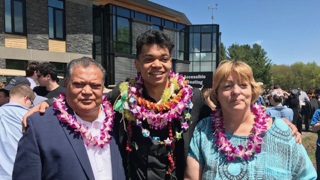
Irene unexpectedly passed away at home in the early morning hours of 29th September 2023, two days before her 77th birthday. Hundreds of people attended her funeral, which was live-streamed world-wide. For two days and nights, mourners from every community paid their tributes and respect. Notable among them was the President of the country; the Speaker of the Nitijela (Parliament); Pro-Chancellor and Vice-President of USP; High Court Judge, CMI Board of Regents, staff, faculty; students of CMI and USP, chiefs and traditional leaders; healers and weavers; and two members of the Continental Board of Counsellors for Australasia. The many tributes recognized Irene’s tremendous contribution to education and capacity-building in the country and region; her love and respect for the people of the Marshall Islands; her commitment to the revival of Marshallese cultural medicine and arts and the empowerment of their practitioners; and her deep bonds of friendship built over three decades.
A loving tribute from the Bahá’í Continental Board of Counsellors for Australasia noted that Irene’s ‘…is a story of obedience and faith, of compassion and constancy and a profound understanding of the nature of capacity building and the power of education to transform both the inner life and external conditions of society. But in the end, it is really a story of a deep love for Bahá’u’lláh – a love that deepened and widened over a lifetime of service to His Cause.’
In recognition of her passing, the Universal House of Justice described Irene as a “consecrated handmaiden of the Blessed Beauty…. Her many services to the Cause of God, including as an international pioneer to your country and as a member of your National Assembly for a quarter of a century, are recalled with warm appreciation. Also remembered are her contributions to the field of education and the promotion of the arts.”
Irene is buried in the garden of their humble home, facing towards the Qiblih, overlooking the calm and peaceful lagoon of Majuro in the Marshall Islands.

Valerie Rhind, Dr. Falairiva Taafaki and Munirih Rose Moore.
December 2024
Irene passed away on 29 September 2023
 UK Baha'i Histories
A very inspiring story of a life of dedication and service to the Cause.
Wonderful life
What a remarkable lady she was in all respects. I am unable to comment on her religious persuasion other than to say she was obviously very committed. However, her drive, social conscious, wonderlust, education, and flexibility, we’re all wonders to behold. RIEP Irene.
I was one of the UK youth group who went to the European Youth Summer School in Berlin in the summer of 1965, along with Irene and her sister Val.
At the same time as Irene pioneered to the Pacific, so did I and my husband Ron – but we spent two years in the British Solomon Islands. Then, a little later, when Irene and family were in India, we were living not so very far away in Kathmandu, Nepal.
Our paths often ‘nearly’ crossed but we were still a few thousand miles away from each other. Irene was a remarkable person, whose dedication and love for the Baha’i Faith knew no bounds. She studied and she served and she raised a remarkable family.
Her sudden death two years ago was a great shock to so many of her friends around the world but inevitably she will be remembered for a very long time to come – in the Marshall Islands, in the UK, and wherever in the world she had friends and was able to serve in the amazing way that she did.