

I must have been 6 or 7 years old when my grandmother asked what I wanted to be when I grew up; I told her an early Christian. She must have wondered what on earth I meant. I never explained that I wanted to know what it was like to have such a Faith that you would be able to face any danger, even the lions. I wanted to teach the new word of God, to be part of the beginning of it all. I didn’t want to be anyone special, just one of the many nameless people 2,000 years ago. It might have been this desire to be in the unknown ranks which made writing this account very challenging! However, that wish to be a follower of the new religion of the age made so long ago has now been completely and amazingly fulfilled. This is my story.
When I was a teenager I wanted to believe in God, but I didn’t. A vicar once said “If you even just want to want to believe, then you are on the first rung of the ladder.” Well, I truly did want to believe but something always held me back. I went to church every Sunday, was a Sunday school teacher, followed all the right responses but there was this emptiness, there was always so much missing. Later, in my twenties, I went to every variety of church I could find. But as each church declared they were the only right way and that everyone else was wrong I would leave, never to go back. In the end I just gave up. I decided to forget all about religion; I would go my own way.
It was many years later that I got a phone call from an old school friend, Kari-Anna Christopherson, nee Blackburne. All our school life we had been good friends, partners in crime as it were, and had got up to all sorts of pranks, often being threatened with being expelled from the school. However, sadly, Kari had begun to lose her sight and had left school early and we had totally lost contact. The last time we had met was when we accidentally bumped into each other in Hull. She was very down, indeed understandably angry about her life, her future, everything. However, she had mentioned she was going to get married to a man she had met whilst the two of them were learning braille. So, this unexpected phone call filled me with curiosity. She now lived in Stevenage, with her husband Oliver and their three children. How on earth did she cope with three children, and what was her husband like? I had to find out. As I was teaching in inner London it would be possible to dash up for a quick visit. So when she asked if I would like to stay with them the following weekend I was more than happy.
I don’t know what I had expected but I was not prepared for such a happy and peaceful house. Something profound had changed Kari. We chatted non-stop – it was so good to see her again. Her husband, Oliver Christopherson, was a wonderful person and her children, Pippa, Robin and Stephanie, absolutely delightful. Everything was right and it was one of the most relaxed and joyous houses I had ever been in. Then I saw a squiggly sign on the wall. I asked Kari what it was. She of course could not see what I was pointing at so I tried to explain all the dots and lines of what I later found out was the Greatest Name. As soon as I heard it was her religion, I started to ask questions, but to my total frustration she would not answer. She said that there was going to be a meeting in her house next weekend, and I should come back then if I really wanted to ask questions. I didn’t know then that there was no meeting planned but as soon as I left, Kari went to work inviting every Bahá’í in the area and by the time I returned the following weekend the room was full with about ten people. I thought they had all, like me, come to find out about the Bahá’í Faith, and I couldn’t understand why none of them wanted to ask any questions and left all the questioning to me! I could not stop asking questions. One question answered just meant I had ten more to ask. I was completely on fire; every response opened a door that said this was right. At the end of the meeting a wonderful elderly Persian gentleman, Mr Azhary Yazhari (I hope this is his name, his signature was difficult to decipher) insisted I be given the book “Bahá’u’lláh and the New Era” as well as “The Hidden Words”. It was the only copy Richard Hainsworth had, and I am eternally grateful that they decided I should have it. When everyone left, I headed for the long drive back to London but only reached the first layby on the A1. The two books were on the seat beside me and I could go no further without opening them and starting to read. Everything I read would set me off on paths of certainty – so much so that I actually felt my mind expanding, expanding in joy. I would drive a few more miles but then have to stop again at the next layby to read some more. It was leap-frogging like this from one layby to the next that I finally reached home. Every fibre of my being was alive, I practised the name Bahá’u’lláh again and again, and when I put out the light to sleep it was the first time in many, many years that I felt safe and protected.
However, there was a problem. I agreed with all the teachings of the Bahá’í Faith but I could not believe in the concept of God. I decided I would search out all the people who had profoundly changed the world for the better and see what they said. I thought of Karl Marx, Gandhi, Kant, but again and again they fell short and I would come back to Jesus, Buddha, Muhammad, Krishna and Moses, and each of them said the same thing. Each said that there was a Supreme Being and that the guidance for the betterment of the world came from Him. I started using the Hidden Words as my divining rod, literally! I would open the book with a question in mind and without exception the answer was given to me in one of the stanzas. I felt I should not keep asking indefinitely. I had the answers and now it was up to me to make a decision. I had to accept what these great teachers said. So, with very shaky certainty of the existence of God, I decided I would be a Bahá’í. But now came another problem. I had been brought up in a family where asking for anything was greatly frowned on. Even at breakfast one had to wait to be offered the marmalade! So it went completely against the grain to ask to be accepted as a Bahá’í. I went to every meeting I could, hoping that someone, anyone, would ask me to be a Bahá’í. I accompanied Kari everywhere, driving her to every discussion she wanted to go to, I agreed with everything I heard and was desperate to be asked but no one seemed to want me. I became more and more dispirited and really gave up hope of ever being a Bahá’í. Then one evening, Kari, bless her, rang one last time and asked if I would like to go to the Irish summer school. Now, my family came from Ireland and it just happened that my parents were returning for a family wedding in Belfast, and as I had nothing to do that summer I was going with them. I could think of no excuse, so more for Kari than for anything else I agreed to go.
I arrived in Waterford in a bad state. I had been living in a tent hitching from the North of Ireland to the South. I had existed on beer and the plentiful brambles along the way. When I reached Waterford, all I needed was to sleep. I found the summer school and the field where the tents were meant to go. All tents had been put up together on one side of the field so I decided to put mine up at the other side as far away as possible. As soon as it was up I collapsed into it and was immediately asleep. I was vaguely aware of hammering and different noises around me but I was too far gone to care. When I awoke I was amazed to find myself surrounded by tents. Unbeknownst to me I had correctly pitched my tent in the area reserved for the girls! Previously I had felt isolated and alone not knowing a soul, but here I was now in the middle of laughter, songs and stories and love.
As I was walking around the building, I met a very distinguished looking man with a troop of maybe ten or more people following him closely. Our paths crossed and as we passed he said this strange word to me, I was not sure what it was so said, “Pardon?” He said “Alláh’u’ Abhá,” again, a little louder this time. Again I was confused as I’d never heard the word before. A third time he said it, louder still, “Alláh’u’ Abhá,” and a third time I repeated my answer to which he asked if I were a Bahá’í. I so wanted to say yes but had to admit no. Little did I realize that I would spend many happy hours in the future listening to his voice on CDs as I drove around the island of Dominica, for I had just met for the first time Adib Taherzadeh.
When we went for dinner I saw an elderly man who was seemingly being ignored by everyone. I thought this was very rude of the Bahá’ís and felt sorry for him so went over to talk so he wouldn’t be alone. I did not realise that everyone was leaving him alone out of respect, it was Mr. John Robarts, Hand of the Cause, the speaker for that summer school. We chatted happily and agreed to meet up again for the next meal. The next day to my amazement my friend stood and gave the opening talk, it was about the Long Obligatory Prayer. I was mesmerized. Listening to his words was like reading the Hidden Words. I knew beyond any doubt whatsoever that this was right. I went back to my tent to say the prayer and knew with complete certainty that I had to ask to be a Bahá’í. All day I kept trying to ask but it wasn’t until the evening that I managed to get enough courage to ask a friend from the tents. She was delighted and searched in her bag for a card. All the time I was thinking what on earth have I done. When she finally found one, it was extremely old and crumpled and slightly grubby. My friend laughed with embarrassment and said that it had been waiting all that time in her bag for me. I signed, and as I signed I knew that everything in my life would change. It was a total feeling of certitude that this was a new beginning, the previous life had gone, nothing would ever be the same. I felt scared.
I was immediately welcomed into the community. People I didn’t know gave me books, jewellery made of wood with the Greatest Name burnt into it, prayer books, pictures. I was totally overwhelmed by their love and acceptance. I was so unbelievably happy that I had to go and share what I had just found with others. I left the noise and laughter of the summer school behind, walking out onto the empty, silent streets of Waterford. I saw a man on the other side of the street so immediately crossed over. Breathlessly I asked him, “Have you heard of the Bahá’í Faith? It is so wonderful, would you like to know about it?” He replied calmly to my rather rushed introduction that, no, he hadn’t heard of it and yes, he would like to hear more. I stood there like a rabbit in the headlights, I couldn’t think of a thing to tell him. I told him I had just become a Bahá’í and should maybe go back and learn a bit more. He smiled kindly and agreed that this was maybe a good idea. I do hope that he met someone better able to teach him than I was able to then.
The summer school totally confirmed me in my new beliefs. Everything I learnt made sense. However, I left with some trepidation about telling my parents of my decision. My father, a Scot who had gone to Ireland as a youth, saw in religion a way of controlling the people and of keeping them in ignorance and poverty, while my mother, a member of the Church of Ireland, was a strong believer in the spiritual path and saw everyone as a child of God. She was always mystified by the hatred which separated Catholic and Protestant. When they heard I was a Bahá’í my father not unkindly laughed, but my mother said, “Well I always knew someone would become a Bahá’í.” I was totally shocked and asked how she knew of the Bahá’í Faith. This is what she told me.
Her family had moved from Dublin to Belfast, and became aquainted with George Hackney. He had always been very interested in spiritual matters and had gone to London to hear a Persian man give a talk. When he returned he was so excited that he was almost unintelligible, so much so that whenever anyone was at a loss for words the family expression became that they were having a “Hackney’s behind”. At least that is what I had heard. I now realized that what my child’s ears should have heard was, “Hackney’s Bahá’í.” The person George Hackney heard, and indeed maybe met, was of course ‘Abdu’l-Bahá and the effect of this meeting on my grandmother was profound. My mother told me that she had always wanted to be a Bahá’í, but as her husband, my grandfather, had died not long before she first heard of the Faith, she wanted to be buried with him and so she never declared what she knew was the truth. I was absolutely amazed. Not only had my grandmother wanted to be a Bahá’í but her doctor had met ‘Abdu’l-Bahá and my mother had never shared any of this! Twenty years later, however, my mother, Daphne Hogarth, declared her Faith in Bahá’u’lláh, saying that she was “honoured to be a Bahá’í”. She, an old woman, would travel on the buses, in and out of Hull, with the hope she would be able to share one of her “special pamphlets” with someone who might sit beside her and show interest in the Faith.
The life changing summer was over and it was time to get back to work. I was a teacher in London, in a very poor, run-down area of Stockwell. Every Friday lunch we, the staff, would escape the school and head to the local pub with the hope that a few drinks would help us get through the final afternoon before the weekend. My announcement that I would not be drinking was met with ribald derision and when it was linked with religion I was considered totally daft. However, their ridicule had no effect; in fact, the school days just sailed by because now I had a purpose in life. First I acquired an old-fashioned hospital room-divider – these were being thrown away by the NHS at the time in favour of curtains on runners. A few evenings work and I had made posters to hang back and front on the divider, then up to Rutland Gate to get some pamphlets and I was ready. I had an instant teaching tool on the Faith! On Saturdays I would throw my display in the back of the car with a card table and the pamphlets and would head off alone looking for somewhere to put it up. I never knew where I was going but I always seemed to find a perfect place! However I do remember once at a small produce fair learning a very important lesson. My display was beside the main path and I had had a few wonderful conversations with passers-by, so was on a high when a vicar walked by. He started to ask questions in order to show how he was right and I was mistaken. Everything he said I not only refuted but showed how totally wrong he was. He asked question after question and I won the argument every single time. When he finally walked away I turned to the next door stallholder and said, “Well what do you think about that?” I had thought she would be impressed with my arguments, instead she said, “I felt sorry for the vicar.” I suddenly realised I had gone about it all completely the wrong way: sharing the Faith is not a matter of winning arguments, it is of gentle love and enlightenment. I hope I have never made that mistake again.
In London I was in the Bahá’í community of Wandsworth, which had a Spiritual Assembly. I arrived at the house not sure what to expect. Sitting in a corner was Meherangiz Munsiff, saying over and over, “Alláh’u’Abhá”. A Persian man who had joined the Faith to find a girlfriend sat eyeing Jyoti Munsiff, her stunningly beautiful daughter, while Eruch Munsiff sat quietly nearby. Then bursting onto the scene came a young Australian with a loud voice and bags of saucepans. He was making money by being a door-to-door salesman and the noise of the saucepans as he made his entrance was impressive. Michael Williams, a pleasant soul who had been living overseas for some time, helped to give the proceedings some calmness, while Richard Poole, our host, sat completely composed throughout all the commotion. It was fascinating, but I really did wonder what I had got involved with. The concept of meeting in a house to hold prayers and read holy writings was completely new to me. During the consultation part we learnt that Mary Kouchekzadeh, an Auxiliary Board member, would be joining us for the next Feast and the question was who would be host. No one offered and we all sat in silence, so I felt almost duty-bound to offer. Of course my offer was immediately pounced on! I hardly knew what a Feast was, and was scared stiff of doing something wrong. I don’t think I have ever spent so much time on my knees begging for guidance. I would dash home from school to pray, I would pray for help all weekend hoping against hope that time would stop. But the big day came inexorably closer. I was ready, I hoped. Every reading had the person’s name on a little bit of paper, all the books were in order. People arrived and sat but as I dashed in with the readings I slipped, the books went flying, little pieces of paper went everywhere. There was no chance of putting everything back where it had been, the names were just placed anywhere and quickly handed out. I often think of this feast when I am worried about things. My prayers were completely answered. It was a wonderful feast. Each reading spoke directly to the person who was reading it, and they were definitely not chosen by me!
My first talk was on the Isle of Man. Three of us decided we would go to Douglas, the capital, and have a public meeting. I was going to be the speaker. We set off on a rather blustery morning for the crossing. The ferry was bouncing about and all were soon looking very green around the gills. However, normally a very poor sailor, I had met this man who had been interested in the Faith and he and I had sat up on deck talking and talking. We had a wonderful crossing. As I walked onto dry land I definitely decided that the best way to overcome seasickness was simply to teach! All day we invited people to the hall. Gave out hundreds of invitations and hoped that we would have a full house in the evening. The time came, I was ready with candles to show progressive revelation but there was an audience of just one person, a Bahá’í. I gave my talk anyway, thinking that the hosts of divine assistance could do with it what they would.
Philip Hainsworth would often ask me to join him in different parts of the country. He would talk and I would sing. He was a truly wonderful person, totally dedicated to the Faith, definitely a person to copy. I will never forget his huge smile as he said, “Right, let’s go then,” before walking onto the stage. The singing got me involved in a number of musical projects. I was invited to join ‘Summer Breeze’ and my desire to teach nearly got me into trouble with my fellow Bahá’ís. We had done a performance and there were some very rowdy youths in the audience who obviously had only come to the show to cause a disturbance. I decided I would follow them out and explain why we were there. I remember being totally surrounded by these lads telling them about Bahá’u’lláh and the Faith but when I went back into the hall it was obvious my motives had been doubted and I realised that doing things on one’s own was maybe not a wise way to go about it. After that I tried to stay in groups, going to Berwick and joining the ‘Daystar’ project with Garry Villiers-Stuart, John Jamieson, Clare Mortimore and Clive and Jill Tully among others. Oh what an unbelievable experience that was. We went to Northern Ireland at the height of “the Troubles”. Being born in Belfast I was fully aware of the situation, so when I was approached by four or five youth wanting to know was I Protestant or Catholic I felt safe proudly telling them I was a Bahá’í. I was not going to be so easily let off the hook, their next words were, “But are you a Protestant Bahá’í or Catholic Bahá’í?”
Oh the sadness of religious turmoil. One day when we were driving to the new venue, all squashed into our white van with the sound equipment, we got right behind one of the army trucks. We were singing loudly, enjoying making new harmonies for the song “Sons of men see the light, Bahá’u’lláh is shining in this dark night” when I became aware of a young soldier in the back of the truck. He must have felt my eyes on him because he swung the gun round right at me. I could see his finger on the trigger and his eyes totally empty. Where was all the positivity for a glorious new day? I barely breathed until his eyes and gun swung away.
The shows were a huge success and our lead singer Clare even managed to continue performing despite suffering from double pneumonia. ‘Daystar’ was asked to open the 1978 Convention but sadly Clare was not well enough to lead us so I was asked to take her place. I was meant to sing ‘Blessed is the Spot’ (Irish version), but when the music got to my entrance the order of the words totally failed me. At the end of the prayer I was so pleased that I had included all the places that I thought no one would notice they were in the wrong order, how naïve could you be?!!
A meeting we organised in Wandsworth had a profound effect on my life. Our Spiritual Assembly decided we would have a public meeting in the York Road Library and my job was to make all the invitation cards. These were not the days of computers so everything had to be done by hand. I decorated the blank postcards and then put them in shop windows, libraries, wherever it looked like a place people would notice. I had got rid of all my invitation cards and was cycling home when I saw a wonderful sweet shop right next door to a bus stop. I decided this shop had to have an invitation card, so I went and bought new cards, new pens and because it was the only card left I took a lot of effort in making a really good job of it. Sometime earlier, on the radio there had been a Desert Island Discs episode with the guest being the opera singer Norman Bailey, a Bahá’í. When he was asked what books he would take with him to the desert island he had said the Writings of Bahá’u’lláh and mentioned he was a Bahá’í. Little did I realise that there was someone in London also listening, a medical student who was interested in religions and who knew nothing about the Bahá’í Faith. When he passed the sweet shop, he was drawn by the fact that someone had taken a lot of care producing the invitation, and when he saw ‘Bahá’í Faith’, he remembered the radio programme. He was the only person who joined our meeting and said later that from the moment he heard the new teachings he knew it was right. His name was Philip Cooles and he was to become my husband. He would join me with my home-made display at Clapham Junction for, as he said, moral support. We talked endlessly and eventually he declared his faith in Bahá’u’lláh, but I became worried he was more interested in me than in the Faith so I left my job, left London and moved to Peterborough.
Peterborough was very like a continuation of Wandsworth. Most Saturdays I would put up my display in the square and then pretending to be an interested passer-by, try and draw in the crowds. But it was here I had a very salutary lesson. Two Pentecostal missionaries came to my door and of course I invited them in. Initially I felt totally able to cope, happily explaining the Faith, but as they talked on and on, I felt more and more beaten down. I felt I was becoming unable to withstand their torrent of dogma. When I had just about gone under, they stood and said, “Well, we better go now.” I knew that my rescue and their sudden departure had nothing to do with how long they had been there, it was solely caused by the watchful eyes of the Concourse, which showed just how much we are cared for and protected.
An interesting development for me in Peterborough was joining the Interfaith group. At my first meeting we all sat in a circle, everyone a member of a Christian church except for a Shia Mullah and myself. When I arrived I saw an empty chair next to the Mullah and so took it. We chatted happily for a good ten minutes but then came the time to introduce ourselves to the group. When it came to my turn, I of course said I was a Bahá’í. The effect of this on the Mullah was electric: he grabbed his long black robes and whisked them away from me as if even being in my vicinity was anathema to him, and noisily swung round in his chair so his back was totally turned to me. The discussion progressed and a point was raised where only the Mullah was in disagreement. I was the last to speak and said, “Well I agree with…” I remember noticing complete quiet in the room, then continued, “With the Mullah”. For a second time he swung round in his chair, but this time to face me with amazement. That was the beginning of a great friendship. He invited me often to his mosque, I remember seeing him on a BBC newsreel when he was with other Mullahs in Qum, Iran, and he was even by chance at the registry office for my wedding. He was about to officiate at the wedding of two Muslims when our party of Bahá’ís left a side room. We literally bumped into each other and our amazement and delight at the chance meeting must have amazed the onlookers. The loud and cheery greetings of “Mullah!” and “Sandra!” rang round the hall long after we had gone.
As soon as Philip and I were married we headed up to Scotland, where Philip was a doctor in internal medicine in the Aberdeen Royal Infirmary. We joined an exciting community of young Bahá’ís in Aberdeen, amongst whom were Alan McKay from the Shetlands, Andrew Goodwin, Alex Reed, Elma and Brian Donald and their family and others. Everyone was very supportive, especially when they knew I was pregnant. Philip and I decided we would move to a very small village called Drumlithie in the unopened area of the Mearns, about thirty miles south of Aberdeen. Our house there was an old Scottish “butt and ben”, built long before the use of cement. The walls stayed up because they were very wide at the bottom, tapering to the top, with sand in between to steady the rocks. We would leave the electric plugs in the sockets to stop the wind blowing through. It was very cold. While there we had a wonderful visitor to our area, Hand of the Cause, Rúhíyyih Khánum and her travelling companion Violette Nakhjavani. They talked of pioneering and we both immediately decided we would go. Denmark needed people so I started to learn Danish. I even tried out some phrases on some neighbouring campers whose broad Glaswegian accent I had mistaken for Danish!
Philip saw an advert from Crown Agents (British Overseas Aid) asking for a doctor to go to Dominica, an island in the Caribbean which had been devastated by a category 5 hurricane and where there were no medical doctors. We asked the NSA if this was a place where pioneers were needed and they quickly arranged with the NSA of the USA to swap pioneer goals. So now we knew where we were going but the question was when? I was pregnant and had had a long and difficult birth with our first child, Abigail, so I really didn’t want to go to a third-world country, the poorest at that time in the Caribbean, until after our second child was born. We waited to hear from the Crown Agents but heard nothing for about six months. Finally, the day for Holly’s birth came, and just as I was being wheeled out of the delivery room Philip’s bleeper went off. It told him he was urgently needed for a phone call. When he came back, he said it was the Crown Agents and we had been asked to leave for Dominica as soon as we could. I looked heavenwards. In my prayers I had said ‘after the birth’ but less than two minutes afterwards, that was cutting it very close!
So in four months the house was closed and we were in the plane waiting to take off. Our eldest daughter, just two years old was hugging a teddy while our youngest, now aged four months, was sound asleep in my arms. Not once did I query our decision and thankfully was totally oblivious of what we were about to face. No guide books or encyclopaedias had any information on Dominica. I was so untravelled that I even thought that moving to the other side of the world would mean that the trees were purple and the sky orange! In Antigua we changed to a small 16-seater island-hopping plane which came hurtling in to land between jungle covered mountains. Sighs of relief came from everyone that we were safe on the ground, but only our family stood to leave the plane. No one else was getting off on what the French call the Savage Island. All eyes turned with amazement telling us we were getting off at the wrong place. But this was right, this was to be our wonderful home and pioneer post for the next 35 years, for we had finally arrived, we were on Dominica.
__________________
Thinking of Dominica, after eight years back in the UK, I am almost overwhelmed by the colour and noise, action and life back then. The constant whine of the insects, the boom of the music pounding up the valley at any time of day or night, the way conversations were held by shouting from either side of the road, or how cars and buses carelessly stopped all traffic just to pass a cheery greeting or share the latest news. The smells of the damp earth, the abundance of blossom which in its season would fall from the trees and totally carpet the earth in orange, yellow or purple. The warmth of the wind and rain and sea. The total blackness of a forest shrieking with insect life, the glory of the stars. How can I begin to share the confusion, the action, the beauty, the smiles, the laughter, the joy, the life? I took no notes, nor did I write a diary, and took hardly any photos. Instead I dived in and was totally swept away by the action and the unbelievable blessings of our new life. So these are just odd memories snatched from so many which I have divided into two parts. The first section is the seventeen years when our children were living with us in Dominica and were so involved in all of our teaching efforts. The second section is the seventeen years after they left, when we were trying to build a strong Dominican Bahá’í community able to survive and thrive on its own.
……………………..
As we touched down in Dominica there was a big problem: no one knew we were coming – not the Bahá’ís, not the government, no one! The only people who were happy to see us were the taxi drivers, of which there were at least twenty. They had been waiting all day for a fare and were now, all twenty, desperate to take us to Roseau. The noise was incredible as each explained at the top of their voices why they should be the lucky one. Philip very wisely told them to choose one person from among themselves and we would go with that person. We retreated into the shade and left them to shout it out. It worked, soon we were loading everything into a car and hurtling off to town. We careered at breakneck speed round blind bends, weaving round innumerable potholes, climbing, braking, accelerating, descending. Abigail, just two, was immediately car sick, but the driver would not stop. I spent the journey trying to balance a baby on one arm and a vomiting child with plastic bags on the other. The brief glimpses I had of Dominica were of a land very hot, wet, green, and steaming. The rain came down in never ending torrents, barefoot children walked at the side of the road, holding huge banana leaves for cover. Where they were going? I did not know, as there seemed to be no villages or houses, just jungle, jungle, and more jungle. Eventually we reached the capital city. The effects of Hurricane David could still be plainly seen, even though it was two years since the island had been devastated. Men sat sullenly under the derelict houses, trying to keep out of the rain. As we passed, every eye followed us, but no sound could be heard above the noise of the rain on the roof. Everything was grey, dirty, wet and sad. We did not know then the Dominican expression, “Rain is a blessing from God”. We were being well and truly blessed!
The hotel we were taken to was also trying to recover from the effects of Hurricane David. Thankfully a newly-renovated room was found and we collapsed inside. The hotel kindly gave us mosquito coils which we immediately lit, but as we had never used them before did not know that before lighting they should be separated. We went to sleep only to be woken in the middle of the night by a foul smell of burning plastic. The lit coils had separated in the night and had started to set fire to the room. Our pioneering days could well have ended then and there but we were meant to stay.
As soon as Philip called the Bahá’ís the next morning we had our first visitors. Dr Heshmat Taeed arrived to take us round Roseau, the capital, to meet some local Bahá’ís. He was wonderful, chatting about the great spiritual awareness of the people. He proudly pointed out a hole in the metal just above the windscreen, right above his head. Laughing, he told the story. He had been returning home after visiting some Bahá’ís when he saw his fuel was nearly on empty. He realised that if he zoomed down one side of the valley he would be able to race up the other side and then free wheel all the way down the mountains to home. At the bottom of the valley he saw a group of Rastas flagging him down, but he knew that if he stopped to give them a lift, he would not have enough gas to get up the other side. So leaning out of the window he yelled apologies and careered by. Then there was an almighty bang and a bullet shot through the back window embedding itself just above the windscreen, directly above his head. The Rastas, who had been trying to get rid of all white people and make Dominica a “black island”, had been specifically waiting for him. The protection which surrounded all of us in Dominica never failed.
Heshmat took us first to meet Catherine Alleyne, an elderly local Bahá’í, and then we had a whistle-stop tour round the town to find where the food shop was located. The only things which were on sale when we arrived were white rice, white sugar, white flour and red beans. I had been starting to wean our second daughter, now four months old, in the UK, but quickly had to do an about turn because even bananas were difficult to come by. It was years before luxuries like the breakfast cereal Weetabix finally arrived! We also visited Edith Johnson, wife of Lowell Johnson. She and her brother Albert Segen had moved to Dominica from the US six years before we arrived and were instrumental in creating a Bahá’í community. Also from the States were Allison and Mark Vaccarro. Mark was a radiologist, and he and Albert took care of all technical things. After we had been round Roseau, Heshmat took us back to meet Nosrat, his wife. What a wonderful woman. As soon as we entered their house, tea and Iranian “aash” was on the table. We all immediately began to perk up! I had thought that to pioneer, especially with young children, it would be enough just to go to the country and say prayers; Heshmat and Nosrat had very different ideas. As soon as we had finished the soup, plans were being made for Nosrat and myself to regularly go up to Eggleston, a village near Roseau, to meet the local Bahá’ís there. Heshmat decided we should go immediately, so while Nosrat did the washing up and Philip looked after the children, we drove up the narrow winding single-track roads to Eggleston. Vertical moss-covered cliffs were on one side and precipitous slopes falling straight down into the valley on the other. There were no safety barriers, and in some places the drop was as much as three hundred feet straight down. Heshmat drove merrily round the bends, regardless of the fact that someone might be coming down. My foot pushed a dent in the floor of his car! However, what a view when we finally levelled off at a small village of wooden houses clinging to the very edge of a steep drop off. I was introduced to Marie Remie, the elderly matriarch of a large and distinguished family of that area, many of whom were already Bahá’ís. Heshmat to my horror asked me to explain to her why I was a Bahá’í. I was totally not expecting to be asked to talk, neither was I ready to give any coherent answer. But stuttering and I am sure making very little sense I did my best and Heshmat seemed pleased. It was my very first and very brief teaching trip in Dominica. We happily descended out of the mountains, making plans for what we would do next.
Soon the government heard of our arrival and we were moved out of the hotel into a badly damaged, very ill-prepared, government flat. It was getting dark when we walked into what was to be home for three years. We had been given a couple of beds, two chairs and a settee all still wrapped in plastic and just placed on piles of bat droppings, dirt, dead insects and loads of broken glass. The incongruity of the clean plastic covered furniture and the filth of the building really struck me. We also had a cooker but no cooking gas. When Philip went for the gas, they refused to sell it to him because he was white. He got it eventually, explaining how thousands of Dominicans were living in his country and he was just one in theirs! The flat was not really safe to move into. There were live wires hanging from sockets on the wall where lamps were meant to have been, the windows were broken and the water in the bathroom shot straight out of a hole in the wall. But most scary of all was that just outside the front door, was an open, 2 ft wide well-like drain leading straight down into the depths of goodness knows where. There was no cover over it and I was very worried that one or other of the girls would fall in, because if they did they would definitely never be found again. But all these problems did not diminish my wonder and excitement at actually being there. Pioneering was meant to be hard, there were meant to be difficulties; if there had not been problems it would have been too easy and not pioneering. So with the Taeeds’ help we settled in, getting used to the swarms of flying cockroaches, the rats eating the bats, the mad woman camping outside our door waiting for food, the hoards of ants, some which bit and some which didn’t, people continually peering in the window to see what we were up to, – just life, and it was all wonderful.
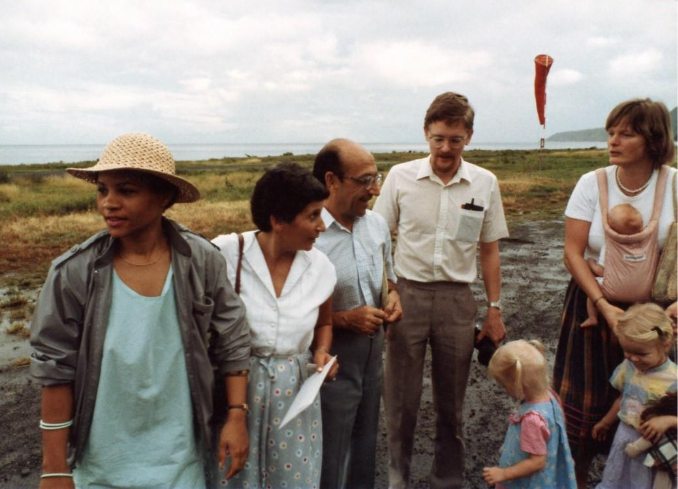
We held our first unity feast a number of weeks later. Heshmat had warned us that many people would come because they would like to see how we lived. Life for them was much harder than for us. We had a mattress, they lay on spare clothes on the floor. We had water piped to the house, they had to go to the river. Most importantly, we had a house and a roof, many people lived in the gap under the house’s concrete slab, the house itself having been blown away. The first time I fully understood how hard it was after the hurricane was a few months later when I was giving a lift into town to a new Bahá’í, Alix Peter. She had five children and her mother-in-law was a Bahá’í. She had also lived with Catherine Alleyne for some time as a child, so she was surrounded by Bahá’ís. However she had not been willing just to follow them blindly, she had wanted to investigate fully to be completely sure it was right. I very much admired her attitude. She would often come with me teaching when she was investigating the Faith and we would sit in the car for hours, talking and talking. This particular afternoon as I drove her to town, I was surprised to hear how she was very grateful for the lift because she wasn’t feeling too good. When I asked her why, she said she felt hungry. I looked at slim Alix and told her she really should not be dieting as she was slim enough. She then quietly said she wasn’t dieting she just hadn’t eaten. When I finally learnt she hadn’t eaten for three days because she had no food and all the food she did have had been given to the children, I was appalled. Many, many people at that time were in the same predicament. So, our first feast was understandably a large cheery affair. I could not believe how wonderful it was to have so many people come. Thankfully we had made a lot of food and jugs and jugs of extremely sweet juice. Everything went!

Our house was fairly close to where Alix and her family lived. I would leave the children with Philip and walk down the hill looking for someone to teach. I was expecting our third child at the time and Alix was also pregnant so we did not want to go far. We would sit in a yard and read the Writings together. Others would join and soon we had a regular mothers’ meeting. The Hidden Words were a great success, often being used to divine the path we should follow. These meetings developed into Unity Feasts on the tiny veranda of Alix’s mother-in- law. She was actually one of Philip’s asthma patients who, to show her gratitude to him, had absolutely insisted on weaving him a grass carpet, doing the very thing which had caused her asthma in the first place!
One of our first public meetings was in a funeral parlour surrounded by coffins where Philip talked, I sang and the children slept! We would often organise a meeting in a village and quickly learnt the importance of taking note of the moon. If it was not a well-lit night no one would come, it would not be safe to climb up and down ravines in the dark. No one in those days had a torch. Instead I remember in one remote hut an old man read prayers by shaking a couple of large beetles in a jam jar. The beetle was like a firefly but much bigger and when shaken it would give off an eerie green light. Locally it was known as a gwo belle meaning big beautiful, the firefly itself was a ti belle or little beautiful. When we arrived in Dominica, electricity was rare outside the capital, so the excitement when we arrived with a generator in the car to show Bahá’í films on the outside of a house was intense. Crowds would come to watch standing in groups in the open air. I would be singing so long and so loud that many nights I would have totally lost my voice by the time we went home. At every major event in Dominica, peanut sellers would gather, eager to sell their nuts. I remember on one occasion, when a key for a hall was missing, singing to keep the people from going home, then looking down to see the peanut sellers busy plying their wares below. I really felt I had made it!
Dominica was a very Catholic country, but the Protestant churches were starting to make inroads. People from one church would hold their Bibles tight to their chests and look the other way as they passed members of another church. They would say that their God was the true God and it took many years before the Bahá’í message of One God finally sank in. I remember walking down a village street meeting a small crowd of people led by a born- again minister. He asked me in a loud and demanding voice if I believed in Jesus. I said yes definitely I believed in Jesus. I suppose to make sure I understood him, he then asked, “Ah but have you been washed in the blood?” I supposed being washed in the blood meant did I really, really believe in Jesus, so I answered with conviction, “Yes I have been washed in the blood!” He was almost disappointed and scuttled off with his small band. It was rather like the time when I went with a friend to her Catholic church and the priest announced, looking straight at me, that not everyone in the church was a bona fide Catholic. He started to sprinkle holy water over all the congregation but when he came to me, he stopped right in front of me. He did not sprinkle, it was more of a deluge. He returned his little brush again and again into the water, and as I wiped water off my face and out of my eyes I thought that he might have thought that I would sizzle!
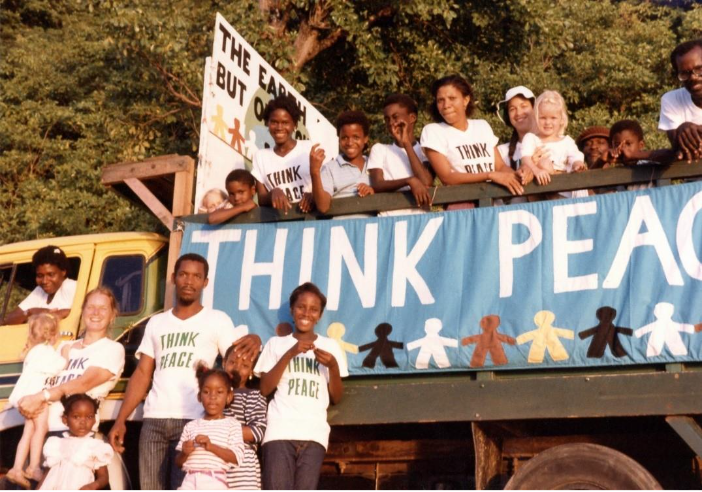
I had been a teacher and had enjoyed making posters so when I saw Albert manning his stall in the Saturday Market, with some pamphlets about the Faith, I thought a few posters could help. He would choose a theme like justice, or the equality of men and women, and I would make a four-poster display on a folding wood board. These were changed weekly and the posters, not to be wasted, were then put up in the Local Bahá’í Centre. I was very happy when Albert gave me his precious National Geographic magazines to use in making the posters as it was a sure sign he approved of the posters! Two other creative endeavours from a not very artistic person were the Peace Truck and the Banner. The Peace Truck was created to give out the 1985 Peace message from the Universal House of Justice. It had a quote painted on a large piece of wood at the front and sewn banners down the sides. (Both the painting and sewing were done after the children had gone to bed!). All the Bahá’ís piled into the back of the lorry and gave the Peace Message to everyone we could, in every village on the island.
The banner was made for the 2nd Bahá’í World Congress in 1992 in New York. There had been a request that every country produce a double-sided banner. These banners were very large and would be hung for display at the event. I did not want Dominica to be left out so bought a load of green, blue and yellow cloth. I draped the green cloth onto the blue so it folded to look like mountains and valleys surrounded by sea, the yellow was the sun with Dominica on one side and Domnik, (the patois spelling) on the other side. People said it looked pretty good.

As a child I had loved the dodgem cars, but in Dominica it was for real. The roads were more pothole than road so cars wove in and out in every direction trying to miss the holes and each other, and the quicker you managed to go, the better. On more than one occasion while driving up the side of a mountain I would meet a huge lorry coming down in the opposite direction. The roads were only single lane so I would be forced to reverse down the extremely steep winding road. With no barriers and a hundred-foot drop, reversing round bends would test anyone’s nerves and driving ability! The other test of nerves was a temporary bridge which had to be crossed to get to Morne Prosper, a village way up in the mountains where there were quite a number of Bahá’ís to visit. One of these Bahá’ís was Mary John. Before becoming a Bahá’í she had been totally illiterate, but her desire to read the prayers had changed all that, so there was no way I could not go. Now I would always take our children with me as I went teaching, but at this bridge I would ask them all to get out and walk across by a special path for pedestrians. The bridge for the cars consisted of just two planks placed car-wheel-width apart over a raging torrent thirty feet below. In the water were the cars and lorries of the people who hadn’t made it. I would bundle the children out, say a quick prayer and, not looking down, edge forward. The wood, mercifully, was strong and did not bend, but as my back wheels finally dropped off the wood onto solid ground on the other side my prayers of gratitude were many. The return journey was a repeat performance. Thankfully, as the country continued to recover from the hurricane damage this bridge was replaced.
Dominica was indeed a very dangerous place, but oh the beauty was indescribable. Massive forest trees with buttress roots, hung with lianas and flowers, lined the roads. Bursting from what seemed like a green tunnel we were met by glorious blue sea and bright sun, then straight away back into the dark mysterious forest. It was stunning. However, very few people drove out into the country from town, it was considered by Dominicans as “Behind God’s Back”. This was wonderful for me because it meant that there were few cars to give lifts to an eternal stream of walking people, which meant of course that I had a captive audience in the car for teaching! Our girls sitting in the back of the car would play a game of guessing how long it would take me to bring up the subject of the Faith. It was usually about a minute I was told!! When I had learnt where our passenger was going, I would tailor the amount I would say for that distance. In 33 years of giving lifts to hundreds and hundreds of people I only once met a person when I was travelling alone whom I did not want in the car, and at the exact moment when an arm crept round the back of my chair, my husband rang and when I told him exactly where I was and when I would be home, the creeping arm retreated!
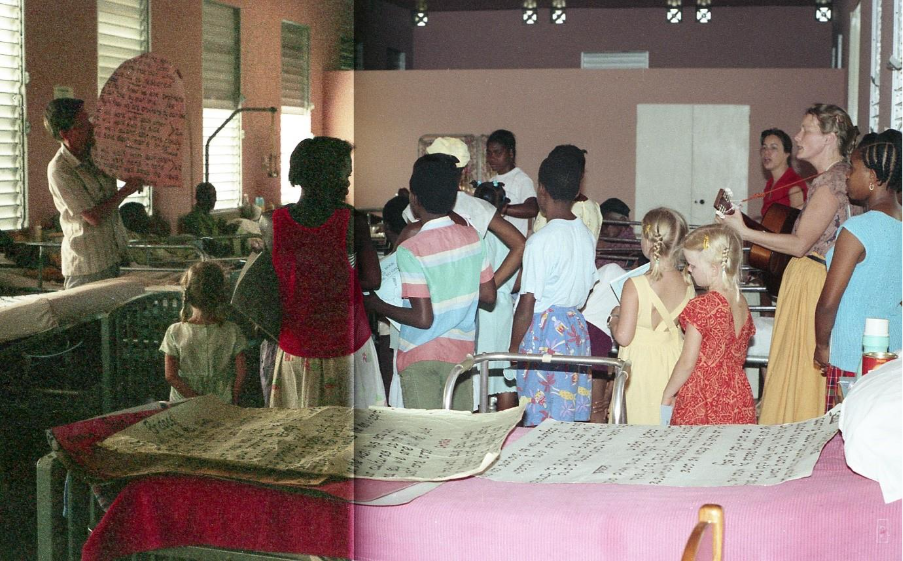
Most weekends when the girls were small, Philip and I would take them to a village where I would play the guitar and sing songs like “Drops”. The girls, though small, would hold up the large pieces of card with the words on and Philip or Dr. Taeed would give a talk about the Faith. But sadly the Taeeds had to leave and Philip’s workload became more and more onerous. So I decided I should go off teaching by myself. The first time I went to a village alone I got to the top of the mountain, got out of the car, looked at all the houses spread over the top of the ridge and totally panicked. I felt so completely alone. Quickly I unlocked the car, jumped back in and dashed down the hill to home and safety. But all the way down I felt such a failure. I made sure that that never happened again: I would be prepared with prayers and I would not lose faith. In Dominica, it was easy to see the source of our strength. Examples were all around us. Like the time when, teaching alone in a very rough area, I had hoped to meet up with Mr. Wade, a Bahá’í who was later honoured by having our first Bahá’í funeral, but he was not home. So, determined not to turn tail, I decided to see who I might meet. A large crowd of young men soon closely surrounded me, laughing, shouting unpleasant comments and blocking my escape route. I was on my own in a very hostile and threatening situation. But there in front of me I did have a crowd of people! So what else could I do? Just teach! After a few minutes of my talking, some of the most aggressive drifted off, not interested, and started to chat amongst themselves, some were listening but not involved, but some, a glorious few, were actually listening. I counted that as a very good day indeed.
People were generally not the danger; the thing I really didn’t like were the dogs. One particular vicious creature was Freeway who totally lived up to his name. He blocked the path to Anora and Gloria Samuel, friends in Eggleston. Now I was always told that Dominican dogs ran away if you bent to pick up a stone, so thinking this was my way to get by him, I bent to pick up a stone. To my total horror the dog ran towards me and was literally an inch from my face, teeth bared and ready to bite. The noise of my scream reverberated round the valley, echoing back and back again. The noise must have stunned the dog because I lived to fight another day and he didn’t bite. On another occasion going down the same path I heard a rustling in the elephant grass. “Please not Freeway, not Freeway,” I said to myself. Well it wasn’t Freeway, it was a Rasta. The militant Rastas had lived in this area of the island and had killed the white people close by. However I was so pleased it wasn’t Freeway I almost laughed. Now here was one of these Rastas bent at the waist in front of me, his long dreadlocks swaying to and fro. In a voice of almost theatrical menace he growled, “Aren’t you scared to be here?” Looking round and feigning innocence I sweetly said, “No, should I be?” He dropped his acting, looked a bit embarrassed and stood up, his swaying locks coming to rest while he muttered in a normal voice, “Er no, no, not really,” and shot off back into the tall grass. That day was the start of a wonderful friendship where we would often laugh about our first meeting.
We did not send our girls to the local school, there was too much prejudice against whites. So instead I started the One World Bahá’í School, an infant and junior school. To fit in with all the local schools and make people realise we were serious about learning, we had a uniform! To begin with it was just our three girls but after a while the numbers swelled to eight, with three other families joining us.
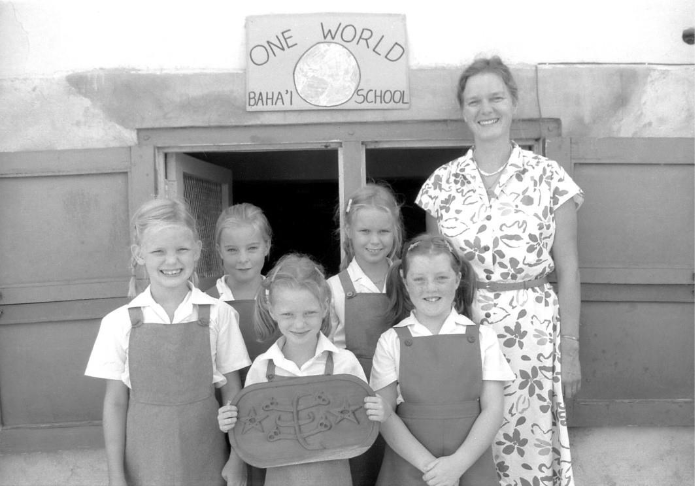
(photo by Mark Vaccarro)
We had thought that for secondary school they would return to the UK but that had not worked out. So the secondary school work was done by correspondence courses, pre- internet of course. It took at least six weeks for them to get an opinion on an essay or even a mark! I remember one time I had been doing the ironing upstairs and had gone down to have a chat and relieve the boredom of housework. I was met by a smile but the firm words, “Please Mummy, we are trying to work”! They were my stalwart supporters all their lives, driving with me all over the island, reminding me of names, events, children’s names, village connections etc. etc. They invented games for village children’s classes, started youth groups, did service projects, beach clean ups, and helped in the Infirmary, the care home for the sick and abandoned elderly. This Infirmary service was later undertaken by the Bahá’í Youth Group that they had started, and for many, many years was used as an example, on local radio, of how youth should be. They also helped with the very popular Summer Schools where one year I had 76 children of all ages in a single room with just the help of a few 12-year-old children. I remember the outrage of one of the participants at this particular summer school when an adult had dared to suggest that they would have been noisy! He so vehemently denied it that there was no doubt at all they had been well behaved. I laughed to myself remembering the large bag of “Goody Goody” sweets, prizes for remembering quotes, showing a virtue, sitting up straight, helping, or even just smiling! Times with the children’s class though had not always been easy. When we had started the children’s classes in the Local Bahá’í Centre, word had quickly gone out that something new would be happening in the main drug area of town. When I opened the door, children from 3 to 18 were waiting on the steps, many clutching half-drunk beer bottles. I insisted that the bottles were left outside when they came in, and could only be collected when they left. For quite a while after that, our classes were accompanied by rocks landing on the roof and bangs on the closed shutters. But the girls and I plodded on, and eventually the classes were so popular in the area that the priest had to announce from the pulpit that no Catholic children were allowed to go to the Bahá’í classes. Of course this ban only lasted a few weeks and just encouraged more children to come. There were so many I could not remember everyone, as the next story shows.
I was a local Red Cross Board member and was putting on a play with some of the Red Cross children, to welcome an overseas executive visitor. Suddenly I became aware that the children were discussing the Bahá’í Faith. Complete rubbish was being spoken and I was just thinking of joining in when I heard one girl, about 16, speak up clearly, explaining beautifully the truth of the Faith and how the other children’s ideas were all wrong. I was very impressed but totally mystified as to how she was able to speak so knowledgeably. Later I asked her how she had learnt about the Bahá’í Faith, and she said, “Oh miss, don’t you remember me? I went to your classes when I was little, but then we moved away.” She had remembered everything for over six years. The classes were well before we had Ruhi Book 3, so I was very glad to become aware of things she had retained so well. Another activity of our Bahá’í class was to make service films for the National TV station. These films showed how to look after the environment, how to reduce the risk of dengue fever, how and why to keep gutters clean, the danger of glass on a beach, etc. etc. The children were great, taking being movie stars very seriously and really entering into the excitement of the whole thing. I was very lucky to have Mark Vaccarro to do the videoing. The videos were aired numerous times on prime-time television and were always announced as a service project from the Bahá’í Faith.
As the children in the children’s classes grew in number and age, I tried to give them different experiences. The things we take for granted were certainly not the norm there. I remember a boy of around 12 years nearly in tears because his painting was such a mess. He was putting his dry brush on the dry paint then in the water then on the paper. I was amazed to find that a 12-year-old boy had never painted before. But I shouldn’t have been surprised, after all I remember in a rural village a man in his 50s not knowing how to hold a pencil. When we first arrived, there were no such things as children’s toys, no girls carried dolls and no boys played with cars, so in the children’s class we tried to make these things. At Independence time when it was traditional to play drums, we made drums by stretching plastic over large milk tins and beating them with sticks from the cocoyea broom. The noise was fantastic and their drumming skills were phenomenal, bringing in passers-by from the street and the admiration of the official La Peau Cabwite (goat skin) drummers. We did rudimentary woodwork, sewed pillowcases, played table tennis as well as studying the Faith and virtues. We would go to the hot springs to boil eggs, hike high into the mountains, and have fun times at the beach as well as do beach clean ups. So many children would be sitting in the back of our pick-up truck for these outings that the front wheels would go up in the air requiring a speedy rearrangement of weight inside! Later, the youth group would come up to our house to study the Ruhi books, swim in the pool and have macaroni. An old woman who lived opposite the Bahá’í centre confided in me that she could tell which of the children in the area went to the Bahá’í classes. She said, “They were different, they were better than the other children, they even walked different.”
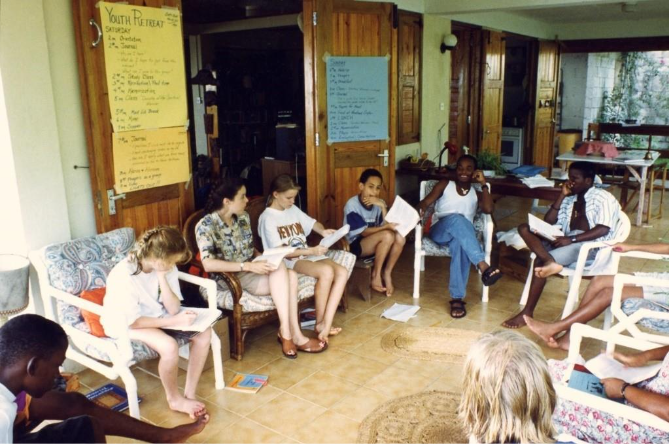
World traditions were often not the same in Dominica. Like Halloween for example. It was not the time of dressing up as a ghoul or a ghost and going trick or treating, but the time for tidying up the grave of your loved one and for prayers. Christmas was the time of singing about snow and reindeer but no one knew what snow was like. I would race down to the Bahá’í Centre with the frost from our fridge. The kids were horrified by the fact snow was so cold! We would drive round the richer areas of town looking for good Christmas house illuminations, marvelling at the best before taking everyone back home. In the hospital, Father Christmas would go round giving presents to the unlucky few who could not go home. The first time I saw Father Christmas on the wards I was totally spooked. He had a red hood completely covering his head with just the eyes cut out. As he walked round in complete silence he rang a little bell and for all the world looked like a red Grim Reaper. I decided we should cheer up his progression round the wards, so with a baby tied on my back and the guitar on the front, Philip holding the hands of a 2-year-old and a 4-year old and struggling with the words on sheets of card, we walked after this red apparition singing Christmas carols galore. Nurses joined us, then doctors, and the media came to record us and interview Philip in Creole. After that every year we would work our way round the different wards to end up being locked into the psychiatric ward with the patients where you never really knew what would happen. One year the girls and I stood merrily singing round a gurney (a wheeled stretcher) with a dead body only covered with a flimsy sheet! When singing was over we would always head for the nurses’ room and a piece of black Christmas cake. It became a tradition for our family to do the hospital, eat macaroni, then go for a swim at the beach. This tradition continued long after the girls had left.
For seventeen years our girls had helped with children’s classes, youth groups, village teaching, Feasts, everything. Now they were all leaving at the same time, one to university, one to 6th form and one to school. I decided that as I was free of the responsibility of taking care of them, I would make teaching the Bahá’í Faith and holding Study Circles my full-time job, I even made a timetable! Every day I would head off to a new village in a new area of the country sometimes alone but often with either Catherine Alleyne or Alix Peter. My new life had begun.
———————————–
On my own
Even though many years had passed since hurricane David, and the roads and bridges had been repaired, it was still very dangerous driving in Dominica. Roads would continually slip away into the valley below. The mountains were very steep and if there was rain, the soil could become very unstable, causing mudslides which could cover houses or even whole villages. I remember zooming round a corner once to see there had been a landslide and a whole portion of road had disappeared. Looking to the right, I saw a sheer drop of easily 300+ feet, and to the left, a steep slope of slipping mud. Not wanting to turn around and with no alternative route to visit everyone on the round island trip, I rather crazily decided to just have a go. Backing up and revving furiously, I roared up the mud slide flying over the gaping hole on just two wheels and thumping down on the other side as the loose mud slipped and fell away hundreds of feet below. Thankfully, the next time I went that way the road had been repaired. Another very close escape on the roads was when we were meant to be catching an early morning plane. We had had continual torrential rain for days, so the airport authorities had rung us explaining that our plane was the unlucky one and would have to be delayed so the pile up of waiting planes could be cleared. On the night before the morning we should have been travelling, the road had been so badly eroded by the rain that a length of about 10 metres had totally disappeared, leaving a huge chasm down into a river which was totally invisible in the dark. We had been saved by Divine Intervention, but sadly four men racing at that time to the airport crashed into the abyss and were drowned.
As pioneers left and local friends did not have cars, the number of people able to go village teaching dropped until I was the only one left. It became imperative to try and help the communities become independent and able to hold feasts, elections and to run children’s classes without waiting to rely on my visits. I decided that the first thing to do was to encourage one or two people in a village to meet together to hold prayers. The National Spiritual Assembly thought that this would be a good opportunity to share the Holy Writings as well, so I started the 19-day Feast package. These letters had a short chat about the meaning of the name of each Feast and then some readings, again with explanations for difficult words. They were sent, or preferably taken, to every village where there was a Bahá’í and proved very popular indeed. I was overcome with pleasure when I would hear that Cecil Prevost, a Bahá’í with only one arm and one eye (a fishing accident while dynamiting the reef) had called his whole village into his house to share the readings. I remember trying to help Cecil count his 95 Alláh’u’Abhás with only one hand to count on! and when another Bahá’í (whose name I have sadly forgotten) in a different village called the street hucksters to share the readings at the side of the road. Francillia Darroux and Saturine Dodds started a Bahá’í community in the Carib Territory, where friends would regularly come together to read the Writings. Many of the Bahá’ís just shared the Feast packages with their families, but everywhere the feedback was very positive. With this success I decided we should start children’s classes island-wide. It was before Ruhi Book 3, but what we did was surprisingly similar. However, these lessons did not really take off. The adults were not willing to commit the time, even though the children really wanted the lessons. It is one of my greatest regrets that I was unable to hold children’s classes in every village. The Local Spiritual Assembly elections were a yearly delight! I would start getting letters off to let everyone know it was that time of the year, then more letters explaining what was happening, then more letters explaining there was a time limit. To do the elections I relied chiefly on the people who had been busy with the Feast packages, so I knew who could be relied on and who would need a bit of support. I remember one year shortly before we lost our National Spiritual Assembly collecting the voting lists for the new Local Spiritual Assemblies from 12 separate villages from every corner of the island. All had elected their own LSA’s at the right time and under their own steam. It was wonderful. I felt that we had the bones of a countrywide community. Sadly, in trying to consolidate our Bahá’í community we had not expanded sufficiently and instead of a National Spiritual Assembly we had an Administrative Committee. This seemed to take the stuffing out of the community. People felt disenfranchised from the Faith, having no say whatsoever in the election of the supreme body, The Universal House of Justice. The one bright light was the Carib Territory.
Catherine and I would often head off to the Carib Territory on a Wednesday. The journey was long, winding, dusty and very hot in a car with no air conditioning. To freshen up and arrive at our destination cool and clean, we would often stop and swim in one of the many rivers on the way. It was beyond idyllic. We were surrounded by hummingbirds, flowers and beauty; prayers of gratitude were never enough. To my initial amazement Catherine, much older than me and used to washing in rivers from childhood, just threw caution and clothes to the wind; truly it was a Garden of Eden! As we drove along, we would challenge each other to see who knew the most prayers or quotes by heart. On one journey we travelled for nearly two hours saying prayer after prayer and quote after quote. When travelling alone I would always perch my Ruhi book on the dashboard in front of me. I remember once giving a lift to a Catholic priest while I was learning, “O wayfarer in the path of God,”. I immediately asked him to hold the book and read it out to me. We both learnt it! By the time we reached the centre of the island where he had to get out, he said with shining eyes how our journey had been the best most spiritually uplifting time he had ever had. Sadly, I never saw him again.
It was always fun travelling through the Carib Territory. I would time my return home to coincide with the school “home-time”. Some of the children would have to walk over two hours to get home and as this was a primary school I felt very sorry indeed for the little ones so it became a regular thing that on Wednesday I would fit into the car as many children as I could. If there were any complaints about the crush I just had to say, “No problem, walk if you want.” No one ever did! I remember once stopping to let them all get out of the back of my small blue Jimny. The amazement of a group of men as they counted 17 children climb out was perfect and had me chuckling most of the way home. I knew these children from a strange roundabout connection with the UK. When our own girls were leaving home and going to 6th form and university, we had bought a house in Scotland to be a pied à terre for them. It was badly needed, as one of Dominica’s thirteen active volcanoes was rumbling and expected to erupt, and it was only half a kilometre from our house. Mrs Singer, the local postmistress in Auchenblae, Scotland, had really taken to heart the fact that the children in Dominica would appreciate the unsold toys often stuck onto the outside of the UK children’s magazines. She would collect bags and bags of these things and I would fill my return suitcases with them. I would make a huge lucky dip and then take it over to the school in the Carib Territory. We would sing Drops and Magic Pennies etc., and I was never really sure who enjoyed these visits most, the teachers, the children or me. They always were very jolly affairs and very useful for the local Bahá’ís to use for teaching.
The Carib territory or as it is now known, the Kalinago Territory, was on the other side of the island and though it is maybe twelve miles away as the crow flies, it would take many hours to get there on the winding roads. Both Saturine Dodds and Francillia Darroux were Indigenous Kalinago who lived in the Kalinago Territory. Both had been members of the NSA, and though they had to cross the island on Sunday for the NSA meetings, which cost 40 dollars each in transport, they had never missed a meeting. They were both very capable, strong women. Saturine had been a Bahá’í when we arrived in Dominica while Francillia became a Bahá’í as we studied the Ruhi books under a neighbour’s house. This house was leaning over so crazily that I was always worried it would collapse on top of us. It did eventually fall over but luckily we were not there and no one was hurt. Initially, Francillia was debating about following one of the many other religions, but after completing Book 2 she happily became a Bahá’í, and so did her six children. That was the start of the intense activity in the Kalinago Territory. I would go over without fail at least once a week and would often take my computer to show them the latest Bahá’í film. In the middle of the day, the sun was very bright, making the screen difficult to see. However, I would bring over my washing basket and put blankets over the top and the computer inside. We had a wonderful, if small, cinema out in the open under the mango trees. As each new Ruhi book would be published we would start a new study from which grew children’s classes, a youth group, Feasts, study classes and many devotionals, all initiated and maintained by the local friends. It was unbelievable going to meetings where I was just a visitor. The youth themselves initiated teaching trips, bringing their friends and neighbours with them. Francillia became an Auxiliary Board member and I felt the light of the Faith radiating out of the Carib Territory to the whole of the Caribbean. What an honour and blessing to have been part of it.
Another good friend, Gloria Samuel, had become very ill while pregnant. Her morning sickness was extreme and had removed all B vitamins from her body. She lost the child and was in great danger herself of not surviving. We decided to have an emergency prayer meeting, at her mother’s home. Gloria by now had been evacuated to Martinique where medical care was more advanced. We all crowded into the small wooden house lit only by one faint electric bulb. The response repeated after each verse of the Long Healing prayer was learnt by heart, then in almost complete darkness the Healing prayer with the response was said by all fifty present. It rang out into the darkness and the spiritual cry for help was heard. It was that very night that the doctors in Martinique said a miracle had happened, one they were unable to explain; Gloria had survived. If that small community ever needed confirmation about the truth of the Faith all they had to do was remember that night. Gloria’s sister Anora Samuel was a wonderful Bahá’í who stayed firm and active in the Faith. She would hold Feasts, devotionals and always be ready to say prayers. I remember once explaining to her that the House of Justice had asked that we should now try and chant our prayers. Straight away she chose the short healing prayer and began to chant. It was so loud and so tuneless and so wonderfully full of deep and certain faith that even to this day I feel shivers down my spine.
Another person who sent shivers down my spine because of being a great and wonderful soul was Rena Raphael. My husband had first met her at one of his clinics. She had come to see him because of deterioration in her sight. He realised something was seriously wrong and had gone to her home to follow up. He was horrified by what he found. People were lying in the utmost poverty on a mud floor inside a dilapidated hut, and all were at different stages of dying. The family had a very rare mitochondrial disease. However, in a simple society it was considered the fault of the family and they were treated as lepers. Rena was looking after them all. She had been their main carer since she was 8, running home from school at break time to get water or tend to other needs. In this way she had cared for her dying mother, aunts, uncles, brothers, sisters and later her own child. Rena, now in her twenties, learnt of the Bahá’í Faith and immediately became a Bahá’í. She knew exactly how her own life would progress, the blindness, the twisting paralysis, then death; she had seen it so many times before. But Rena was unfailingly happy, even joyous. As the years went by and her condition slowly worsened, she never lost this joy, always answering cheerily to the question of how are you? with, “I’m fine.” When she was unable to walk, Philip would carry her in his arms to the Sunday service in the Bahá’í Centre, but when even that was impossible, she was moved to the infirmary. There the priests would come again and again, trying to bring her back into their fold. I can never forget walking onto her ward one day and seeing at the far end the priest leaning over her and whispering something into her ear. Then blind Rena, her young body twisted and frozen, her face radiant and joyously shining, triumphantly shouted out to the insistent priest, “I…..AM.….A…..BAHÁ’Í.”
After Mark and Allison Vaccarro left, doing radio programmes for our 15-minute slot on Sunday became more and more difficult. Mark tried to continue making them in the States and we limped on using replays of old programmes for some time, but then he decided to call it a day.
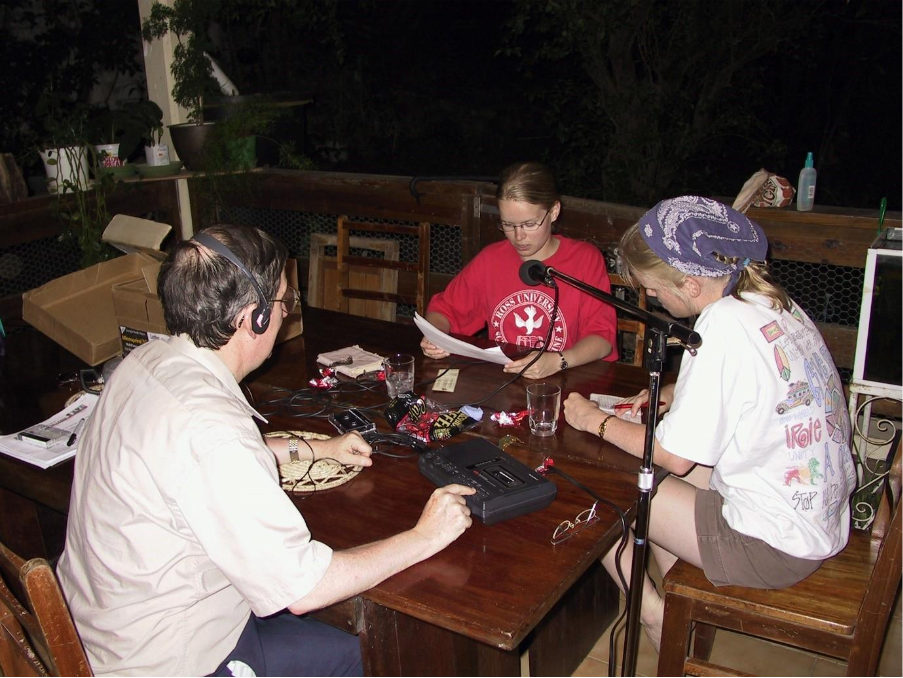
Rather than let our time on the airwaves finish, I decided I would see what I could do and have a go. It was fantastic fun. I would go out and about and record Bahá’ís reading quotes or prayers. Most people were so shy it took a lot of encouragement for them to talk, but mistakes and cars passing gave authenticity, and as it was the only programme like this, Dominicans loved it. Some, especially the youth, recorded little skits to illustrate either a virtue or a principle. Holy days were remembered on air, and isolated Bahá’ís said how much the programmes meant to them. We used jolly West Indian Bahá’í music, recorded in Jamaica, as our introduction, and I can proudly say we never missed one Sunday Morning.
Being pioneers, we were more than blessed by having continual visits from wonderful people. Some were Bahá’ís who were considering moving to the islands, but many were Bahá’í giants. Before I even realised the bounty of having a Hand of the Cause in our house, I was serving tea to Mr Khadem. Jenabe Caldwell gave us study classes and Mr Yazdi, who had lived in the house of ‘Abdu’l -Bahá, was telling us stories of his childhood. Mr Khazei showed his selfless dedication by donating land for the future building of a Bahá’í Centre and Delores Springay, a young Inuit, gave of her time and energy to show we are one people on one earth. Dr Taeed had been challenged by a Dominican over the concept of the Earth is one Country, and was told that an Eskimo would not be able to live in such a hot country as Dominica. Dr Taeed had immediately risen to the challenge and had paid for Delores to come down and prove we are one. The visits from the Counsellors were invaluable, showing dedication, love, and support. Loretta King, Artemis Lamb, Errol Sealy, Holly Woodward, and more, but above all Mrs Ruth Pringle, a glorious shining star in the history of Dominica.
Jenabe Caldwell said, “Just follow the instructions.” We were told to teach and that is what we did. Now our three girls are all strong Bahá’ís and bringing up our seven grandchildren as Bahá’ís, what more could one want? Truly we have been and still are, so completely blessed.
Back to the UK
Philip cannot go back to Dominica until the government changes, the reason being he was asked by relatives to explain in court how the hospital had caused the death of their loved one. He had to tell the truth. The court case was explicitly clear and came down against the government. As Philip was instrumental in this judgment, they made it increasingly impossible for us to stay. I hope to return some day, and I still keep in close contact with Francilia and Alex. In fact, Alex and I are at the moment doing the new Ruhi Book 2 using the WhatsApp messaging service!
However, coming back to the UK has not been easy. For two years I was unable to get out of Dominica mode, thinking that people would want to talk about religion and would be interested to hear of the Faith and even join a study circle! At a party when I had introduced the Faith into the conversation a person said to me, “You must tell me about it sometime.” I had taken her at face value and a few weeks later went to her house to tell her more! She was truly horrified! But there are blessings being here as well. I am able to read Bahá’í books for Kari, my blind school friend who had taught me the Faith. She and I meet up every time I leave my Scottish home and go to England, and we read a page or two of Ruhi Book 10. At the moment I am recording God Passes By for her. What a book!
In order to meet people when Philip and I came back from Dominica, I had joined as many clubs as I could; The Friendship club, Probus, Inner Wheel, two walking groups, Tai chi, The Heritage Society, Auchenblae Community Association, Stoney Fiddlers, Bowling Club, Community Café, Knitting and Crafts, and the list goes on. When I knew the family of a person who had died I would visit with an “Open Door” booklet. Everyone was very grateful and always said how they enjoyed the Writings and found such comfort from them. I started a Wednesday devotional, inviting everyone to join us, and placed a “Thought for The Week” from the Writings on the village notice board. I even started three study circles and a children’s class using local youth to help, but did not manage to light a fire of real interest. That is until now, and this is how it happened. We had gone to the local church, but this particular service was one of church business so we decided to leave early. As we left, we started chatting to a woman who was also leaving early. It turned out she was a Romanian who could speak very little English. I went round to her house to help her with her English and to learn Romanian! Now we have been studying the prayers and Ruhi Book 1 for a number of months, all in Romanian. Her constant words as we read the prayers and the writings are “frumos, frumos”, beautiful, beautiful. The Minister from the church also feels the power of the Faith, because whenever they have a prayer meeting, I like to go along and share a Bahá’í prayer. He says he feels a mighty spiritual wave wash over him. Sadly, even though I’ve given him many books, he has not wanted to investigate further. At one service he asked the congregation who was the strongest person they could think of. Ideas were called out like Batman and the Hulk, but I said, “One of the Manifestations” and gave my reasons. Knowing from earlier chats what I meant by Manifestation he asked which one. He looked at me laughing, almost daring me to say any name other than Jesus. However, as the church, condemned to be closed by the Church of Scotland, rang to the name of Bahá’u’lláh, I felt the whole building respond with relief and joy. It was quite amazing.
Whenever we have had a conversation, however small, Philip and I will share what was said and if there can be a follow up. Because our house is very rural, we are both volunteers for the Mearns and Coastal Healthy Living network. This group provides transport for hospital appointments, dentist etc. The long journeys into the city always provide perfect opportunities to chat. Philip was asked by his Rotary group to give a talk on the Faith and though it was well received with a fair bit of interest, it did not go further. It was the same with The Twin Birthdays. We had nearly 50 people at each event, and an overheard comment as people left the hall was, “Sandra’s events always make us feel so happy.” But how do we take it further? How do we begin to awaken the dead? We continue with devotional meetings, eating far too much cake, supporting activities in Aberdeen and our area. We have been able to take two elderly Bahá’ís to the Mother Temple in Germany and a couple of years later on pilgrimage to Haifa and now hold a weekly study with them in their house.
Our three girls are far away: Abigail is in Canada, Holly is in America and Faye in Northumberland, UK. However, once a week, without fail, we all get together on zoom and share our news. Our girls all did well. Abigail, who went to Dominica aged 2, is a lawyer and is now the HRSF of Surety in HER International American Insurance firm in Canada. She is married and has three children. Holly, who arrived in Dominica aged 4 months, is a geologist who having left Shell is now working as a high school teacher in Boston. She is married and has two children. She also holds Bahá’í children and youth classes in person as well as on zoom, and is a regular teacher at the Bahá’í Centre in Green Acre. Faye, our third daughter who was born in Dominica, is a hospital consultant in the UK and is also doing ground breaking research into autoimmune diseases. She is married with two children. The grandchildren are growing fast and the three eldest have now declared their Faith in Bahá’u’lláh. Both our girls and grandchildren are in their own way sharing the Faith with the people they come across. I love to get the excited phone calls saying how they have met someone who has shown real interest in learning more.
I would like to finish this very long account with the words we used to sing so loudly and fervently in the Bahá’í Centre in Dominica. People would come in off the street, Rastas would beat on the drums and all of us would be lifted to a higher plain of existence.
O Lord! Enable all the people of the earth to gain admittance into the Paradise of Thy Faith, so that no created being may remain beyond the bounds of Thy good pleasure. From time immemorial Thou hast been potent to do what pleaseth Thee and transcendent above whatsoever Thou desirest. The Báb
________________________
Sandra Hogarth Cooles
Scotland
March 2023
 UK Baha'i Histories
Dear Sandra,
it was such a delight to read your story from beginning to end. Could not stop reading. It brought back so many memories of my seven years pioneering in the Caribbean.
Sending much love from Germany to Scotland
How beautiful. Your description of your life and in particular, your time in Dominica makes my heart sing.
Many of those you mentioned, we knew from our time in Grenada.
You are an inspiration to us all.
Arthur
geeeeee, most wondrous adventure for the Greatest Name and the future of the Cause of God is guaranteed .. .. ..