
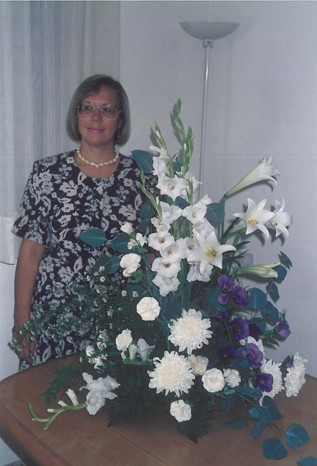
I was born in Birmingham in 1947 soon after the Second World War ended. My father Arthur Thomas Baller worked at the Austin Motor Company and my mother Jenny worked at Cadbury’s. Their families were from Birmingham but previous generations must have moved to Birmingham during the Industrial Revolution. My father’s forebears came from Worcestershire and my mother’s from Derbyshire. My older sister Barbara was born before the war and evacuated during the war to Worcestershire. At 18 she emigrated to Australia. My brother Robert Allen was also born before the war, he still lives in Birmingham. My mother lost a baby at the end of the war and then I followed. I remember a very happy childhood with lots of family around (I was one of twenty-five cousins) and good neighbours. Sadly my father suffered from heart trouble and he died when I was only sixteen.
First, I attended the small Methodist chapel on Raddlebarn Road, Birmingham, and then my godmother, Mary Chambers, took me to Saint Wulstan’s Church. I was confirmed and became a Sunday school teacher. From primary school, I went to Selly Park Secondary Modern School for Girls and then to Bournville Grammar Technical School for Girls. I got five O-levels and three A-levels. I volunteered for a year at Saint Basil’s Youth project in central Birmingham before working at Cadburys in the Patterns Office for a year. Then I went to Westhill College Selly Oak, where I trained to be a youth and community worker.
During my sixth form years, I was often engaged in community projects. As a result, I came to know about the work of the International Voluntary Service. As well as projects, they also organised social events and I attended one with my school friend Pauline Cunningham. It was a barn dance in a hall in central Birmingham. There was a very lively group also attending and on our way home, at the bus stop, one of them approached us. He asked if we had seen his friends as he had lost them. We had not. We started chatting as we were all waiting for the same bus. He introduced himself as Bidar Ashraf. He was wearing a small star shaped badge and we asked him what it was. He explained that he was a Bahá’í and promptly invited us to a public meeting the next day. The bus came and it turned out that he and I were getting off at the same stop. I had farther to walk and that took us past the home where he was staying. He invited me in to meet his friends. I accepted.
Inside were many of the young people who had been at the social event. I was given a seat and tea and invited to listen to the father of the house who told me more about the Báb and Bahá’u’lláh and the history of the Bahá’í Faith. I later understood that he was Hand of the Cause of God Abu’l-Qasim Faizi. Mr Faizi always travelled a lot and was not in Birmingham for long, but later he kindly sent me a letter and a gift dated 20th December 1966. Inside a beautiful card he wrote:
Dearly beloved daughter,
Whenever I think of and pray for May, you are also remembered and I wish you all the best in your precious life. May the Lord of this season keep you under His special care and protection is the ardent supplication of this humble servant.
I hope that you will be successful in your studies, services and aspirations. I pray that a glorious life will be yours – a life full of real happiness and spiritual upliftment. I should be very glad if you would accept the enclosed Persian handkerchief as a souvenir from the one who often remembers you.
Yours ever
Faizi
I was very interested and charmed by all this; fascinated to learn about something I hadn’t heard of before. I became friends with the daughter of the house, May, and often joined in with activities they were involved in, such as putting up a showcase display about the Faith in the centre of Birmingham and a trip to visit Stratford on Avon to see the Bahá’ís there – Ann and Phillip Hinton. Philip was acting at the RSC at the time and we later saw him in Birmingham in A Chorus Line. The Faizis were very kind and hospitable, always welcoming. It was only later I realised how carefully they were teaching me all about the Faith.
The first Bahá’í weekend school I attended was at Birmingham University. It was on “The Dawnbreakers” and was led by Mrs Gloria Faizi. It was part of a series that I attended and although it was difficult to get my head round all the names, it was gripping. We remained friends until the Faizis left Birmingham. After that I didn’t have a lot of contact with them for a while but my mother prompted me to find out how they were when the Six Day War occurred. They were all fine.
I remained in Birmingham finishing my education; convinced that what the Faizis had told me was right, but that it was their religion. However, I did take to heart one of the laws of Baha’u’llah and stopped drinking alcohol from that time.
I was training to be a Youth Worker and went on a hitchhiking trip around Ireland with a fellow student. I told this friend about the Faith and she expressed an interest. I was able to find out that another Bahá’í family was living in Birmingham, Patrick and Patricia Green and their two sons. We visited their home and attended some firesides. My friend decided not to continue but I did. I met many friends through the Birmingham Bahá’í Community and again went to lots of activities. This time I actually read the books I was offered and came closer to The Faith. The Bahá’ís kindly invited me to a special meeting in London and I was told that Amatu’l Bahá Rúhíyyih Khánum, the widow of the Guardian, would be speaking. Everyone was very excited about this and I was very happy to accept the invitation.
We arrived in London and went to the home of Earl and Audrey Cameron in Ealing. Adib Taherzadeh was also there and he served us all tea. He especially mentioned the importance Bahá’u’lláh had given to green tea. We went to the meeting. There were so many people there. After the talk everyone present was invited to line up to meet Amatu’l Bahá Rúhíyyih Khánum. This surprised me at the time. Everything I had heard about the Faith had involved equality and it seemed odd to me at the time that we should have to line up to meet someone. It didn’t even occur to me that this meant that everyone would actually get a chance to meet her which wouldn’t have happened if we had just mingled. But it bothered me and I asked Quentin Lewis, who was with me, why this should happen. His reply in an instant enabled me to understand that Bahá’u’lláh was indeed the Prophet of God for today and that The Universal House of Justice was the centre to whom we should all turn and look for guidance and offer obedience. Following the teachings of Bahá’u’lláh would bring peace to the world which it needed so much.
I declared as a Bahá’í on 8th August 1969. I received a beautiful white covered prayer book from my friend Quentin and a copy of Bahá’í World Faith from the Bahá’ís of Birmingham signed by:
- Pixie Rawhani
- Monica Jarvis
- Mansur Hussain Shah
- Amelie Campbell
- Malcolm Lake
- Daryoush Kazemi
- John Ball
- Patricia Green
- Enayat Rawhani
- Patrick Green
- Richard Blake
I served for a while on the Local Spiritual Assembly of Birmingham and when I finished my course and qualified as a youth and community worker I went as a pioneer to Chelmsford in Essex. I was reunited with May Faizi who was living there with her husband Peter and baby son Paul Faizi. I worked at a youth centre in Malden in Essex for over a year during that time. I was very privileged to be also reunited with Mr Faizi when he visited his daughter and her family.
During this time, Naysan Faizi was married to Zohreh Zahrai in Chelmsford and so we were all very honoured to have the wedding party there. Here I was privileged to meet Zohreh’s parents Mr. and Mrs Zahra’i. it was such a happy day and included so many friends and family members including dear Mahnaz, Zohreh’s auntie, who has been a lifelong friend of mine and helped me so much.
I was able to serve as the secretary of the National Youth Committee at that time under the chairmanship first of Liz Morley (later Emerson) and then Shahram Mottahed. (We often went afterwards to the Afsharians’ home in Barnes where Shahram’s fiancee Mojdeh lived with her parents.) Later, Moojan Momen (whose wedding in Cambridge to Wendi Worth was such a splendid occasion) was the chairman of the Committee, with George Bowers serving on the Committee as the representative of the National Spiritual Assembly. There were so many Bahá’í youth activities all over the country and many many gatherings. After each committee meeting I was in contact by letter with each of the Bahá’í youth to encourage them.
In 1971, there were two international youth conferences: one in Plon, Germany attended by Hands of The Cause Mr Faizi, Dr Muhlschlegel and Mr Olinga, and the other in Fiesch, Switzerland, where we were blessed with the presence of other Hands of the Cause of God Rúhíyyih Khánum and Dr Muhlschlegel.
There was also a great summer school at Harlech and it was there I made an offer to Pioneer to Africa when a call was made. I didn’t know how I was going to do this or when, but within a few months I was married and on my way to Dahomey, now known as Benin, which was part of the area covered by the National Spiritual Assembly of Dahomey, Togo and Niger.
After a difficult journey and getting stuck in Togo for several weeks, we discovered that one of the two young American pioneers in Dahomey had passed away and so the first occasion for meeting the friends was a funeral. This still left several pioneers living in Cotonou, the capital of Dahomey, and so we travelled to the centre of the country to Bohicon, the ancient capital of Dahomey, trying to find accommodation. Eventually we found a house to rent in nearby Abomey and lived there until the following Ridván.
During that time, we visited all the Bahá’ís we were able to reach in the centre and north of the country. We held regular Nineteen Day Feasts in our home with the local community and also helped to establish a community in the village of Yokon, which was some miles from Abomey. We visited this village weekly and when it became time for us to take a short vacation, we discussed with the villagers how the classes could continue for the children. There was one resident who had served as a soldier in the French army. His French was fluent and it was agreed that this man should act as a teacher for the children and give them lessons in basic arithmetic and writing. We provided pencils and notebooks.
Imagine our surprise on our returning from holiday to find that the notebooks were full, the children had learnt their alphabet completely and their numbers were improving daily. The children even knew some French army songs which they proudly sang to us. We were even happier that they had learnt some Bahá’í prayers which they repeated for us whenever we visited. Whenever oranges were in season, the Bahá’ís in Yokon would always give us baskets of oranges. In exchange for these, we used to make a donation to the National Fund.
Two other special occurrences came while we were living in Abomey. The first was on the occasion of the election of the National Spiritual Assembly In Cotonou. We explained to the community about the election and they elected their delegates and said they would attend the Convention, which they did. It wasn’t until we got there that we realised that they had actually walked over 100 km to get there. However, there was a surprise for them too when they realised that their community was actually the second biggest contributor to the Fund in the country because of all the oranges they had donated. The Bahá’ís of Yokon also made another major contribution while we were there as the community decided to donate a parcel of land to the Faith. This is recorded in the records in the Holy Land.
After the Convention we moved to Cotonou for service requirements. During that time, we received many visitors including a group of young travel teachers fresh from the European Summer Schools. We were also honoured to receive uplifting visits from Counsellor Ardekani from Senegal and Counsellor Kebdani (he had been imprisoned and tortured as a Bahá’í in Morocco ; such a gentle, quietly-spoken man who strongly encouraged us in our position as pioneers). In addition Mr Hassan Sabri visited us from the Bahá’í World Centre. Also the Knight of Bahá’u’lláh, Mehrangiz Munsiff, visited as a travel teacher just at the time when an elderly American lady had been granted pilgrimage to the Holy Land and was worried about having enough clothes to wear. Mrs Munsiff very kindly took up her needle and sat there sewing clothes for her.
In 1973, on returning to the United Kingdom, we lived in Westminster community and were lucky enough to be able to share accommodation with dear friends Ann and Ridvan Moqbel. We moved to share a house together in Rayners Lane in the London Borough of Harrow, where there was an active assembly and we had many community activities.
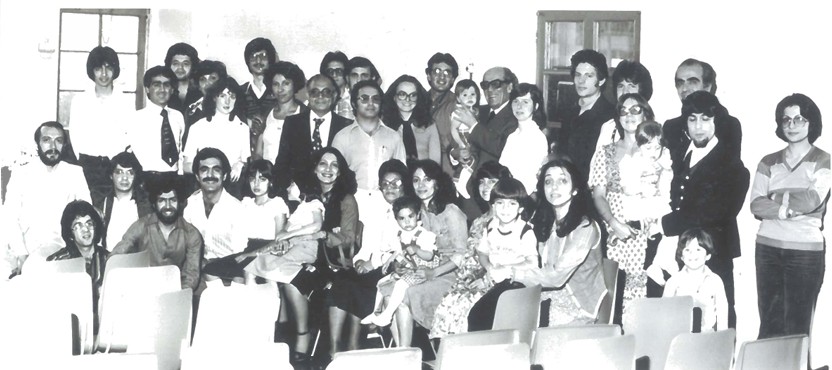
I was appointed to the National Teaching Committee and, following that, several other national committees. I continued as a member of my local community which was Harrow in North London and did my utmost to serve the Faith whenever the opportunity arrived. For some of that time we had the privilege of being neighbours with Fariborz and Goli Sahba and their two sons. Fariborz was already fully engaged with the work on the Indian Temple and he was in London for a period of time conducting tests, particularly wind tests, on the model for the Indian Temple, and it was very interesting to be party to that process. I was very happy to be reunited with Naysan and Zohreh Faizi, who also came to live in Harrow.
The invitation came to serve as a member of the Continental Pioneer Committee for Europe together with Iraj Munsiff and Earl Cameron. We met regularly, attending the annual meetings of the Counsellors of Europe which was held at the Mother Temple of Europe in Germany. I was privileged to belong to the committee to organise the 50th Anniversary of the Passing of Bahíyyih Khánum with Philip Hainsworth, John Wade and others in the UK. That same year, I attended the International Conferences in Dublin and Montreal to commemorate the Passing of Bahíyyih Khánum.
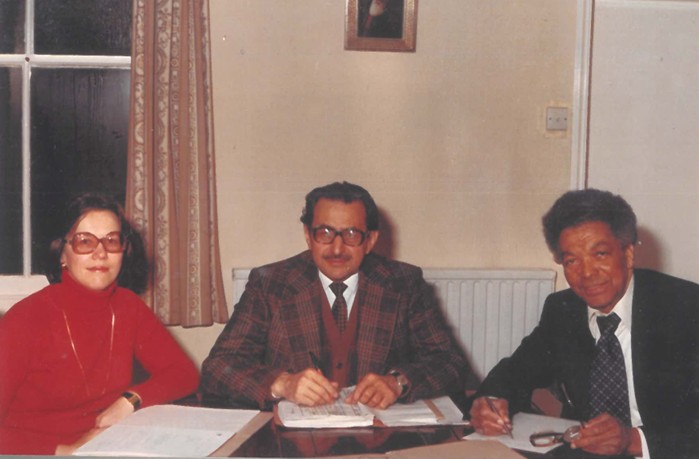
Following that time in Harrow, I moved to Carpenders Park where both the Faizis and Moqbels now lived, and another LSA was born. After some time there, my husband and I pioneered to Somerset, to the town of Taunton, and lived there for three years. Bahá’í community activities continued and in particular at this period of time the Thomas Breakwell schools were founded, and were very active in the Somerset area. Also at that time the Universal House of Justice made an appeal for volunteers to serve at the Bahá’í World Centre in Haifa. As a request had been made, it seemed only right to offer our services. We had no expectation of them being taken up but they were, and in 1987 we moved to Haifa.
For 8 1/2 years I served in the Office of Holy Places under the guidance of the coordinator Dr Bahia Mitchell. At that time the purpose of the Office of Holy Places was to :
- take care of the Holy Places
- the programme of pilgrimage
- the visitors that came for pilgrimage
- those who came for short 3 day visits
- and to oversee the cemeteries in the Holy Land (Haifa, Galilee, Jerusalem and Eilat)
Approximately 80 staff and volunteers were required to provide these services:
- custodians to look after each of the Holy Places
- guides to greet the visitors at the Shrines
- more guides who received the pilgrims and took them on their programme of pilgrimage around each of the Holy Places
- architects who worked on the ‘As-Built ‘ drawings of each of the Holy Places
- conservators who were able to catalogue, measure and fully record all the many items in each of the Holy Places
- a photographer who was able to fully photograph each of these items
- building surveyors
- people skilled in ornament maintenance and conservation
- office staff required to maintain files, to do research and to look into historical occurrences
Building maintenance and gardening were undertaken by independent separate offices.
One of the main parts of my work was to visit the custodians of the Holy Places who were based around the northern part of Israel in the actual Holy Places. Their role was a full-time residential one and they were trusted with the cleaning and care of the Holy Places and the items in them, often including items belonging to either Bahá’u’lláh or ‘Abdu’l-Bahá themselves. Custodians, a husband and wife team, were also responsible for receiving all the visitors and the pilgrims. Their life was quite isolated except in very busy times when they had maybe fifty pilgrims visiting. Before that visit they took special efforts to make sure that everything was ready for them and the refreshments were served. Custodians would inspect the Holy Places every day making sure that all was in order and when I went along on a quiet day we would look around and see if there was any work that needed doing. If there was anything that needed attention we would discuss the problem and I would look into how this could be taken care of. Sometimes it was a conservation matter; other times it was work that required the expertise of the maintenance staff from the workshop. The whole job had to be planned and prepared, materials required ordered, often from overseas, and time for the works scheduled. Occasionally, as in the case of the Persian carpets, experts were brought from abroad to give advice.
One day when I was visiting the house of Abdullah Pasha I received a phone call from the custodians at Bahji. I was informed that Rúhíyyih Khánum was visiting there and that she wanted me to go over there as she had some information for me. I went immediately. The time was approaching the Commemoration of the Centenary of the Ascension of Bahá’u’lláh. When I arrived, Khanum and the custodians were waiting outside the Shrine. The doors were open and Khanum indicated to me exactly where the stones should be lifted inside the threshold so that the Scroll bearing the names of the Knights of Bahá’u’lláh, initiated under the direction of Shoghi Effendi and only recently completed, could be placed during that sacred occasion. To be so closely involved with the directions for this event was an overwhelming opportunity. I returned to the office and informed Mrs Mitchell and the workshop also so that they could prepare a plan to undertake this work in time for the Commemoration.
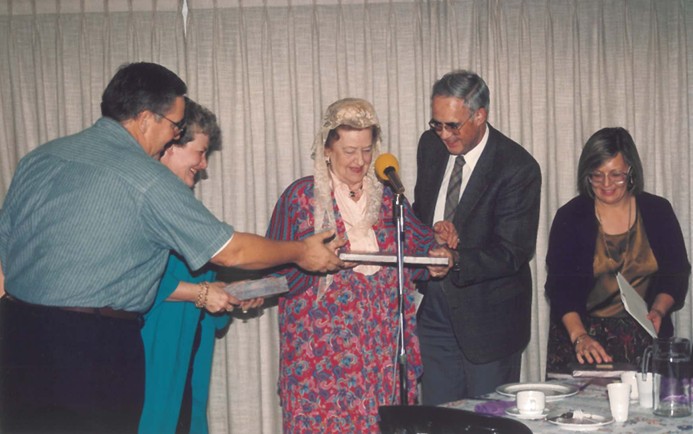
In addition to this day-to-day work there were also many special projects carried out from time to time, particularly during the summer months when the pilgrimage season was closed. This was also a time when extensive cleaning and re-decoration took place in the Holy Places. Some of the special projects we undertook were:
- the development of a cleaning program for all the Holy Places based on the one used by the National Trust in the UK
- the restoration of the Ridván Garden benches and its central fountain
- the repair and cleaning of all the Persian carpets in the Holy Places
- obtaining replacement and additional parts for chandeliers for the Holy Places from eastern Europe
- the airing and cleaning of the Tent of Baha’u’llah
Dr Mitchell’s expertise was needed at the Medical Centre at the World Centre and I stayed at the Office of Holy Places for a further 3 1/2 years as the coordinator until August 1995.
Returning to Taunton, I became a member of the Local Spiritual Assembly and active again in community life. I also served on the Venues Committee. Eventually I returned to my home in the West Midlands and lived in a village called Fradley near Lichfield. Later I moved into Lichfield itself where I still live. Staffordshire is a large rural county and is sparsely populated by Bahá’ís. But we are a close group trying to keep up with our Feasts, Ruhi books, our children’s activities , our deepenings and devotionals, home visits and all the activities that we try to do.
As my life draws to its final stages (my sister is already over 90 and next year my brother will be 90 and I will be 80), I am immensely grateful for all these opportunities and activities I have been allowed to be involved with as a Bahá’í. But these few words are insufficient without remembering the love of my family and friends and of all the Bahá’í friends I have come to meet and learn from.
To encounter such diverse people, to learn so much and to be able to undertake such a marvellous spiritual journey which I hope will always continue, is something I could never have hoped for. All of these opportunities are increased a hundred fold by the special friends I have met along the way, many of whom I’m still lucky to have.
From the first night in the home of Mrs Faizi and her two children May and Naysan with Mr Faizi visiting them from the World Centre when I first received the gift of the Faith of Bahá’u’lláh, I have met so many different people and I still have so many dear friends, some of them for forty or fifty years, who stand by me now and have stood by me in very difficult times in my life, supporting me through thick and thin. I have not mentioned all of them as I am at a loss to express how much they mean to me and I apologise for these shortcomings.
The dear friends in my community here in Lichfield and Staffordshire support me all the time and it is uplifting to see how we grow together over the years. But my dearest friend Yvonne Teimoori and her husband Behdad have been so generous to me throughout everything , that they cannot go without a mention; I only wish I had the words to thank them enough.
God Is Great! He gives us everything.
Hazel Felton
March 2026


How wonderful to find your ‘Story’ waiting to be opened after Ann Moqbel’s funeral. Still have ‘Annie’s Song’ ringing in my ears… Samim’s words and your wonderful recollections both brought back so many memories of my own early days in the Faith in the early 70s. Such times we have lived through!
So very pleased, dear Hazel, to see and to read your Baha’i history in print. What an amazing story you have written about the life you have lived serving the Faith in so many unique ways.
And how great that you have been associated through the decades with numerous characters well known to those affiliated with the past 60 years of the growth of the Bahá’í faith all around the world.
Well done!
A moving and very interesting history. We moved to Somerset in 1987 and our daughter Heather was born in 1990 at Taunton Hospital, shortly after Shirin Fozdar’s. We attended the Thomas Breakwell School in Puriton for many years.